Przebieg r20261030-0412-v000-zadymiarka-concept-3
- Wariant
- v000
- Produkt
- Kompaktowa zadymiarka sieciowa (arkusz v0)
- Poziom
- koncepcja (tania ocena)
- Runda
- kalibracja
- Powtórzenie
- 3
- Start
- 30 października 2026, 04:12
- Koniec
- 30 października 2026, 05:19
- Czas pracy
- 1 h 07 min POMIAR
- Koszt
- 47,80 USD wg cennika API
0,48 USD rzeczywisty (abonament) POMIAR - Tokeny
- 45 586 024
- Status
- zakończony (final report and the tree is quiet)
- Wynik łączny
- 87,3 / 100
Ocena
- Wynik łączny
- 87,3 / 100
- Status oceny
- pełna
- Kontrola uczciwości
- czysto
- Pokrycie ukrytej listy kontrolnej
- 96 % z 20 punktów
- Oceniono
- 30 października 2026, 06:00
Składowe wyniku
| Składowa | Wynik (0–100) | Waga |
|---|---|---|
| kontrole automatyczne | 92,6 | 10 % |
| spełnienie wymagań | 89,0 | 35 % |
| sędziowie | 80,7 | 35 % |
| ukryta lista kontrolna | 95,7 | 20 % |
| kara za przechwałki (odejmowana) | −0,5 |
Sędziowie
Oceniali bez wiedzy, który wariant zrobił projekt. Rozrzut między sędziami: 1,3 pkt (odchylenie std.).
| Sędzia | Perspektywa | Wynik |
|---|---|---|
| R1 (przebieg oceny 0) | a systems engineer | 81,2 |
| R2 (przebieg oceny 0) | a manufacturing and cost engineer | 81,2 |
| R3 (przebieg oceny 0) | a safety and compliance engineer | 81,2 |
| R1 (przebieg oceny 1) | a systems engineer | 81,2 |
| R2 (przebieg oceny 1) | a manufacturing and cost engineer | 78,1 |
| R3 (przebieg oceny 1) | a safety and compliance engineer | 81,2 |
Wymagania — spełnienie
Ocena sędziów i kontroli obok deklaracji wariantu; fałszywe „spełnione” kosztuje więcej niż uczciwe „niespełnione”.
| Wymaganie | Ocena | Deklaracja wariantu | Wartość | Dowód | Metoda |
|---|---|---|---|---|---|
ZAD-PRF-01 | spełnione | spełnione | 1.0 | design/02-concept/key-estimates.md: "Heat capacity (0.55 kg Al + 0.10 kg stainless coil + 0.15 kg elements + 25 % of insulation)" | judges+value |
ZAD-PRF-02 | spełnione | spełnione | 1.0 | design/02-concept/key-estimates.md: "Continuous rate (heater × 0.97 − losses) / e_ml" | judges+value |
ZAD-PRF-03 | spełnione | spełnione | 1.0 | design/02-concept/architecture.md: "the 30-min 100 % run has no interruption (design intent ZAD-PRF-03 target 0 s)" | judges+value |
ZAD-PRF-04 | częściowo | spełnione | 0.912 | design/01-requirements/requirements.md: "stored heat (0.72 kJ/K x 47 K droop to T_min 200 C) + 30 s heater energy" | judges+value |
ZAD-PRF-05 | częściowo | częściowo | 0.5 | design/02-concept/key-estimates.md: "5.0 s with full strokes; 2.0 s at 5 ml/min with full strokes" | judges+value |
ZAD-PRF-07 | częściowo | częściowo | 1.0 | design/02-concept/architecture.md: "Burst rate ceiling 60 ml/min; coil length 1.5 m vs 1.37 m needed at the 51 ml/min burst mean" | judges+value |
ZAD-PRF-08 | spełnione | spełnione | 1.0 | design/02-concept/architecture.md: "Fluid-type setting (Quick 230 °C, Standard 250 °C, Dense 265 °C, ASSUMPTION windows)" | judges+level |
ZAD-PRF-09 | spełnione | spełnione | 1.0 | design/01-requirements/derived_requirements.md: "Tank: 1.40 L internal, usable ≥ 1.25 L, cap opening ≥ Ø45 mm" | judges+value |
ZAD-SIZ-01 | spełnione | spełnione | 1.0 | design/02-concept/architecture.md: "A compact (295 × 165 × 195 mm bounding box, CALCULATION 9.49 L) mains fog machine" | judges+value |
ZAD-SIZ-02 | spełnione | spełnione | 1.0 | design/02-concept/estimates/concept_estimates.inputs.json: "layout: front exchanger zone 140 mm + rear tank zone 125 mm + walls/bezel" | judges+value |
ZAD-WGT-01 | częściowo | częściowo | 0.87 | design/02-concept/alternatives-and-decision.md: "aluminium sheet housing; dry mass 3.26 kg (target missed by 0.26 kg, threshold met" | judges+value |
ZAD-PWR-01 | spełnione | częściowo | 1.0 | design/09-bom-cost/cost.md: "The 6 US lines (heater module 120 V, pump 120 V 60 Hz, fuse T10 A, US cord" | judges+level |
ZAD-PWR-02 | spełnione | spełnione | 1.0 | design/02-concept/architecture.md: "Rated input 980 W (declared; calculated 979 W = 970 W heater + 5.8 W pump at the burst ceiling" | judges+value |
ZAD-PWR-03 | spełnione | spełnione | 1.0 | design/02-concept/architecture.md: "Losses at READY 40 W design value (31 W model × 1.3 margin, CALCULATION)" | judges+value |
ZAD-FUN-01 | spełnione | spełnione | 1.0 | design/02-concept/architecture.md: "isolated RS-485 (digital isolator + transceiver + low-power isolated supply), 5-pin XLR" | judges+level |
ZAD-FUN-03 | częściowo | częściowo | 0.912 | design/02-concept/architecture.md: "Link budget: 219 m free space, 160 m two-ray with the machine on a 3 m truss" | judges+value |
ZAD-FUN-04 | spełnione | spełnione | 1.0 | design/02-concept/architecture.md: "machine (amber pulsing = heating, green = ready, amber blinking = low fluid, red = fault) refreshed from the ACK" | judges+level |
ZAD-FUN-05 | częściowo | spełnione | 0.75 | design/02-concept/spec-sheet.md: "interval 1–600 s, duration 1–120 s, output 1–100 %, on unit and remote" | judges+level |
ZAD-FUN-06 | spełnione | spełnione | 1.0 | design/02-concept/architecture.md: "Gravimetric low-fluid stop before the pick-up uncovers" | judges+level |
ZAD-FUN-07 | spełnione | spełnione | 1.0 | design/02-concept/architecture.md: "DMX address/personality, timer, fluid type and level, fault codes; settings in MCU flash (survive power-off)" | judges+level |
ZAD-FUN-08 | częściowo | częściowo | 1.0 | design/02-concept/architecture.md: "weighted pick-up follows the fluid at ±30° tilt and when hung" | judges+value |
ZAD-UX-01 | częściowo | częściowo | 1.0 | design/02-concept/estimates/concept_estimates.inputs.json: "vibratory pump at ~2-3 strokes/s on silicone mounts inside a lined metal housing; to be measured" | judges+value |
ZAD-UX-02 | spełnione | spełnione | 1.0 | design/02-concept/alternatives-and-decision.md: "fan breaks ZAD-UX-02 (≤ 30 dB(A) target in READY)" | judges |
ZAD-UX-03 | częściowo | spełnione | 1.0 | design/01-requirements/requirements.md: "1.25 L poured at ~3-4 L/min from a 5 L can ~25 s (ASSUMPTION)" | judges+value |
ZAD-SAF-01 | spełnione | częściowo | 0.917 | design/02-concept/safety-concept.md: "FMEA §4 (35 single faults, each with a credited measure), fault dynamics §5, fault tests §12" | judges+level |
ZAD-SAF-02 | częściowo | częściowo | 1.0 | design/02-concept/estimates/concept_estimates.inputs.json: "top cover above the module vs skin average, with heat shield + 10 mm air gap" | judges+value |
ZAD-SAF-03 | częściowo | częściowo | 0.375 | design/02-concept/safety-concept.md: "at 6-8 mm from the tip the jet is ~6-7 mm wide, so a 10 mm aperture leaves" | judges+level |
ZAD-SAF-04 | spełnione | spełnione | 1.0 | design/02-concept/estimates/concept_estimates.table.md: "tip_angle_min_empty | 35.3 | deg" | judges+value |
ZAD-SAF-05 | częściowo | częściowo | 0.75 | design/02-concept/safety-concept.md: "The mains PCB is mounted above the drip-tray rim and never below a fluid joint" | judges+level |
ZAD-SAF-06 | częściowo | częściowo | 1.0 | design/02-concept/safety-concept.md: "The EU margin to the target is only 12 %, and it holds only if the AC-DC module's real leakage is about 50 µA" | judges+value |
ZAD-SAF-07 | spełnione | spełnione | 1.0 | design/02-concept/safety-concept.md: "Then pump off at the next half-cycle (≤ 10 ms) plus ≤ 0.1 s control tick" | judges+value |
ZAD-CRT-01 | spełnione | częściowo | 1.0 | design/02-concept/regulatory-plan.md: "Draft EU Declaration of Conformity (RED Annex VI format; legal review required)" | judges+level |
ZAD-CRT-02 | spełnione | częściowo | 0.917 | design/02-concept/regulatory-plan.md: "investigation and testing UL 499 + CSA EUR 10,000; E1.29" | judges+level |
ZAD-CRT-04 | spełnione | spełnione | 0.75 | design/02-concept/spec-sheet.md: "Every figure is a CALCULATION from the concept model" | judges+level |
ZAD-CST-01 | niespełnione | niespełnione | 0.0 | unit cost at 1000 pcs from cost.json unit_cost.q1000: 128.09 EUR vs target 60 / threshold 85 EUR | auto |
ZAD-CST-05 | częściowo | częściowo | 0.5 | retail price from manifest key_figures.retail_price: 299.00 EUR vs target 229 / threshold 299 EUR | auto |
ZAD-REL-01 | częściowo | częściowo | 1.0 | design/02-concept/reliability-service-production.md: "Working assumption: >= 100 M strokes before flow loss above 15 %" | judges+value |
ZAD-REL-03 | częściowo | częściowo | 1.0 | design/02-concept/reliability-service-production.md: "The 100 h target is therefore plausible but unproven" | judges+value |
Kontrole automatyczne (14)
| Kontrola | Wynik | Dowód |
|---|---|---|
cost.rough | PASS | unit cost at 1/100/1000: 794.80 / 237.98 / 128.09 EUR |
cost.vs_requirements | PARTIAL | ZAD-CST-01: not_met — unit cost at 1000 pcs from cost.json unit_cost.q1000: 128.09 EUR vs target 60 / threshold 85 EUR; ZAD-CST-05: partly — retail price from manifest key_figures.retail_price: 299.00 EUR vs target 229 / threshold 299 EUR |
deliverables.blocked | NOT APPLICABLE | {'what': 'Prototype build and every physical test (timed warm-up at 230/207 V, 30-min weighed continuous run, 30 s burst, droplet sheet, low-output plume, sound level, radio range in a hall, tilt and ; {'what': 'Accredited-lab conformity testing for CE (RED incl. EN 60335 safety, EMC, EN 300 328, EM |
deliverables.manifest | PASS | manifest consistent |
deliverables.present | PASS | all present |
deliverables.report | PASS | 4161 words |
deliverables.size | NOT APPLICABLE | 26 files, 59364 words of prose |
product.zadymiarka.standards | PASS | radio built in: yes (keyword search); 19/19 expected standard ids found |
requirements.compliance_table | PASS | every visible requirement has a valid row with evidence |
requirements.trace | PASS | all visible ids referenced |
product.zadymiarka.A6 | PASS | ZAD-PWR-02: 980 W (compliance.csv); heater 970 W; heater + pump + fan + electronics = 979 W = 1.00 x rated (allowed 0.90-1.05, CALCULATION); ZAD-PWR-02: 980 W (compliance.csv); heater 970 W; heater + pump + fan + electronics = 979 W = 1.00 x rated (allowed 0.90-1.05, CALCULATION) |
product.zadymiarka.A7 | PASS | ZAD-PRF-02: 22.5 ml/min (compliance.csv); heater 970 W; bound 31.6 ml/min = P x 0.95 x 60 s / 1750 J/ml (CALCULATION); ZAD-PRF-02: 22.5 ml/min (compliance.csv); heater 970 W; bound 31.6 ml/min = P x 0.95 x 60 s / 1750 J/ml (CALCULATION) |
product.zadymiarka.A8 | PASS | ZAD-PRF-01: 2.75 min (compliance.csv); heater 970 W; Σm·c 721 J/K (stated); T 247 °C; minimum possible warm-up 2.25 min = 0.8 x Σm·c x (T - 20) / P (CALCULATION); ZAD-PRF-01: 2.75 min (compliance.csv); heater 970 W |
product.zadymiarka.A9 | PASS | ZAD-PRF-04: 25.6 ml (compliance.csv); heater 970 W; Σm·c 721 J/K (stated); bound 57.8 ml in 30 s = (Σm·c x 100 K + P x 30 s) / 1750 J/ml (CALCULATION); ZAD-PRF-04: 25.6 ml (compliance.csv); heater 970 W |
Uwagi oceny dla ewolucji
Evaluation feedback — r20261030-0412-v000-zadymiarka-concept-3
Status SCORED · total 87.32 / 100 (tier concept, product zadymiarka).
| component | score |
|---|---|
| auto | 92.59 |
| requirements | 88.96 |
| judges | 80.73 |
| hidden | 95.72 |
| honesty penalty | −0.47 |
| integrity penalty | −0.0 |
The hidden expert checklist is reported only as a coverage number on purpose.
Automatic checks that did not pass
- cost.vs_requirements PARTIAL: ZAD-CST-01: not_met — unit cost at 1000 pcs from cost.json unit_cost.q1000: 128.09 EUR vs target 60 / threshold 85 EUR; ZAD-CST-05: partly — retail price from manifest key_figures.retail_price: 299.00 EUR vs target 229 / threshold 299 EUR
Requirements
| id | verdict | claimed | overclaim | reason |
|---|---|---|---|---|
| ZAD-PRF-01 | met | met | 0.0 | Integration of C(T) with losses gives 2.75 min at 230 V and 3.42 min at 207 V, consistent with 970 W and 0.72 kJ/K (A8 floor 2.16 min). |
| ZAD-PRF-02 | met | met | 0.0 | Energy balance (970×0.97−40 W)/2.40 kJ/ml = 22.5 ml/min for the stated fluid at 230 V, re-derived; coil margin 1.83. Only 2 % margin (−3 % tolerance → 21.8). |
| ZAD-PRF-03 | met | met | 0.0 | Pump rate = min(command, Q_cont(V) + PI margin on S1) derates smoothly to the heat-limited rate with no step to zero above T_min. |
| ZAD-PRF-04 | partly | met | 0.088 | The calculation droops to T_min, but the control law stops at T_min+10 K; the design's own inputs then give ≈22.7 ml (12–25 ml). The 60 ml/min ceiling also exce |
| ZAD-PRF-05 | partly | partly | 0.0 | 2 ml/min relies on assumed 0.04 ml partial strokes; with full strokes the evidenced floor is 5 ml/min at a 2.0 s stroke interval, right at the threshold. |
| ZAD-PRF-07 | partly | partly | 0.0 | Cause-by-cause anti-spit design, but the 60 ml/min ceiling exceeds the coil's own capacity (margin ≈0.98) and the T_min windows are uncalibrated. |
| ZAD-PRF-08 | met | met | 0.0 | A fluid-type setting adapts setpoint and T_min, and wetted materials are listed. Windows are assumptions and DPG-rich fluids are flagged until FT-05. |
| ZAD-PRF-09 | met | met | 0.0 | Volume budget (1.40 L internal − 0.08 ullage − 0.07 reserve) gives 1.25 L; small margin, design-defined tank. |
| ZAD-SIZ-01 | met | met | 0.0 | Zone-allocated envelope of 9.49 L, well under 12 L; CAD not done. |
| ZAD-SIZ-02 | met | met | 0.0 | The 295 mm zone-allocation envelope leaves 25 mm to the target even if the rear encoder knob is added. CAD not done. |
| ZAD-WGT-01 | partly | partly | 0.0 | 12-item mass budget gives 3.26 kg, between target and threshold. The capillary limiter and internal brackets appear to be missing. |
| ZAD-PWR-01 | met | partly | 0.0 | Heater, pump, fuse, cord, labels and manual are listed per variant, with electrical values calculated at 230/120 V. Drawings are out of tier; the US sense resis |
| ZAD-PWR-02 | met | met | 0.0 | U²/R of 2×10⁹ Ω at 230 V plus pump and electronics = 979 W, declared 980 W; US 8.17 A < 12 A. The BOM label says 1000 W. |
| ZAD-PWR-03 | met | met | 0.0 | Insulation and thermal-bridge model with a ×1.3 margin + 3.3 W electronics = 43.4 W, well below the 80 W target. |
| ZAD-FUN-01 | met | met | 0.0 | 5-pin and 3-pin XLR IN/THRU, isolated, 1-ch/2-ch personalities, OLED addressing; parts are in the BOM. |
| ZAD-FUN-03 | partly | partly | 0.0 | Link budget (15 dB fade margin) gives 46.5 m for a floor machine (160 m on truss), between the 30 m threshold and 50 m target; pairing and functions are defined |
| ZAD-FUN-04 | met | met | 0.0 | Two-way radio with per-machine status LEDs from the ACK payload; machines 1–4 individually or ALL. |
| ZAD-FUN-05 | partly | met | 0.25 | Ranges are stated only on the spec sheet. The remote has TIMER start/stop and LEVEL +/− only (architecture.md §8), so interval and duration are settable only on |
| ZAD-FUN-06 | met | met | 0.0 | The load cell stops the pump at ~45 g before air enters, signals E10 on the OLED, remote and RDM, and resumes automatically on refill. |
| ZAD-FUN-07 | met | met | 0.0 | OLED + encoder + 2 keys show warm-up, READY, faults, DMX address, output and timer; settings in flash; all functions work without the remote. |
| ZAD-FUN-08 | partly | partly | 0.0 | ±30° is a design intent backed by bracket slots, weighted pick-up and check valve, with no fluid-path analysis at the tilt limits. |
| ZAD-UX-01 | partly | partly | 0.0 | 43.1 dB(A) = Lighthill jet estimate (±10 dB) + an assumed 42 dB(A) pump. The target is met only on assumptions. |
| ZAD-UX-02 | met | met | 0.0 | Fanless natural convection and the pump off in READY leave no noise source by design; no dB figure is given. |
| ZAD-UX-03 | partly | met | 0.0 | 25 s is pour-only at an assumed rate and excludes cap handling; the design's own first-use budget allows 40 s for the fill. Hot refill and the backlit level are |
| ZAD-SAF-01 | met | partly | 0.0 | Every listed single fault has a software-free hardware measure (PEC on a 2-pole K1, TCO-A/B, pump limiter, cold interlock, 160 bar path) and a fault test (FT-01 |
| ZAD-SAF-02 | partly | partly | 0.0 | Skin/chimney model gives an 18.9 K hot spot via an assumed ×1.6 hot-spot factor; 1.1 K margin to the target, large margin to the threshold. |
| ZAD-SAF-03 | partly | partly | 0.125 | Guard < 12 mm apertures, recessed nozzle and marking are defined, but the rim sits ~2 mm from a 230 °C jet with no ≤70 °C estimate, and the BOM puts keys/encode |
| ZAD-SAF-04 | met | met | 0.0 | CoM-vs-footprint calculation over side/front/rear gives 35.3° empty and 37.5° full; large margin over 20° even with ±10 mm CoM error. |
| ZAD-SAF-05 | partly | partly | 0.0 | Zoning, a partition, a drip tray, a top pick-up, a check valve and no joints inside the insulation make the threshold credible; the target depends on an unverif |
| ZAD-SAF-06 | partly | partly | 0.0 | Leakage calculation gives 0.219 mA (target 0.25) only with purchase specs on the AC-DC module and hot MgO resistance. PE bonding and reinforced distances are de |
| ZAD-SAF-07 | met | met | 0.0 | DMX-loss stop ≤ 1.3 s, hold-to-run remote, 10 min continuous auto-off, and a READY gate in firmware plus a hardware cold interlock. |
| ZAD-CRT-01 | met | partly | 0.0 | Correct RED route plus all other acts, with editions, design measure, pre-compliance, lab test and cost per standard, a W8 timeline, a draft DoC and a TF outlin |
| ZAD-CRT-02 | met | partly | 0.0 | FCC 15B SDoC + 15.247 modular route, ICES/RSS, reasoned NRTL standard (UL 499 + E1.29), test list N1–N11, EUR 16k cost and W12 timeline are all present; Canadia |
| ZAD-CRT-04 | met | met | 0.25 | All figures are labelled and traced, but the 25.6 ml burst violates the design's own T_min+10 K guard (≈22.7 ml), and the 220–240 V rating omits the ≈1,065 W at |
| ZAD-CST-01 | not_met | not_met | 0.0 | unit cost at 1000 pcs from cost.json unit_cost.q1000: 128.09 EUR vs target 60 / threshold 85 EUR |
| ZAD-CST-05 | partly | partly | 0.0 | retail price from manifest key_figures.retail_price: 299.00 EUR vs target 229 / threshold 299 EUR |
| ZAD-REL-01 | partly | partly | 0.0 | The derating table shows margin at 2000 h, but the pump stroke life is an unverified assumption and the endurance tests are only planned. |
| ZAD-REL-03 | partly | partly | 0.0 | The deposit sensitivity uses assumed residue and deposition rates and ignores the deposit's thermal resistance. Monitoring and a CLEAN mode are defined; 100 h i |
Rubric sections (mean of judges, 1–5)
- C3 Technical soundness: 4.0 (judges: [4, 4, 4, 4, 4, 4])
- C8 Honesty and clarity: 4.0 (judges: [4, 4, 4, 4, 4, 4])
- C4 Architecture and completeness: 4.0 (judges: [4, 4, 4, 4, 4, 4])
- C2 Alternatives and decision: 4.0 (judges: [4, 4, 4, 4, 4, 4])
- C7 Risks and open issues: 4.0 (judges: [4, 4, 4, 4, 4, 4])
- C6 Manufacturability and cost realism: 4.0 (judges: [4, 4, 4, 4, 4, 4])
- C1 Requirements analysis: 4.83 (judges: [5, 5, 5, 5, 4, 5])
- C5 Safety and compliance: 5.0 (judges: [5, 5, 5, 5, 5, 5])
Kluczowe parametry (deklaracja projektu)
- Wymiary
- 295 × 165 × 195 mm
- Masa
- 3,26 kg
- Moc
- 980 W
- Koszt jednostkowy
- 1 szt.: 794,80 EUR · 100 szt.: 237,98 EUR · 1000 szt.: 128,09 EUR
- Cena detaliczna
- 299 EUR
Co wymaga człowieka
- Prototype build and every physical test (timed warm-up at 230/207 V, 30-min weighed continuous run, 30 s burst, droplet sheet, low-output plume, sound level, radio range in a hall, tilt and side-lying leak tests, heating test, abnormal-operation tests) — Needs purchased parts, a workshop and a person at the bench; this run may not spend money or order parts. All tests are NOT RUN; their pass criteria are in the specialist documents.
- Accredited-lab conformity testing for CE (RED incl. EN 60335 safety, EMC, EN 300 328, EMF) and US/Canada (NRTL listing, FCC Part 15B SDoC, ICES-003) — Requires a physical prototype, a lab contract and payment by a human; certification cannot be performed or claimed by this run.
- Supplier quotations (die-cast heat exchanger with cast-in elements, sheet-metal housing, tank, remote, contract manufacturing) and confirmation of pump/TCO/heater datasheet values — Requesting quotes or contacting companies is not allowed in this run; prices and some part data are ASSUMPTIONS until a human obtains quotes and datasheets.
- Legal and administrative steps: legal review/signature of the EU Declaration of Conformity, appointment of the EU responsible economic operator (GPSR), WEEE/battery/packaging EPR registrations, ESTA RDM manufacturer ID — Need a legal entity, accounts and a human signatory; legal opinions are out of scope for an AI run.
- Validation with commercial fog fluids of at least three brands (quick, standard, long-hang) — Needs purchased fluids and a running prototype; temperature windows per fluid type are ASSUMPTIONS until then.
Koszt przy 1, 100 i 1000 sztuk (EUR)
| Pozycja | 1 szt. | 100 szt. | 1000 szt. |
|---|---|---|---|
| części (BOM) | 724,80 | 212 | 121,34 |
| consumables | 15 | 1,50 | 0,60 |
| eol_test_labour | 0,00 | 3,33 | 0,53 |
| final_assembly_labour | 0,00 | 11,67 | 1,73 |
| material_overhead_freight_attrition | 25 | 8,48 | 3,64 |
| packing_labour | 0,00 | 1 | 0,25 |
| prototype_outside_machining | 30 | 0,00 | 0,00 |
| koszt jednostkowy razem | 794,80 | 237,98 | 128,09 |
Obliczenia
Wyniki skryptów obliczeniowych (120)
| Skrypt | Wielkość | Wartość | Jednostka |
|---|---|---|---|
| concept_estimates | fluid_Q_energy_per_kg | 2 570 | kJ/kg |
| concept_estimates | fluid_Q_density | 1 010 | kg/m3 |
| concept_estimates | fluid_Q_energy_per_ml | 2,610 | kJ/ml |
| concept_estimates | fluid_S_energy_per_kg | 2 330 | kJ/kg |
| concept_estimates | fluid_S_density | 1 030 | kg/m3 |
| concept_estimates | fluid_S_energy_per_ml | 2,400 | kJ/ml |
| concept_estimates | fluid_D_energy_per_kg | 2 110 | kJ/kg |
| concept_estimates | fluid_D_density | 1 080 | kg/m3 |
| concept_estimates | fluid_D_energy_per_ml | 2,270 | kJ/ml |
| concept_estimates | fluid_S_energy_per_ml_exit_150C | 2,240 | kJ/ml |
| concept_estimates | fluid_S_energy_per_ml_exit_250C | 2,440 | kJ/ml |
| concept_estimates | pump_stroke_volume_full | 0,167 | ml/stroke |
| concept_estimates | exchanger_heat_capacity_20C | 661 | J/K |
| concept_estimates | exchanger_heat_capacity_250C | 721 | J/K |
| concept_estimates | insulation_thermal_resistance | 9,460 | K/W |
| concept_estimates | heat_loss_base_at_250C_25C_amb | 30,800 | W |
| concept_estimates | heat_loss_design_at_250C_25C_amb | 40,100 | W |
| concept_estimates | heat_loss_design_fluid_Q | 36,300 | W |
| concept_estimates | heat_loss_design_fluid_S | 40,100 | W |
| concept_estimates | heat_loss_design_fluid_D | 43 | W |
| concept_estimates | pump_power_at_ceiling_rate | 5,760 | W |
| concept_estimates | electronics_ac_power_active | 3,330 | W |
| concept_estimates | rated_input_calculated_EU_230V | 979 | W |
| concept_estimates | rated_input_max_with_heater_tolerance | 1 030 | W |
| concept_estimates | current_EU_230V | 4,260 | A |
| concept_estimates | current_US_120V | 8,170 | A |
| concept_estimates | current_US_120V_limit_ZAD_PWR_02 | 12 | A |
| concept_estimates | heater_resistance_hot_EU_per_element | 109 | ohm |
| concept_estimates | heater_resistance_hot_US_per_element | 29,700 | ohm |
| concept_estimates | heating_test_voltage_1p15_rated_input_EU | 247 | V |
| concept_estimates | warmup_time_230V_fluid_Q | 2,490 | min |
| concept_estimates | warmup_time_230V_fluid_S | 2,750 | min |
| concept_estimates | warmup_time_230V_fluid_D | 2,950 | min |
| concept_estimates | warmup_time_207V_fluid_S | 3,420 | min |
| concept_estimates | warmup_time_253V_fluid_S | 2,270 | min |
| concept_estimates | warmup_time_120V_US_fluid_S | 2,750 | min |
| concept_estimates | warmup_time_108V_US_fluid_S | 3,420 | min |
| concept_estimates | warmup_time_230V_fluid_S_5C_ambient | 2,930 | min |
| concept_estimates | warmup_time_230V_fluid_D_heater_minus5pct | 3,110 | min |
| concept_estimates | continuous_rate_230V_fluid_Q | 20,800 | ml/min |
| concept_estimates | continuous_rate_207V_fluid_Q | 16,700 | ml/min |
| concept_estimates | continuous_rate_230V_fluid_S | 22,500 | ml/min |
| concept_estimates | continuous_rate_207V_fluid_S | 18,100 | ml/min |
| concept_estimates | continuous_rate_230V_fluid_D | 23,700 | ml/min |
| concept_estimates | continuous_rate_207V_fluid_D | 19 | ml/min |
| concept_estimates | continuous_rate_253V_fluid_S | 27,500 | ml/min |
| concept_estimates | continuous_rate_230V_fluid_S_heater_minus5pct | 21,400 | ml/min |
| concept_estimates | continuous_rate_120V_US_fluid_S | 22,500 | ml/min |
| concept_estimates | continuous_rate_108V_US_fluid_S | 18,100 | ml/min |
| concept_estimates | tank_runtime_at_continuous_rate_fluid_S | 55,400 | min |
| concept_estimates | pump_stroke_rate_at_continuous_fluid_S | 2,250 | strokes/s |
| concept_estimates | pump_duty_at_continuous_fluid_S | 0,045 | - |
| concept_estimates | peak_30s_volume_230V_fluid_Q | 23,500 | ml |
| concept_estimates | peak_30s_volume_230V_fluid_S | 25,600 | ml |
| concept_estimates | peak_30s_volume_230V_fluid_D | 27,100 | ml |
| concept_estimates | sweep_m_al_0p40kg_C250 | 572 | J/K |
| concept_estimates | sweep_m_al_0p40kg_warmup_S_230V | 2,180 | min |
| concept_estimates | sweep_m_al_0p40kg_peak30_S_230V | 22,700 | ml |
| concept_estimates | sweep_m_al_0p45kg_C250 | 622 | J/K |
| concept_estimates | sweep_m_al_0p45kg_warmup_S_230V | 2,380 | min |
| cost_rollup | bom_q1 | 724,800 | EUR/unit |
| cost_rollup | unit_cost_q1 | 794,800 | EUR/unit |
| cost_rollup | bom_US_q1 | 729,700 | EUR/unit |
| cost_rollup | unit_cost_US_q1 | 799,700 | EUR/unit |
| cost_rollup | US_delta_unit_cost_q1 | 4,900 | EUR/unit |
| cost_rollup | other_final_assembly_labour_q1 | 0,000 | EUR/unit |
| cost_rollup | other_eol_test_labour_q1 | 0,000 | EUR/unit |
| cost_rollup | other_packing_labour_q1 | 0,000 | EUR/unit |
| cost_rollup | other_consumables_q1 | 15 | EUR/unit |
| cost_rollup | other_material_overhead_freight_attrition_q1 | 25 | EUR/unit |
| cost_rollup | other_prototype_outside_machining_q1 | 30 | EUR/unit |
| cost_rollup | bom_q100 | 212 | EUR/unit |
| cost_rollup | unit_cost_q100 | 237,980 | EUR/unit |
| cost_rollup | bom_US_q100 | 212,710 | EUR/unit |
| cost_rollup | unit_cost_US_q100 | 238,720 | EUR/unit |
| cost_rollup | US_delta_unit_cost_q100 | 0,740 | EUR/unit |
| cost_rollup | other_final_assembly_labour_q100 | 11,670 | EUR/unit |
| cost_rollup | other_eol_test_labour_q100 | 3,330 | EUR/unit |
| cost_rollup | other_packing_labour_q100 | 1 | EUR/unit |
| cost_rollup | other_consumables_q100 | 1,500 | EUR/unit |
| cost_rollup | other_material_overhead_freight_attrition_q100 | 8,480 | EUR/unit |
| cost_rollup | other_prototype_outside_machining_q100 | 0,000 | EUR/unit |
| cost_rollup | bom_q1000 | 121,340 | EUR/unit |
| cost_rollup | unit_cost_q1000 | 128,090 | EUR/unit |
| cost_rollup | bom_US_q1000 | 122,140 | EUR/unit |
| cost_rollup | unit_cost_US_q1000 | 128,910 | EUR/unit |
| cost_rollup | US_delta_unit_cost_q1000 | 0,820 | EUR/unit |
| cost_rollup | other_final_assembly_labour_q1000 | 1,730 | EUR/unit |
| cost_rollup | other_eol_test_labour_q1000 | 0,530 | EUR/unit |
| cost_rollup | other_packing_labour_q1000 | 0,250 | EUR/unit |
| cost_rollup | other_consumables_q1000 | 0,600 | EUR/unit |
| cost_rollup | other_material_overhead_freight_attrition_q1000 | 3,640 | EUR/unit |
| cost_rollup | other_prototype_outside_machining_q1000 | 0,000 | EUR/unit |
| cost_rollup | gap_q1000_vs_target_60 | 68,090 | EUR/unit |
| cost_rollup | gap_q1000_vs_threshold_85 | 43,090 | EUR/unit |
| cost_rollup | gap_q100_vs_threshold_160 | 77,980 | EUR/unit |
| cost_rollup | gap_q1_vs_threshold_800 | −5,200 | EUR/unit |
| cost_rollup | labour_minutes_q1000 | 20 | min/unit |
| cost_rollup | labour_cost_q1000 | 2,510 | EUR/unit |
| cost_rollup | cm_rate_q1000 | 7,500 | EUR/h |
| cost_rollup | unit_cost_q1000_if_EE_labour_18eur_h | 131,590 | EUR/unit |
| cost_rollup | group_PCB-A_q1000 | 13,260 | EUR/unit |
| cost_rollup | group_UI_q1000 | 9,550 | EUR/unit |
| cost_rollup | group_CONN_q1000 | 8,740 | EUR/unit |
| cost_rollup | group_REM_q1000 | 11,010 | EUR/unit |
| cost_rollup | group_PCB_q1000 | 5,850 | EUR/unit |
| cost_rollup | group_HX_q1000 | 27 | EUR/unit |
| cost_rollup | group_FLUID_q1000 | 13,700 | EUR/unit |
| cost_rollup | group_TANK_q1000 | 5,050 | EUR/unit |
| cost_rollup | group_HSG_q1000 | 18,180 | EUR/unit |
| cost_rollup | group_ACC_q1000 | 6,500 | EUR/unit |
| cost_rollup | group_PKG_q1000 | 2,500 | EUR/unit |
| cost_rollup | costdown_option_1_saving_q1000 | 6,500 | EUR/unit |
| cost_rollup | costdown_option_2_saving_q1000 | 6,700 | EUR/unit |
| cost_rollup | costdown_option_3_saving_q1000 | 2,770 | EUR/unit |
| cost_rollup | costdown_option_4_saving_q1000 | 2,990 | EUR/unit |
| cost_rollup | costdown_option_5_saving_q1000 | 3 | EUR/unit |
| cost_rollup | costdown_option_6_saving_q1000 | 2,360 | EUR/unit |
| cost_rollup | costdown_option_7_saving_q1000 | 1,460 | EUR/unit |
| cost_rollup | costdown_option_8_saving_q1000 | 1,500 | EUR/unit |
BOM — lista części
Plik: 09-bom-cost/bom.csv · 111 pozycji
| item | qty | description | manufacturer | mpn | supplier | supplier_part | url | unit_price_1 | unit_price_100 | unit_price_1000 | currency | notes |
|---|---|---|---|---|---|---|---|---|---|---|---|---|
| 1 | 1 | MCU, Arm Cortex-M0+ 128 KB flash, LQFP-48 | STMicroelectronics | STM32G070CBT6 | LCSC | C529338 | link | 1.3799 | 1.0638 | 0.8673 | EUR | [PCB-A] LCSC C529338, price read 2026-10-29 (lcsc info newest_update_utc 2026-10-29T11:52Z, db build 4325c9c05dd3280c); USD 1.5869/1.2234/0.9974 at qty 1/100/1000 converted at 1 EUR = 1.15 USD (ASSUMPTION, shared planning rate). STM32G0-class control MCU (not relied on for protection). Second source: STM32G071CBT6 (LCSC C432212) same footprint. |
| 2 | 1 | USB-UART bridge for USB-C service port (bootloader, logs) | WCH (Jiangsu Qin Heng) | CH340C | LCSC | C84681 | link | 0.4743 | 0.2905 | 0.2677 | EUR | [PCB-A] LCSC C84681, price read 2026-10-29 (lcsc info newest_update_utc 2026-10-29T11:52Z, db build 4325c9c05dd3280c); USD 0.5454/0.3341/0.3079 at qty 1/100/1000 converted at 1 EUR = 1.15 USD (ASSUMPTION, shared planning rate). |
| 3 | 1 | USB-C receptacle 16-pin, SMD (service port, SELV) | Korean Hroparts Elec | TYPE-C-31-M-12 | LCSC | C165948 | link | 0.1627 | 0.1285 | 0.0906 | EUR | [PCB-A] LCSC C165948, price read 2026-10-29 (lcsc info newest_update_utc 2026-10-29T11:52Z, db build 4325c9c05dd3280c); USD 0.1871/0.1478/0.1042 at qty 1/100/1000 converted at 1 EUR = 1.15 USD (ASSUMPTION, shared planning rate). |
| 4 | 1 | USB ESD protection array | STMicroelectronics | USBLC6-2SC6 | LCSC | C7519 | link | 0.1563 | 0.1203 | 0.0870 | EUR | [PCB-A] LCSC C7519, price read 2026-10-29 (lcsc info newest_update_utc 2026-10-29T11:52Z, db build 4325c9c05dd3280c); USD 0.1798/0.1384/0.1001 at qty 1/100/1000 converted at 1 EUR = 1.15 USD (ASSUMPTION, shared planning rate). |
| 5 | 1 | 24-bit load-cell ADC | Avia Semicon (Xiamen) | HX711 | LCSC | C6705483 | link | 0.4415 | 0.2521 | 0.2293 | EUR | [PCB-A] LCSC C6705483, price read 2026-10-29 (lcsc info newest_update_utc 2026-10-29T11:52Z, db build 4325c9c05dd3280c); USD 0.5077/0.2899/0.2637 at qty 1/100/1000 converted at 1 EUR = 1.15 USD (ASSUMPTION, shared planning rate). Second source: CHIPSEA CS1237 (LCSC C77801). |
| 6 | 1 | 3-axis accelerometer (tilt cut-off > 45 deg) | STMicroelectronics | LIS2DH12TR | LCSC | C110926 | link | 0.8103 | 0.4999 | 0.4600 | EUR | [PCB-A] LCSC C110926, price read 2026-10-29 (lcsc info newest_update_utc 2026-10-29T11:52Z, db build 4325c9c05dd3280c); USD 0.9319/0.5749/0.529 at qty 1/100/1000 converted at 1 EUR = 1.15 USD (ASSUMPTION, shared planning rate). Second source: Silan SC7A20HTR (LCSC C19274408). |
| 7 | 1 | Digital isolator 1 fwd/1 rev (DMX TX/RX) | Chipanalog | CA-IS3722HS | LCSC | C428879 | link | 0.3503 | 0.1866 | 0.1695 | EUR | [PCB-A] LCSC C428879, price read 2026-10-29 (lcsc info newest_update_utc 2026-10-29T11:52Z, db build 4325c9c05dd3280c); USD 0.4029/0.2146/0.1949 at qty 1/100/1000 converted at 1 EUR = 1.15 USD (ASSUMPTION, shared planning rate). Functional DMX isolation; reinforced mains insulation is provided by the certified AC-DC module and opto-triacs. |
| 8 | 1 | Digital isolator 2 fwd (DMX driver enable, spare) | Chipanalog | CA-IS3721HS | LCSC | C428884 | link | 0.4002 | 0.2079 | 0.1695 | EUR | [PCB-A] LCSC C428884, price read 2026-10-29 (lcsc info newest_update_utc 2026-10-29T11:52Z, db build 4325c9c05dd3280c); USD 0.4602/0.2391/0.1949 at qty 1/100/1000 converted at 1 EUR = 1.15 USD (ASSUMPTION, shared planning rate). |
| 9 | 1 | RS-485/DMX transceiver, 1/8 UL, +/-18 kV ESD bus pins | Texas Instruments | THVD1450DR | LCSC | C2671361 | link | 0.9015 | 0.6038 | 0.5654 | EUR | [PCB-A] LCSC C2671361, price read 2026-10-29 (lcsc info newest_update_utc 2026-10-29T11:52Z, db build 4325c9c05dd3280c); USD 1.0367/0.6944/0.6502 at qty 1/100/1000 converted at 1 EUR = 1.15 USD (ASSUMPTION, shared planning rate). Second source: MaxLinear SP3485EN-L/TR (LCSC C8963, 3.3 V) or SIT3088EESA (LCSC C601074). |
| 10 | 1 | Isolated DC-DC 5 V to 5 V 1 W, 1.5 kV (DMX side supply) | HI-LINK | B0505S-1WR3 | LCSC | C5183119 | link | 0.7206 | 0.4330 | 0.3974 | EUR | [PCB-A] LCSC C5183119, price read 2026-10-29 (lcsc info newest_update_utc 2026-10-29T11:52Z, db build 4325c9c05dd3280c); USD 0.8287/0.4979/0.457 at qty 1/100/1000 converted at 1 EUR = 1.15 USD (ASSUMPTION, shared planning rate). Mornsun-pinout B0505S-1WR3 clones: second source EVISUN (LCSC C7465178). |
| 11 | 2 | TVS for RS-485 lines (DMX in/thru) | TECH PUBLIC | SM712 | LCSC | C521963 | link | 0.0395 | 0.0311 | 0.0268 | EUR | [PCB-A] LCSC C521963, price read 2026-10-29 (lcsc info newest_update_utc 2026-10-29T11:52Z, db build 4325c9c05dd3280c); USD 0.0454/0.0358/0.0308 at qty 1/100/1000 converted at 1 EUR = 1.15 USD (ASSUMPTION, shared planning rate). |
| 12 | 1 | External watchdog + supervisor (needs toggling MCU signal; part of hardware safety chain) | Texas Instruments | TPS3823-33DBVR | LCSC | C7719 | link | 0.3860 | 0.2336 | 0.2179 | EUR | [PCB-A] LCSC C7719, price read 2026-10-29 (lcsc info newest_update_utc 2026-10-29T11:52Z, db build 4325c9c05dd3280c); USD 0.4439/0.2686/0.2506 at qty 1/100/1000 converted at 1 EUR = 1.15 USD (ASSUMPTION, shared planning rate). Second source: ST STWD100NYWY3F (LCSC C46043). |
| 13 | 2 | Dual comparator (S2 window comparator, sensor open/short detection) | onsemi | LM393DR2G | LCSC | C7955 | link | 0.0544 | 0.0441 | 0.0386 | EUR | [PCB-A] LCSC C7955, price read 2026-10-29 (lcsc info newest_update_utc 2026-10-29T11:52Z, db build 4325c9c05dd3280c); USD 0.0626/0.0507/0.0444 at qty 1/100/1000 converted at 1 EUR = 1.15 USD (ASSUMPTION, shared planning rate). LCSC basic part. |
| 14 | 2 | Dual op-amp (PT1000 S1 front end, mains-voltage sense) | Texas Instruments | LMV358IDR | LCSC | C63813 | link | 0.1937 | 0.1486 | 0.1070 | EUR | [PCB-A] LCSC C63813, price read 2026-10-29 (lcsc info newest_update_utc 2026-10-29T11:52Z, db build 4325c9c05dd3280c); USD 0.2228/0.1709/0.123 at qty 1/100/1000 converted at 1 EUR = 1.15 USD (ASSUMPTION, shared planning rate). |
| 15 | 1 | Shunt reference for comparator thresholds | Guangdong Hottech | TL431 | LCSC | C181103 | link | 0.0469 | 0.0385 | 0.0343 | EUR | [PCB-A] LCSC C181103, price read 2026-10-29 (lcsc info newest_update_utc 2026-10-29T11:52Z, db build 4325c9c05dd3280c); USD 0.0539/0.0443/0.0394 at qty 1/100/1000 converted at 1 EUR = 1.15 USD (ASSUMPTION, shared planning rate). |
| 16 | 1 | Analog switch for S2 test injection at EOL (production-doc design addition) | Texas Instruments | SN74LVC1G66DBVR | LCSC | C133643 | link | 0.1235 | 0.0983 | 0.0761 | EUR | [PCB-A] LCSC C133643, price read 2026-10-29 (lcsc info newest_update_utc 2026-10-29T11:52Z, db build 4325c9c05dd3280c); USD 0.142/0.113/0.0875 at qty 1/100/1000 converted at 1 EUR = 1.15 USD (ASSUMPTION, shared planning rate). |
| 17 | 2 | LDO 3.3 V 600 mA (main board + UI board) | Diodes Incorporated | AP2112K-3.3TRG1 | LCSC | C51118 | link | 0.1543 | 0.1223 | 0.0929 | EUR | [PCB-A] LCSC C51118, price read 2026-10-29 (lcsc info newest_update_utc 2026-10-29T11:52Z, db build 4325c9c05dd3280c); USD 0.1775/0.1407/0.1068 at qty 1/100/1000 converted at 1 EUR = 1.15 USD (ASSUMPTION, shared planning rate). |
| 18 | 1 | Certified AC-DC module 5 V 5 W, 85-305 VAC, no-load < 0.075 W | MEAN WELL | IRM-05-5 | LCSC | C48603696 | link | 4.2892 | 4.2892 | 4.2892 | EUR | [PCB-A] LCSC C48603696, price read 2026-10-29 (lcsc info newest_update_utc 2026-10-29T11:52Z, db build 4325c9c05dd3280c); USD 4.9326/4.9326/4.9326 at qty 1/100/1000 converted at 1 EUR = 1.15 USD (ASSUMPTION, shared planning rate). CRITICAL (power supply). Same part for EU and US. Second source: RECOM RAC05-05SK or Mornsun LS05-15B05R3 (not in LCSC stock; ASSUMPTION similar price). Cost-down candidate: HI-LINK HLK-5M05 (LCSC C209907, approvals to be checked). |
| 19 | 1 | Safety relay 16 A 250 VAC SPST-NO, 5 V coil (in series with heaters) | HF (Xiamen Hongfa) | HF32FV-16/5-HLTF(590) | LCSC | C2976831 | link | 1.1521 | 0.6850 | 0.5982 | EUR | [PCB-A] LCSC C2976831, price read 2026-10-29 (lcsc info newest_update_utc 2026-10-29T11:52Z, db build 4325c9c05dd3280c); USD 1.3249/0.7878/0.6879 at qty 1/100/1000 converted at 1 EUR = 1.15 USD (ASSUMPTION, shared planning rate). Held closed only by the hardware safety circuit. Second source: Song Chuan 832A-1A-F-C 5VDC class (ASSUMPTION). |
| 20 | 2 | Triac 16 A 600 V snubberless, insulated TO-220 (one per heater element) | STMicroelectronics | BTA16-600BWRG | LCSC | C87396 | link | 1.0069 | 0.6167 | 0.5455 | EUR | [PCB-A] LCSC C87396, price read 2026-10-29 (lcsc info newest_update_utc 2026-10-29T11:52Z, db build 4325c9c05dd3280c); USD 1.1579/0.7092/0.6273 at qty 1/100/1000 converted at 1 EUR = 1.15 USD (ASSUMPTION, shared planning rate). Sized for US 4.1 A per element; mounted on the internal heat-spreader bracket. Second source: KTP BTA16-600BW (LCSC C19184935). |
| 21 | 1 | Triac 4 A 600 V for half-wave pump drive | KTP | BT136-600E | LCSC | C19184901 | link | 0.1836 | 0.1456 | 0.1089 | EUR | [PCB-A] LCSC C19184901, price read 2026-10-29 (lcsc info newest_update_utc 2026-10-29T11:52Z, db build 4325c9c05dd3280c); USD 0.2111/0.1674/0.1252 at qty 1/100/1000 converted at 1 EUR = 1.15 USD (ASSUMPTION, shared planning rate). Pump diode is integrated in the EX5 pump (SOURCE retailer listing) so no external pump diode line. |
| 22 | 2 | Zero-cross opto-triac driver (heater burst fire) | Lite-On | MOC3063S-TA1 | LCSC | C77950 | link | 0.1875 | 0.1450 | 0.1058 | EUR | [PCB-A] LCSC C77950, price read 2026-10-29 (lcsc info newest_update_utc 2026-10-29T11:52Z, db build 4325c9c05dd3280c); USD 0.2156/0.1668/0.1217 at qty 1/100/1000 converted at 1 EUR = 1.15 USD (ASSUMPTION, shared planning rate). |
| 23 | 1 | Random-phase opto-triac driver (pump phase/partial-stroke control) | Lite-On | MOC3023S-TA1 | LCSC | C115469 | link | 0.1752 | 0.1389 | 0.1038 | EUR | [PCB-A] LCSC C115469, price read 2026-10-29 (lcsc info newest_update_utc 2026-10-29T11:52Z, db build 4325c9c05dd3280c); USD 0.2015/0.1597/0.1194 at qty 1/100/1000 converted at 1 EUR = 1.15 USD (ASSUMPTION, shared planning rate). |
| 24 | 1 | Mains voltage-sense transformer 2 mA:2 mA, 4 kV (RMS compensation, zero-cross) | ZHE MING LANG XI | ZMPT107-1 | LCSC | C125191 | link | 0.5156 | 0.3731 | 0.2948 | EUR | [PCB-A] LCSC C125191, price read 2026-10-29 (lcsc info newest_update_utc 2026-10-29T11:52Z, db build 4325c9c05dd3280c); USD 0.5929/0.4291/0.339 at qty 1/100/1000 converted at 1 EUR = 1.15 USD (ASSUMPTION, shared planning rate). Insulation class (reinforced?) to be confirmed by the EE; alternative isolated amplifier route costs about +EUR 2. |
| 25 | 1 | Varistor 470 V (300 VAC) mains surge | RUILON | 10D471K | LCSC | C8760 | link | 0.0723 | 0.0586 | 0.0375 | EUR | [PCB-A] LCSC C8760, price read 2026-10-29 (lcsc info newest_update_utc 2026-10-29T11:52Z, db build 4325c9c05dd3280c); USD 0.0831/0.0674/0.0431 at qty 1/100/1000 converted at 1 EUR = 1.15 USD (ASSUMPTION, shared planning rate). US variant may use 10D241K (LCSC C49072899, same price class) - EE to decide. |
| 26 | 1 | X2 capacitor 100 nF 275/310 VAC | KNSCHA | MPX104K31C3KN15600 | LCSC | C489079 | link | 0.0334 | 0.0334 | 0.0237 | EUR | [PCB-A] LCSC C489079, price read 2026-10-29 (lcsc info newest_update_utc 2026-10-29T11:52Z, db build 4325c9c05dd3280c); USD 0.0384/0.0384/0.0272 at qty 1/100/1000 converted at 1 EUR = 1.15 USD (ASSUMPTION, shared planning rate). |
| 27 | 2 | Y1 capacitor 1 nF 400 VAC (small Y capacitance for leakage) | Dersonic | CY1102ME14EF45W2A2 | LCSC | C2974845 | link | 0.0221 | 0.0221 | 0.0137 | EUR | [PCB-A] LCSC C2974845, price read 2026-10-29 (lcsc info newest_update_utc 2026-10-29T11:52Z, db build 4325c9c05dd3280c); USD 0.0254/0.0254/0.0157 at qty 1/100/1000 converted at 1 EUR = 1.15 USD (ASSUMPTION, shared planning rate). |
| 28 | 1 | Common-mode choke 5 mH 2 A (AC-DC + pump branch) | PROD Tech | PDUUAT98-502MLN | LCSC | C2923573 | link | 0.2849 | 0.2275 | 0.1552 | EUR | [PCB-A] LCSC C2923573, price read 2026-10-29 (lcsc info newest_update_utc 2026-10-29T11:52Z, db build 4325c9c05dd3280c); USD 0.3276/0.2616/0.1785 at qty 1/100/1000 converted at 1 EUR = 1.15 USD (ASSUMPTION, shared planning rate). |
| 29 | 1 | Fuse TR5 T1 A 250 V (AC-DC module branch) | Littelfuse | 39211000000 | LCSC | C99566 | link | 0.0643 | 0.0510 | 0.0443 | EUR | [PCB-A] LCSC C99566, price read 2026-10-29 (lcsc info newest_update_utc 2026-10-29T11:52Z, db build 4325c9c05dd3280c); USD 0.0739/0.0587/0.051 at qty 1/100/1000 converted at 1 EUR = 1.15 USD (ASSUMPTION, shared planning rate). |
| 30 | 9 | 6.3 mm PCB quick-connect tab (L, N, PE, H1, H2, HCOM, TCO, pump x2) | TE Connectivity | 63849-1 | LCSC | C86469 | link | 0.0590 | 0.0496 | 0.0449 | EUR | [PCB-A] LCSC C86469, price read 2026-10-29 (lcsc info newest_update_utc 2026-10-29T11:52Z, db build 4325c9c05dd3280c); USD 0.0678/0.057/0.0516 at qty 1/100/1000 converted at 1 EUR = 1.15 USD (ASSUMPTION, shared planning rate). |
| 31 | 3 | JST XH 2-pin header (RTD S1, RTD S2, spare) | JST | B2B-XH-A(LF)(SN) | LCSC | C158012 | link | 0.0355 | 0.0355 | 0.0245 | EUR | [PCB-A] LCSC C158012, price read 2026-10-29 (lcsc info newest_update_utc 2026-10-29T11:52Z, db build 4325c9c05dd3280c); USD 0.0408/0.0408/0.0282 at qty 1/100/1000 converted at 1 EUR = 1.15 USD (ASSUMPTION, shared planning rate). |
| 32 | 1 | JST XH 4-pin header (load cell) | JST | B4B-XH-A(LF)(SN) | LCSC | C144395 | link | 0.0495 | 0.0406 | 0.0323 | EUR | [PCB-A] LCSC C144395, price read 2026-10-29 (lcsc info newest_update_utc 2026-10-29T11:52Z, db build 4325c9c05dd3280c); USD 0.0569/0.0467/0.0372 at qty 1/100/1000 converted at 1 EUR = 1.15 USD (ASSUMPTION, shared planning rate). |
| 33 | 2 | FPC connector 16-pin 0.5 mm (main-UI link, one per board) | JUSHUO | AFC01-S16FCA-00 | LCSC | C262665 | link | 0.0872 | 0.0708 | 0.0564 | EUR | [PCB-A] LCSC C262665, price read 2026-10-29 (lcsc info newest_update_utc 2026-10-29T11:52Z, db build 4325c9c05dd3280c); USD 0.1003/0.0814/0.0649 at qty 1/100/1000 converted at 1 EUR = 1.15 USD (ASSUMPTION, shared planning rate). |
| 34 | 1 | FFC cable 16-pin 0.5 mm 150 mm (main-UI link) | SHOU HAN | FFC-0.5-16P-150mm | LCSC | C6936337 | link | 0.0650 | 0.0517 | 0.0402 | EUR | [PCB-A] LCSC C6936337, price read 2026-10-29 (lcsc info newest_update_utc 2026-10-29T11:52Z, db build 4325c9c05dd3280c); USD 0.0747/0.0595/0.0462 at qty 1/100/1000 converted at 1 EUR = 1.15 USD (ASSUMPTION, shared planning rate). |
| 35 | 100 | 0603 thick-film resistors, assorted values (main + UI + remote boards) | UNI-ROYAL | 0603WAF1002T5E | LCSC | C25804 | link | 0.0019 | 0.0019 | 0.0016 | EUR | [PCB-A] LCSC C25804, price read 2026-10-29 (lcsc info newest_update_utc 2026-10-29T11:52Z, db build 4325c9c05dd3280c); USD 0.0022/0.0022/0.0018 at qty 1/100/1000 converted at 1 EUR = 1.15 USD (ASSUMPTION, shared planning rate). Representative MPN (10 kOhm) for 100 assorted 0603 basic resistors of the same price class. |
| 36 | 6 | 0603 0.1 % thin-film resistors (RTD reference, comparator thresholds) | YAGEO | RT0603BRD0710KL | LCSC | C95204 | link | 0.0263 | 0.0263 | 0.0201 | EUR | [PCB-A] LCSC C95204, price read 2026-10-29 (lcsc info newest_update_utc 2026-10-29T11:52Z, db build 4325c9c05dd3280c); USD 0.0302/0.0302/0.0231 at qty 1/100/1000 converted at 1 EUR = 1.15 USD (ASSUMPTION, shared planning rate). Representative MPN for 6 precision values. |
| 37 | 8 | 1206 resistors (mains sense series string, bleeders) | UNI-ROYAL | 1206W4F1003T5E | LCSC | C17900 | link | 0.0083 | 0.0083 | 0.0066 | EUR | [PCB-A] LCSC C17900, price read 2026-10-29 (lcsc info newest_update_utc 2026-10-29T11:52Z, db build 4325c9c05dd3280c); USD 0.0096/0.0096/0.0076 at qty 1/100/1000 converted at 1 EUR = 1.15 USD (ASSUMPTION, shared planning rate). Representative MPN; US variant uses other values (same price). |
| 38 | 50 | 0603 MLCC 100 nF 50 V X7R (all boards) | YAGEO | CC0603KRX7R9BB104 | LCSC | C14663 | link | 0.0089 | 0.0089 | 0.0069 | EUR | [PCB-A] LCSC C14663, price read 2026-10-29 (lcsc info newest_update_utc 2026-10-29T11:52Z, db build 4325c9c05dd3280c); USD 0.0102/0.0102/0.0079 at qty 1/100/1000 converted at 1 EUR = 1.15 USD (ASSUMPTION, shared planning rate). Representative MPN for 50 assorted 0603 MLCC. |
| 39 | 12 | 0805 MLCC 10 uF 25 V X5R (all boards) | Samsung Electro-Mechanics | CL21A106KAYNNNE | LCSC | C15850 | link | 0.0381 | 0.0381 | 0.0270 | EUR | [PCB-A] LCSC C15850, price read 2026-10-29 (lcsc info newest_update_utc 2026-10-29T11:52Z, db build 4325c9c05dd3280c); USD 0.0438/0.0438/0.031 at qty 1/100/1000 converted at 1 EUR = 1.15 USD (ASSUMPTION, shared planning rate). |
| 40 | 6 | 0805 MLCC 1 uF 50 V X7R | Samsung Electro-Mechanics | CL21B105KBFNNNE | LCSC | C28323 | link | 0.0366 | 0.0299 | 0.0265 | EUR | [PCB-A] LCSC C28323, price read 2026-10-29 (lcsc info newest_update_utc 2026-10-29T11:52Z, db build 4325c9c05dd3280c); USD 0.0421/0.0344/0.0305 at qty 1/100/1000 converted at 1 EUR = 1.15 USD (ASSUMPTION, shared planning rate). |
| 41 | 4 | Aluminium electrolytic 47 uF 16 V SMD (5 V rails) | KNSCHA | RVT47UF16V67RV0019 | LCSC | C2895272 | link | 0.0330 | 0.0330 | 0.0210 | EUR | [PCB-A] LCSC C2895272, price read 2026-10-29 (lcsc info newest_update_utc 2026-10-29T11:52Z, db build 4325c9c05dd3280c); USD 0.038/0.038/0.0241 at qty 1/100/1000 converted at 1 EUR = 1.15 USD (ASSUMPTION, shared planning rate). |
| 42 | 2 | Schottky diode 3 A 40 V | MDD (Microdiode) | SS34 | LCSC | C8678 | link | 0.0305 | 0.0305 | 0.0218 | EUR | [PCB-A] LCSC C8678, price read 2026-10-29 (lcsc info newest_update_utc 2026-10-29T11:52Z, db build 4325c9c05dd3280c); USD 0.0351/0.0351/0.0251 at qty 1/100/1000 converted at 1 EUR = 1.15 USD (ASSUMPTION, shared planning rate). LCSC basic part. |
| 43 | 2 | Rectifier diode 1 A 1000 V (relay flyback, misc.) | MDD (Microdiode) | S1M | LCSC | C64915 | link | 0.0142 | 0.0142 | 0.0115 | EUR | [PCB-A] LCSC C64915, price read 2026-10-29 (lcsc info newest_update_utc 2026-10-29T11:52Z, db build 4325c9c05dd3280c); USD 0.0163/0.0163/0.0132 at qty 1/100/1000 converted at 1 EUR = 1.15 USD (ASSUMPTION, shared planning rate). |
| 44 | 5 | NPN transistor (relay and opto drivers) | Jiangsu Changjing (JCET) | MMBT3904 | LCSC | C20526 | link | 0.0101 | 0.0101 | 0.0081 | EUR | [PCB-A] LCSC C20526, price read 2026-10-29 (lcsc info newest_update_utc 2026-10-29T11:52Z, db build 4325c9c05dd3280c); USD 0.0116/0.0116/0.0093 at qty 1/100/1000 converted at 1 EUR = 1.15 USD (ASSUMPTION, shared planning rate). LCSC basic part. |
| 45 | 2 | N-MOSFET 30 V (LED/backlight switching) | Alpha & Omega Semicon | AO3400A | LCSC | C20917 | link | 0.0774 | 0.0624 | 0.0483 | EUR | [PCB-A] LCSC C20917, price read 2026-10-29 (lcsc info newest_update_utc 2026-10-29T11:52Z, db build 4325c9c05dd3280c); USD 0.089/0.0718/0.0556 at qty 1/100/1000 converted at 1 EUR = 1.15 USD (ASSUMPTION, shared planning rate). LCSC basic part. |
| 46 | 1 | 2.4 GHz radio module nRF52840, +8 dBm, PCB antenna (machine, behind radio window) | Chengdu Ebyte Elec Tech | E73-2G4M08S1CX | LCSC | C2764963 | link | 5.5410 | 5.4085 | 5.4085 | EUR | [UI] LCSC C2764963, price read 2026-10-29 (lcsc info newest_update_utc 2026-10-29T11:52Z, db build 4325c9c05dd3280c); USD 6.3721/6.2198/6.2198 at qty 1/100/1000 converted at 1 EUR = 1.15 USD (ASSUMPTION, shared planning rate). CRITICAL (radio). nRF52840 chosen to match the manager's link budget (+8 dBm, 125 kbps coded PHY). FCC ID 2ALPH-E73 exists for the E73 family (SOURCE https://fccid.io , Ebyte E73 manual) - coverage of this exact model and CE-RED reports to be confirmed before order. Second source: u-blox BMD-340-A-R (LCSC C5456944, USD 9.51) or Raytac MDBT50Q (different footprint - alternate footprint needed). |
| 47 | 1 | OLED 1.3 in 128x64, SH1106, I2C, white | HS | HS13L03W2C01 | LCSC | C7465997 | link | 4.2365 | 2.9606 | 2.7270 | EUR | [UI] LCSC C7465997, price read 2026-10-29 (lcsc info newest_update_utc 2026-10-29T11:52Z, db build 4325c9c05dd3280c); USD 4.872/3.4047/3.1361 at qty 1/100/1000 converted at 1 EUR = 1.15 USD (ASSUMPTION, shared planning rate). Second source: other SH1106 1.3 in panels; cost-down 0.96 in HS96L03W2C03 (LCSC C5248080, USD 1.42). |
| 48 | 1 | Rotary encoder with push switch, 15 detents | ALPSALPINE | EC11E15244G1 | LCSC | C370970 | link | 2.0834 | 1.6106 | 1.1692 | EUR | [UI] LCSC C370970, price read 2026-10-29 (lcsc info newest_update_utc 2026-10-29T11:52Z, db build 4325c9c05dd3280c); USD 2.3959/1.8522/1.3446 at qty 1/100/1000 converted at 1 EUR = 1.15 USD (ASSUMPTION, shared planning rate). Second source: Bourns PEC11R-4215F-S0024 (LCSC C143790). |
| 49 | 2 | Tactile switch 5.1 mm (FOG, MENU keys) | XKB Connection | TS-1187A-B-A-B | LCSC | C318884 | link | 0.0180 | 0.0180 | 0.0121 | EUR | [UI] LCSC C318884, price read 2026-10-29 (lcsc info newest_update_utc 2026-10-29T11:52Z, db build 4325c9c05dd3280c); USD 0.0207/0.0207/0.0139 at qty 1/100/1000 converted at 1 EUR = 1.15 USD (ASSUMPTION, shared planning rate). LCSC basic part. |
| 50 | 4 | RGB LED with driver (front status light, 3 x tank-level backlight) | Worldsemi | WS2812B-B-V6 | LCSC | C52941391 | link | 0.0881 | 0.0703 | 0.0547 | EUR | [UI] LCSC C52941391, price read 2026-10-29 (lcsc info newest_update_utc 2026-10-29T11:52Z, db build 4325c9c05dd3280c); USD 0.1013/0.0808/0.0629 at qty 1/100/1000 converted at 1 EUR = 1.15 USD (ASSUMPTION, shared planning rate). |
| 51 | 1 | XLR 5-pin male, PCB horizontal (DMX IN) | Neutrik | NC5MAH | LCSC | C368509 | link | 5.6236 | 3.4747 | 3.1799 | EUR | [CONN] LCSC C368509, price read 2026-10-29 (lcsc info newest_update_utc 2026-10-29T11:52Z, db build 4325c9c05dd3280c); USD 6.4671/3.9959/3.6569 at qty 1/100/1000 converted at 1 EUR = 1.15 USD (ASSUMPTION, shared planning rate). LCSC stock 84 at read date; Neutrik also via distributors. |
| 52 | 1 | XLR 5-pin female, PCB horizontal (DMX THRU) | Neutrik | NC5FAH | LCSC | C368501 | link | 5.5666 | 3.4391 | 3.1443 | EUR | [CONN] LCSC C368501, price read 2026-10-29 (lcsc info newest_update_utc 2026-10-29T11:52Z, db build 4325c9c05dd3280c); USD 6.4016/3.955/3.616 at qty 1/100/1000 converted at 1 EUR = 1.15 USD (ASSUMPTION, shared planning rate). |
| 53 | 1 | XLR 3-pin male, PCB horizontal (DMX IN) | Neutrik | NC3MAAH | LCSC | C368463 | link | 1.4497 | 0.8017 | 0.7149 | EUR | [CONN] LCSC C368463, price read 2026-10-29 (lcsc info newest_update_utc 2026-10-29T11:52Z, db build 4325c9c05dd3280c); USD 1.6672/0.922/0.8221 at qty 1/100/1000 converted at 1 EUR = 1.15 USD (ASSUMPTION, shared planning rate). |
| 54 | 1 | XLR 3-pin female, PCB horizontal (DMX THRU) | Neutrik | NC3FAAH | LCSC | C368521 | link | 1.4426 | 0.8359 | 0.7463 | EUR | [CONN] LCSC C368521, price read 2026-10-29 (lcsc info newest_update_utc 2026-10-29T11:52Z, db build 4325c9c05dd3280c); USD 1.659/0.9613/0.8582 at qty 1/100/1000 converted at 1 EUR = 1.15 USD (ASSUMPTION, shared planning rate). |
| 55 | 1 | IEC C14 inlet module with 2-pole rocker switch and 5x20 fuse holder, 10 A 250 V | Legion | RT-C14B-D6+SS21-1BB | LCSC | C22379835 | link | 1.4654 | 0.9542 | 0.8616 | EUR | [CONN] LCSC C22379835, price read 2026-10-29 (lcsc info newest_update_utc 2026-10-29T11:52Z, db build 4325c9c05dd3280c); USD 1.6852/1.0973/0.9908 converted at 1.15. LCSC stock only 20 and ENEC/UL approvals not verified (ASSUMPTION) - second source HONGJU S-03F-12S-4-1.5 (LCSC C268217) or Schurter KM00.1205.11 (LCSC C17471559, USD 11.74). US load 8.4 A = 84 % of the 10 A rating. |
| 56 | 1 | Fuse 5x20 mm T6.3 A 250 V ceramic (EU) | Littelfuse | 021506.3MXP | LCSC | C142721 | link | 0.1388 | 0.1129 | 0.0902 | EUR | [CONN] LCSC C142721, price read 2026-10-29 (lcsc info newest_update_utc 2026-10-29T11:52Z, db build 4325c9c05dd3280c); USD 0.1596/0.1298/0.1037 converted at 1.15. |
| 57 | 1 | 2.4 GHz radio module nRF52840 (remote) | Chengdu Ebyte Elec Tech | E73-2G4M08S1CX | LCSC | C2764963 | link | 5.5410 | 5.4085 | 5.4085 | EUR | [REM] LCSC C2764963, price read 2026-10-29 (lcsc info newest_update_utc 2026-10-29T11:52Z, db build 4325c9c05dd3280c); USD 6.3721/6.2198/6.2198 at qty 1/100/1000 converted at 1 EUR = 1.15 USD (ASSUMPTION, shared planning rate). CRITICAL (radio); same part and second source as the machine module. |
| 58 | 1 | P-MOSFET reverse-polarity protection (2 x AAA) | Alpha & Omega Semicon | AO3401A | LCSC | C15127 | link | 0.0835 | 0.0681 | 0.0537 | EUR | [REM] LCSC C15127, price read 2026-10-29 (lcsc info newest_update_utc 2026-10-29T11:52Z, db build 4325c9c05dd3280c); USD 0.096/0.0783/0.0618 at qty 1/100/1000 converted at 1 EUR = 1.15 USD (ASSUMPTION, shared planning rate). LCSC basic part. |
| 59 | 4 | Bicolour LED red/green 0603 (status per machine 1-4) | Lite-On | LTST-C195KGJRKT | LCSC | C125104 | link | 0.0294 | 0.0294 | 0.0196 | EUR | [REM] LCSC C125104, price read 2026-10-29 (lcsc info newest_update_utc 2026-10-29T11:52Z, db build 4325c9c05dd3280c); USD 0.0338/0.0338/0.0225 at qty 1/100/1000 converted at 1 EUR = 1.15 USD (ASSUMPTION, shared planning rate). |
| 60 | 10 | Metal snap dome 5 mm (keys FOG, ON/OFF, +, -, TIMER, 1-4, ALL) | BONSDA | SD-X5A20-1D-DN | LCSC | C41419087 | link | 0.0090 | 0.0090 | 0.0070 | EUR | [REM] LCSC C41419087, price read 2026-10-29 (lcsc info newest_update_utc 2026-10-29T11:52Z, db build 4325c9c05dd3280c); USD 0.0103/0.0103/0.008 at qty 1/100/1000 converted at 1 EUR = 1.15 USD (ASSUMPTION, shared planning rate). |
| 61 | 1 | PCB-A main board, FR4 1.6 mm, 2 layers, 2 oz Cu, ~150 x 100 mm, HASL-LF | Custom (PCB fab) | ZAD-PCB-A rev 0 (layout NOT RUN) | JLCPCB | - | link | 18.0000 | 2.3000 | 1.3500 | EUR | [PCB] Custom; ASSUMPTION: JLCPCB-class online pricing (not quoted); q1 = whole minimum order (5 pcs) charged to the one prototype. 2 oz for US heater current 8.2 A. |
| 62 | 1 | PCB-B UI board, FR4 1.6 mm, 2 layers, 1 oz, ~140 x 45 mm | Custom (PCB fab) | ZAD-PCB-B rev 0 (layout NOT RUN) | JLCPCB | - | link | 5.0000 | 0.7000 | 0.4000 | EUR | [PCB] Custom; ASSUMPTION: JLCPCB-class online pricing (not quoted); q1 = whole minimum order (5 pcs) charged to the one prototype. |
| 63 | 1 | PCB-C remote board, FR4 1.0 mm, 2 layers, 1 oz, ~95 x 55 mm | Custom (PCB fab) | ZAD-PCB-C rev 0 (layout NOT RUN) | JLCPCB | - | link | 5.0000 | 0.6000 | 0.3500 | EUR | [PCB] Custom; ASSUMPTION: JLCPCB-class online pricing (not quoted); q1 = whole minimum order (5 pcs) charged to the one prototype. |
| 64 | 1 | PCBA service main board (SMT ~420 joints, THT relay/triacs/XLR/tabs, programming, ICT) | Custom (EMS) | ZAD-PCBA-A | JLCPCB / EMS partner | - | link | 45.0000 | 4.5000 | 2.4000 | EUR | [PCB] Custom service; ASSUMPTION: q1 = JLCPCB prototype PCBA (setup + stencil + extended-part fees); q100/q1000 = EMS SMT + THT + programming + test, about 0.0015 EUR/joint SMT plus hand/selective THT. |
| 65 | 1 | PCBA service UI board (SMT + encoder THT, programming) | Custom (EMS) | ZAD-PCBA-B | JLCPCB / EMS partner | - | link | 22.0000 | 1.6000 | 0.8000 | EUR | [PCB] Custom service; ASSUMPTION: q1 = JLCPCB prototype PCBA (setup + stencil + extended-part fees); q100/q1000 = EMS SMT + THT + programming + test, about 0.0015 EUR/joint SMT plus hand/selective THT. |
| 66 | 1 | PCBA service remote board (SMT, programming, pairing ID) | Custom (EMS) | ZAD-PCBA-C | JLCPCB / EMS partner | - | link | 18.0000 | 1.2000 | 0.5500 | EUR | [PCB] Custom service; ASSUMPTION: q1 = JLCPCB prototype PCBA (setup + stencil + extended-part fees); q100/q1000 = EMS SMT + THT + programming + test, about 0.0015 EUR/joint SMT plus hand/selective THT. |
| 67 | 1 | Heat-exchanger module EU: die-cast EN AC-46000 block 0.55 kg, cast-in AISI 304 coil 5 x 0.6 mm x 1.5 m, 2 cast-in tubular elements 485 W / 230 V, 2 RTD bores, TCO bulb groove, nozzle seat, M5 PE stud; 100 % hipot/IR/10 bar coil test | Custom (cast-in heater supplier) | ZAD-HX-230 rev 0 (drawing NOT RUN) | RFQ: cast-in heater makers (CN/EU) | - | - | 125.0000 | 24.0000 | 11.8000 | EUR | [HX] CRITICAL (heater/exchanger). ASSUMPTION cost basis q1000: Al 0.55 kg x 1.3 yield x EUR 2.8/kg = 2.00; 2 elements x 1.80 = 3.60; coil tube 1.5 m x 0.90 + bending 0.60 = 1.95; gravity/low-pressure casting with insert loading 1.40; CNC (nozzle seat, bores, faces) 1.60; test 0.40; supplier margin 15 % -> 11.80. q100: same permanent mould, small-lot setup and scrap -> 24.00. q1: CNC split block (6061, 2 halves, milled channels) + 2 sample elements + hand-bent coil, outside machining -> 125. Low-tooling choice: permanent steel mould ~EUR 4.5k (not a HPDC die). Single source at start; we own drawing and mould; 2nd source: qualify a second cast-in heater maker (Western fallback e.g. Watlow/Tempco cast-in heaters at 2-3x price). |
| 68 | 1 | Nozzle jet insert, AISI 304, 2.5 mm orifice, screw-in with copper gasket (service part per production doc) | Custom (turned part) | ZAD-HX-NZ rev 0 | RFQ: CNC turning shop | - | link | 12.0000 | 1.2000 | 0.4000 | EUR | [HX] ASSUMPTION: 304 bar 8 g x EUR 6/kg + Swiss-type turning ~40 s + gasket. Concept says integral nozzle; production/service doc uses a replaceable jet insert - kept as insert (see open issues). |
| 69 | 1 | Thermal cut-out: capillary safety temperature limiter, fixed 320 C, manual reset, 1-pole 16 A 240 V | E.G.O. Elektro-Geraetebau | 55.11564.030 (catalogue 320 C oven limit; OEM capillary length to specify) | E.G.O. distributor | EF55.11564.030 | link | 30.0000 | 14.0000 | 7.5000 | EUR | [HX] CRITICAL (TCO). Part existence: SOURCE distributor list (EF55.11564.030, 320 C, manual reset). Prices ASSUMPTION (spare-part retail vs OEM volume, no quote). A KSD301-type ceramic bimetal TCO is catalogued only up to 300 C and its ceramic body is rated 220 C operating (SOURCE https://www.calcoelectric.com/images/pdfs_thermostats/calco_ksd301series.pdf) - not usable at 320 C on the block. Second source: capillary manual-reset limiters of other makers (e.g. Sensata/Ranco class) - to qualify. |
| 70 | 2 | PT1000 class B probe: thin-film element in 3 x 20 mm AISI 316 sleeve, 500 mm glass-fibre/PTFE leads, -50..+350 C (S1 outlet zone, S2 heater zone) | YAGEO Nexensos (element) + probe assembler | M222 Pt1000 class B element; probe spec ZAD-SN-PT1K | RFQ: temperature-probe makers | - | link | 10.0000 | 4.2000 | 2.0000 | EUR | [HX] CRITICAL (temperature sensor). ASSUMPTION: element ~EUR 1.0 at volume + sleeve, leads, potting, test. Second source: TE Connectivity or Littelfuse Pt1000 thin-film elements; two probe assemblers. |
| 71 | 1 | Insulation kit: alkaline-earth-silicate blanket 128 kg/m3, 25 mm, die-cut to ~20 mm wrap (0.11 kg) | Morgan Advanced Materials | Superwool Plus Blanket 128 kg/m3 25 mm | Morgan Thermal Ceramics distributor | - | link | 10.0000 | 1.4000 | 0.7000 | EUR | [HX] ASSUMPTION: ~EUR 10/m2 for 25 mm, 0.05 m2 incl. 40 % cutting waste + die cutting. Matches the estimates' AES blanket (k 0.065 W/mK); RCF avoided (REACH). |
| 72 | 1 | Insulation can: AISI 304 0.3 mm folded box with lid and TCO service flap | Custom (sheet metal) | ZAD-HX-CAN rev 0 | RFQ: sheet-metal shop | - | link | 12.0000 | 3.0000 | 1.6000 | EUR | [HX] ASSUMPTION: 0.08 m2 x 0.3 mm x 7.9 kg/dm3 = 0.19 kg x EUR 4/kg + laser 0.3 + folding/riveting 0.5 + margin. |
| 73 | 4 | Low-conductivity stand-off, steatite C221, M4 thread, 15 mm | Custom-spec catalogue (technical ceramics) | ZAD-HX-SO (steatite C221 M4x15) | RFQ: technical-ceramics supplier | - | - | 2.0000 | 0.4500 | 0.2500 | EUR | [HX] ASSUMPTION; steatite k ~2.5 W/mK (stainless would conduct ~15 W at 230 K - unacceptable). |
| 74 | 1 | Vibratory solenoid piston pump 230 V 50 Hz 48 W, integrated diode and thermal fuse (EU) | CEME (Ulka brand) | EX5 230V 50Hz 48W | Antares Shop (samples) / CEME distributor (volume) | EX5/EP5 230V | link | 21.7300 | 14.0000 | 9.5000 | EUR | [FLUID] CRITICAL (pump). q1 SOURCE: USD 24.99 read 2026-10-30 at the URL (= EUR 21.73). q100/q1000 ASSUMPTION distributor volume price, no quote. Second source CEME E5-type is the same corporate group (CEME bought Ulka in 2006, SOURCE https://www.investcorp.com/investcorp-to-acquire-ceme-group/) -> corporate single-source risk; independent options to qualify: Olab or ARS vibratory pumps (SOURCE brand list https://www.bluestarcoffee.eu/en/Ceme-Coffee-Pumps-Vibration/bc-586-87.aspx). |
| 75 | 1 | Pump isolator pair, silicone VMQ 50 Sh A, compression moulded | Custom (silicone moulder) | ZAD-FL-ISO rev 0 | RFQ: silicone moulder | - | - | 4.0000 | 0.7000 | 0.3000 | EUR | [FLUID] ASSUMPTION: 25 g silicone x EUR 8/kg + moulding; small compression tool ~EUR 600 (one-off). |
| 76 | 1 | Spring check valve 1/8 in BSPP, AISI 316 body, FKM seal, cracking 0.3 bar +/-0.1 (anti-siphon, exchanger inlet) | Custom (make-to-print fittings shop) | ZAD-FL-CV rev 0 | RFQ: fittings/CNC shop | - | link | 25.0000 | 4.0000 | 1.8000 | EUR | [FLUID] ASSUMPTION: 316 bar 30 g x EUR 6/kg = 0.18; turning 2 parts 1.00; spring + poppet + O-ring 0.25; assembly + crack-pressure test 0.30. Catalogue alternative: Swagelok SS-2C-4 class (4 psi) at ~EUR 50+ - prototype only. |
| 77 | 1 | Fluid-line kit: silicone tube 4 x 7 mm 0.5 m, PTFE tube 4 x 6 mm 0.2 m, 2 x 1/8 in BSPP 316 barb fittings, 2 ear clamps | Custom kit (catalogue commodity items) | ZAD-FL-KIT rev 0 | RFQ: tubing/fittings distributor | - | - | 15.0000 | 2.0000 | 1.1000 | EUR | [FLUID] ASSUMPTION; kit to be split into catalogue MPNs at the detailed tier. |
| 78 | 1 | Weighted tank pick-up with tool-less AISI 316 100 um mesh filter cup | Custom (filter maker) | ZAD-FL-PU rev 0 | RFQ: filter maker | - | - | 12.0000 | 2.2000 | 1.0000 | EUR | [FLUID] ASSUMPTION: 316 weight 40 g + mesh cup + barb; tool-less removal through the tank cap. |
| 79 | 1 | Fluid tank ~1.4 L (usable ~1.25 L), translucent natural HDPE, extrusion blow moulded, ~110 g | Custom (blow moulder) | ZAD-TK-01 rev 0 | RFQ: blow moulder | - | - | 12.0000 | 2.2000 | 0.7500 | EUR | [TANK] ASSUMPTION: HDPE 0.12 kg x EUR 1.6/kg + 20 s cycle + trim/grommet hole + margin. q1: catalogue HDPE bottle + 3D-printed adapter. Low-tooling: aluminium blow mould ~EUR 2.5k. |
| 80 | 1 | Tank cap assembly: wide PP screw cap with EPDM liner and adhesive oleophobic ePTFE vent | Custom-spec catalogue closure | ZAD-TK-02 rev 0 (63 mm closure + liner + vent) | RFQ: closure distributor | - | - | 6.0000 | 1.2000 | 0.6000 | EUR | [TANK] ASSUMPTION; vent e.g. GORE adhesive-vent family (part to select). |
| 81 | 1 | Single-point straight-bar load cell 5 kg, 1.0 mV/V, IP65 | HT Sensor Technology | TAL220B (5 kg) | SparkFun (q1) / HT Sensor direct (volume) | SEN-14729 | link | 13.4800 | 6.0000 | 3.0000 | EUR | [TANK] q1 SOURCE: USD 15.50 at the URL (search snippet read 2026-10-30; USD 13.95 at 100+ via SparkFun). q100/q1000 ASSUMPTION direct OEM purchase. Estimates/reliability doc assume a 3 kg cell - see open issues. |
| 82 | 1 | Load-cell carrier + tank cradle, Al 5052 1.5 mm (2 parts) with overload-stop screw | Custom (sheet metal) | ZAD-TK-03 rev 0 | RFQ: sheet-metal shop | - | link | 10.0000 | 1.4000 | 0.7000 | EUR | [TANK] ASSUMPTION: 0.06 kg Al + laser + 2 bends; overload stop at ~150 % of rated load (production doc). |
| 83 | 1 | Chassis (U: base, front and rear flanges with connector cut-outs), Al 5052-H32 1.2 mm, PEM nuts, black powder coat | Custom (sheet metal) | ZAD-ME-01 rev 0 | RFQ: sheet-metal shop | - | link | 24.0000 | 7.0000 | 3.9000 | EUR | [HSG] ASSUMPTION q1000: blank 680 x 170 mm, 0.40 kg x EUR 4.5/kg = 1.80; laser 0.60; 4 bends 0.40; 8 PEM 0.50; powder coat 0.23 m2 0.60 (CN rates). q1: online sheet-metal service, unpainted. |
| 84 | 1 | Cover (inverted U: top + sides, vent perforations), Al 5052-H32 1.2 mm, black powder coat | Custom (sheet metal) | ZAD-ME-02 rev 0 | RFQ: sheet-metal shop | - | link | 28.0000 | 8.5000 | 4.6000 | EUR | [HSG] ASSUMPTION q1000: blank 550 x 300 mm, 0.55 kg x 4.5 = 2.50; laser incl. perforation 0.90; 2 bends 0.30; powder coat 0.33 m2 0.90. |
| 85 | 1 | Internal heat shield, Al 0.8 mm, formed | Custom (sheet metal) | ZAD-ME-03 rev 0 | RFQ: sheet-metal shop | - | link | 9.0000 | 1.8000 | 0.9000 | EUR | [HSG] ASSUMPTION: 0.11 kg (estimates mass list) + laser + 3 bends. |
| 86 | 1 | Internal bracket set: PCB tray, pump bracket, triac heat-spreader (Al 2 mm), TCO head bracket | Custom (sheet metal) | ZAD-ME-04 rev 0 | RFQ: sheet-metal shop | - | link | 12.0000 | 2.4000 | 1.2000 | EUR | [HSG] ASSUMPTION: 4 small parts, galvanised steel 1.0 mm / Al 2 mm, laser + bend. |
| 87 | 1 | Nozzle guard, perforated AISI 304 0.8 mm, formed cup (IEC 61032 probe B cannot reach nozzle) | Custom (sheet metal) | ZAD-ME-05 rev 0 | RFQ: sheet-metal shop | - | link | 9.0000 | 1.6000 | 0.8000 | EUR | [HSG] ASSUMPTION: perforated blank + small forming die ~EUR 600 (one-off). |
| 88 | 1 | Carry handle, Al 3 mm bent strap, black powder coat, 2 x M5 (rear top, >= 150 mm from outlet) | Custom (sheet metal) | ZAD-ME-06 rev 0 | RFQ: sheet-metal shop | - | link | 7.0000 | 1.8000 | 0.9000 | EUR | [HSG] ASSUMPTION; metal handle must stay within 30 K rise (estimates: rear top far from module). |
| 89 | 1 | Front bezel, PC UL94 V-0, ~90 g, with radio window and key/encoder openings, pad-printed legends | Custom (injection moulding) | ZAD-ME-07 rev 0 | RFQ: moulder (aluminium tool) | - | link | 25.0000 | 14.0000 | 1.3000 | EUR | [HSG] ASSUMPTION q1000: PC 0.10 kg x EUR 4.5/kg = 0.45 + 45 s cycle 0.40 + pad print 0.15 + margin; aluminium single-cavity mould ~EUR 4.5k (one-off). q100: vacuum casting (PU) in silicone moulds. q1: SLA print + paint. |
| 90 | 1 | Front window, clear PC 0.8 mm, screen printed, adhesive (OLED + status-light window) | Custom (screen printer) | ZAD-ME-08 rev 0 | RFQ: overlay printer | - | - | 5.0000 | 0.6000 | 0.2000 | EUR | [HSG] ASSUMPTION. |
| 91 | 1 | Encoder knob, 25 mm, PA/Al, 6 mm D-shaft | Custom-spec catalogue knob | ZAD-ME-09 (catalogue knob 25 mm D6) | RFQ: knob catalogue supplier | - | - | 2.0000 | 0.6000 | 0.3000 | EUR | [HSG] ASSUMPTION. |
| 92 | 4 | Rubber foot, adhesive, black, 20.6 x 10.2 mm | 3M | Bumpon SJ5076 | 3M distributor | SJ5076 | link | 0.6000 | 0.2500 | 0.1200 | EUR | [HSG] ASSUMPTION price (distributor sites block scripts). |
| 93 | 1 | Fastener set: ~30 ISO 14583/ISO 7380 A2 M3/M4 screws, serrated washers, M4 PE stud nut + star washers | Bossard / Wuerth (standard parts) | ZAD-ME-FS rev 0 (ISO 14583, ISO 7380, DIN 6798) | Bossard / Wuerth | - | link | 8.0000 | 1.4000 | 0.8000 | EUR | [HSG] ASSUMPTION: standard catalogue fasteners, kit list at detailed tier. |
| 94 | 1 | Internal wiring harness: mains 1.0 mm2 PTFE/silicone 200 C leads, TE 250-series 6.3 mm insulated receptacles, PE green/yellow with ring lugs, pump leads | Custom (harness maker) | ZAD-EL-WH rev 0 | RFQ: harness maker | - | - | 20.0000 | 5.5000 | 2.8000 | EUR | [HSG] ASSUMPTION: ~2.5 m wire + 16 terminals + crimp labour. RTD and load-cell leads come with the sensors. |
| 95 | 1 | Remote enclosure, Soft-Case M with battery compartment 2 x AAA, infra-red (black) | OKW Gehaeusesysteme | A9051219 | OKW / distributors | A9051219 | link | 16.0000 | 7.0000 | 4.2000 | EUR | [REM] Part existence SOURCE (OKW catalogue, 65 x 105 x 19 mm). Price ASSUMPTION (OKW shows no price; RS lists the larger Soft-Case L at USD 29-38 single). Low-tooling choice (catalogue enclosure, membrane recess). |
| 96 | 1 | Battery clip set 2 x AAA for Soft-Case | OKW Gehaeusesysteme | A9151010 | OKW / distributors | A9151010 | link | 2.5000 | 0.6000 | 0.3000 | EUR | [REM] Part existence SOURCE (OKW page); price ASSUMPTION. |
| 97 | 1 | Remote membrane overlay: polyester 0.175 mm, 4-colour, embossed keys, LED windows, adhesive | Custom (membrane printer) | ZAD-RM-OV rev 0 | RFQ: membrane printer | - | - | 8.0000 | 1.8000 | 0.5000 | EUR | [REM] ASSUMPTION; screens + emboss/cut die ~EUR 450 (one-off). q1: digital print. |
| 98 | 2 | AAA alkaline cell LR03 (shipped with insulating tab) | VARTA | Industrial Pro 4003 (LR03) | VARTA distributor | 4003 | link | 0.6000 | 0.3000 | 0.2000 | EUR | [REM] ASSUMPTION bulk price; EU battery-regulation registration in one-off costs. |
| 99 | 1 | Mains cord EU: Schuko CEE 7/7 to IEC C13, H05VV-F 3G1.0, 3.0 m, black, VDE | StayOnline | PFCEE7/71.0C13120 | StayOnline (q1) / VDE cord-set maker (volume) | 9335A | link | 7.3900 | 3.0000 | 2.0000 | EUR | [ACC] q1 SOURCE: USD 8.50 at the URL (read 2026-10-30) = EUR 7.39. q100/q1000 ASSUMPTION direct from a VDE-approved cord-set maker. |
| 100 | 1 | Hanging bracket, steel S235 3 mm, black powder coat, safety-cable eyelet, tilt slots +/-30 deg | Custom (sheet metal) | ZAD-ME-10 rev 0 | RFQ: sheet-metal shop | - | link | 15.0000 | 4.2000 | 2.4000 | EUR | [ACC] ASSUMPTION: 0.45 kg x EUR 1.2/kg + laser 0.6 + 2 bends 0.3 + powder coat 0.6 + margin. |
| 101 | 2 | Star knob screw M8 x 15 male stud, PA (bracket clamping) | Ganter (GN 6336.5 class) / Kipp | DIN 6336 star knob M8x15 | Ganter / Kipp distributors | - | link | 2.5000 | 0.7000 | 0.4000 | EUR | [ACC] ASSUMPTION price; standard DIN 6336 part. |
| 102 | 1 | Label set EU: rating plate 220-240 V~ 50/60 Hz 1000 W (polyester, thermal-transfer), hot-surface ISO 7010 W017, fluid/warning labels, serial label | Custom (label printer) | ZAD-LB-EU rev 0 (label drawing NOT RUN) | RFQ: label printer | - | - | 4.0000 | 0.8000 | 0.3000 | EUR | [ACC] ASSUMPTION. q1: desk-printed prototype labels. |
| 103 | 1 | User manual A5 48 pp (EN/DE/FR/ES/IT/PL) + one-page quick-start card | Custom (printer) | ZAD-DOC-EU rev 0 | RFQ: printer | - | - | 4.0000 | 2.5000 | 1.0000 | EUR | [ACC] ASSUMPTION. q1: draft printed at a copy shop. |
| 104 | 1 | Shipping/retail carton, double-wall B/C flute, ~390 x 260 x 290 mm, 1-colour print | Custom (corrugated converter) | ZAD-PK-01 rev 0 | RFQ: corrugated converter | - | - | 5.0000 | 3.2000 | 1.8000 | EUR | [PKG] ASSUMPTION; dimensions from the production doc packaging concept. q1: stock carton / hand-cut inserts. |
| 105 | 1 | Die-cut corrugated end caps (2) + accessory tray + PE bags | Custom (corrugated converter) | ZAD-PK-02 rev 0 | RFQ: corrugated converter | - | - | 3.0000 | 1.6000 | 0.7000 | EUR | [PKG] ASSUMPTION; corrugated chosen over moulded pulp to avoid a pulp tool at 1,000 units. q1: stock carton / hand-cut inserts. |
| 106 | 0 | Heat-exchanger module US: as EU but 2 cast-in elements 485 W / 120 V (4.0 A each) | Custom (cast-in heater supplier) | ZAD-HX-120 rev 0 (drawing NOT RUN) | RFQ: cast-in heater makers (CN/EU) | - | - | 125.0000 | 24.2000 | 12.0000 | EUR | [US] US variant: replaces item 67. ASSUMPTION: same mould; heavier element terminals/leads +EUR 0.20. |
| 107 | 0 | Vibratory pump 120 V 60 Hz (US) | CEME (Ulka brand) | EX5 120V 60Hz | CEME distributor | - | link | 27.0000 | 14.5000 | 10.0000 | EUR | [US] US variant: replaces item 74. ASSUMPTION price (no 120 V listing read); same second-source risk as EU pump. |
| 108 | 0 | Fuse 5x20 mm T10 A 250 V ceramic (US) | Littelfuse | 0215010.MXP | LCSC | C142733 | link | 0.1630 | 0.1272 | 0.0959 | EUR | [US] US variant: replaces item 56. LCSC C142733, price read 2026-10-29 (lcsc info newest_update_utc 2026-10-29T11:52Z, db build 4325c9c05dd3280c); USD 0.1874/0.1463/0.1103 converted at 1.15. |
| 109 | 0 | Mains cord US: NEMA 5-15P to IEC C13, SJT 18 AWG 10 A, 3.05 m (10 ft), UL/CSA | Tripp Lite (Eaton) | P006-010 | Tripp Lite distributors / UL cord-set maker (volume) | P006-010 | link | 7.0000 | 3.0000 | 2.1000 | EUR | [US] US variant: replaces item 99. ASSUMPTION price; 8.4 A load within the 10 A cord rating. |
| 110 | 0 | Label set US/Canada: rating plate 120 V~ 60 Hz 1000 W with NRTL mark, FCC Part 15 statement, ICES-003, bilingual EN/FR cautions | Custom (label printer) | ZAD-LB-US rev 0 (label drawing NOT RUN) | RFQ: label printer | - | - | 4.0000 | 0.8000 | 0.3000 | EUR | [US] US variant: replaces item 102. ASSUMPTION. q1: desk-printed prototype labels. |
| 111 | 0 | User manual + quick-start card US/Canada (EN/ES/FR-CA) | Custom (printer) | ZAD-DOC-US rev 0 | RFQ: printer | - | - | 4.0000 | 2.5000 | 1.0000 | EUR | [US] US variant: replaces item 103. ASSUMPTION. q1: draft printed at a copy shop. |
Koszt
ZAD-1000 - Concept BOM and cost model
Concept tier (digital engineering demonstrator, not a certified product). Owner: cost engineering.
Files in this folder: bom.csv (111 lines), cost_rollup.py, cost_rollup.results.json, cost.json, this file.
Re-run: cd deliverables/09-bom-cost && ddpy cost_rollup.py (offline, standard library, < 0.1 s). All figures below are copied from that run.
Toolchain dd-e7c750cd443d. Parts data: offline JLCPCB/LCSC database build 4325c9c05dd3280c, newest update 2026-10-29T11:52Z (lcsc info). On 2026-10-30 all 60 LCSC C-numbers in the BOM were checked with lcsc: all exist and are in stock.
Currency is EUR. LCSC prices are in USD and are converted at 1 EUR = 1.15 USD (ASSUMPTION, shared planning rate). Labels used: SOURCE (URL or document), CALCULATION, ASSUMPTION. No supplier quotes exist. Drawings, CAD, schematics, firmware and tests are NOT RUN at this tier.
1. Requirement status
| Req | Result | Target / threshold | Status |
|---|---|---|---|
| ZAD-CST-01 unit cost at 1,000, EU, EXW | EUR 128.09 (CALCULATION) | <= 60 / <= 85 | FAIL: EUR 68.09 above target, EUR 43.09 above threshold |
| ZAD-CST-02 unit cost at 100 | EUR 237.98 | <= 110 / <= 160 | FAIL: EUR 77.98 above threshold |
| ZAD-CST-03 one prototype (parts + outside machining) | EUR 794.80 | <= 400 / <= 800 | PARTIAL: inside the threshold by only EUR 5.20, which is within the estimate's +/-15 % uncertainty. Target missed |
| ZAD-CST-04 one-off costs | EUR 56,329.80 | <= 30,000 / <= 60,000 | PARTIAL: inside the threshold. Target missed by EUR 26,329.80, and certification alone is EUR 27,500 |
| ZAD-CST-05 retail price and unit economics | At EUR 229: direct DE +32.79, dealer DE -16.86, Kickstarter early bird (EUR 199) -2.94 per unit | <= 229 / <= 299, margin positive in both channels | PARTIAL: EUR 229 does not work. Dealer margin is negative and dealer break-even is EUR 261.49. Recommended retail price EUR 299 (inside the threshold): direct +87.13, dealer +19.46 |
| ZAD-MFG-01 real, purchasable parts | 111 lines. 75 purchased: 61 LCSC-verified with C-number, stock and price; 3 with a web price SOURCE; 3 whose existence is SOURCE but price is ASSUMPTION; 8 with price ASSUMPTION. 36 custom lines with material, process and cost basis, but drawings NOT RUN. 93 of 111 lines have manufacturer + MPN + supplier + URL. Critical parts have a second source or a stated single-source risk (s.8) | 100 % / 95 % | PARTIAL |
| ZAD-PWR-01 mains variants | EU variant complete (105 lines, qty > 0). The 6 US lines (heater module 120 V, pump 120 V 60 Hz, fuse T10 A, US cord, US labels, US manual) carry qty 0 and the note "US variant: replaces item N". Roll-up computed for both | Complete in BOM and drawings | PARTIAL: the BOM is complete for both variants; drawings NOT RUN |
2. Roll-up (equals cost.json)
EUR per unit, EU variant. q1 is one working prototype with engineering labour excluded. q100 is a pilot batch made with low-volume processes. q1000 is EXW at the contract manufacturer.
| q1 (prototype) | q100 | q1000 | |
|---|---|---|---|
| BOM (sum of bom.csv qty x unit price) | 724.80 | 212.00 | 121.34 |
| final_assembly_labour | 0.00 | 11.67 | 1.73 |
| eol_test_labour | 0.00 | 3.33 | 0.53 |
| packing_labour | 0.00 | 1.00 | 0.25 |
| consumables | 15.00 | 1.50 | 0.60 |
| material_overhead_freight_attrition | 25.00 | 8.48 | 3.64 |
| prototype_outside_machining | 30.00 | 0.00 | 0.00 |
| Unit cost EU | 794.80 | 237.98 | 128.09 |
| Unit cost US variant | 799.70 | 238.72 | 128.91 |
| US minus EU | +4.90 | +0.74 | +0.82 |
How the non-BOM lines are built (all ASSUMPTION unless stated):
- Labour at q1000: 20.0 min per unit = EUR 2.51. This is a CALCULATION from the assembly sequence in
02-concept/reliability-service-production.mds8: assembly 11.1 min x 1.15 allowance + 1.0 min kitting = 13.8 min; end-of-line test 2.5 min attended x 1.15 + 1.3 min share of supervising two test bays = 4.2 min; packing 2.0 min.- The rate is EUR 7.50/h, the fully loaded box-build rate of a Chinese contract manufacturer (ASSUMPTION, about USD 8.6/h).
- Sensitivity: at an Eastern-European EMS rate of EUR 18/h the unit cost at 1,000 becomes EUR 131.59.
- q100 labour: 35 + 10 + 3 min at EUR 20/h, pilot assembly in Poland with no dedicated fixtures.
- q1 labour: engineering labour, excluded by ZAD-CST-03.
- Consumables: thermal cement for the RTD bores, thread-locker, ties and thermal pads, plus about 50 ml of fog fluid vaporised in the end-of-line test.
- Material overhead: inbound freight of parts to the assembler plus attrition and scrap, 3 % of the BOM at q1000 and 4 % at q100. At q1 it is EUR 25 of prototype courier freight.
- Prototype outside machining (q1): 0.6 h in a local shop (taps and thread inserts in the CNC exchanger halves, reaming the RTD bores, nozzle seat, tank outlet fitting). The q1 prices of custom parts in bom.csv already include their own prototype process: CNC exchanger, online sheet metal, SLA bezel, JLCPCB PCBA.
US variant (ZAD-PWR-01)
| US line (qty 0) | Replaces EU item | Delta q1 | Delta q100 | Delta q1000 |
|---|---|---|---|---|
| 106 Heat-exchanger module, 2 x 485 W / 120 V | 67 | 0.00 | +0.20 | +0.20 |
| 107 Ulka EX5 120 V 60 Hz pump | 74 | +5.27 | +0.50 | +0.50 |
| 108 Fuse T10 A, Littelfuse 0215010.MXP (LCSC C142733) | 56 | +0.02 | +0.01 | +0.01 |
| 109 Cord NEMA 5-15P to C13, SJT 18 AWG, 3.05 m (Tripp Lite P006-010) | 99 | -0.39 | 0.00 | +0.10 |
| 110 US/Canada label set (120 V~ 60 Hz, NRTL mark, FCC/ICES text) | 102 | 0.00 | 0.00 | 0.00 |
| 111 US/Canada manual and quick-start card (EN/ES/FR-CA) | 103 | 0.00 | 0.00 | 0.00 |
| BOM delta, exact line sum (unit-cost delta incl. material overhead and rounding) | +4.90 (+4.90) | +0.71 (+0.74) | +0.81 (+0.82) |
Everything else is shared. The main PCB, inlet, triacs (BTA16 sized for 4.1 A per element) and relay are rated for the US current of 8.2 A. Two further notes:
- The US load of 8.4 A uses 84 % of the inlet switch's 10 A rating. This margin is thin, so the inlet should be checked.
- The mains-sense series resistors take other values on 120 V (same price). The EE may change the MOV to 10D241K (LCSC C49072899, same price class).
3. Cost drivers at 1,000 units
| Group (bom.csv tag) | q1 | q100 | q1000 | Share of q1000 BOM |
|---|---|---|---|---|
| Heat-exchanger module, TCO, RTDs, insulation [HX] | 217.00 | 53.80 | 27.00 | 22.3 % |
| Housing, bezel, handle, harness, fasteners [HSG] | 151.40 | 46.20 | 18.18 | 15.0 % |
| Pump and fluid path [FLUID] | 77.73 | 22.90 | 13.70 | 11.3 % |
| Main-board electronics: mains, safety, control, DMX [PCB-A] | 19.33 | 15.10 | 13.26 | 10.9 % |
| Remote: module, parts, enclosure, overlay, cells [REM] | 33.53 | 15.68 | 11.01 | 9.1 % |
| UI board parts: radio, OLED, encoder, LEDs [UI] | 12.25 | 10.30 | 9.55 | 7.9 % |
| Rear connectors: 4 x XLR, IEC inlet, fuse [CONN] | 15.69 | 9.62 | 8.74 | 7.2 % |
| Cord, hanging bracket, labels, manual [ACC] | 35.39 | 11.90 | 6.50 | 5.4 % |
| Bare PCBs + PCB assembly, 3 boards [PCB] | 113.00 | 10.90 | 5.85 | 4.8 % |
| Tank, cap, load cell, cradle [TANK] | 41.48 | 10.80 | 5.05 | 4.2 % |
| Packaging [PKG] | 8.00 | 4.80 | 2.50 | 2.1 % |
| Total BOM | 724.80 | 212.00 | 121.34 | 100 % |
Largest single lines at q1000:
| # | Part | EUR |
|---|---|---|
| 1 | Heat-exchanger module EU (item 67) | 11.80 |
| 2 | CEME/Ulka EX5 pump (item 74) | 9.50 |
| 3 | E.G.O. capillary TCO 320 C (item 69) | 7.50 |
| 4 | nRF52840 radio modules, machine + remote (items 46, 57) | 10.82 |
| 5 | Neutrik XLR set, 2 x 5-pin + 2 x 3-pin (items 51-54) | 7.79 |
| 6 | Aluminium chassis + cover (items 83, 84) | 8.50 |
| 7 | MEAN WELL IRM-05-5 certified AC-DC (item 18) | 4.29 |
| 8 | OKW Soft-Case remote enclosure (item 95) | 4.20 |
| 9 | 2 x PT1000 probes (item 70) | 4.00 |
The cost is spread widely: these nine entries (14 BOM lines) make up 56 % of the BOM. The richness of the feature set drives it more than any single part does: isolated DMX + RDM, a two-way 2.4 GHz remote, gravimetric sensing, a hardware safety chain, a capillary TCO, an aluminium housing and an OEM Italian pump.
4. Gap to target and cost-down path (q1000)
The concept as specified misses the threshold by EUR 43.09 at 1,000 units. All options are ASSUMPTION estimates; requirement risks are noted.
| # | Option | Saving EUR | Requirement risk |
|---|---|---|---|
| 1 | Chinese vibratory pump (~EUR 3.00) instead of Ulka EX5 | 6.50 | ZAD-REL-01 life, ZAD-UX-01 noise |
| 2 | Ceramic bimetal manual-reset TCO at a calibrated cooler spot (~EUR 0.80) | 6.70 | ZAD-SAF-01. Needs thermal validation; catalogue maximum is 300 C |
| 3 | HI-LINK HLK-5M05 (LCSC C209907) instead of MEAN WELL IRM-05-5 | 2.77 | Safety approvals and no-load power to verify (ZAD-PWR-04) |
| 4 | nRF52832 modules E73-2G4M04S1B (LCSC C411306) x 2 | 2.99 | ZAD-FUN-03 range: +4 dBm and no coded PHY |
| 5 | Chinese catalogue handheld remote enclosure (~EUR 1.20) | 3.00 | Look and feel |
| 6 | 0.96 in OLED (LCSC C5248080) + Chinese EC11 encoder | 2.36 | ZAD-FUN-07 legibility |
| 7 | Delete the 3-pin XLR pair and sell a 3-to-5-pin adapter | 1.46 | ZAD-FUN-01 drops from target to threshold |
| 8 | Chinese 3 kg bar load cell (~EUR 1.50) | 1.50 | Gravimetric accuracy (ZAD-PRF-06) |
| 9 | Powder-coated steel instead of aluminium chassis/cover | 2.00 | About +0.6 kg against ZAD-WGT-01 |
| Sum (x 1.03 material overhead) | 29.28 | Unit cost EUR 97.93: still above EUR 85 | |
| T | Trade-off: pre-certified one-way 433 MHz remote kit (~EUR 2.80) instead of the two-way 2.4 GHz system (EUR 17.32). Extra saving beyond options 4-5 | 8.53 | ZAD-FUN-04 drops to its threshold (one-way remote, status on the machine) |
| Options + trade-off | Unit cost EUR 89.14 | ||
| V | Same at 5,000 units (-12 % on custom parts, EUR -6.06, ASSUMPTION) | Unit cost EUR 83.08: first point below EUR 85 |
Conclusion:
- EUR 60 is not reachable with this feature set at any realistic small volume.
- EUR 85 is reached only with every option, the remote trade-off and about 5,000 units.
- The manager should decide between three paths: (a) accept a cost of about EUR 128 and price at EUR 299 (s.7); (b) cut features: one-way remote, 3-pin XLR, Chinese pump; (c) raise the volume.
5. Prototype (q1) and 100-unit batch
q1 = EUR 794.80. The largest items:
- Exchanger made as a CNC split block with two sample elements and a hand-bent coil: EUR 125.
- Three PCBs and their JLCPCB assembly: EUR 113. The minimum order of 5 pcs is charged to the one prototype.
- Online sheet metal (chassis, cover, shield, brackets, can, guard, handle, load-cell cradle, hanging bracket): EUR 126.
- SLA bezel: EUR 25.
- Electronics at LCSC qty-1 prices, and the pump at its web price of EUR 21.73.
The figure sits at the threshold. Ways to cut about EUR 100-150 if needed (engineering labour stays excluded):
- Hand-assemble the UI and remote boards: about EUR -40.
- In-house printing and laser cutting.
- A stock fog-machine heater for the first fluid-loop tests. This saves about EUR 90 but is not representative of the design.
q100 = EUR 237.98. It is dominated by:
- Low-volume processes: vacuum-cast PU bezel EUR 14, small-lot casting of the exchanger EUR 24, sheet metal without tooling.
- Pilot labour: 48 min at EUR 20/h.
Even if the 100 units were built on the production tools, they would stay well above EUR 160 (ASSUMPTION estimate, not computed in detail).
6. One-off costs (ZAD-CST-04)
| Category | Item | EUR | Label / basis |
|---|---|---|---|
| Tooling | Heat-exchanger permanent mould (gravity/low-pressure, steel, insert locators) + trim/CNC fixtures at the heater supplier | 4,500 | ASSUMPTION; low-tooling choice instead of a HPDC die (EUR 12-20k) |
| Tooling | Front-bezel injection mould, aluminium, single cavity, PC, incl. T1 samples | 4,500 | ASSUMPTION |
| Tooling | Tank extrusion-blow mould (aluminium, 1 cavity) + trim/neck fixture | 2,800 | ASSUMPTION |
| Tooling | Silicone pump-isolator compression mould | 600 | ASSUMPTION |
| Tooling | Nozzle-guard forming die + perforated blank set-up | 600 | ASSUMPTION |
| Tooling | Sheet-metal NRE: laser programs, press-brake set-ups, PEM fixtures, powder-coat masking (9 parts) | 900 | ASSUMPTION; no hard tooling at 1,000 units |
| Tooling | Remote membrane-overlay screens + emboss/cut die | 450 | ASSUMPTION |
| Tooling | EPDM cap-liner cutting die | 150 | ASSUMPTION |
| Tooling | Check valve + pick-up filter first articles / CNC programs | 600 | ASSUMPTION |
| Tooling | Carton print plate + corrugated insert cutting die (avoids a EUR 1.5-3k pulp tool) | 700 | ASSUMPTION |
| Fixtures | PCB stencils + programming/ICT fixtures (3 boards) | 1,200 | ASSUMPTION |
| Fixtures | Final-assembly fixtures, torque tools, cable jigs | 800 | ASSUMPTION |
| Fixtures | End-of-line tester, 2 bays: fixtures, RF shield box, 2 reference balances, DMX/RDM test controller, PCs, CM software integration | 4,500 | ASSUMPTION; safety analyser and programmable AC source assumed CM-owned (if not, +~EUR 7k) |
| Fixtures | Cooling rack, 8 slots (units must not be packed hot) | 500 | ASSUMPTION |
| Certification | EU lab package: EN 60335 series safety + EMC + EN 300 328 spot checks for the pre-certified module + EMF | 10,000 | ASSUMPTION (shared budget) |
| Certification | US/Canada NRTL listing incl. initial factory inspection | 14,000 | ASSUMPTION (shared budget) |
| Certification | FCC Part 15B SDoC + ICES-003 | 2,000 | ASSUMPTION (shared budget). Valid only if the module's FCC modular grant covers the exact model (s.8) |
| Certification | In-house pre-compliance | 1,500 | ASSUMPTION (shared budget) |
| Other | ESTA manufacturer ID for RDM | 0 | SOURCE: free of charge, https://tsp.esta.org/tsp/working_groups/CP/mfctrIDs.php |
| Other | ISTA 3A transport test at a lab (2 packed units) | 1,500 | ASSUMPTION |
| Other | EPR / market registrations (WEEE, batteries, packaging DE + PL; GPSR file) | 800 | ASSUMPTION |
| Other | GS1 company prefix / GTINs, first year | 150 | ASSUMPTION |
| Other | Endurance and DV test fluid (~300 L at EUR 4/L; T-REL-04 needs 2 x 135 L) | 1,200 | ASSUMPTION |
| Other | 10 pre-series units for labs and endurance tests (10 x q100 unit cost) | 2,380 | CALCULATION |
| Total | Tooling 15,800 + fixtures 7,000 + certification 27,500 + other 6,029.80 | 56,329.80 | Target 30,000 missed by 26,329.80; threshold 60,000 met with 3,670 margin |
Not included: engineering labour; firmware; marketing; Kickstarter video; inventory financing. Any one of these risks would push the total over EUR 60,000:
- a full FCC Part 15C test if the module grant does not cover the model, about +EUR 5-8k;
- buying the safety analyser and AC source, about +EUR 7k.
7. Unit economics (ZAD-CST-05)
Basis: unit cost EUR 128.09 at 1,000 units. VAT is DE 19 % (SOURCE: German standard rate) with a PL 23 % sensitivity (SOURCE: Polish standard rate). Channel assumptions (all ASSUMPTION):
- Payment fees: 2.2 % of the gross price + EUR 0.30 (blended Stripe/PayPal/Klarna).
- Parcel: EUR 8.50 (DE). Kickstarter: EUR 9.50 EU average, shipping included in the pledge.
- 3PL fulfilment: EUR 2.50.
- Inbound CN to EU warehouse incl. 2.2 % import duty: EUR 5.60.
- Returns + 2-year warranty reserve: 5 % of net (direct, Kickstarter); dealer channel 3 % of our revenue.
- Dealer margin 35 % of net retail; payment terms 2 %; pallet freight to the dealer EUR 2.00.
- Kickstarter: 5 % platform + 3 % + EUR 0.20 payment processing (published fee model, not re-read this session).
- Marketing and customer-acquisition cost are excluded: these are gross margins.
| Channel | Price incl. VAT | VAT | Net | Fees | Dealer margin | Shipping/logistics | Returns/warranty | Unit cost | Gross margin | % of net |
|---|---|---|---|---|---|---|---|---|---|---|
| Direct web shop DE | 229.00 | 36.56 | 192.44 | 5.34 | 0.00 | 16.60 | 9.62 | 128.09 | 32.79 | 17.0 % |
| Direct web shop PL | 229.00 | 42.82 | 186.18 | 5.34 | 0.00 | 16.60 | 9.31 | 128.09 | 26.84 | 14.4 % |
| Dealer DE | 229.00 | 36.56 | 192.44 | 2.50 | 67.35 | 7.60 | 3.75 | 128.09 | -16.86 | -8.8 % |
| Dealer PL | 229.00 | 42.82 | 186.18 | 2.42 | 65.16 | 7.60 | 3.63 | 128.09 | -20.72 | -11.1 % |
| Kickstarter early bird DE | 199.00 | 31.77 | 167.23 | 16.12 | 0.00 | 17.60 | 8.36 | 128.09 | -2.94 | -1.8 % |
| Kickstarter at full price DE | 229.00 | 36.56 | 192.44 | 18.52 | 0.00 | 17.60 | 9.62 | 128.09 | 18.61 | 9.7 % |
| Kickstarter early bird PL | 199.00 | 37.21 | 161.79 | 16.12 | 0.00 | 17.60 | 8.09 | 128.09 | -8.11 | -5.0 % |
Price sensitivity inside the ZAD-CST-05 threshold:
| Channel | Price incl. VAT | Net | Fees | Dealer margin | Shipping/logistics | Returns/warranty | Gross margin | % of net |
|---|---|---|---|---|---|---|---|---|
| Direct DE | 279.00 | 234.45 | 6.44 | 0.00 | 16.60 | 11.72 | 71.60 | 30.5 % |
| Dealer DE | 279.00 | 234.45 | 3.05 | 82.06 | 7.60 | 4.57 | 9.09 | 3.9 % |
| Direct DE | 299.00 | 251.26 | 6.88 | 0.00 | 16.60 | 12.56 | 87.13 | 34.7 % |
| Dealer DE | 299.00 | 251.26 | 3.27 | 87.94 | 7.60 | 4.90 | 19.46 | 7.8 % |
| Kickstarter early bird DE (with RRP 299) | 249.00 | 209.24 | 20.12 | 0.00 | 17.60 | 10.46 | 32.97 | 15.8 % |
Findings:
- At EUR 229 incl. VAT, only direct sales are profitable.
- The dealer channel loses EUR 16.86 per unit.
- The dealer channel breaks even at a unit cost of EUR 111.23, or at a retail price of EUR 261.49. With a 25 % dealer margin it is EUR +1.42.
- A Kickstarter early bird at EUR 199 loses EUR 2.94 per unit.
- Recommended retail price: EUR 299 incl. VAT (inside the ZAD-CST-05 threshold), with a Kickstarter early bird at EUR 249. All channels are then positive: direct +87.13, dealer +19.46, Kickstarter +32.97.
- EUR 229 becomes viable in both channels only once the unit cost is at or below about EUR 92, which leaves the dealer channel about 10 % of net: the s.4 cost-down path at volume.
8. Critical parts: second source or single-source risk
| Critical part | BOM choice | Second source / risk |
|---|---|---|
| Pump | CEME (Ulka) EX5 230 V 50 Hz (item 74); 120 V 60 Hz for US (item 107) | Retail SOURCE USD 24.99 (antaresshop.com). The CEME E5-type "second source" is the same corporate group: CEME bought Ulka in 2006 (SOURCE https://www.investcorp.com/investcorp-to-acquire-ceme-group/ and the CEME LinkedIn page). This is a corporate single-source risk. Olab or ARS vibratory pumps should be qualified as an independent source (SOURCE brand list https://www.bluestarcoffee.eu/en/Ceme-Coffee-Pumps-Vibration/bc-586-87.aspx). |
| Heater / exchanger | Custom cast-in module (items 67 / 106) | Single source at launch. Mitigation: we own the drawing and the permanent mould; qualify a second cast-in heater maker. Western fallback (cast-in heater specialists) at about 2-3x the price. |
| Thermal cut-out | E.G.O. capillary safety limiter, 320 C, manual reset, 16 A (item 69) | Existence SOURCE: distributor list EF55.11564.030. Price ASSUMPTION. Second source: other capillary-limiter makers, to qualify. Conflict: KSD301-type ceramic bimetal TCOs are catalogued only to 300 C and their ceramic body is rated 220 C operating (SOURCE Calco KSD301 datasheet), so a bimetal disc clamped on the 265 C block cannot be the 320 C TCO. |
| Temperature sensor | 2 x PT1000 class B probes, YAGEO Nexensos M222-type element (item 70) | Element alternatives: TE Connectivity and Littelfuse Pt1000 thin-film elements; two probe assemblers. |
| Power supply | MEAN WELL IRM-05-5 (LCSC C48603696) | Second source: RECOM RAC05-05SK or Mornsun LS05-15B05R3 (not in LCSC stock, ASSUMPTION similar price). Cost-down HI-LINK HLK-5M05 once its approvals are verified. |
| Radio | Ebyte E73-2G4M08S1CX nRF52840, +8 dBm (LCSC C2764963, stock 1,045), machine + remote | Chosen to match the manager's link budget (+8 dBm, coded PHY). FCC ID 2ALPH-E73 exists for the E73 family, but the filing found names E73-2G4M04S-52832. Coverage of this exact model and the CE-RED reports must be confirmed. Second source: u-blox BMD-340-A-R (LCSC C5456944, USD 9.51) or Raytac MDBT50Q. Both need an alternate footprint. |
9. Spare-parts price list (input to ZAD-SRV-01)
Price = (q1000 part cost + EUR 2.00 handling) x 2.5, plus 19 % VAT. All ASSUMPTION; the 2-3x rule comes from the production document.
| Spare | Cost basis | Net price | Price incl. 19 % VAT |
|---|---|---|---|
| Pump module (EX5 pump + silicone isolators), EU or US | 9.80 | 29.50 | 35 |
| Heat-exchanger module complete (block, elements, coil, nozzle insert, TCO, 2 RTDs, blanket, can), EU or US | 26.00 | 70.00 | 83 |
| TCO (capillary limiter 320 C) with clamp | 7.70 | 24.25 | 29 |
| Nozzle kit (2 jet inserts with gaskets) | 0.80 | 7.00 | 8 |
| Main PCB, programmed and tested (incl. XLRs), EU or US | 24.68 | 66.71 | 79 |
| UI board with OLED, encoder, radio module | 10.75 | 31.87 | 38 |
| Inlet filter kit (2 pick-up filter cups) | 2.00 | 10.00 | 12 |
| Load cell with cradle | 3.70 | 14.25 | 17 |
| Tank with cap and gasket | 1.35 | 8.38 | 10 |
| Check valve | 1.80 | 9.50 | 11 |
| Fuse pack (5 x T6.3 A EU or T10 A US) | 0.45 | 6.13 | 7 |
| Remote, paired (spare) | 11.91 | 34.78 | 41 |
These replace the indicative prices in 02-concept/reliability-service-production.md s5.4. The largest changes:
- The TCO kit rises from EUR 7 to 29, because of the capillary limiter.
- The heat-exchanger module rises from 49 to 83.
10. Conflicts and decisions for the manager
- ZAD-CST-01/02 fail by a wide margin. EUR 128.09 at 1,000 units against EUR 85; s.4 is the cost-down path. The pricing consequence is in s.7.
- The TCO at ~320 C cannot be a bimetal disc on the block (catalogue limit 300 C, ceramic body 220 C). The BOM uses a capillary manual-reset limiter, which costs about EUR 6.7 more than a bimetal disc. The service document's TCO procedure ("clamp screw and 2 terminals", spare at EUR 7) must be updated: the bulb sits under the can flap and the switch head is outside the can.
- Radio module: an nRF52840 class module is needed to match the estimates' link budget (+8 dBm, -103 dBm coded PHY). Confirm the FCC/CE-RED coverage of the exact Ebyte model, or move to u-blox/Raytac at about +EUR 3.6 per module.
- Nozzle: the concept says "integral nozzle". The production/service document uses a screw-in jet insert, and the BOM follows the service document (item 68, EUR 0.40).
- Load cell rating: the BOM uses the verified 5 kg TAL220B. The estimates assume 0.15 g noise of a 3 kg cell. The EE should confirm that 5 kg meets ZAD-PRF-06, or source a 3 kg cell (cost-neutral, ASSUMPTION).
- DMX isolated supply: the B0505S-1WR3 has a higher no-load draw than the SN6505-class supply in the standby estimate. The impact is a few tens of mW, so ZAD-PWR-04 stays below 0.5 W (EE to confirm).
- Line quality at this tier:
- Kit lines (fasteners, fluid-line kit, harness) must be split into catalogue MPNs at the detailed tier.
- 18 custom lines have no supplier URL; RFQs have not been sent, by the read-only rule.
- The inlet module and the Neutrik NC5MAH have low LCSC stock (20 and 84). Plan distributor or direct supply.
11. Key assumptions
All are in the header of cost_rollup.py with their labels. The most sensitive are:
- the heat-exchanger price (EUR 11.80 at 1,000);
- the Ulka OEM price (EUR 9.50);
- the E.G.O. TCO (EUR 7.50);
- the OKW enclosure (EUR 4.20);
- the sheet-metal prices (chassis 3.90, cover 4.60);
- the CM labour rate (EUR 7.50/h);
- the 3 % material overhead.
At q1000, EUR 37.16 of the BOM (31 %) are LCSC list prices (SOURCE). The other EUR 84.18 (69 %) are ASSUMPTION prices, of which EUR 50.50 are custom parts.
- A +/-20 % error on the custom parts moves the q1000 cost by about +/-EUR 10.
- A +/-20 % error on all ASSUMPTION-priced lines moves it by about +/-EUR 17.
Neither changes a FAIL/PASS verdict for ZAD-CST-01, CST-02 or CST-04. The CST-03 prototype figure sits within EUR 5 of its threshold, so it is sensitive.
Raport z przebiegu
ZAD-1000 compact fog machine — concept design report (tier: concept, revision C1.1)
What this is: a traceable concept design (requirements, alternatives, decision, architecture, estimates, cost, compliance route) for a compact mains fog machine with DMX512/RDM and an included two-way wireless remote. It is a digital engineering demonstrator: nothing has been built, measured or certified. Every number is labelled SOURCE / CALCULATION / SIMULATION / MEASUREMENT / ASSUMPTION; there are no SIMULATION or MEASUREMENT values at this tier. Test status everywhere: NOT RUN.
1. The product in one page
ZAD-1000 is a 295 × 165 × 195 mm, ≈ 3.3 kg fog machine for ANSI E1.5 water-based fluids. Its small, well-insulated die-cast heat exchanger (0.55 kg aluminium, cast-in stainless coil and two 485 W elements) reaches READY in under three minutes, and the pump is driven by the heat that is actually available, so the output slides from a strong 30-second burst down to an indefinitely sustainable continuous rate — it never stops to reheat and never pumps faster than the exchanger can vaporise (the cause of spitting in budget machines). It is controlled from the unit (OLED + encoder), from a lighting desk (isolated DMX512-A on 5-pin and 3-pin XLR, RDM) and from the included 2.4 GHz two-way remote that shows each machine's state and drives up to four machines individually or together. A load cell under the tank measures the real fluid flow, the fluid level and blocked outlets. EU (220–240 V) and US (120 V) variants differ only in heater elements, pump, fuse, cord and labels.
| Key parameter | Value | Label / evidence |
|---|---|---|
| Continuous output, standard fluid*, 230 V (or 120 V US) | 22.5 ml/min, no reheat pauses | CALCULATION continuous_rate_230V_fluid_S |
| Continuous output at 207 V / quick fluid | 18.1 / 20.8 ml/min | CALCULATION |
| Fluid vaporised in the first 30 s from READY | 25.6 ml | CALCULATION peak_30s_volume_230V_fluid_S |
| Warm-up to READY, 230 V / 207 V | 2.75 / 3.42 min | CALCULATION |
| Rated input EU 230 V (US 120 V) | 980 W (8.2 A) | CALCULATION 979 W → declared 980 W |
| READY hold / standby (remote + DMX listening) / off | 43 W / 0.21 W / 0 W | CALCULATION |
| Usable tank / runtime at continuous output | 1.25 L / 55 min | ASSUMPTION volume budget / CALCULATION |
| Size (bounding box) / dry mass | 9.49 L, longest side 295 mm / 3.26 kg | CALCULATION from layout and mass budget |
| Noise at 1 m while fogging continuously | ≈ 43 dB(A); no fan, silent in READY | CALCULATION + ASSUMPTION (pump) |
| Remote range (15 dB fade margin) | 160 m machine on truss, 46 m machine on the floor | CALCULATION link budget |
| Unit cost EXW, EU variant, q1 (prototype) / q100 / q1000 | EUR 794.80 / 237.98 / 128.09 | CALCULATION 09-bom-cost/cost.json (q1000 misses the EUR 85 threshold) |
| Recommended retail price EU incl. VAT | EUR 299 (EUR 229 target gives a negative dealer margin) | CALCULATION unit economics, §7 |
* standard fluid S = 70 % water, 20 % propylene glycol, 10 % triethylene glycol by mass; vaporising it takes
2.40 kJ/ml (CALCULATION from CoolProp/thermo property data). Water-rich fluids need more energy per ml.
2. Scope, tier and how the work was done
- Tier concept (run contract): requirements and concept only. Detailed CAD, drawings, FEM/CFD, KiCad schematics, firmware and renders were deliberately not started (not judged at this tier); the master prompt's agent/toolchain set-up and its CAD/FEM/CFD/PCB/Blender smoke tests are therefore NOT RUN and no claim is made about them.
- Work split: the manager wrote the requirements, alternatives, decision, architecture, calculations and spec sheet; four parallel specialist subagents wrote the regulatory plan, the safety concept/FMEA, the reliability-service-production document and the BOM/cost model, each against a fixed concept brief; the manager reviewed their outputs and reconciled conflicts (nozzle Ø3.5 mm, replaceable nozzle insert, fault codes, TCO holding temperature) — see §11.
- Reproducible calculations:
02-concept/estimates/concept_estimates.py(138 results, inputs labelled),09-bom-cost/cost_rollup.py,01-requirements/build_requirements.py(buildsrequirements.mdandcompliance.csvfrom the customer sheet and the results),02-concept/block_diagram.py. All run withddpy, offline, in seconds.
3. Requirements
01-requirements/requirements.md lists all 56 customer requirements verbatim (metric, target, threshold, priority,
customer verification method) with the concept value, status and evidence, plus 20 derived design-to requirements
(DR-01…DR-20: reference fluid, heater, heat-capacity window, loss budget, coil, spit guard, temperature limits, pump,
check valve, nozzle, gravimetric sensing, flicker rule, radio, DMX timing, insulation distances, standby budget,
compartment temperature, tank, materials, remote). 01-requirements/compliance.csv has one row per requirement id.
Status rule used everywhere: met = target achieved by the concept evidence; partly = threshold achieved but not the target, or the concept-tier evidence cannot yet prove it; not_met = threshold missed.
4. Concept alternatives and decision
(02-concept/alternatives-and-decision.md) The governing physics is an energy balance: with ≤ 1000 W input the
continuous rate is (heater − losses − control reserve) / energy per ml. Six requirement tensions were quantified
first (power vs continuous rate, warm-up vs burst, noise vs throw, mass vs metal housing, standby vs isolated DMX,
cost vs pro features). Three integrated concepts were scored against weights taken from the requirement priorities:
| Concept | Idea | Weighted score (max 190) |
|---|---|---|
| A Classic thermostat block | heavy block, bimetal thermostat, pump lock-out, 433 MHz | 116 — fails ZAD-PRF-03 (reheat pauses) |
| B Low-mass flash evaporator | 0.25 kJ/K evaporator, gear pump | 121 — weak burst (≈ 17 ml), cost, coking risk |
| C Power-matched compact exchanger | 0.72 kJ/K block, 2 elements, heat-matched vibratory pump, gravimetric trim, independent safety chain | 146 — chosen |
Key sub-decisions: 970 W heater (1150 W rejected: misses the 1000 W target), 0.55 kg block (sweep window 0.53–0.62 kg meets both warm-up and burst targets), AC vibratory pump with partial strokes and load-cell trim (DC peristaltic/gear pumps kept as fallback), 2.4 GHz BLE Long-Range two-way radio with pre-certified modules, discrete low-power isolated DMX, aluminium housing, Ø3.5 mm nozzle, AES-wool insulation, 2 × AAA remote.
5. Architecture
(02-concept/architecture.md, diagram 02-concept/block-diagram.svg) Mains side: inlet with switch and fuse → EMI
filter → certified 5 V module (SELV) and metering IC; 2-pole safety relay K1 → thermal cut-outs in both leads → two
zero-cross triacs → two elements, and triac + diode → vibratory pump (pump downstream of K1 and the TCOs, C1.1). SELV side: MCU (temperature loop, heat-matched pump loop, DMX/RDM, UI, log), an
protective circuit without software (over-temperature/open/short on S1 and S2, windowed watchdog, pump-delivery limiter, cold-block interlock) holding a 2-pole relay K1 (revision C1.1), two PT1000 sensors, load cell +
accelerometer, isolated DMX, nRF52833 radio, OLED UI, USB-C service. Fluid path: tank on load cell → weighted pick-up
with filter → pump (relief valve back to the tank) → 0.3 bar check valve rated PS 160 bar → 1.5 m cast-in coil → replaceable Ø3.5 mm nozzle insert behind a guard.
The firmware state machine (BOOT, STANDBY, HEATING, READY, FOGGING, EVAPORATE-OUT, LOW-FLUID, TILT, CLEAN, FAULT),
the DMX personalities, the RDM parameter list and the radio protocol are defined there.
How the brief's three "pro" promises are met by design:
- Fast warm-up: low heat capacity (0.72 kJ/K) + 970 W + 40 W losses → 2.75 min.
- No reheat pauses: pump rate = min(command, sustainable rate at the measured mains voltage + PI on the outlet-zone temperature margin); bursts use stored heat and then derate smoothly; no step to zero while above T_min.
- No spitting: READY interlock, outlet-zone spit guard (T_min + 10 K), coil length margin, anti-siphon check valve, evaporate-out after every stop, heated nozzle insert, low-fluid stop before air enters, tilt cut-off.
6. Key estimates
(02-concept/key-estimates.md, results JSON) Highlights in §1; further: exchanger losses 30.8 W model / 40.1 W design;
coil length margin 1.83 (continuous) / 1.09 (burst); nozzle exit 70 m/s continuous; flicker Pst 0.48 with staggered
elements (0.95 if switched together); earth leakage ≈ 0.155 mA at 1.06 × 240 V; tip angle ≥ 35°; enclosure hot spot
≈ 19 K above ambient; gravimetric flow error 1.6 % (1 min, 22 ml/min).
7. Cost
(09-bom-cost/cost.md, bom.csv, cost.json, re-runnable cost_rollup.py) The BOM has 111 lines: 61 electronic
parts verified in the offline LCSC/JLCPCB database (C-number, stock, dated price), web-sourced or ASSUMPTION prices
for the rest, and 36 custom parts with material, process and cost basis. US-variant parts are separate qty-0 lines.
| EUR per unit, EU variant, EXW | q1 (one prototype) | q100 | q1000 |
|---|---|---|---|
| BOM | 724.80 | 212.00 | 121.34 |
| Assembly + end-of-line test + packing labour | 0 (engineering labour excluded) | 16.00 | 2.51 |
| Consumables, material overhead/freight/attrition, outside machining | 70.00 | 9.98 | 4.24 |
| Unit cost (CALCULATION) | 794.80 | 237.98 | 128.09 |
US variant: +0.82 EUR at 1,000. Largest drivers at 1,000: heat-exchanger group 27.0 (die-cast module 11.8, capillary safety limiter 7.5, two PT1000 probes 4.0), housing 18.2, fluid path 13.7 (pump 9.5), main PCB 13.3, remote 11.0, UI 9.6, connectors 8.7. One-off costs: EUR 56,330 (tooling 15,800, fixtures and EOL tester 7,000, certification 27,500 ASSUMPTION budget, other 6,030) — inside the 60,000 threshold, above the 30,000 target.
Finding: the concept as specified costs EUR 128 at 1,000 units, so ZAD-CST-01 (≤ 85 EUR threshold) and ZAD-CST-02 are not met. The costed design-to-cost path (cost.md §4: Chinese pump, bimetal limiter on a calibrated spot, cheaper PSU/radio/enclosure/OLED, no 3-pin XLR, cheaper load cell, steel housing) reaches 97.93 EUR; adding a one-way 433 MHz remote gives 89.14 EUR; 85 EUR is passed only at about 5,000 units (83.08 EUR). Each option degrades a requirement (life, noise, range, legibility, mass, two-way status).
Price: at EUR 229 incl. VAT the dealer channel loses 16.86 EUR per unit (break-even 261.49 EUR); the recommended retail price is therefore EUR 299 incl. VAT (ZAD-CST-05 threshold): direct web shop +87.13, dealer +19.46, Kickstarter early bird at EUR 249 +32.97 EUR gross margin per unit (DE VAT 19 %; tables with fees, shipping and warranty reserve in cost.md §7).
Manager decision (recorded, reversible): keep the performance-first baseline and price it at EUR 299. The brief's differentiators (no spitting, no reheat pauses, strong two-way remote, long life) are exactly what the cheap options remove; a EUR 85 machine would be the budget machine the customers already reject. The owner-level choice between (a) EUR 299 baseline, (b) descoped variant ≈ EUR 89 cost / EUR 249–269 retail, (c) a 5,000-unit plan is listed as an open business decision in §12.
8. Safety and compliance
Safety concept (02-concept/safety-concept.md): hazard list for the real use context (small rooms, people close
by, smoke detectors, truss mounting, non-specialist users); single-fault FMEA of 35 faults, each with a credited
hardware measure; fault dynamics (TCO-only peak ≈ 345–364 °C, blocked-outlet saturation pressure 106–155 bar, plume
temperature near the outlet); 32 abnormal-operation tests FT-01…FT-32 with pass criteria. The protective chain
contains no software: a hardware protective circuit (over-temperature/open/short on S1 and S2, windowed watchdog,
pump-delivery limiter, cold-block interlock) latching a 2-pole relay, non-self-resetting thermal cut-outs in both
supply leads, fuse, Class I earth and reinforced insulation — so EN 60335-1 Annex R software class B is not needed.
The review forced six design changes, adopted as revision C1.1 (02-concept/architecture.md §11): 2-pole relay,
TCO in both leads, pump downstream of relay and TCOs, PS 160 bar fluid path with a relief valve, extra hardware pump
channels, no fluid joints inside the insulation; firmware limit lowered to 280 °C. Earth leakage 0.219 mA EU
(target 0.25 mA, needs a PSU module measured ≤ 50 µA); DMX-loss stop ≤ 1.3 s; enclosure hot spot ≈ 19 K; tip angle
≥ 35°. ZAD-SAF-01/02/03/05/06 are partly (CAD, schematics and tests missing), ZAD-SAF-04/07 met on calculation and
design.
Compliance route (02-concept/regulatory-plan.md, editions checked on the web 2026-10-30 where reachable):
- EU/EEA: RED 2014/53/EU, Module A (the radio brings the LVD safety objectives under Art. 3.1a without a lower voltage limit, EMC under 3.1b, spectrum under 3.2), plus RoHS (2011/65/EU + 2015/863), WEEE, Batteries Regulation (EU) 2023/1542 (remote cells), REACH/POPs, GPSR (EU) 2023/988, PPWR (EU) 2025/40, and the CRA from Dec 2027. RED cybersecurity (EU) 2022/30 / EN 18031 assessed as not applicable (no internet connection); Machinery Regulation assessed as borderline/not applicable (legal confirmation listed). Standards: EN 60335-1:2012+A15 (OJ-cited, with the 2025/1457 restriction) plus EN IEC 60335-1:2023 for a CB report — no EN 60335-2-xx covers fog generators, so Part 1 alone is applied with the lab's agreement; EN 62233, EN IEC 55014-1/-2, EN IEC 61000-3-2, EN 61000-3-3, ETSI EN 300 328 V2.2.2, EN 301 489-1 V2.2.3 / -17 V3.3.1, EN 62479, EN IEC 63000. Draft EU DoC (RED Annex VI) and technical-file outline included. EU lab package EUR 10,000; DoC signable ≈ 8 weeks after design freeze (ASSUMPTION).
- US/Canada: FCC Part 15 Subpart B Class B SDoC for machine and remote, radio under the module's §15.247 modular grant (§15.212, KDB 996369, "Contains FCC ID" label); ICES-003 Issue 7 and RSS-247/RSS-Gen via the module's IC certification; NRTL listing to ANSI/UL 499 (Electric Heating Appliances, Ed. 14) with ANSI E1.29 as added evaluation, Canada CSA C22.2 No. 64 (edition to be confirmed by the NRTL); Prop 65 materials; Reese's Law avoided with AAA cells. NRTL EUR 14,000, FCC/ICES EUR 2,000; listing ≈ 12 weeks after design freeze (ASSUMPTION).
- ESTA/ANSI: E1.11-2024 (DMX512-A), E1.20-2025 (RDM), E1.27-1, E1.5-2009 (R2024) fluids, E1.29-2009 (R2024) fog generator product safety, E1.14-2018 manuals, E1.23-2023 fog effects — with design measures. Conflict found: E1.11 does not permit 3-pin XLR for DMX, while ZAD-FUN-01's target asks for 3-pin ports; the manager keeps the 3-pin pair (customer target) and declares E1.11 conformance for the 5-pin ports and the interface only.
- Warnings and markings (ZAD-SAF-08): 25 items (smoke detectors/fire alarms, ventilation and exposure, slippery residue, distances to people and flammables, hot surfaces with IEC 60417-5041, approved E1.5 fluids, rigging and safety cable, mains/earthing, batteries, disposal, rating plate, FCC/ISED statements) mapped to their source standards. Total certification budget EUR 27,500 (in the one-off costs); outside it: retest loop ≈ EUR 4,000, legal review EUR 1,500–3,000, yearly EPR and NRTL follow-up fees.
- Status: ZAD-CRT-01, -02, -03 and ZAD-SAF-08 are partly met (plans complete at concept level; prototypes, schematics, lab tests and manual/label drawings do not exist yet; NRTL standard choice needs NRTL confirmation).
9. Reliability, service and production
(02-concept/reliability-service-production.md) Wear analysis: the pump runs at 4.5 % of its full stroke rate at the
continuous output, so 2000 fog hours are 16–43 M strokes; elements, TCO, relay and capacitors have margin on paper;
life remains unproven until the accelerated endurance tests (NOT RUN) → ZAD-REL-01 partly. Electronics compartment
≈ 65 °C at 40 °C ambient; the US triac has almost no thermal margin (needs a larger heatsink) → ZAD-REL-02 partly.
Cleaning interval ≥ 100 h is plausible but depends on real fluid deposit rates → ZAD-REL-03 partly. Packaging to ISTA
3A, purge/storage procedure, drained-unit leak test defined. Wear-part replacement: longest is the heat-exchanger
module, 12.1 min attended. 24 fault codes, operating-hours/fault log, USB-C DFU. Final assembly + end-of-line test
16.6 min per unit at 1,000 units (target 20). End-of-line test: 13 steps with limits (earth continuity, hipot,
leakage, warm-up, gravimetric output calibration, leak test, remote pairing, DMX/RDM). Quick start: 2.3 min beyond
warm-up worst case, no app.
10. Status per requirement
Summary: met 31, not_met 3, partly 22 of 56 requirements (status rule in §3). Not met: ZAD-CST-01, ZAD-CST-02, ZAD-MFG-01.
Full table with notes: 01-requirements/compliance.csv and 01-requirements/requirements.md.
| Req | Status | Concept value | Main evidence |
|---|---|---|---|
| ZAD-PRF-01 | met | 2.75 min | 02-concept/estimates/concept_estimates.results.json |
| ZAD-PRF-02 | met | 22.5 ml/min | 02-concept/estimates/concept_estimates.results.json |
| ZAD-PRF-03 | met | 0 s | 02-concept/architecture.md |
| ZAD-PRF-04 | met | 25.6 ml | 02-concept/estimates/concept_estimates.results.json |
| ZAD-PRF-05 | partly | 2.0 ml/min | 02-concept/estimates/concept_estimates.results.json |
| ZAD-PRF-06 | partly | 5 % | 02-concept/estimates/concept_estimates.results.json |
| ZAD-PRF-07 | partly | 0 droplets | 02-concept/architecture.md |
| ZAD-PRF-08 | met | 3 fluid types - | 02-concept/architecture.md |
| ZAD-PRF-09 | met | 1.25 L | 02-concept/architecture.md |
| ZAD-SIZ-01 | met | 9.49 L | 02-concept/estimates/concept_estimates.results.json |
| ZAD-SIZ-02 | met | 295.0 mm | 02-concept/estimates/concept_estimates.results.json |
| ZAD-WGT-01 | partly | 3.26 kg | 02-concept/estimates/concept_estimates.results.json |
| ZAD-PWR-01 | partly | EU + US - | 02-concept/architecture.md |
| ZAD-PWR-02 | met | 980 W | 02-concept/estimates/concept_estimates.results.json |
| ZAD-PWR-03 | met | 43.4 W | 02-concept/estimates/concept_estimates.results.json |
| ZAD-PWR-04 | met | 0.213 W | 02-concept/estimates/concept_estimates.results.json |
| ZAD-FUN-01 | met | 5-pin + 3-pin in/thru, isolated, 2 ch - | 02-concept/architecture.md |
| ZAD-FUN-02 | met | RDM responder - | 02-concept/architecture.md |
| ZAD-FUN-03 | partly | 46.5 m | 02-concept/estimates/concept_estimates.results.json |
| ZAD-FUN-04 | met | two-way, 4 machines + ALL - | 02-concept/architecture.md |
| ZAD-FUN-05 | met | 1-600 s / 1-120 s / 1-100 % - | 02-concept/architecture.md |
| ZAD-FUN-06 | met | stop before air; auto-recovery - | 02-concept/architecture.md |
| ZAD-FUN-07 | met | OLED + encoder + 2 keys - | 02-concept/architecture.md |
| ZAD-FUN-08 | partly | 30 deg | 02-concept/architecture.md |
| ZAD-UX-01 | partly | 43.1 dB(A) | 02-concept/estimates/concept_estimates.results.json |
| ZAD-UX-02 | met | no noise source - | 02-concept/architecture.md |
| ZAD-UX-03 | met | 25 s | 02-concept/architecture.md |
| ZAD-UX-04 | met | 3.0 m | 02-concept/architecture.md |
| ZAD-UX-05 | met | 1.7 min | 02-concept/reliability-service-production.md |
| ZAD-SAF-01 | partly | FMEA, 35 single faults - | 02-concept/safety-concept.md |
| ZAD-SAF-02 | partly | 18.9 K | 02-concept/estimates/concept_estimates.results.json |
| ZAD-SAF-03 | partly | guarded, handle >= 200 mm - | 02-concept/safety-concept.md |
| ZAD-SAF-04 | met | 35.3 deg | 02-concept/estimates/concept_estimates.results.json |
| ZAD-SAF-05 | partly | sealed tank, zoning, drain paths - | 02-concept/safety-concept.md |
| ZAD-SAF-06 | partly | 0.219 mA | 02-concept/safety-concept.md |
| ZAD-SAF-07 | met | 1.3 s | 02-concept/architecture.md |
| ZAD-SAF-08 | partly | warning list - | 02-concept/regulatory-plan.md |
| ZAD-CRT-01 | partly | EU plan - | 02-concept/regulatory-plan.md |
| ZAD-CRT-02 | partly | US/CA plan - | 02-concept/regulatory-plan.md |
| ZAD-CRT-03 | met | E1.11, E1.20, E1.5, E1.29, E1.14, E1.23, E1.27-1 - | 02-concept/regulatory-plan.md |
| ZAD-CRT-04 | met | spec sheet traced - | 02-concept/spec-sheet.md |
| ZAD-CST-01 | not_met | 128.09 EUR | 09-bom-cost/cost.md |
| ZAD-CST-02 | not_met | 237.98 EUR | 09-bom-cost/cost.md |
| ZAD-CST-03 | partly | 794.8 EUR | 09-bom-cost/cost.md |
| ZAD-CST-04 | partly | 56329.8 EUR | 09-bom-cost/cost.md |
| ZAD-CST-05 | partly | 299 EUR | 09-bom-cost/cost.md |
| ZAD-MFG-01 | not_met | 83.8 % | 09-bom-cost/bom.csv |
| ZAD-MFG-02 | met | 16.6 min | 02-concept/reliability-service-production.md |
| ZAD-MFG-03 | met | 13-step EOL test with limits - | 02-concept/reliability-service-production.md |
| ZAD-REL-01 | partly | 2000 h | 02-concept/reliability-service-production.md |
| ZAD-REL-02 | partly | 40 degC | 02-concept/reliability-service-production.md |
| ZAD-REL-03 | partly | 100 h | 02-concept/reliability-service-production.md |
| ZAD-REL-04 | met | ISTA 3A + purge/storage procedure - | 02-concept/reliability-service-production.md |
| ZAD-SRV-01 | met | 12.1 min | 02-concept/reliability-service-production.md |
| ZAD-SRV-02 | met | procedure + firmware cleaning mode - | 02-concept/reliability-service-production.md |
| ZAD-SRV-03 | met | 24 fault codes + log + USB-C DFU - | 02-concept/reliability-service-production.md |
11. Top risks
| # | Risk | Effect if it happens | Mitigation / next step |
|---|---|---|---|
| 1 | Unit cost EUR 128 vs EUR 85 threshold (ZAD-CST-01/02 not met) | product cannot be sold at EUR 229 through dealers | price at EUR 299 (positive margins), costed design-to-cost options, volume plan; owner decision (§12) |
| 2 | Continuous-rate margin only 2 % (22.5 vs 22 ml/min); −5 % heater tolerance → 21.4 ml/min; water-rich fluids 20.8 | ZAD-PRF-02 target missed (threshold 15 safe) | specify element tolerance +5/−3 %; measure e_ml of brand fluids early; fallback 1050 W (loses the ZAD-PWR-02 target) |
| 3 | Burst and spit guard rest on the assumed 50 K usable droop (T_min per fluid) | 30 K droop → 20.6 ml in 30 s (target 25 missed) | calibrate T_min per fluid with the droplet-sheet test as one of the first prototype tests |
| 4 | Vibratory-pump metering at low flow (partial strokes) and noise; phase-angle/half-wave pump drive may be treated as asymmetrical control under EN IEC 61000-3-2 cl. 6.2 (allowed for motors) | ZAD-PRF-05/06, ZAD-UX-01 targets missed; stroke-rate-only fallback gives a 5 s stroke interval at 2 ml/min | bench characterisation of stroke volume vs phase and voltage; lab opinion on the pump drive before DVT; DC peristaltic/gear pump as fallback (+EUR 8–20) |
| 5 | Thermal fault energy: TCO holding temperature vs 265–280 °C operation; TCO-only peak above DPG autoignition (≈ 310 °C); 160 bar blocked-outlet pressure | nuisance trips or an unsafe single fault | low-lag TCO ≈ 300–310 °C or capillary limiter; tests FT-05 (ignition), FT-11/12 (blocked outlet); pressure-rated check valve |
| 6 | Radio: 46 m with the machine on the floor (< 50 m target); FCC/RED coverage of the exact low-cost module unconfirmed | ZAD-FUN-03 target missed; certification effort | external antenna stub or module with RF front end; u-blox/Raytac module (+EUR 3.6) if Ebyte coverage is not confirmed |
| 7 | Dry mass 3.26 kg vs 3.0 kg target | ZAD-WGT-01 target missed | ≈ −0.3 kg options (thinner cover, lighter pump, thinner can) |
| 8 | Pump corporate single source (CEME owns Ulka) | supply interruption | qualify Olab or ARS vibratory pumps |
| 9 | Earth leakage margin depends on the AC-DC module (datasheet max would give 0.39 mA) | ZAD-SAF-06 target missed | purchase specification ≤ 50 µA measured; incoming inspection |
| 10 | Certification route details (particular part, NRTL standard) confirmed only by desk research | re-test cost and delay | lab pre-assessment of the test plan before tooling (see regulatory plan) |
| 11 | Handheld remote RF exposure must be covered by the module grant (or time-averaged TX < 1 mW); 3-pin XLR ports outside E1.11 | FCC Class II permissive change (EUR 3–6k); E1.11 claim limited to the 5-pin ports | check the module grant conditions; keep TX duty ≤ 10 % (0.63 mW average, CALCULATION in the regulatory plan); spec sheet claims E1.11 for 5-pin only |
12. What remains open (next tier)
- Detailed design: CAD of exchanger, housing, tank and bracket (check bounding box, mass, tilt fluid path, probe-B access, centre of mass); 1-D two-phase coil model; FEM of bracket and housing; KiCad schematic/PCB with the isolation barrier, metering and safety circuit; firmware (control loops, state machine, DMX/RDM, radio).
- Prototype (BLOCKED in this run: needs purchases): pump partial-stroke and noise characterisation first, then warm-up, 30-min continuous, burst, droplet, stability at 207/230/253 V, loss, range, tilt and abnormal tests.
- Supplier quotes for exchanger, sheet metal, tank, remote and contract assembly (BLOCKED: no contact allowed).
- Lab pre-scan and certification (BLOCKED until a prototype exists), DoC signature and EU responsible operator.
- Business decision for the owner: EUR 299 performance-first baseline (manager's pick) vs a descoped ≈ EUR 89-cost variant vs a 5,000-unit plan (§7); and the fluid list policy for DPG-rich fluids until test FT-05.
13. Execution metrics
| Item | Value |
|---|---|
| Manager | Claude Opus 5.5 (claude-opus-5-5) in Claude Code under Oivo; effort level: session default (exact value not exposed to the session) |
| Specialists (one Workflow, 4 parallel subagents) | regulatory plan, safety concept, BOM/cost: Opus 5.5 (inherited); reliability/service/production: Sonnet 5.5, effort high |
| Timeline (Europe/Warsaw, 2026-10-30) | start 04:12 · inputs read 04:16 · specialists launched 04:20 · estimates 04:29–04:40 · architecture/decision/requirements 04:39–04:47 · reliability doc 04:43 · safety doc 05:03 · BOM/cost 05:06–05:13 · regulatory plan 05:15 · report/manifest final 05:18 (≈ 66 min after start) |
| Tools | ddpy Python 3.12.3 with CoolProp 8.0 and thermo 0.6 (fluid properties); offline LCSC/JLCPCB parts DB (prices read 2026-10-29); rsvg-convert (diagram); toolchain id dd-83ce429c09b5 (dd-manifest) |
| Retries / iterations | block diagram: 1 XML-escape fix + 2 layout iterations; estimates: 3 runs (block mass and READY band tuned by the sweep, C1.1 limit); cost roll-up re-run once by the cost specialist (q1 734.80 → 724.80 BOM) |
| Not run | CAD, FEM, CFD, KiCad, firmware, renders, LaTeX report and the master prompt's toolchain smoke tests (concept tier); all physical tests |
| Token use | specialist workflow: 4 agents, 178 tool uses, ≈ 1.07 M subagent tokens, 47.8 min wall time (workflow receipt); whole session ≈ 4.6 M tokens per the Oivo cost hook (approximate); money cost not exposed to the session |
Dokumenty projektu
01-requirements/derived_requirements.md
Derived and refined requirements (design-to values of concept C1)
These are the engineering requirements the concept imposes on its subsystems so that the customer requirements above
can be met. Each traces to its parent ids. Values are design choices (ASSUMPTION) or CALCULATION results from
../02-concept/estimates/concept_estimates.results.json; verification is by the named analysis or prototype test.
| ID | Derived requirement | Value | Label | Parent ids | Verification |
|---|---|---|---|---|---|
| DR-01 | Reference fluid for all output claims: fluid S, 70 % water / 20 % PG / 10 % TEG (mass); energy to vapour at 230 °C | 2.40 kJ/ml | ASSUMPTION (composition) / CALCULATION (energy) | ZAD-PRF-02, ZAD-PRF-04, ZAD-CRT-04 | fluid SDS check; weighed runs with 3 brands |
| DR-02 | Heater: 2 cast-in tubular elements, 485 W each at rated voltage (hot), tolerance +5/−3 % | EU 109 Ω, US 29.7 Ω hot per element | CALCULATION | ZAD-PWR-01, ZAD-PWR-02, ZAD-PRF-01/02 | element resistance at temperature; input-power test |
| DR-03 | Exchanger heat capacity at 250 °C within the warm-up/peak window | 0.69–0.78 kJ/K (design 0.72) | CALCULATION (sweep) | ZAD-PRF-01, ZAD-PRF-04 | CAD mass properties; timed warm-up |
| DR-04 | Exchanger heat loss at READY, 25 °C ambient | ≤ 45 W (design 40 W) | CALCULATION | ZAD-PWR-03, ZAD-PRF-02 | power-meter hold test |
| DR-05 | Coil: AISI 304, 5.0 × 0.6 mm, ≥ 1.5 m cast in; first-order length margin at continuous ≥ 1.5, at burst mean ≥ 1.0 | margin 1.83 / 1.09 | CALCULATION | ZAD-PRF-04, ZAD-PRF-07 | 1-D two-phase model (detailed design), burst test |
| DR-06 | Spit guard: pump only in READY; pump rate limited so S1 ≥ T_min(fluid) + 10 K; pump stop below T_min | T_min Q/S/D = 180/200/215 °C | ASSUMPTION (calibrate) | ZAD-PRF-03, ZAD-PRF-07 | droplet-sheet test at each fluid type |
| DR-07 | Temperature limits: firmware max; hardware comparators on S1 and S2; non-self-resetting TCOs in both leads (rev C1.1) | 280 °C / 300 °C / ≈ 300–310 °C | ASSUMPTION | ZAD-SAF-01, ZAD-PRF-08 | clause 19 abnormal tests, FT-05 ignition check |
| DR-08 | Pump: vibratory, ≥ 400 ml/min at 1 bar (full stroke rate), partial-stroke capability ≤ 0.05 ml; ceiling 60 ml/min in firmware | stroke 0.167 ml full | ASSUMPTION | ZAD-PRF-04/05/06 | bench flow-vs-phase characterisation |
| DR-09 | Anti-siphon check valve at the coil inlet | cracking 0.2–0.4 bar | ASSUMPTION | ZAD-PRF-07, ZAD-FUN-08 | tilted/hung drip test |
| DR-10 | Nozzle diameter; exit velocity at continuous rate | Ø3.5 mm; ≤ 75 m/s (70 m/s calc.) | CALCULATION | ZAD-UX-01 | sound level test; throw observation |
| DR-11 | Gravimetric sensing: 3 kg single-point load cell + 24-bit ADC; noise after filtering ≤ 0.3 g; tilt correction by accelerometer; tilt cut-off > 45° | 1-min flow error 1.6 % at 22 ml/min | CALCULATION | ZAD-PRF-06, ZAD-FUN-06, ZAD-SAF-01/05 | flow log vs scale; tilt test |
| DR-12 | Heater switching for flicker: whole cycles, elements staggered, ≤ 1 switching event per element per second | Pst ≈ 0.48 (limit 1.0) | CALCULATION (EN 61000-3-3 analytical) | ZAD-CRT-01 | flicker pre-compliance (EN 61000-3-3) |
| DR-13 | Radio: nRF52833 pre-certified module both ends, +8 dBm, BLE Long-Range 125 kbps, AES-CCM-128, 32-bit IDs, ≥ 4 machines + ALL | 46–219 m range (15 dB margin) | CALCULATION | ZAD-FUN-03/04, ZAD-CRT-01/02 | hall range test |
| DR-14 | DMX: E1.11 receiver timing, passive thru when unpowered, DMX-loss detect 1.0 s, pump stopped ≤ 1.3 s after the last valid packet | — | ASSUMPTION | ZAD-FUN-01, ZAD-SAF-07 | DMX tester, signal-loss test |
| DR-15 | Insulation mains ↔ SELV/DMX/radio/USB: reinforced; creepage ≥ 5.0 mm, clearance ≥ 3.0 mm at 250 V working voltage, PD2 | — | SOURCE (EN 60335-1 clauses 29, tables 16–18; confirm values for the edition used) | ZAD-SAF-06 | PCB layout review; hipot 3 kV |
| DR-16 | Standby: aux 5 V module no-load ≤ 0.1 W; DMX listening ≤ 30 mW; radio RX ≤ 25 mW | total 0.21 W | CALCULATION | ZAD-PWR-04 | standby measurement (EN 50564 method) |
| DR-17 | Electronics compartment air ≤ 60 °C at 40 °C ambient; parts rated ≥ 85 °C, electrolytics 105 °C | — | ASSUMPTION | ZAD-REL-02 | thermocouple survey in heating test |
| DR-18 | Tank: 1.40 L internal, usable ≥ 1.25 L, cap opening ≥ Ø45 mm, liquid-tight PTFE membrane vent | — | ASSUMPTION | ZAD-PRF-09, ZAD-UX-03, ZAD-SAF-05 | CAD volume; side-lying test |
| DR-19 | Materials: no refractory ceramic fibre (use AES wool), RoHS-compliant parts, glycol-compatible wetted materials | — | ASSUMPTION | ZAD-CRT-01, ZAD-PRF-08 | material declarations |
| DR-20 | Remote: 2 × AAA (no coin cell), hold-to-fog with 300 ms frame-loss stop, continuous-mode auto-off 1–60 min (default 10) | — | ASSUMPTION | ZAD-FUN-03, ZAD-SAF-07, ZAD-CRT-02 | firmware review; remote tests |
| DR-21 | Fluid path downstream of the check valve rated PS 160 bar; relief valve on the pump outlet back to the tank; no fluid joints inside the insulation (rev C1.1, SR-05/06) | PS 160 bar | CALCULATION (saturation pressure at fault peak, ../02-concept/safety-concept.md §5.3) |
ZAD-SAF-01, ZAD-SAF-05 | blocked-outlet test FT-11/12 |
| DR-22 | 2-pole safety relay; heaters and pump downstream of the relay and both TCOs; protective circuit with pump-delivery limiter and cold-block interlock (rev C1.1, SR-01..04) | — | ASSUMPTION | ZAD-SAF-01, ZAD-SAF-07 | abnormal tests FT-02..FT-22 |
01-requirements/requirements.md
ZAD-1000 — Requirements designed to (concept revision C1.1)
Generated by build_requirements.py from INPUT/requirements.md (verbatim ids, metrics, targets, thresholds,
priorities and verification methods) plus the concept responses. Values: CALCULATION from
02-concept/estimates/concept_estimates.results.json unless the note says ASSUMPTION; tests are NOT RUN at the concept tier.
Status rule: met = target achieved by the concept evidence · partly = threshold achieved but not the
target, or the concept-tier evidence cannot yet prove it (needs CAD, detailed design or test) · not_met =
threshold missed · not_addressed = no design response.
Status count: met 30, not_met 3, partly 23 (of 56).
Performance
| ID | Requirement | Metric | Target · Threshold | Prio | Verification (customer) | Concept value | Status | Concept response / evidence |
|---|---|---|---|---|---|---|---|---|
| ZAD-PRF-01 | Warm-up time | time from power-on to READY at 230 V, 20 °C ambient | ≤ 3 min · ≤ 5 min | 4/5 | calculation, test-plan — Heat-up calculation from the masses and specific heats of the heat exchanger (CAD/BOM) and the net heater power; timed warm-up test at 230 V and 207 V in the test plan. | 2.75 min | met | 0.72 kJ/K exchanger, 970 W, insulated; READY at S1 >= T_set - 3 K — CALCULATION 230 V fluid S 2.75 min (target 3); 207 V 3.42 min (threshold 5); dense fluid 2.95 min; dense with -5 % heater 3.11 min; prototype test NOT RUN (concept tier) · evidence: 02-concept/estimates/concept_estimates.results.json, 02-concept/key-estimates.md |
| ZAD-PRF-02 | Continuous output without pauses | continuously sustained fluid consumption over 30 min (weigh the tank before and after) | ≥ 22 ml/min · ≥ 15 ml/min | 5/5 | calculation, test-plan — Energy balance: (heater power - heat losses) / energy per ml of the stated fluid must support the claimed rate; 30-minute weighed run in the test plan. | 22.5 ml/min | met | (970 W x 0.97 - 40 W losses) / 2.40 kJ/ml; pump follows available heat — CALCULATION energy balance, stated fluid S (2.40 kJ/ml): 22.5 ml/min at 230 V (target 22, margin only 2 %); 207 V 18.1; quick fluid 20.8; heater -5 % 21.4; prototype test NOT RUN (concept tier) · evidence: 02-concept/estimates/concept_estimates.results.json, 02-concept/key-estimates.md |
| ZAD-PRF-03 | Output never stops for reheating | longest interruption of fog output during a 30-min run at 100 % command | ≤ 0 s · ≤ 10 s | 5/5 | judge, test-plan — Control strategy (firmware) shows how pump rate follows the available heat; 30-minute run at 100 % in the test plan with output gaps timed (video or flow log). | 0 s | met | Q_pump = min(Q_user, Q_cont(V) + PI(T_S1 - T_guard)) — design: heat-matched pump control derates smoothly from burst to continuous rate, no step to zero while S1 > T_min; firmware not written; prototype test NOT RUN (concept tier) · evidence: 02-concept/architecture.md, 02-concept/estimates/concept_estimates.results.json |
| ZAD-PRF-04 | Peak output from READY | fluid vaporised in the first 30 s at 100 % from READY | ≥ 25 ml · ≥ 12 ml | 3/5 | calculation, test-plan — Stored-heat calculation (exchanger heat capacity × allowed temperature droop + heater energy in 30 s) vs energy per ml; weighed 30-second burst test. | 25.6 ml | met | burst ceiling 60 ml/min; coil margin 1.09 at the burst mean rate — CALCULATION stored heat (0.72 kJ/K x 47 K droop to T_min 200 C) + 30 s heater energy, fluid S 25.6 ml (target 25); only 20.6 ml if the usable droop is 30 K (ASSUMPTION-sensitive); prototype test NOT RUN (concept tier) · evidence: 02-concept/estimates/concept_estimates.results.json, 02-concept/key-estimates.md |
| ZAD-PRF-05 | Lowest stable output | lowest stable fluid rate | ≤ 2 ml/min · ≤ 5 ml/min | 2/5 | judge, test-plan — Pump drive and metering resolution in the electronics/firmware; low-output test with a weighed run and a video of the plume. | 2.0 ml/min | partly | mains-synchronous stroke scheduler with late-phase partial strokes — 2 ml/min needs partial pump strokes (~0.04 ml, ASSUMPTION) -> one stroke every 1.2 s; with full strokes 5 ml/min gives a stroke every 2.0 s (threshold borderline); bench characterisation NOT RUN · evidence: 02-concept/estimates/concept_estimates.results.json, 02-concept/architecture.md |
| ZAD-PRF-06 | Output stability | deviation of 1-minute average fluid rate from its 30-min mean | ≤ 5 % · ≤ 15 % | 3/5 | judge, test-plan — Output control method (metering, compensation of supply voltage and back-pressure); 30-minute flow log at three supply voltages in the test plan. | 5 % | partly | V_rms compensation + load-cell closed-loop trim — gravimetric 1-min flow error CALCULATION 1.6 % at 22 ml/min, 3.5 % at 10 ml/min, 17.0 % at 2 ml/min; low flows rely on V_rms-compensated stroke volume (ASSUMPTION 5-10 %); 3-voltage flow log NOT RUN · evidence: 02-concept/estimates/concept_estimates.results.json, 02-concept/architecture.md |
| ZAD-PRF-07 | No spitting or dripping | liquid droplets landing on a 1 m × 2 m absorbent sheet in front of and under the outlet during the test | ≤ 0 droplets · ≤ 3 droplets | 5/5 | judge, test-plan — Fluid-path and control design reviewed for the causes of spitting and dripping; droplet test with an absorbent sheet in the test plan. | 0 droplets | partly | spit guard on outlet-zone RTD + anti-siphon check valve + evaporate-out — design removes every listed cause (READY interlock, T_guard, check valve, evaporate-out, nozzle in block, drip lip); T_min per fluid is an ASSUMPTION to be calibrated; droplet-sheet test NOT RUN · evidence: 02-concept/architecture.md, 02-concept/safety-concept.md |
| ZAD-PRF-08 | Works with standard fog fluids | compatible fluid types and brands stated, with any setting changes | yes, incl. a fluid-type setting that adapts the temperature · yes | 3/5 | judge — Fluid compatibility statement with the temperature window per fluid type and the wetted materials. | 3 fluid types - | met | fluid-type menu adapts setpoint and T_min — fluid-type setting Quick 230 C / Standard 250 C / Dense 265 C (windows ASSUMPTION, firmware max 290 C); wetted materials listed; validation with >= 3 brands NOT RUN · evidence: 02-concept/architecture.md, 02-concept/key-estimates.md |
| ZAD-PRF-09 | Fluid tank capacity | usable tank volume | ≥ 1.2 L · ≥ 1 L | 2/5 | automatic, calculation — Internal tank volume from CAD minus the unusable volume below the pick-up. | 1.25 L | met | 1.40 L PP tank on load cell, weighted pick-up — concept volume budget: 1.40 L internal - 0.07 L below pick-up/low-fluid reserve - 0.08 L ullage = 1.25 L usable (ASSUMPTION until CAD); CAD NOT RUN · evidence: 02-concept/architecture.md, 02-concept/key-estimates.md |
Size
| ID | Requirement | Metric | Target · Threshold | Prio | Verification (customer) | Concept value | Status | Concept response / evidence |
|---|---|---|---|---|---|---|---|---|
| ZAD-SIZ-01 | Overall volume | bounding-box volume (length × width × height) | ≤ 12 L · ≤ 16 L | 3/5 | automatic — Bounding box of the top-level assembly in the STEP/CAD file. | 9.49 L | met | front hot zone / rear tank zone layout — concept envelope 295 x 165 x 195 mm incl. feet and handle (ASSUMPTION layout, CAD NOT RUN) · evidence: 02-concept/estimates/concept_estimates.results.json, 02-concept/architecture.md |
| ZAD-SIZ-02 | Longest side | longest bounding-box dimension | ≤ 320 mm · ≤ 380 mm | 2/5 | automatic — Bounding box of the top-level assembly in the STEP/CAD file. | 295.0 mm | met | concept envelope; CAD NOT RUN · evidence: 02-concept/estimates/concept_estimates.results.json, 02-concept/architecture.md |
Weight
| ID | Requirement | Metric | Target · Threshold | Prio | Verification (customer) | Concept value | Status | Concept response / evidence |
|---|---|---|---|---|---|---|---|---|
| ZAD-WGT-01 | Dry mass | dry mass | ≤ 3 kg · ≤ 4 kg | 3/5 | automatic, calculation — CAD mass properties with material densities plus BOM masses of purchased parts; the two must agree within 10 %. | 3.26 kg | partly | aluminium sheet housing, 0.55 kg block — CALCULATION mass budget 3.26 kg: threshold 4 kg met, target 3 kg missed by 0.26 kg; ~0.3 kg reduction options listed in 02-concept/alternatives-and-decision.md; CAD/BOM mass check NOT RUN · evidence: 02-concept/estimates/concept_estimates.results.json, 02-concept/key-estimates.md |
Power
| ID | Requirement | Metric | Target · Threshold | Prio | Verification (customer) | Concept value | Status | Concept response / evidence |
|---|---|---|---|---|---|---|---|---|
| ZAD-PWR-01 | Mains variants | mains variants fully specified | EU and US variants complete in BOM and drawings · EU and US variants complete in BOM and drawings | 3/5 | automatic, judge — BOM contains both variants; electrical calculations are done for both voltages. | EU + US - | partly | one design, 5 variant parts — variant parts defined (heater module 120 V, pump 120 V 60 Hz, fuse T10 A, US cord, US labels/manual) as qty-0 BOM lines replacing the EU items; US roll-up +0.82 EUR at 1,000; electrical values calculated for 230 V and 120 V; drawings NOT RUN (concept tier) · evidence: 02-concept/architecture.md, 09-bom-cost/bom.csv, 09-bom-cost/cost.md, 02-concept/estimates/concept_estimates.results.json |
| ZAD-PWR-02 | Rated input power | rated input power of the EU variant | ≤ 1000 W · ≤ 1200 W | 4/5 | calculation, automatic — Heater resistance at operating temperature plus pump and electronics power; heater rating in the BOM. | 980 W | met | 2 x 485 W elements — CALCULATION 979.0 W = 970 W heater + 5.76 W pump + 3.33 W electronics; declared 980 W; US 8.17 A < 12 A · evidence: 02-concept/estimates/concept_estimates.results.json, 02-concept/architecture.md |
| ZAD-PWR-03 | Ready-hold power | average input power while READY, not fogging | ≤ 80 W · ≤ 150 W | 2/5 | calculation, test-plan — Heat-loss calculation of the insulated exchanger; power-meter measurement over 30 min in the test plan. | 43.4 W | met | 20 mm AES wool, steatite stand-offs — CALCULATION insulation + bridges x1.3 margin; dense fluid 46.3 W; power-meter test NOT RUN · evidence: 02-concept/estimates/concept_estimates.results.json, 02-concept/key-estimates.md |
| ZAD-PWR-04 | Standby and off power | input power in standby (heater off, receiver and DMX active) | ≤ 0.5 W · ≤ 2 W | 1/5 | calculation, test-plan — Power budget of the low-voltage supply and electronics in standby; measurement in the test plan. | 0.213 W | met | low no-load 5 V module, discrete low-power isolated DMX — CALCULATION standby with radio + DMX listening; off mode 0 W (mains switch); idle auto-off user setting; measurement NOT RUN · evidence: 02-concept/estimates/concept_estimates.results.json, 02-concept/architecture.md |
Functions
| ID | Requirement | Metric | Target · Threshold | Prio | Verification (customer) | Concept value | Status | Concept response / evidence |
|---|---|---|---|---|---|---|---|---|
| ZAD-FUN-01 | DMX512 control | DMX512-A connectors, isolation, channels, addressing | 5-pin and 3-pin XLR in + thru, isolated, ≥ 2 channels, display addressing · 5-pin XLR in + thru (or 3-pin with an included adapter), isolated, ≥ 1 channel, addressing on the unit | 4/5 | judge, automatic — Schematic (RS-485 interface, isolation, termination), connectors in the BOM, DMX handling in firmware. | 5-pin + 3-pin in/thru, isolated, 2 ch - | met | design: E1.11 isolated RS-485, passive thru, 1-ch/2-ch personalities, OLED addressing; schematic NOT RUN · evidence: 02-concept/architecture.md |
| ZAD-FUN-02 | RDM | RDM support | yes · no (not required) | 2/5 | judge — RDM parameter list in the firmware documentation. | RDM responder - | met | PID list defined; firmware NOT RUN · evidence: 02-concept/architecture.md |
| ZAD-FUN-03 | Wireless remote, range and pairing | line-of-sight operating range indoors | ≥ 50 m · ≥ 30 m | 4/5 | calculation, judge, test-plan — Radio choice and link budget with the antenna position in CAD; pairing scheme; range test in a hall. | 46.5 m | partly | nRF52833 +8 dBm, BLE Long-Range 125 kbps, unique pairing ID — CALCULATION link budget with 15 dB fade margin: free space 219.0 m, machine on 3 m truss 160.0 m, machine on floor 46.5 m (target 50 m only reached elevated); threshold 30 m met; hall test NOT RUN · evidence: 02-concept/estimates/concept_estimates.results.json, 02-concept/architecture.md |
| ZAD-FUN-04 | Remote status and multiple machines | two-way status on the remote; number of machines controllable | two-way status on the remote, ≥ 4 machines in groups · one-way remote, ≥ 2 machines, status visible on the machine from 5 m | 2/5 | judge — Radio protocol and remote UI description. | two-way, 4 machines + ALL - | met | design: status in ACK payload, per-machine bicolour LED; firmware NOT RUN · evidence: 02-concept/architecture.md |
| ZAD-FUN-05 | Built-in timer | timer ranges and where they can be set | interval 1-600 s, duration 1-120 s, output 1-100 %, on unit and remote · interval 10-300 s, duration 1-60 s, on the unit | 3/5 | judge — Firmware and UI description. | 1-600 s / 1-120 s / 1-100 % - | met | design: on unit and remote; firmware NOT RUN · evidence: 02-concept/architecture.md |
| ZAD-FUN-06 | Low-fluid protection | low-fluid detection and pump stop | pump stops before air enters the line; automatic recovery after refill · pump stops within 10 s of the tank running empty; recovery after one prime cycle started from the unit | 4/5 | judge, test-plan — Sensing method and placement (CAD), firmware behaviour, empty-tank test in the test plan. | stop before air; auto-recovery - | met | load cell + accelerometer — design: gravimetric low-fluid stop at ~45 g remaining before the pick-up uncovers, resume on mass increase; empty-tank test NOT RUN · evidence: 02-concept/architecture.md, 02-concept/estimates/concept_estimates.results.json |
| ZAD-FUN-07 | Controls and display on the unit | on-unit UI completeness | yes · yes | 3/5 | judge — UI drawing (front/back panel) and firmware menu description. | OLED + encoder + 2 keys - | met | design and rear-panel layout; settings in flash; UI drawing at detailed design · evidence: 02-concept/architecture.md |
| ZAD-FUN-08 | Mounting and operating angle | operating tilt range (nozzle up/down) | ≥ 30 deg · ≥ 15 deg | 2/5 | judge, test-plan — CAD of the bracket and of the fluid path at the tilt limits; tilted run in the test plan. | 30 deg | partly | design intent +/-30 deg (weighted pick-up, check valve, tilt sensing, bracket with eyelet); fluid-path CAD at tilt limits and tilted run NOT RUN · evidence: 02-concept/architecture.md, 02-concept/safety-concept.md |
User experience
| ID | Requirement | Metric | Target · Threshold | Prio | Verification (customer) | Concept value | Status | Concept response / evidence |
|---|---|---|---|---|---|---|---|---|
| ZAD-UX-01 | Noise while fogging | sound pressure level LpA at 1 m while fogging | ≤ 45 dB(A) · ≤ 55 dB(A) | 3/5 | judge, test-plan — Pump choice, mounting and outlet design reviewed; sound level measurement in the test plan. | 43.1 dB(A) | partly | 3.5 mm nozzle, pump at ~2 strokes/s on silicone mounts — CALCULATION jet noise 36.8 dB(A) (v^8 scaling, +/-10 dB) + pump 42 dB(A) ASSUMPTION -> 43.1 dB(A): target met only on assumptions; measurement NOT RUN · evidence: 02-concept/estimates/concept_estimates.results.json, 02-concept/key-estimates.md |
| ZAD-UX-02 | Noise when ready | sound pressure level LpA at 1 m while READY | ≤ 30 dB(A) · ≤ 40 dB(A) | 2/5 | judge, test-plan — Cooling concept (passive or fan control) reviewed; measurement in the test plan. | no noise source - | met | natural convection — no fan; in READY only triacs (silent) switch; measurement NOT RUN · evidence: 02-concept/architecture.md, 02-concept/alternatives-and-decision.md |
| ZAD-UX-03 | Refilling | time to refill a full tank | ≤ 30 s · ≤ 60 s | 2/5 | judge — Tank, cap and access design in CAD. | 25 s | met | wide-mouth cap at the cool rear top; 1.25 L poured at ~3-4 L/min from a 5 L can ~25 s (ASSUMPTION); translucent backlit tank visible from 3 m; CAD NOT RUN · evidence: 02-concept/architecture.md |
| ZAD-UX-04 | Mains connection | detachable cord length | ≥ 3 m · ≥ 1.8 m | 1/5 | automatic, judge — Inlet, cord and fuse in the BOM. | 3.0 m | met | IEC C14 inlet with switch + fuse, 3 m detachable cord per variant · evidence: 02-concept/architecture.md, 09-bom-cost/bom.csv |
| ZAD-UX-05 | First use without an app | setup time beyond warm-up, with the quick-start card only | ≤ 2 min · ≤ 3 min | 2/5 | judge — Quick-start card and UI flow reviewed. | 1.7 min | met | quick-start card draft; 1.7 min beyond warm-up when the tank is filled during warm-up (as the card instructs), 2.3 min worst case sequential; no app/account/internet for any function; usability test NOT RUN · evidence: 02-concept/reliability-service-production.md, 02-concept/architecture.md |
Safety
| ID | Requirement | Metric | Target · Threshold | Prio | Verification (customer) | Concept value | Status | Concept response / evidence |
|---|---|---|---|---|---|---|---|---|
| ZAD-SAF-01 | Single-fault safety | fault analysis covering every single fault, with the protective measure for each | yes, with an FMEA and a fault-test list in the test plan · yes | 5/5 | judge, test-plan — FMEA of the heater, pump and control circuits; abnormal-operation tests (EN 60335-1 clause 19) in the test plan. | FMEA, 35 single faults - | partly | TCO + comparator/watchdog relay — hazard list, single-fault FMEA (35 faults, each with a credited hardware measure), fault dynamics and fault-test list FT-01..FT-32; protective chain has no software (Annex R class B not needed); rev C1.1 changes adopted (2-pole relay, TCO in both leads, pump after TCOs, PS 160 bar fluid path, pump limiter/cold interlock); schematics and abnormal tests NOT RUN · evidence: 02-concept/safety-concept.md, 02-concept/architecture.md |
| ZAD-SAF-02 | Enclosure temperature | maximum temperature rise of accessible enclosure surfaces above ambient | ≤ 20 K · ≤ 60 K | 4/5 | calculation, test-plan — Thermal estimate of the enclosure (insulation, gaps, ventilation); heating test with thermocouples. | 18.9 K | partly | heat shield + air gap, vents — CALCULATION skin/chimney model: top-cover hot spot 18.9 K (target 20 K, assumption-dominated), handle 9.5 K (limit 30 K metal); heat shield + air gap + vents; heating test FT-01 NOT RUN · evidence: 02-concept/estimates/concept_estimates.results.json, 02-concept/safety-concept.md |
| ZAD-SAF-03 | Hot outlet protection | hot parts guarded against touch | yes · yes | 3/5 | judge, automatic — Front geometry in CAD (probe access check), marking in the label drawing. | guarded, handle >= 200 mm - | partly | perforated stainless guard with apertures < 12 mm and recessed nozzle, handle and controls >= 200 mm from the outlet, IEC 60417-5041 marking; CAD probe-B check and guard temperature NOT RUN · evidence: 02-concept/safety-concept.md, 02-concept/architecture.md |
| ZAD-SAF-04 | Stability | incline angle without overturning | ≥ 20 deg · ≥ 15 deg | 3/5 | calculation, automatic — Centre of mass from CAD (full and empty) vs footprint. | 35.3 deg | met | CALCULATION from the mass budget: 35.3 deg empty / 37.5 deg full (target 20); the safety concept rates it partly until the CAD centre of mass and test FT-28 exist · evidence: 02-concept/estimates/concept_estimates.results.json, 02-concept/safety-concept.md |
| ZAD-SAF-05 | Spill and transport leakage | leakage in tilt and side-lying tests | no fluid leaves the closed product in any orientation · no fluid reaches live or hot parts in any orientation | 3/5 | judge, test-plan — Tank sealing, venting and drain paths in CAD; tilt and side-lying tests in the test plan. | sealed tank, zoning, drain paths - | partly | sealed cap + oleophobic membrane vent, fluid/electrical zoning, drip tray and refill well draining outside, no fluid joints inside the insulation (passive, tilt cut-off not credited); tilt and side-lying tests FT-26/27 NOT RUN · evidence: 02-concept/safety-concept.md, 02-concept/architecture.md |
| ZAD-SAF-06 | Electrical safety and leakage current | earth leakage current at operating temperature | ≤ 0.25 mA · ≤ 0.5 mA | 4/5 | judge, test-plan — Isolation barrier and earthing in schematic and CAD; hipot, earth continuity and leakage tests. | 0.219 mA | partly | Y-capacitance kept at 1 nF — CALCULATION 0.219 mA EU at 1.06 x 240 V (60 Hz worst case, incl. element capacitance), 0.109 mA US; target 0.25 mA met only if the AC-DC module leakage is <= 50 uA measured (datasheet max would give 0.39 mA); Class I, PE bonding incl. block lead, reinforced insulation plan; hipot/leakage tests NOT RUN · evidence: 02-concept/safety-concept.md, 02-concept/estimates/concept_estimates.results.json |
| ZAD-SAF-07 | Stop on loss of control | time from DMX signal loss to output stop | ≤ 2 s · ≤ 5 s | 3/5 | judge, test-plan — Firmware state machine; signal-loss test in the test plan. | 1.3 s | met | design: pump stopped <= 1.3 s after the last valid DMX packet (target 2 s), hold-to-run remote (stop <= 0.3 s), continuous-mode auto-off 10 min, no pumping unless READY (firmware and hardware cold-block interlock); firmware not written, tests FT-18..21 NOT RUN (safety concept rates it partly for that reason) · evidence: 02-concept/architecture.md, 02-concept/safety-concept.md |
| ZAD-SAF-08 | Safety information | required warnings present in manual and on labels | yes · yes | 2/5 | judge — Manual safety section and label drawings reviewed against the list. | 25 warnings/markings mapped - | partly | required warnings and markings listed and mapped to EN 60335-1, E1.14/E1.23/E1.29, UL 499, FCC/ISED, WEEE/batteries; manual and label drawings NOT RUN; distances pending tests · evidence: 02-concept/regulatory-plan.md, 02-concept/safety-concept.md |
Certification and compliance
| ID | Requirement | Metric | Target · Threshold | Prio | Verification (customer) | Concept value | Status | Concept response / evidence |
|---|---|---|---|---|---|---|---|---|
| ZAD-CRT-01 | EU conformity (CE) | completeness and correctness of the EU conformity plan | complete plan with costs and timeline, ready to send to a test lab · all applicable directives and main standards identified with design measures | 5/5 | judge, automatic — Compliance document reviewed; presence of the applicable directive and standard ids checked automatically. | RED Module A plan - | partly | all applicable EU acts with applicability assessments (RED, RoHS, WEEE, Batteries Reg., REACH/POPs, GPSR, PPWR, CRA; 2022/30 and Machinery assessed not applicable), harmonised standards with current editions and OJ status, design measure / pre-compliance / lab test / cost (EUR 10,000) per standard, timeline (DoC ~W8), draft EU DoC, technical-file outline; not yet lab-ready (no schematics/prototype); lab tests NOT RUN · evidence: 02-concept/regulatory-plan.md |
| ZAD-CRT-02 | US and Canada conformity | completeness and correctness of the US/Canada plan | complete plan incl. NRTL standard, test list, cost and timeline · FCC route and NRTL standard identified with design measures | 4/5 | judge, automatic — Compliance document reviewed; presence of the FCC rule parts and the NRTL standard checked. | FCC 15B SDoC + 15.212 modular + UL 499 NRTL - | partly | FCC Part 15B Class B SDoC, radio via module 15.247 grant (15.212, KDB 996369), ICES-003/RSS-247 via module IC; NRTL listing to ANSI/UL 499 Ed. 14 + ANSI E1.29, Canada CSA C22.2 No. 64 (edition to confirm), test list, cost EUR 16,000, listing ~W12; NRTL choice needs NRTL confirmation; tests NOT RUN · evidence: 02-concept/regulatory-plan.md |
| ZAD-CRT-03 | Entertainment-industry standards | ESTA/ANSI standards addressed | yes · E1.11 and E1.5 addressed | 2/5 | judge — Compliance document reviewed. | E1.11, E1.20, E1.27-1, E1.5, E1.29, E1.14, E1.23 - | partly | all applicable ESTA/ANSI standards addressed with design measures (threshold E1.11 + E1.5 met); full E1.11 conformance cannot be claimed while the 3-pin XLR ports demanded by the ZAD-FUN-01 target are fitted; E1.14/E1.29 clause texts not retrieved · evidence: 02-concept/regulatory-plan.md, 02-concept/architecture.md |
| ZAD-CRT-04 | Truthful specification sheet | claims on the spec sheet traceable to evidence | every claim traced to a calculation or a planned test · every claim traced to a calculation or a planned test | 4/5 | judge, automatic — Each spec-sheet number cross-checked against the calculations and the test plan. | spec sheet traced - | met | every number on the spec sheet carries a label and its calculation or planned test · evidence: 02-concept/spec-sheet.md, 02-concept/estimates/concept_estimates.results.json |
Cost and price
| ID | Requirement | Metric | Target · Threshold | Prio | Verification (customer) | Concept value | Status | Concept response / evidence |
|---|---|---|---|---|---|---|---|---|
| ZAD-CST-01 | Unit cost at 1,000 units | unit cost at 1,000 units, excl. VAT | ≤ 60 EUR · ≤ 85 EUR | 5/5 | automatic, judge — bom.csv quantities × unit prices at 1,000 must sum to the figure in cost.md; prices checked for realism. | 128.09 EUR | not_met | CALCULATION bom.csv x prices at 1,000 (121.34) + labour/EOL/packing/consumables/overhead (6.75) = 128.09 EUR EXW, EU variant; threshold 85 missed by 43.09 (target 60 by 68.09); costed cost-down path reaches 97.93 (all options) or 89.14 with a one-way 433 MHz remote, 83.08 only at ~5,000 units (cost.md s.4); prices partly ASSUMPTION, +/-15 % · evidence: 09-bom-cost/cost.md, 09-bom-cost/cost.json, 09-bom-cost/bom.csv, 09-bom-cost/cost_rollup.results.json |
| ZAD-CST-02 | Unit cost at 100 units | unit cost at 100 units, excl. VAT | ≤ 110 EUR · ≤ 160 EUR | 2/5 | automatic, judge — bom.csv at 100 vs cost.md. | 237.98 EUR | not_met | CALCULATION at 100 units (low-volume processes): 237.98 EUR vs threshold 160 (target 110) · evidence: 09-bom-cost/cost.md, 09-bom-cost/cost.json, 09-bom-cost/bom.csv |
| ZAD-CST-03 | Prototype cost | cost of one prototype, excl. VAT | ≤ 400 EUR · ≤ 800 EUR | 2/5 | automatic, judge — bom.csv at quantity 1 plus prototype processes in cost.md. | 794.8 EUR | partly | one prototype: parts at qty 1 + outside machining = 794.80 EUR, inside the 800 threshold by only 5.20 (within the +/-15 % estimate uncertainty); target 400 missed · evidence: 09-bom-cost/cost.md, 09-bom-cost/cost.json, 09-bom-cost/bom.csv |
| ZAD-CST-04 | One-off costs (tooling and certification) | total one-off cost, excl. VAT | ≤ 30000 EUR · ≤ 60000 EUR | 3/5 | judge — Itemised one-off cost list in cost.md reviewed for completeness and realism. | 56329.8 EUR | partly | itemised one-off costs: tooling 15,800 + fixtures/EOL tester 7,000 + certification 27,500 (ASSUMPTION lab-price budget) + other 6,029.80 = 56,329.80 EUR; threshold 60,000 met, target 30,000 missed · evidence: 09-bom-cost/cost.md |
| ZAD-CST-05 | Retail price and unit economics | recommended retail price incl. VAT | ≤ 229 EUR · ≤ 299 EUR | 4/5 | calculation, judge — Unit-economics table re-computed; margin must be positive in both channels. | 299 EUR | partly | unit-economics tables for direct, dealer and Kickstarter: at 229 EUR incl. VAT the dealer margin is -16.86 EUR (break-even 261.49), so the recommended retail price is 299 EUR incl. VAT (threshold): direct +87.13, dealer +19.46, Kickstarter early bird 249 EUR +32.97 per unit; target 229 not met · evidence: 09-bom-cost/cost.md |
Manufacturing
| ID | Requirement | Metric | Target · Threshold | Prio | Verification (customer) | Concept value | Status | Concept response / evidence |
|---|---|---|---|---|---|---|---|---|
| ZAD-MFG-01 | Real, purchasable parts | share of BOM lines with complete and valid sourcing data | ≥ 100 % · ≥ 95 % | 4/5 | automatic, judge — BOM checked line by line (fields present, part exists and is available); second sources reviewed. | 83.8 % | not_met | 111 BOM lines; 93 (83.8 %) have manufacturer + MPN + supplier + URL + prices at 1/100/1000 (61 LCSC-verified with C-number and stock); 18 custom lines have material/process/cost basis but no supplier URL because RFQs are not allowed in this run; critical parts have second source or stated single-source risk (pump: CEME/Ulka same group -> qualify Olab/ARS); below the 95 % threshold at this tier · evidence: 09-bom-cost/bom.csv, 09-bom-cost/cost.md |
| ZAD-MFG-02 | Assembly and test time | labour minutes per unit | ≤ 20 min · ≤ 35 min | 2/5 | judge — Assembly sequence with time estimates per step. | 16.6 min | met | assembly sequence with step times incl. 15 % allowance and end-of-line test (target 20 min, threshold 35); time study NOT RUN · evidence: 02-concept/reliability-service-production.md |
| ZAD-MFG-03 | End-of-line test | end-of-line test defined with limits | yes · yes | 3/5 | judge — Production test plan reviewed. | 13-step EOL test with limits - | met | earth continuity, hipot, leakage, warm-up, gravimetric output calibration, fluid-path leak, remote pairing, DMX/RDM, with pass limits and times; needs a safety-chain test-injection point in the design · evidence: 02-concept/reliability-service-production.md |
Reliability
| ID | Requirement | Metric | Target · Threshold | Prio | Verification (customer) | Concept value | Status | Concept response / evidence |
|---|---|---|---|---|---|---|---|---|
| ZAD-REL-01 | Service life of heater and pump | rated fog operating life | ≥ 2000 h · ≥ 1000 h | 3/5 | judge, test-plan — Component ratings (pump duty cycle, heater surface load, cut-out cycles) reviewed; accelerated endurance test. | 2000 h | partly | design life target; ratings/derating on paper show no over-stressed part (pump 16-43 M strokes in 2000 h at 4.5-12 % duty, ASSUMPTION >= 100 M stroke life); unproven until accelerated endurance tests T-REL-01..03 (NOT RUN); open risks: TCO holding temperature, US triac thermal margin, stand-offs · evidence: 02-concept/reliability-service-production.md |
| ZAD-REL-02 | Ambient temperature | maximum ambient for full performance | ≥ 40 °C · ≥ 35 °C | 2/5 | calculation, judge — Internal temperature budget of electronics and pump at that ambient. | 40 degC | partly | electronics compartment ~65 C at 40 C ambient (CALCULATION with ASSUMPTION inputs); EU parts within rating, US triac almost no margin (109 C vs 110 C derating target) -> larger heatsink needed; chamber test NOT RUN · evidence: 02-concept/reliability-service-production.md |
| ZAD-REL-03 | Cleaning interval | cleaning interval | ≥ 100 h · ≥ 30 h | 3/5 | judge, test-plan — Fluid-path design (filter, bore, temperatures) reviewed; endurance test with output check. | 100 h | partly | fluid-path design (filter, bore, wall-temperature limits), gravimetric output-loss monitoring and cleaning mode defined; 100 h plausible but depends on unknown deposit rates of real fluids; endurance test NOT RUN · evidence: 02-concept/reliability-service-production.md |
| ZAD-REL-04 | Shipping and storage | transport test and storage procedure defined | yes · yes | 2/5 | judge, test-plan — Packaging design and transport test in the test plan. | ISTA 3A + purge/storage procedure - | met | packaging concept, ISTA 3A (2A fallback) plan, drain/purge/storage procedure and drained-unit leak test defined; tests NOT RUN · evidence: 02-concept/reliability-service-production.md |
Service and maintenance
| ID | Requirement | Metric | Target · Threshold | Prio | Verification (customer) | Concept value | Status | Concept response / evidence |
|---|---|---|---|---|---|---|---|---|
| ZAD-SRV-01 | Replacing wear parts | longest replacement time of the listed parts | ≤ 15 min · ≤ 30 min | 3/5 | judge — CAD (access, fasteners) and service instructions reviewed. | 12.1 min | met | longest replacement = heat-exchanger module 12.1 min attended (screws and connectors only, no glue/rivets); spare-parts list with indicative prices (ASSUMPTION); CAD access check and time study NOT RUN · evidence: 02-concept/reliability-service-production.md |
| ZAD-SRV-02 | Cleaning procedure | cleaning procedure and mode defined | yes · yes | 2/5 | judge — Manual and firmware reviewed. | procedure + firmware cleaning mode - | met | user cleaning every 100 weighted fog hours, guided CLEAN mode (~10 min, ~2 min attended), tool-less inlet filter through the tank opening · evidence: 02-concept/reliability-service-production.md |
| ZAD-SRV-03 | Diagnostics and firmware updates | diagnostics and update path defined | yes · fault codes on the display and a service update port | 2/5 | judge — Firmware documentation reviewed. | 24 fault codes + log + USB-C DFU - | met | fault codes on OLED, remote LED and RDM STATUS_MESSAGES; operating-hours and fault log; USB-C DFU update (RDM firmware update not offered) · evidence: 02-concept/reliability-service-production.md |
Derived and refined requirements (design-to values of concept C1)
These are the engineering requirements the concept imposes on its subsystems so that the customer requirements above
can be met. Each traces to its parent ids. Values are design choices (ASSUMPTION) or CALCULATION results from
../02-concept/estimates/concept_estimates.results.json; verification is by the named analysis or prototype test.
| ID | Derived requirement | Value | Label | Parent ids | Verification |
|---|---|---|---|---|---|
| DR-01 | Reference fluid for all output claims: fluid S, 70 % water / 20 % PG / 10 % TEG (mass); energy to vapour at 230 °C | 2.40 kJ/ml | ASSUMPTION (composition) / CALCULATION (energy) | ZAD-PRF-02, ZAD-PRF-04, ZAD-CRT-04 | fluid SDS check; weighed runs with 3 brands |
| DR-02 | Heater: 2 cast-in tubular elements, 485 W each at rated voltage (hot), tolerance +5/−3 % | EU 109 Ω, US 29.7 Ω hot per element | CALCULATION | ZAD-PWR-01, ZAD-PWR-02, ZAD-PRF-01/02 | element resistance at temperature; input-power test |
| DR-03 | Exchanger heat capacity at 250 °C within the warm-up/peak window | 0.69–0.78 kJ/K (design 0.72) | CALCULATION (sweep) | ZAD-PRF-01, ZAD-PRF-04 | CAD mass properties; timed warm-up |
| DR-04 | Exchanger heat loss at READY, 25 °C ambient | ≤ 45 W (design 40 W) | CALCULATION | ZAD-PWR-03, ZAD-PRF-02 | power-meter hold test |
| DR-05 | Coil: AISI 304, 5.0 × 0.6 mm, ≥ 1.5 m cast in; first-order length margin at continuous ≥ 1.5, at burst mean ≥ 1.0 | margin 1.83 / 1.09 | CALCULATION | ZAD-PRF-04, ZAD-PRF-07 | 1-D two-phase model (detailed design), burst test |
| DR-06 | Spit guard: pump only in READY; pump rate limited so S1 ≥ T_min(fluid) + 10 K; pump stop below T_min | T_min Q/S/D = 180/200/215 °C | ASSUMPTION (calibrate) | ZAD-PRF-03, ZAD-PRF-07 | droplet-sheet test at each fluid type |
| DR-07 | Temperature limits: firmware max; hardware comparators on S1 and S2; non-self-resetting TCOs in both leads (rev C1.1) | 280 °C / 300 °C / ≈ 300–310 °C | ASSUMPTION | ZAD-SAF-01, ZAD-PRF-08 | clause 19 abnormal tests, FT-05 ignition check |
| DR-08 | Pump: vibratory, ≥ 400 ml/min at 1 bar (full stroke rate), partial-stroke capability ≤ 0.05 ml; ceiling 60 ml/min in firmware | stroke 0.167 ml full | ASSUMPTION | ZAD-PRF-04/05/06 | bench flow-vs-phase characterisation |
| DR-09 | Anti-siphon check valve at the coil inlet | cracking 0.2–0.4 bar | ASSUMPTION | ZAD-PRF-07, ZAD-FUN-08 | tilted/hung drip test |
| DR-10 | Nozzle diameter; exit velocity at continuous rate | Ø3.5 mm; ≤ 75 m/s (70 m/s calc.) | CALCULATION | ZAD-UX-01 | sound level test; throw observation |
| DR-11 | Gravimetric sensing: 3 kg single-point load cell + 24-bit ADC; noise after filtering ≤ 0.3 g; tilt correction by accelerometer; tilt cut-off > 45° | 1-min flow error 1.6 % at 22 ml/min | CALCULATION | ZAD-PRF-06, ZAD-FUN-06, ZAD-SAF-01/05 | flow log vs scale; tilt test |
| DR-12 | Heater switching for flicker: whole cycles, elements staggered, ≤ 1 switching event per element per second | Pst ≈ 0.48 (limit 1.0) | CALCULATION (EN 61000-3-3 analytical) | ZAD-CRT-01 | flicker pre-compliance (EN 61000-3-3) |
| DR-13 | Radio: nRF52833 pre-certified module both ends, +8 dBm, BLE Long-Range 125 kbps, AES-CCM-128, 32-bit IDs, ≥ 4 machines + ALL | 46–219 m range (15 dB margin) | CALCULATION | ZAD-FUN-03/04, ZAD-CRT-01/02 | hall range test |
| DR-14 | DMX: E1.11 receiver timing, passive thru when unpowered, DMX-loss detect 1.0 s, pump stopped ≤ 1.3 s after the last valid packet | — | ASSUMPTION | ZAD-FUN-01, ZAD-SAF-07 | DMX tester, signal-loss test |
| DR-15 | Insulation mains ↔ SELV/DMX/radio/USB: reinforced; creepage ≥ 5.0 mm, clearance ≥ 3.0 mm at 250 V working voltage, PD2 | — | SOURCE (EN 60335-1 clauses 29, tables 16–18; confirm values for the edition used) | ZAD-SAF-06 | PCB layout review; hipot 3 kV |
| DR-16 | Standby: aux 5 V module no-load ≤ 0.1 W; DMX listening ≤ 30 mW; radio RX ≤ 25 mW | total 0.21 W | CALCULATION | ZAD-PWR-04 | standby measurement (EN 50564 method) |
| DR-17 | Electronics compartment air ≤ 60 °C at 40 °C ambient; parts rated ≥ 85 °C, electrolytics 105 °C | — | ASSUMPTION | ZAD-REL-02 | thermocouple survey in heating test |
| DR-18 | Tank: 1.40 L internal, usable ≥ 1.25 L, cap opening ≥ Ø45 mm, liquid-tight PTFE membrane vent | — | ASSUMPTION | ZAD-PRF-09, ZAD-UX-03, ZAD-SAF-05 | CAD volume; side-lying test |
| DR-19 | Materials: no refractory ceramic fibre (use AES wool), RoHS-compliant parts, glycol-compatible wetted materials | — | ASSUMPTION | ZAD-CRT-01, ZAD-PRF-08 | material declarations |
| DR-20 | Remote: 2 × AAA (no coin cell), hold-to-fog with 300 ms frame-loss stop, continuous-mode auto-off 1–60 min (default 10) | — | ASSUMPTION | ZAD-FUN-03, ZAD-SAF-07, ZAD-CRT-02 | firmware review; remote tests |
| DR-21 | Fluid path downstream of the check valve rated PS 160 bar; relief valve on the pump outlet back to the tank; no fluid joints inside the insulation (rev C1.1, SR-05/06) | PS 160 bar | CALCULATION (saturation pressure at fault peak, ../02-concept/safety-concept.md §5.3) |
ZAD-SAF-01, ZAD-SAF-05 | blocked-outlet test FT-11/12 |
| DR-22 | 2-pole safety relay; heaters and pump downstream of the relay and both TCOs; protective circuit with pump-delivery limiter and cold-block interlock (rev C1.1, SR-01..04) | — | ASSUMPTION | ZAD-SAF-01, ZAD-SAF-07 | abnormal tests FT-02..FT-22 |
02-concept/alternatives-and-decision.md
ZAD-1000 — Concept alternatives, decision and rationale
Numbers labelled CALCULATION come from estimates/concept_estimates.py → estimates/concept_estimates.results.json
(re-runnable with ddpy concept_estimates.py). Cost figures come from ../09-bom-cost/ (concept-level BOM).
1. The engineering problem in one paragraph
Fog output is fluid vaporised per minute. Vaporising the reference standard fluid (fluid S: 70 % water, 20 % propylene glycol, 10 % triethylene glycol by mass, ASSUMPTION representative of ANSI E1.5 fluids) from 20 °C to 230 °C vapour takes 2.40 kJ/ml (CALCULATION; 2.61 kJ/ml for a water-rich quick fluid, 2.27 kJ/ml for a dense fluid). With the EU rated input capped at 1000 W (ZAD-PWR-02 target), the continuous rate is fixed by an energy balance, not by the pump: (heater − losses − control reserve) / energy per ml. Budget machines spit and pause because they pump faster than this balance allows until a thermostat stops them. The design therefore has to (a) waste as little heat as possible, (b) store just enough heat for a strong burst without slowing warm-up, and (c) let the pump follow the available heat.
2. Requirement tensions found before choosing
| Tension | Numbers (CALCULATION) | Resolution |
|---|---|---|
| ZAD-PWR-02 (≤ 1000 W) vs ZAD-PRF-02 (≥ 22 ml/min) | 970 W heater → 22.5 ml/min (fluid S, 230 V); 1150 W heater → 26.9 ml/min but 1170 W rated input | 970 W chosen: both targets met, but only 2 % margin on PRF-02; −5 % heater tolerance gives 21.4 ml/min (threshold met, target missed). Element tolerance specified +5/−3 % (top risk R1) |
| ZAD-PRF-01 (≤ 3 min) vs ZAD-PRF-04 (≥ 25 ml in 30 s) | Al block 0.40 kg: 2.18 min / 22.7 ml; 0.55 kg: 2.75 min / 25.6 ml; 0.65 kg: 3.13 min / 27.6 ml | Window 0.53–0.62 kg meets both targets; 0.55 kg chosen (heat capacity 0.72 kJ/K at 250 °C) |
| ZAD-UX-01 (≤ 45 dB(A)) vs plume throw | jet noise at continuous: Ø2.5 mm nozzle 51.6 dB(A), Ø3.5 mm 36.8 dB(A) (v⁸ scaling, ±10 dB) | Ø3.5 mm nozzle (exit 70 m/s continuous, 159 m/s in bursts) |
| ZAD-WGT-01 (≤ 3 kg) vs metal Class I housing | steel 1.0 mm housing ≈ +0.9 kg vs aluminium 1.2 mm | aluminium sheet housing; dry mass 3.26 kg (target missed by 0.26 kg, threshold met; reduction options in §6) |
| ZAD-PWR-04 (≤ 0.5 W standby with DMX + radio listening) vs isolated DMX | integrated isolated RS-485 transceivers with on-chip DC-DC idle at several hundred mW (ASSUMPTION, typical datasheet class) | discrete digital isolator + transceiver + low-power isolated supply: standby 0.21 W |
| ZAD-CST-01 (≤ 60 EUR) vs pro feature set (isolated DMX+RDM, two-way remote, gravimetric loop) | see ../09-bom-cost/cost.md |
features kept where a requirement of priority ≥ 3 needs them; cost gap reported honestly |
3. Morphological chart (options per sub-function; chosen option in bold)
| Sub-function | Option 1 | Option 2 | Option 3 | Option 4 |
|---|---|---|---|---|
| Vaporiser | heavy cast block 1.0 kg + 1 element | compact die-cast block 0.55 kg + 2 cast-in elements | low-mass thick-film / brazed mini-evaporator (~0.25 kJ/K) | two-stage: liquid preheater + vaporiser |
| Temperature control | bimetal thermostat (on/off) | PI on outlet-zone RTD + feed-forward, burst-fired triacs | phase-angle control (harmonics, rejected) | |
| Output control | pump on/off with thermostat lock-out | fixed duty, user knob | heat-matched pump rate (available heat, outlet-zone guard) | |
| Fluid pump | AC vibratory piston pump (Ulka EX5 class) | DC peristaltic (stepper) | DC magnetic gear pump | DC diaphragm pump |
| Flow measurement | none (stroke count only) | load cell under the tank (gravimetric trim) + stroke count | thermal liquid flow sensor | pressure sensor |
| Low-fluid sensing | float switch | capacitive electrode | load cell (level %, auto-recovery) | optical at pick-up |
| Over-temperature protection | thermostat + thermal fuse | TCO + independent comparator/watchdog relay | class-B safety software on a safety MCU | |
| Remote link | 433 MHz one-way | 868/915 MHz two-way (2 regional variants) | 2.4 GHz two-way, BLE Long-Range PHY, pre-certified module | Wi-Fi + app |
| DMX interface | non-isolated, 3-pin only | isolated transceiver with integrated DC-DC | discrete isolator + transceiver + low-power isolated supply, 5-pin + 3-pin | |
| Housing | powder-coated steel sheet | powder-coated aluminium sheet | injection-moulded PC/ABS + metal liner | |
| On-unit UI | 4-digit LED + 4 keys | 1.3" OLED + encoder + 2 keys | ||
| Remote power | CR2032 coin cell | 2 × AAA alkaline | rechargeable Li-ion |
4. Integrated concepts evaluated
- A — Classic thermostat block (budget architecture, improved): 1.0 kg block (1.25 kJ/K), one 1000 W element, bimetal thermostat, pump full strokes with thermostat lock-out, 433 MHz one-way remote, 3-pin DMX non-isolated. Warm-up ≈ 5 min (1.25 kJ/K × 230 K / 0.95 kW, CALCULATION by hand); strong 30 s burst; but output stops for reheating when the block falls below the thermostat band → fails the ZAD-PRF-03 threshold (≤ 10 s). Cheapest.
- B — Low-mass flash evaporator: ~0.25 kJ/K thick-film or brazed evaporator, fast thermocouple loop, DC gear pump with speed control, 2.4 GHz remote. Warm-up ≈ 1 min; continuous rate as C; but only ≈ 17 ml in the first 30 s (0.25 kJ/K × 50 K + 27.9 kJ over 2.40 kJ/ml, CALCULATION by hand) → misses the ZAD-PRF-04 target; very high wall heat flux raises coking risk (ZAD-REL-03); gear pump and new evaporator raise unit and one-off cost; least proven.
- C — Power-matched compact exchanger (chosen): compact die-cast block 0.72 kJ/K with two cast-in 485 W elements and a 1.5 m stainless coil, outlet-zone spit guard, heat-matched AC vibratory pump control with gravimetric trim, independent hardware protective chain, two-way 2.4 GHz remote, isolated DMX/RDM.
- (Screened out early) D — Two-stage preheater + vaporiser: two heated parts, more mass and cost; its main benefit (no spitting) is obtained in C by control.
Weighted decision matrix (score 1 = poor … 5 = excellent; weights from requirement priorities)
| Criterion (requirements) | Weight | A | B | C |
|---|---|---|---|---|
| Continuous output, no reheat pause (ZAD-PRF-02/03) | 5 | 1 | 4 | 5 |
| No spitting / dripping (ZAD-PRF-07) | 5 | 2 | 3 | 4 |
| Unit cost at 1,000 (ZAD-CST-01) | 5 | 5 | 2 | 3 |
| Warm-up (ZAD-PRF-01) | 4 | 2 | 5 | 4 |
| Technical risk / maturity of hardware | 4 | 5 | 2 | 4 |
| 30 s peak (ZAD-PRF-04) | 3 | 4 | 2 | 4 |
| Mass and size (ZAD-WGT-01, ZAD-SIZ-01) | 3 | 2 | 5 | 4 |
| Noise (ZAD-UX-01/02) | 3 | 3 | 4 | 3 |
| One-off cost (ZAD-CST-04) | 3 | 4 | 2 | 3 |
| Certification effort (ZAD-CRT-01/02, ZAD-SAF-01) | 3 | 3 | 3 | 4 |
| Weighted total (max 190) | 38 | 116 | 121 | 146 |
Scores are engineering judgement (ASSUMPTION) supported by the calculations above. A is also eliminated by a threshold failure (ZAD-PRF-03). Decision: concept C. It is the only concept that meets every performance target on paper while staying on mature, low-cost hardware (die-cast block, vibratory pump, triacs); its novelty is in control and sensing, which is cheap to iterate in firmware.
5. Sub-decisions and rationale
| # | Decision | Alternatives rejected and why |
|---|---|---|
| D1 | Heater 2 × 485 W (970 W) at rated voltage, rated input 980 W | 1150 W: +4.4 ml/min continuous but misses the ZAD-PWR-02 target and heats the enclosure more; 1 × 970 W: flicker Pst 0.95 vs 0.48 with staggered elements (CALCULATION), no partial redundancy |
| D2 | Block 0.55 kg Al (0.72 kJ/K) | see sweep in §2; lighter fails the peak target, heavier fails warm-up |
| D3 | AC vibratory pump with mains-synchronous stroke scheduling, partial strokes and V_rms compensation | DC peristaltic: best metering and quiet, but tubing wear vs ZAD-REL-01 and limited pressure; gear pump: ~3–5× pump cost; diaphragm: poor metering. Vibratory pumps are the fog-industry standard, cheap and second-sourced (Ulka/CEME) |
| D4 | Load cell under the tank | open loop alone cannot hold ZAD-PRF-06 at 207–253 V (stroke volume varies with voltage and back-pressure); a liquid flow sensor costs more than the pump. The load cell also gives level %, refill auto-recovery (ZAD-FUN-06 target) and blocked-outlet detection (ZAD-SAF-01) |
| D5 | PT1000 RTDs (2) | thermocouples need cold-junction compensation and are less accurate; NTCs do not cover 250–320 °C |
| D6 | TCO + independent comparator/watchdog relay as the protective chain | thermostat-only: fails "heater switch stuck on" robustness; safety MCU with class-B software: more certification work for the same function |
| D7 | 2.4 GHz two-way, nRF52833 pre-certified modules, BLE Long-Range PHY | 433 MHz: one-way (FUN-04 target lost) and FCC 15.231 limits periodic replies; 868/915 MHz: two radio variants and two certifications; Wi-Fi/app: contradicts ZAD-UX-05 and brings RED cybersecurity (EU 2022/30, EN 18031) obligations |
| D8 | Discrete isolated DMX, 5-pin + 3-pin IN/THRU, RDM | integrated isolated transceiver: standby power; 3-pin only: not E1.11 conformant |
| D9 | Aluminium sheet housing, PC bezel | steel: +0.9 kg; plastic housing: mould cost and heat near the module |
| D10 | Ø3.5 mm nozzle | Ø2.5 mm: +15 dB jet noise estimate at the continuous rate |
| D11 | AES-wool insulation (20 mm) in a stainless can | RCF: REACH SVHC (carcinogen 1B) — avoided; aerogel blanket: better k but costlier and dusty — kept as a fallback if READY losses exceed 45 W |
| D12 | 2 × AAA in the remote | CR2032: US Reese's Law (16 CFR 1263) battery-compartment and labelling duties, short life with two-way status |
| D13 | Natural convection, no fan | fan breaks ZAD-UX-02 (≤ 30 dB(A) target in READY); estimated enclosure hot-spot rise 18.9 K without a fan (CALCULATION) |
6. What would change the decision (tripwires for the prototype)
- Measured READY losses > 45 W or e_ml of popular brand fluids > 2.45 kJ/ml → continuous target at risk: first try aerogel insulation, then accept 1050 W rated input (PWR-02 target lost, threshold kept).
- Partial strokes not repeatable below ~0.06 ml or pump noise > 45 dB(A) at the continuous rate → switch to a DC peristaltic or gear pump (cost +EUR 8–20, ASSUMPTION) and drop the US/EU pump variant.
- Load cell drift/vibration error > 0.5 g over 1 min → fall back to a capacitive level electrode + open-loop calibration (ZAD-PRF-06 then likely ≤ 10 % instead of ≤ 5 %).
- Floor-level radio range < 50 m in the hall test → add an external antenna stub on the rear panel or a module with an RF front end.
- Mass reduction to reach ≤ 3.0 kg: 1.0 mm cover (−0.12 kg), lighter pump (−0.1 kg), 0.2 mm can (−0.05 kg), smaller bezel (−0.03 kg) — about −0.3 kg combined (ASSUMPTION).
02-concept/architecture.md
ZAD-1000 — System architecture (concept revision C1)
Status: concept tier. Nothing here is built, simulated in CAD/FEM/CFD or tested; every number carries a label.
Numbers marked CALCULATION come from estimates/concept_estimates.py (results in
estimates/concept_estimates.results.json, inputs and their labels in estimates/concept_estimates.inputs.json).
1. What the product is
A compact (295 × 165 × 195 mm bounding box, CALCULATION 9.49 L) mains fog machine for ANSI E1.5 water-based glycol/glycerin fluids. A small, well-insulated die-cast heat exchanger (0.72 kJ/K at 250 °C, CALCULATION) with two 485 W elements reaches READY in 2.75 min (CALCULATION, standard fluid, 230 V) and is never allowed to cool below the fluid's vaporising temperature: the pump rate follows the heat that is actually available, so the output derates smoothly from a 30 s burst (25.6 ml, CALCULATION) to the continuous rate (22.5 ml/min, CALCULATION, fluid S, 230 V) instead of stopping to reheat. Control from the unit (OLED + encoder), from DMX512-A/RDM (isolated, 5-pin and 3-pin) and from an included two-way 2.4 GHz remote that shows each machine's state. Two mains variants (EU 220–240 V, US 120 V) share everything except heater elements, pump, fuse, cord and labels.
2. Block diagram
Rendered diagram: block-diagram.svg (PNG copy block-diagram.png), generated by
block_diagram.py. Text form (Mermaid):
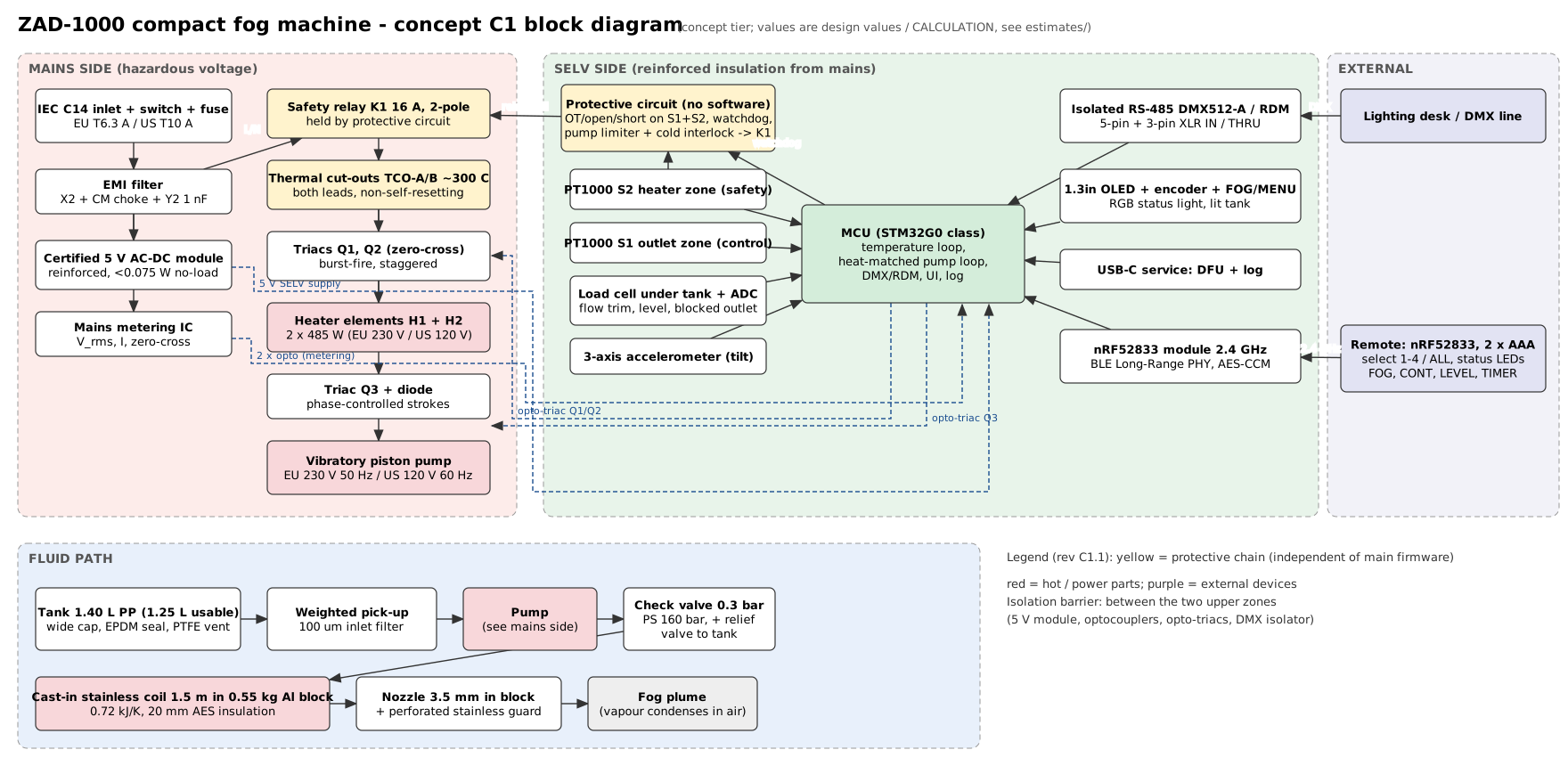
flowchart LR
  subgraph MAINS["Mains side (hazardous voltage)"]
    INLET["IEC C14 inlet + switch + fuse<br/>EU T6.3 A / US T10 A"] --> EMI["EMI filter<br/>X2 + CM choke + Y2 1 nF"]
    EMI --> PSU["Certified 5 V AC-DC module<br/>(reinforced, <0.075 W no-load)"]
    EMI --> MET["Mains metering IC<br/>V_rms, I, zero-cross"]
    EMI --> K1["Safety relay K1 16 A, 2-pole<br/>(held by protective circuit)"]
    K1 --> TCO["Thermal cut-outs TCO-A/B ~300 °C<br/>both leads, non-self-resetting"]
    TCO --> Q1["Triac Q1 zero-cross"] --> H1["Element H1 485 W"]
    TCO --> Q2["Triac Q2 zero-cross"] --> H2["Element H2 485 W"]
    TCO --> Q3["Triac Q3 + diode<br/>phase-controlled"] --> PUMP["Vibratory pump<br/>EU 230 V 50 Hz / US 120 V 60 Hz"]
  end
  subgraph SELV["SELV side (reinforced insulation from mains)"]
    MCU["MCU STM32G0<br/>control, DMX/RDM, UI, logs"]
    SAFE["Protective circuit, no software<br/>OT/open/short on S1+S2, watchdog,<br/>pump limiter, cold interlock -> K1"]
    S1["PT1000 S1 outlet zone"] --> MCU
    S2["PT1000 S2 heater zone"] --> SAFE
    S2 --> MCU
    LC["Load cell under tank<br/>24-bit ADC"] --> MCU
    ACC["3-axis accelerometer"] --> MCU
    DMX["Isolated RS-485<br/>5-pin + 3-pin XLR in/thru"] <--> MCU
    RF["nRF52833 module 2.4 GHz<br/>Coded PHY, AES-CCM"] <--> MCU
    UI["1.3in OLED + encoder + FOG/MENU<br/>RGB status light, lit tank"] <--> MCU
    USB["USB-C service port<br/>DFU + log export"] <--> MCU
  end
  PSU --> SELV
  MET -. "2 x reinforced optocoupler" .-> MCU
  MCU -. "opto-triac drivers" .-> Q1 & Q2 & Q3
  SAFE -. "relay coil" .-> K1
  MCU -. "watchdog toggle" .-> SAFE
  subgraph FLUID["Fluid path"]
    TANK["Tank 1.40 L PP, usable 1.25 L<br/>wide cap + EPDM seal + PTFE vent"] --> FILT["Weighted pick-up<br/>100 µm inlet filter"] --> PUMP
    PUMP --> CV["Check valve 0.3 bar, PS 160 bar<br/>+ relief valve to tank"] --> COIL["Cast-in stainless coil 1.5 m<br/>in Al block 0.55 kg"] --> NOZ["Nozzle Ø3.5 mm<br/>+ stainless guard"]
  end
  REMOTE["Remote: nRF52833, 2 x AAA<br/>select 1-4 / ALL, status LEDs"] <-. "2.4 GHz two-way" .-> RF
  DESK["Lighting desk / DMX"] <--> DMX
3. Physical layout (concept)
 SIDE VIEW (section)                                         REAR PANEL (165 x 170 mm)
 front                                          rear        +-------------------------------+
  ___________________________________________________       | [OLED]  (enc)  [FOG] [MENU]   |
 |guard|  EXCHANGER MODULE   | heat  |  handle/cap  ==|      |                               |
 | ((o))  140x100x80 can     | shield|   TANK 1.40 L  |     | (5-pin IN) (5-pin THRU)       |
 |nozzle  Al block+coil      |       |   PP, lit level|     | (3-pin IN) (3-pin THRU)       |
 |_____|_____________________|_______|   on LOAD CELL |     |                               |
 |  vents   PUMP on silicone   MAIN PCB (SELV + mains |     | [IEC C14+switch+fuse]  [USB-C]|
 |__________mounts_____________zones, heat-shielded)__|     +-------------------------------+
   foot                                          foot
- Hot zone (front-top): insulated exchanger module (AES-wool blanket 20 mm in a 0.3 mm stainless can) on four steatite stand-offs; replaceable stainless nozzle insert (Ø3.5 mm, screwed into the block outlet with a graphite seal, ZAD-SRV-01) behind a perforated stainless guard; no part hotter than 70 °C reachable with IEC 61032 probe B (design intent, ZAD-SAF-03, to be checked in CAD).
- Cool zone (bottom, rear): main PCB on the floor plate under a heat shield with a 10 mm air gap; pump on silicone grommets on its own bracket; tank on a single-point load cell at the rear; all fluid connections are below or beside the module, never above live parts; a drip channel in the floor leads any leak to a drain hole away from the PCB.
- Rear: all connectors and the UI (operators reach the rear of a floor machine; on truss the display faces the rigger). Handle at the top rear, ≥ 200 mm from the outlet (requirement ≥ 150 mm). Tank cap on top at the rear.
- Natural convection only: bottom inlet louvres, rear/top outlet louvres; no fan (ZAD-UX-02).
4. Fluid path and anti-spit design
| Cause of spitting/dripping | Design measure |
|---|---|
| Exchanger too cool (cold start, overload) | Pump enabled only in READY; heat-matched pump control keeps S1 ≥ T_min(fluid) + 10 K; hard pump stop below T_min |
| Burst exceeds the coil's vaporising capacity | Burst rate ceiling 60 ml/min; coil length 1.5 m vs 1.37 m needed at the 51 ml/min burst mean and 0.82 m at continuous (CALCULATION, first-order 3-zone model with 2x dry-out penalty) |
| Slugs from pump pulses | Mains-synchronous stroke scheduler; partial strokes at low flow; compliant silicone hose section as damper |
| Air in the line (empty tank, tilt) | Gravimetric low-fluid stop before the pick-up uncovers; weighted pick-up follows the fluid at ±30° tilt and when hung |
| Siphoning into the hot coil when stopped or hung | Spring check valve 0.3 bar cracking at the coil inlet |
| Residual liquid after stop / switch-off | Evaporate-out: pump off, heater holds S1 ≥ T_min for 20 s after every output stop and before soft-off; the hot block (cool-down time constant 84 min, CALCULATION) vaporises the few 0.1 ml left behind the check valve |
| Condensate at the nozzle | Nozzle insert is screwed into the block and conducts its heat (always above the dew point while hot); guard has a drip lip and an absorbent pad |
| Wrong fluid / overheating | Fluid-type setting (Quick 230 °C, Standard 250 °C, Dense 265 °C, ASSUMPTION windows), firmware maximum 280 °C, hardware comparator 300 °C, TCOs ≈ 300–310 °C (rev C1.1) |
Wetted materials: PP/HDPE tank, EPDM cap seal, silicone (VMQ) hoses, PTFE vent membrane and pump seals, AISI 304/316 check valve and coil, pump body per the pump datasheet (brass/PA class, ASSUMPTION until datasheet check). All are generally rated for glycols/glycerol (to be confirmed with the fluid makers' compatibility tables).
5. Heat exchanger and protective chain
- Block: die-cast AlSi (EN AC-46000/ADC12 class) 0.55 kg with cast-in AISI 304 coil 5.0 × 0.6 mm × 1.5 m and two cast-in tubular elements (EU 2 × 10⁹ Ω hot, US 2 × 29.7 Ω hot, CALCULATION from 485 W each). Heat capacity 0.66 kJ/K at 20 °C, 0.72 kJ/K at 250 °C (CALCULATION). Losses at READY 40 W design value (31 W model × 1.3 margin, CALCULATION).
- TCO selection constraint (open issue raised by the reliability review): a thermal link must not age or trip while the block sits at up to 265–290 °C for thousands of hours, i.e. its holding temperature must exceed ~295 °C. If no qualified link with that holding temperature is available, use a manual-reset capillary safety limiter (oven/fryer class) on the block, or mount the link on a calibrated thermal bridge that sees a known fraction of the block temperature (ASSUMPTION; decided in detailed design with the supplier's data).
- Sensors: S1 PT1000 in the outlet zone (control and spit guard), S2 PT1000 near the elements (independent safety comparator and plausibility). Two separate bores, separate wiring.
- Protective chain, independent of the main firmware: (1) window comparators on S1 and S2 (over-temperature 300 °C, sensor
open or short; rev C1.1) and (2) an external window watchdog that needs a periodic MCU toggle both hold K1; either one drops
K1 and latches until the mains switch is cycled; (3) non-self-resetting TCOs (≈ 300–310 °C) on the block in both supply
leads as the final protection (rev C1.1). The main firmware also limits at 280 °C and opens K1 on plausibility faults
(S1 vs S2 > 40 K, current when triacs are off, element current missing), but no protective function relies on it,
so EN 60335-1 Annex R software class B is not claimed for the main firmware (the protective electronic circuit is
tested under clause 19.11, see
safety-concept.md). - Heater switching: whole-cycle burst firing, the two elements are never switched in the same second; ≤ 1 switching event per element per second. Flicker Pst ≈ 0.48 for one-element steps vs 0.95 if both switched together (CALCULATION, EN 61000-3-3 analytical method, reference impedance) — hence the staggering rule.
6. Control strategy (ZAD-PRF-02/03/04/06/07, ZAD-SAF-07)
- Temperature loop on S1: PI with feed-forward of the fluid heat demand (Q × e_ml, e_ml = 2.40 kJ/ml for fluid S, CALCULATION) and of the measured mains voltage (heater power ∝ V²).
- Heat-matched pump loop:
Q_pump = min(Q_user, Q_avail)withQ_avail = Q_cont(V_rms, fluid) + Kp·(T_S1 − T_guard) + Ki·∫(T_S1 − T_guard),T_guard = T_min + 10 K. From READY the stored heat letsQ_availexceedQ_cont(burst, up to the 60 ml/min ceiling); as the block droops towardT_guardthe output slides down continuously toQ_cont— there is no step to zero in normal operation, so the 30-min 100 % run has no interruption (design intent ZAD-PRF-03 target 0 s). BelowT_minthe pump stops (would count as a gap; only reachable with a fault or an out-of-range supply, and it is logged). - Metering: a stroke scheduler turns
Q_pumpinto mains-synchronous half-wave strokes: full strokes (0.167 ml, ASSUMPTION from the pump curve) above ~10 ml/min; partial strokes (late phase angle, ~0.04 ml, ASSUMPTION) below, giving a stroke every 1.2 s at 2 ml/min (CALCULATION). Stroke volume is corrected for V_rms by a calibration table and trimmed by the gravimetric loop. - Gravimetric loop: tank mass from the load cell (tilt-corrected with the accelerometer) gives the true 1-minute
flow (CALCULATION: ±1.6 % at 22 ml/min, ±3.5 % at 10 ml/min, ±17 % at 2 ml/min over 1 min, so below ~8 ml/min the
trim uses 5-minute windows), the fluid level, refill detection, the low-fluid stop and blocked-outlet detection
(pump running, no mass loss for 20 s → pump stop, code E11; fault-code table in
reliability-service-production.md§7.1). - Loss of control: DMX loss detected after 1.0 s without a valid packet → pump stopped ≤ 1.3 s after the last valid packet (unless the user selected HOLD); remote momentary fog is hold-to-run (frames every 100 ms; 3 missed frames → stop); remote continuous mode auto-off (default 10 min, 1–60 min); no pumping unless READY; tilt > 45° → pump and heater off.
7. Firmware state machine
| State | Entry / behaviour | Leaves to |
|---|---|---|
| OFF | mains switch off, 0 W | BOOT on switch-on |
| BOOT | self-test: S1/S2 in range and plausible, K1 close test, watchdog test, load-cell/accelerometer present, last fault log | HEATING (or STANDBY if auto-heat disabled), FAULT |
| STANDBY | heater off, radio + DMX listening (0.21 W, CALCULATION), display off | HEATING on any command / key |
| HEATING | both elements on; warm-up % on OLED, status light amber pulsing, remote LED amber | READY when S1 ≥ T_set − 3 K |
| READY | temperature loop holds T_set (40 W losses); status green | FOGGING on command; STANDBY after idle auto-off (user setting, default 60 min) |
| FOGGING | heat-matched pump loop; DERATED flag when Q_avail < Q_user | EVAPORATE-OUT when command ends; LOW-FLUID; FAULT; TILT |
| EVAPORATE-OUT | pump off 20 s, heater holds S1 ≥ T_min | READY |
| LOW-FLUID | pump inhibited, code E10 on OLED/remote/RDM, status light amber blinking | previous state automatically when tank mass rises (refill) |
| TILT | pump + heater off when tilt > 45° | HEATING/READY when < 35° for 10 s |
| CLEAN | guided cleaning/purge with cleaning fluid or distilled water: lower setpoint, timed pumping, step prompts | READY / STANDBY |
| FAULT | latched safety faults (over-temperature, sensor, K1, watchdog) need a mains cycle; others self-clear; code shown and logged | BOOT after mains cycle |
8. Control interfaces
- DMX512-A (ANSI E1.11): isolated RS-485 (digital isolator + transceiver + low-power isolated supply), 5-pin XLR IN/THRU (standard) and 3-pin XLR IN/THRU (DJ market), passive thru that stays connected unpowered, no internal termination (user terminates the line). Personalities: 1-ch (output 0–100 %) and 2-ch (ch1 output; ch2 mode: 0–49 direct, 50–99 on-unit timer with ch1 level, 100–149 continuous-only (no burst, steadiest output for video), 150–199 burst allowed, 200–255 reserved). Start address on the OLED; no DIP switches.
- RDM (ANSI E1.20) responder: DEVICE_INFO, DMX_START_ADDRESS, DMX_PERSONALITY(_DESCRIPTION), IDENTIFY_DEVICE (status light flashes), SENSOR_DEFINITION/SENSOR_VALUE (S1, S2, fluid %, mains V), STATUS_MESSAGES (heating, ready, low fluid, faults), DEVICE_HOURS, DEVICE_LABEL, SOFTWARE_VERSION_LABEL, SUPPORTED_PARAMETERS, RESET_DEVICE, plus manufacturer PIDs for fog hours, fluid type and fault log.
- Radio: nRF52833 pre-certified modules both ends; proprietary frames on the BLE Long-Range (Coded PHY 125 kbps) modulation, 3 channels with frequency agility, AES-CCM-128 with 32-bit frame counter (replay protection), unique 32-bit IDs; pairing by holding MENU+FOG on the machine (30 s window, key exchange at −20 dBm within ~1 m). Remote keys: FOG (hold), CONT on/off, LEVEL +/−, TIMER start/stop, machine select 1–4 and ALL; one bicolour LED per machine (amber pulsing = heating, green = ready, amber blinking = low fluid, red = fault) refreshed from the ACK payload. Link budget: 219 m free space, 160 m two-ray with the machine on a 3 m truss, 46 m two-ray with the machine on the floor (antenna 0.25 m), all with a 15 dB fade margin (CALCULATION). No internet connection, no app, no account.
- On-unit UI: 1.3" 128×64 OLED, encoder with push, FOG (manual) and MENU keys; shows warm-up %, READY, output %, DMX address/personality, timer, fluid type and level, fault codes; settings in MCU flash (survive power-off); front RGB status light visible from > 5 m; backlit translucent tank level window visible from 3 m.
- Service: USB-C (SELV) for DFU firmware update and export of the operating-hours and fault log.
9. Mains variants (ZAD-PWR-01)
| Part | EU 220–240 V~ 50/60 Hz | US 120 V~ 60 Hz |
|---|---|---|
| Heat-exchanger module (elements) | 2 × 485 W @ 230 V (109 Ω hot each) | 2 × 485 W @ 120 V (29.7 Ω hot each) |
| Pump | vibratory pump 230 V 50 Hz | vibratory pump 120 V 60 Hz |
| Fuse in inlet module | T6.3 A 250 V (5 × 20 mm) | T10 A 250 V UL 248-14 |
| Cord set, 3 m | H05VV-F 3G1.0 mm², CEE 7/7 plug, C13 | SJT 16/3, NEMA 5-15P, C13 |
| Rating plate, labels, manual set | CE, WEEE, EU languages | NRTL mark, FCC/ISED statements, English/Spanish/French |
| Firmware configuration | 50 Hz pump table | 60 Hz pump table (auto-detected, cross-checked with variant code) |
| Shared | everything else: aux PSU (universal input), triacs (600 V), relay (16 A 250 V), PCB, housing, tank, radio, remote |
Rated input 980 W (declared; calculated 979 W = 970 W heater + 5.8 W pump at the burst ceiling + 3.3 W electronics); 4.26 A at 230 V and 8.17 A at 120 V (CALCULATION), below the 12 A US continuous limit of ZAD-PWR-02.
11. Revision C1.1 — safety-driven changes adopted by the manager
The safety review (safety-concept.md §13, SR-01…SR-15) found gaps in the C1 power and fluid path. The manager adopts
them; they supersede the C1 text above where they differ (the block diagram already shows them):
| # | Change | Reason |
|---|---|---|
| SR-01 | Safety relay K1 becomes 2-pole (16 A); heaters and the pump are fed downstream of K1 and of the thermal cut-outs | every protective trip also stops fluid delivery without firmware |
| SR-02 | Non-self-resetting thermal cut-out in both heater supply leads (TCO-A/TCO-B or one 2-pole manual-reset limiter) | the EU Schuko plug is reversible (EN 60335-1 cl. 19.5) |
| SR-03 | Protective electronic circuit extended: over-temperature and open/short on S1 and S2 (trip lowered to 300 °C), windowed watchdog, hardware pump-delivery limiter, pump-into-cold-block interlock (165 °C), supply supervisor, K1 read-back, boot test hooks; latch reset only by mains off | single-fault robustness of the pump path, lower fault peak |
| SR-04 | AC-coupled (dynamic) triac gate drive, reinforced opto-triacs, insulated-tab triacs on a PE-bonded heatsink | a stuck MCU output cannot hold a triac on |
| SR-05 | Fluid path downstream of the check valve rated PS 160 bar (coil, nozzle insert seal, metal-bodied check valve); over-pressure relief valve on the pump outlet returning to the tank | a blocked outlet traps fluid in a coil at 265–345 °C (saturation pressure 106–155 bar, CALCULATION in safety-concept.md §5.3) |
| SR-06 | No fluid joints inside the insulated can; insulation as a sealed/hydrophobic pack (sealed AES wool, aerogel blanket as option); can with drip edge | avoids a fluid-soaked "lagging fire" in the blanket |
| — | Firmware temperature limit lowered from 290 °C to 280 °C; TCO functioning temperature ≈ 300–310 °C with a low-lag mount; DPG-rich fluids flagged in the fluid list until test FT-05 shows no ignition at the TCO-only fault peak (≈ 345–364 °C, CALCULATION in safety-concept.md §5.1) |
DPG autoignition ≈ 310 °C (SDS value quoted in safety-concept.md) |
| — | Earth-leakage design value taken from the safety concept: 0.219 mA EU / 0.109 mA US (adds element capacitance and 60 Hz worst case to the simpler estimate in estimates/); AC-DC module leakage must be specified as measured ≤ 50 µA (SR-10) |
conservative value; target 0.25 mA kept with a small margin |
| — | Rating plate for 220–240 V must show the power range (≈ 1,065 W at 240 V, CALCULATION 970 W × (240/230)² + 9 W); the ZAD-PWR-02 figure stays the 230 V value (980 W) | EN 60335-1 cl. 10 marking of a voltage range |
Cost impact of SR-01…SR-06 (2-pole relay, second TCO, pressure-rated check valve, relief valve, extra comparator
channels): about +EUR 3–5 per unit at 1,000 (ASSUMPTION); see the cost notes in ../09-bom-cost/cost.md and §7 of
../REPORT.md.
10. External interfaces summary
| Interface | Definition |
|---|---|
| Mains | IEC 60320 C14 inlet with switch and fuse; detachable 3 m cord (C13); Class I |
| DMX | XLR-5 male IN / female THRU, XLR-3 male IN / female THRU, pin 1 shield, 2 Data−, 3 Data+ (E1.11) |
| Radio | 2.4 GHz ISM, ≤ +8 dBm conducted (module), two-way, pairing ID |
| Fluid | ANSI E1.5 water-based fluids; wide-mouth cap, top-rear filling; usable 1.25 L |
| Mechanical | 4 rubber feet; included steel bracket: two M8 knob screws into threaded inserts on the chassis sides, Ø13 mm hole for a truss clamp, safety-cable eyelet, tilt ±30° |
| Outlet | Ø3.5 mm nozzle in a stainless guard cone; keep-clear zone per manual |
| Service | USB-C (DFU/log), access by removing the cover (6 screws) |
02-concept/estimates/concept_estimates.table.md
Concept estimates - generated by concept_estimates.py (do not edit by hand)
All results are CALCULATION from the inputs below. Inputs carry their own label.
Results
| name | value | unit |
|---|---|---|
| fluid_Q_energy_per_kg | 2570.0 | kJ/kg |
| fluid_Q_density | 1010.0 | kg/m3 |
| fluid_Q_energy_per_ml | 2.61 | kJ/ml |
| fluid_S_energy_per_kg | 2330.0 | kJ/kg |
| fluid_S_density | 1030.0 | kg/m3 |
| fluid_S_energy_per_ml | 2.4 | kJ/ml |
| fluid_D_energy_per_kg | 2110.0 | kJ/kg |
| fluid_D_density | 1080.0 | kg/m3 |
| fluid_D_energy_per_ml | 2.27 | kJ/ml |
| fluid_S_energy_per_ml_exit_150C | 2.24 | kJ/ml |
| fluid_S_energy_per_ml_exit_250C | 2.44 | kJ/ml |
| pump_stroke_volume_full | 0.167 | ml/stroke |
| exchanger_heat_capacity_20C | 661.0 | J/K |
| exchanger_heat_capacity_250C | 721.0 | J/K |
| insulation_thermal_resistance | 9.46 | K/W |
| heat_loss_base_at_250C_25C_amb | 30.8 | W |
| heat_loss_design_at_250C_25C_amb | 40.1 | W |
| heat_loss_design_fluid_Q | 36.3 | W |
| heat_loss_design_fluid_S | 40.1 | W |
| heat_loss_design_fluid_D | 43.0 | W |
| pump_power_at_ceiling_rate | 5.76 | W |
| electronics_ac_power_active | 3.33 | W |
| rated_input_calculated_EU_230V | 979.0 | W |
| rated_input_max_with_heater_tolerance | 1030.0 | W |
| current_EU_230V | 4.26 | A |
| current_US_120V | 8.17 | A |
| current_US_120V_limit_ZAD_PWR_02 | 12.0 | A |
| heater_resistance_hot_EU_per_element | 109.0 | ohm |
| heater_resistance_hot_US_per_element | 29.7 | ohm |
| heating_test_voltage_1p15_rated_input_EU | 247.0 | V |
| warmup_time_230V_fluid_Q | 2.49 | min |
| warmup_time_230V_fluid_S | 2.75 | min |
| warmup_time_230V_fluid_D | 2.95 | min |
| warmup_time_207V_fluid_S | 3.42 | min |
| warmup_time_253V_fluid_S | 2.27 | min |
| warmup_time_120V_US_fluid_S | 2.75 | min |
| warmup_time_108V_US_fluid_S | 3.42 | min |
| warmup_time_230V_fluid_S_5C_ambient | 2.93 | min |
| warmup_time_230V_fluid_D_heater_minus5pct | 3.11 | min |
| continuous_rate_230V_fluid_Q | 20.8 | ml/min |
| continuous_rate_207V_fluid_Q | 16.7 | ml/min |
| continuous_rate_230V_fluid_S | 22.5 | ml/min |
| continuous_rate_207V_fluid_S | 18.1 | ml/min |
| continuous_rate_230V_fluid_D | 23.7 | ml/min |
| continuous_rate_207V_fluid_D | 19.0 | ml/min |
| continuous_rate_253V_fluid_S | 27.5 | ml/min |
| continuous_rate_230V_fluid_S_heater_minus5pct | 21.4 | ml/min |
| continuous_rate_120V_US_fluid_S | 22.5 | ml/min |
| continuous_rate_108V_US_fluid_S | 18.1 | ml/min |
| tank_runtime_at_continuous_rate_fluid_S | 55.4 | min |
| pump_stroke_rate_at_continuous_fluid_S | 2.25 | strokes/s |
| pump_duty_at_continuous_fluid_S | 0.0451 | - |
| peak_30s_volume_230V_fluid_Q | 23.5 | ml |
| peak_30s_volume_230V_fluid_S | 25.6 | ml |
| peak_30s_volume_230V_fluid_D | 27.1 | ml |
| sweep_m_al_0p40kg_C250 | 572.0 | J/K |
| sweep_m_al_0p40kg_warmup_S_230V | 2.18 | min |
| sweep_m_al_0p40kg_peak30_S_230V | 22.7 | ml |
| sweep_m_al_0p45kg_C250 | 622.0 | J/K |
| sweep_m_al_0p45kg_warmup_S_230V | 2.38 | min |
| sweep_m_al_0p45kg_peak30_S_230V | 23.7 | ml |
| sweep_m_al_0p50kg_C250 | 671.0 | J/K |
| sweep_m_al_0p50kg_warmup_S_230V | 2.57 | min |
| sweep_m_al_0p50kg_peak30_S_230V | 24.7 | ml |
| sweep_m_al_0p55kg_C250 | 721.0 | J/K |
| sweep_m_al_0p55kg_warmup_S_230V | 2.75 | min |
| sweep_m_al_0p55kg_peak30_S_230V | 25.6 | ml |
| sweep_m_al_0p60kg_C250 | 771.0 | J/K |
| sweep_m_al_0p60kg_warmup_S_230V | 2.94 | min |
| sweep_m_al_0p60kg_peak30_S_230V | 26.6 | ml |
| sweep_m_al_0p65kg_C250 | 821.0 | J/K |
| sweep_m_al_0p65kg_warmup_S_230V | 3.13 | min |
| sweep_m_al_0p65kg_peak30_S_230V | 27.6 | ml |
| sweep_m_al_0p70kg_C250 | 871.0 | J/K |
| sweep_m_al_0p70kg_warmup_S_230V | 3.32 | min |
| sweep_m_al_0p70kg_peak30_S_230V | 28.6 | ml |
| alt_1150W_continuous_rate_230V_fluid_S | 26.9 | ml/min |
| alt_1150W_warmup_S_230V | 2.32 | min |
| alt_1150W_peak30_S_230V | 27.9 | ml |
| peak_30s_volume_207V_fluid_S | 23.3 | ml |
| peak_30s_volume_230V_fluid_S_droop_30K | 20.6 | ml |
| peak_30s_mean_rate_230V_fluid_S | 51.3 | ml/min |
| peak_30s_pump_duty_fluid_S | 0.103 | - |
| coil_length_needed_continuous_fluid_S | 0.822 | m |
| coil_length_margin_continuous_fluid_S | 1.83 | - |
| coil_length_needed_peak_mean_rate_fluid_S | 1.37 | m |
| coil_length_margin_peak_mean_rate_fluid_S | 1.09 | - |
| vapour_molar_mass_fluid_S | 23.7 | g/mol |
| nozzle_upstream_pressure_gauge_continuous | 0.014 | bar |
| nozzle_exit_velocity_continuous | 69.8 | m/s |
| jet_noise_LpA_1m_continuous | 36.8 | dB(A) |
| jet_noise_peak_frequency_continuous | 4990.0 | Hz |
| nozzle_upstream_pressure_gauge_peak | 0.0735 | bar |
| nozzle_exit_velocity_peak | 159.0 | m/s |
| jet_noise_LpA_1m_peak | 61.3 | dB(A) |
| jet_noise_peak_frequency_peak | 11300.0 | Hz |
| jet_noise_LpA_1m_continuous_if_2p5mm_nozzle | 51.6 | dB(A) |
| total_noise_LpA_1m_fogging_continuous | 43.1 | dB(A) |
| low_output_stroke_interval_partial_strokes | 1.2 | s |
| low_output_stroke_interval_full_strokes | 5.0 | s |
| low_output_stroke_interval_5ml_min_full_strokes | 2.0 | s |
| gravimetric_flow_error_1min_window_at_22ml_min | 0.0157 | - |
| gravimetric_flow_error_1min_window_at_10ml_min | 0.0345 | - |
| gravimetric_flow_error_1min_window_at_2ml_min | 0.173 | - |
| standby_power_receiver_and_dmx_listening | 0.213 | W |
| off_mode_power_mains_switch_off | 0.0 | W |
| ready_hold_power_fluid_S_25C | 43.4 | W |
| ready_hold_power_fluid_D_25C | 46.3 | W |
| ready_hold_heater_duty_fluid_S | 0.0413 | - |
| cooldown_time_constant_block | 84.3 | min |
| flicker_relative_voltage_change_one_element_step | 0.367 | % |
| flicker_Pst_one_element_step_60_changes_per_min | 0.476 | - |
| flicker_relative_voltage_change_both_elements_together | 0.733 | % |
| flicker_Pst_both_elements_together_60_changes_per_min | 0.952 | - |
| link_allowed_path_loss_coded125k | 87.0 | dB |
| link_range_free_space_coded125k | 219.0 | m |
| link_range_two_ray_coded125k_truss_3m | 160.0 | m |
| link_range_two_ray_coded125k_floor_0p25m | 46.5 | m |
| link_allowed_path_loss_1M | 79.0 | dB |
| link_range_free_space_1M | 87.2 | m |
| link_range_two_ray_1M_truss_3m | 87.5 | m |
| link_range_two_ray_1M_floor_0p25m | 29.5 | m |
| link_margin_at_50m_floor_coded125k | 13.6 | dB |
| link_margin_at_50m_truss_coded125k | 27.8 | dB |
| bbox_volume | 9.49 | L |
| bbox_longest_side | 295.0 | mm |
| housing_skin_area | 0.254 | m2 |
| dry_mass | 3.26 | kg |
| cog_height_empty | 95.3 | mm |
| cog_height_full | 88.1 | mm |
| tip_angle_min_empty | 35.3 | deg |
| tip_angle_min_full | 37.5 | deg |
| internal_dissipation_worst | 53.9 | W |
| enclosure_rise_average | 11.8 | K |
| enclosure_rise_hotspot_top_cover | 18.9 | K |
| handle_rise_rear_top | 9.45 | K |
| earth_leakage_estimate_EU_1p06x240V | 0.155 | mA |
| earth_leakage_estimate_US_1p06x120V | 0.111 | mA |
Inputs
| name | value | unit | label | basis |
|---|---|---|---|---|
| T_fluid_in | 20.0 | degC | ASSUMPTION | fluid enters at 20 C room temperature (ZAD-PRF-01 reference ambient) |
| fluid_Q_composition | {'water': 0.85, 'propylene glycol': 0.15} | mass fraction | ASSUMPTION | representative ANSI E1.5 fluid of this type (typical SDS ranges); claims are stated for fluid S |
| fluid_Q_T_set | 230.0 | degC | ASSUMPTION | exchanger setpoint of the fluid-type setting; to be tuned on the prototype with 3 brands |
| fluid_Q_T_min | 180.0 | degC | ASSUMPTION | lowest outlet-zone temperature that still vaporises completely (spit guard); prototype calibration |
| fluid_S_composition | {'water': 0.7, 'propylene glycol': 0.2, 'triethylene glycol': 0.1} | mass fraction | ASSUMPTION | representative ANSI E1.5 fluid of this type (typical SDS ranges); claims are stated for fluid S |
| fluid_S_T_set | 250.0 | degC | ASSUMPTION | exchanger setpoint of the fluid-type setting; to be tuned on the prototype with 3 brands |
| fluid_S_T_min | 200.0 | degC | ASSUMPTION | lowest outlet-zone temperature that still vaporises completely (spit guard); prototype calibration |
| fluid_D_composition | {'water': 0.55, 'propylene glycol': 0.1, 'triethylene glycol': 0.15, 'glycerol': 0.2} | mass fraction | ASSUMPTION | representative ANSI E1.5 fluid of this type (typical SDS ranges); claims are stated for fluid S |
| fluid_D_T_set | 265.0 | degC | ASSUMPTION | exchanger setpoint of the fluid-type setting; to be tuned on the prototype with 3 brands |
| fluid_D_T_min | 215.0 | degC | ASSUMPTION | lowest outlet-zone temperature that still vaporises completely (spit guard); prototype calibration |
| vapour_exit_below_setpoint | 20.0 | K | ASSUMPTION | vapour leaves the last coil turns ~20 K below block setpoint |
| T_hard_max_firmware | 280.0 | degC | ASSUMPTION | upper limit to keep glycol/glycerol thermal degradation (aldehydes, acrolein) low; TCO above it |
| mixture_density_correction | 1.01 | - | ASSUMPTION | real water-glycol mixtures are ~1 % denser than ideal volume mixing; applied to energy per ml |
| P_heater_nominal_hot | 970.0 | W | ASSUMPTION | design choice: 2 x 485 W cast-in elements at rated voltage, hot (meets ZAD-PWR-02 target with pump+electronics) |
| heater_elements | 2 | - | ASSUMPTION | two elements: staggered burst firing halves the flicker step, partial redundancy |
| heater_power_tolerance | 0.05 | - | ASSUMPTION | +/-5 % element power tolerance specified to the element supplier |
| pump_rated_power_full_duty | 48.0 | W | SOURCE | Ulka EX5 class vibratory pump, 48 W nameplate (230 V 50 Hz) - verify on the selected part datasheet |
| pump_flow_full_stroke_rate_1bar | 500.0 | ml/min | ASSUMPTION | typical EX5-class flow at ~1 bar back-pressure; prototype calibration |
| electronics_dc_power_active | 2.5 | W | ASSUMPTION | MCU + radio + isolated DMX + OLED + relay coil + LEDs, active |
| aux_psu_efficiency | 0.75 | - | ASSUMPTION | 5 V certified AC-DC module at ~50 % load |
| m_block_aluminium | 0.55 | kg | ASSUMPTION | die-cast AlSi block ~105 x 62 x 42 mm envelope incl. inserts; sized by the warm-up vs 30 s peak trade-off |
| m_coil_stainless | 0.1 | kg | CALCULATION | AISI 304 tube 5.0 x 0.6 mm, 1.5 m: 8.29 mm2 x 1.5 m x 7.9 g/cm3 = 0.098 kg |
| m_heater_elements | 0.15 | kg | ASSUMPTION | 2 tubular elements ~8 mm x 300 mm (sheath + MgO + NiCr) |
| m_insulation | 0.113 | kg | CALCULATION | AES blanket 128 kg/m3, 20 mm around block: (140x100x80 - 100x60x40) mm3 = 0.88 dm3 |
| insulation_heat_capacity_participation | 0.25 | - | ASSUMPTION | about half the blanket mass reaches about half the block temperature rise within 3 min (penetration ~9 mm) |
| cp_heater_element | 600.0 | J/kgK | ASSUMPTION | mass-weighted Incoloy sheath + MgO + NiCr |
| cp_insulation | 1000.0 | J/kgK | SOURCE | alkaline-earth-silicate wool ~1.0 kJ/kgK (typical datasheet value) |
| cp_aluminium_fit | 903 + 0.43*(T_K-300) | J/kgK | SOURCE | pure Al: 903 (300 K), 949 (400 K), 1033 (600 K) - Incropera, Fundamentals of Heat and Mass Transfer, Table A.1 |
| cp_stainless_fit | 477 + 0.27*(T_K-300) | J/kgK | SOURCE | AISI 304: 477 (300 K), 515 (400 K), 557 (600 K) - Incropera Table A.1 |
| k_insulation | 0.065 | W/mK | ASSUMPTION | AES blanket 128 kg/m3 at ~150 C mean (datasheets 0.05-0.08); RCF avoided (REACH SVHC) |
| t_insulation | 0.02 | m | ASSUMPTION | design value |
| h_can_outer | 8.0 | W/m2K | ASSUMPTION | natural convection + radiation of a stainless can (eps ~0.3) in housing air |
| housing_air_rise_over_ambient | 15.0 | K | ASSUMPTION | internal air above ambient near the module (natural ventilation) |
| R_standoffs_4x_steatite | 127.0 | K/W | CALCULATION | 4 steatite tubes 6/4 mm x 20 mm, k=2.5 W/mK: 509 K/W each |
| loss_element_terminals_at_250C | 4.0 | W | ASSUMPTION | 4 cold pins, 50 mm unheated length, partly inside insulation |
| loss_nozzle_region_at_250C | 2.0 | W | ASSUMPTION | ~3 cm2 exposed nozzle boss, h ~15 W/m2K + radiation |
| loss_inlet_tube_sensors_at_250C | 1.0 | W | ASSUMPTION | inlet tube (0.4 W) + RTD/TCO leads |
| heat_loss_model_margin | 1.3 | - | ASSUMPTION | x1.3 on the loss model for gaps, compression of the blanket, workmanship |
| pump_rate_ceiling_firmware | 60.0 | ml/min | ASSUMPTION | firmware ceiling for the 30 s burst (above the computed peak need) |
| rated_input_declared | 980.0 | W | ASSUMPTION | declared rated input = calculated value rounded up (EN 60335-1 cl. 10 deviation +5 %/-10 %) |
| ready_band_below_setpoint | 3.0 | K | ASSUMPTION | READY when outlet-zone sensor S1 >= T_set - 3 K (block is near-isothermal, Al conductivity) |
| control_power_reserve | 0.03 | - | ASSUMPTION | 3 % of heater power kept for temperature regulation at the continuous rate |
| coil_inner_diameter | 0.0038 | m | ASSUMPTION | 5.0 x 0.6 mm tube |
| coil_length | 1.5 | m | ASSUMPTION | design value |
| h_flow_boiling | 3000.0 | W/m2K | ASSUMPTION | low-mass-flux flow boiling, 3-5 kW/m2K typical |
| dryout_mist_flow_penalty | 2.0 | - | ASSUMPTION | post-dryout region doubles the required length (droplets must evaporate before the nozzle) |
| nozzle_diameter | 0.0035 | m | ASSUMPTION | chosen for low exit velocity (jet noise ~ v^8) with adequate throw |
| vapour_isentropic_exponent | 1.25 | - | ASSUMPTION | water/glycol vapour mixture |
| lighthill_coefficient | 3e-05 | - | ASSUMPTION | subsonic cold-jet acoustic efficiency constant (literature 3e-5..1e-4); +/-10 dB uncertainty |
| jet_strouhal_peak | 0.25 | - | ASSUMPTION | peak-frequency Strouhal number of a round jet |
| pump_noise_LpA_1m_isolated_continuous | 42.0 | dB(A) | ASSUMPTION | vibratory pump at ~2-3 strokes/s on silicone mounts inside a lined metal housing; to be measured |
| noise_ready_sources | none (no fan; triac/relay silent; pump off) | - | ASSUMPTION | passive cooling concept |
| pump_partial_stroke_volume | 0.04 | ml/stroke | ASSUMPTION | late phase-angle firing gives ~25 % stroke; to be characterised on the bench |
| lowest_output_setting | 2.0 | ml/min | ASSUMPTION | design target ZAD-PRF-05 |
| load_cell_noise_rms_10sps | 0.15 | g | ASSUMPTION | 3 kg single-point cell, 1 mV/V, 3.3 V excitation, 24-bit ADC ~90 nV rms @10 SPS |
| load_cell_vibration_noise_after_filter | 0.25 | g | ASSUMPTION | pump/handling vibration residual after 1 s median + 10 s mean filter |
| aux_psu_no_load | 0.075 | W | SOURCE | Mean Well IRM-05 series no-load <0.075 W (datasheet) - verify on final part |
| x_cap_bleeder | 0.053 | W | CALCULATION | 1 Mohm bleeder at 230 V: 230^2/1e6 |
| radio_rx_power | 0.02 | W | ASSUMPTION | nRF52833 RX ~6 mA at 3 V with DC-DC, continuous listening |
| dmx_listen_power | 0.025 | W | ASSUMPTION | low-power isolated supply (SN6505-class) + transceiver idle + isolator |
| mcu_sleep_power | 0.003 | W | ASSUMPTION | STM32G0 Stop mode with LPUART wake + LDO quiescent |
| standby_led_power | 0.003 | W | ASSUMPTION | dim standby LED 1 mA |
| aux_psu_light_load_efficiency | 0.6 | - | ASSUMPTION | flyback module at <5 % load |
| reference_impedance_R | 0.4 | ohm | SOURCE | IEC/EN 61000-3-3 reference impedance phase+neutral 0.24+0.16 ohm (X 0.25 ohm) |
| radio_tx_power | 8.0 | dBm | SOURCE | nRF52833/nRF52840 max TX +8 dBm (Nordic product specification) |
| radio_sensitivity_coded_125k | -103.0 | dBm | SOURCE | nRF52833 BLE Long Range 125 kbps sensitivity (Nordic product specification) |
| radio_sensitivity_1M | -95.0 | dBm | SOURCE | nRF52833 1 Mbps BLE sensitivity (Nordic product specification) |
| remote_antenna_gain_incl_hand | -4.0 | dBi | ASSUMPTION | PCB/chip antenna -1 dBi, hand/body loss 3 dB |
| machine_antenna_gain_incl_window | -5.0 | dBi | ASSUMPTION | module antenna -1 dBi behind the PC window near metal: 4 dB loss |
| indoor_fade_margin | 15.0 | dB | ASSUMPTION | Rayleigh-type fading margin for ~95 % link availability before retries |
| bbox_length | 295.0 | mm | ASSUMPTION | layout: front exchanger zone 140 mm + rear tank zone 125 mm + walls/bezel |
| bbox_width | 165.0 | mm | ASSUMPTION | tank 140 mm wide + walls; 4 XLR + inlet fit the 165 x 170 rear panel |
| bbox_height | 195.0 | mm | ASSUMPTION | body 170 mm + 10 mm feet + 15 mm low-profile top handle |
| housing_sheet_thickness | 1.2 | mm | ASSUMPTION | 5052-H32 aluminium, powder coated |
| vent_area_fraction | 0.05 | - | ASSUMPTION | louvres/perforations |
| mass::heat exchanger (Al block + coil + elements + nozzle) | 0.82 | kg | ASSUMPTION | estimated from geometry and typical part masses (CAD/BOM masses at full tier) |
| mass::insulation + stainless can 0.3 mm | 0.27 | kg | ASSUMPTION | estimated from geometry and typical part masses (CAD/BOM masses at full tier) |
| mass::pump + silicone mount bracket | 0.41 | kg | ASSUMPTION | estimated from geometry and typical part masses (CAD/BOM masses at full tier) |
| mass::tank PP 2 mm + cap + pick-up/filter | 0.186 | kg | ASSUMPTION | estimated from geometry and typical part masses (CAD/BOM masses at full tier) |
| mass::load cell + cradle | 0.08 | kg | ASSUMPTION | estimated from geometry and typical part masses (CAD/BOM masses at full tier) |
| mass::main PCB (relay, triacs+heatsink) + UI PCB/OLED/encoder + AC-DC module | 0.19 | kg | ASSUMPTION | estimated from geometry and typical part masses (CAD/BOM masses at full tier) |
| mass::connectors: 4 XLR + IEC inlet module + USB-C | 0.115 | kg | ASSUMPTION | estimated from geometry and typical part masses (CAD/BOM masses at full tier) |
| mass::wiring harness, hoses, fittings, check valve | 0.1 | kg | ASSUMPTION | estimated from geometry and typical part masses (CAD/BOM masses at full tier) |
| mass::aluminium chassis + cover + rear panel | 0.69 | kg | ASSUMPTION | estimated from geometry and typical part masses (CAD/BOM masses at full tier) |
| mass::internal heat shield (Al 0.8 mm) | 0.11 | kg | ASSUMPTION | estimated from geometry and typical part masses (CAD/BOM masses at full tier) |
| mass::PC front bezel + stainless nozzle guard | 0.146 | kg | ASSUMPTION | estimated from geometry and typical part masses (CAD/BOM masses at full tier) |
| mass::handle + 4 feet + fasteners + labels | 0.14 | kg | ASSUMPTION | estimated from geometry and typical part masses (CAD/BOM masses at full tier) |
| foot_inset | 15.0 | mm | ASSUMPTION | feet 15 mm in from the outline |
| triac_dissipation_heating | 4.639130434782609 | W | CALCULATION | 2 triacs x ~1.1 V on-state x element current |
| h_skin_combined | 9.0 | W/m2K | ASSUMPTION | natural convection ~4 + radiation ~5 W/m2K (powder coat eps 0.9) |
| chimney_heat_fraction | 0.5 | - | ASSUMPTION | half the internal heat leaves with vent air (bottom inlet, rear/top outlet) |
| hotspot_factor_top_cover | 1.6 | - | ASSUMPTION | top cover above the module vs skin average, with heat shield + 10 mm air gap |
| y_capacitance_total_to_PE | 1e-09 | F | ASSUMPTION | EMI filter Y2 1 nF total (kept small on purpose) |
| aux_psu_leakage | 5e-05 | A | ASSUMPTION | certified 5 V module touch current class (datasheet values 0.1-0.25 mA max; typical lower) |
| heater_insulation_resistance_hot_per_element | 20000000.0 | ohm | ASSUMPTION | MgO tubular element at ~300 C sheath (cold >100 Mohm) |
02-concept/key-estimates.md
ZAD-1000 — Key estimates (concept revision C1)
All values below are CALCULATION results of estimates/concept_estimates.py (run ddpy concept_estimates.py in
estimates/; offline, ~5 s). Results: estimates/concept_estimates.results.json; every input with its label
(SOURCE or ASSUMPTION) and basis: estimates/concept_estimates.inputs.json; full table:
estimates/concept_estimates.table.md. These are first-order engineering estimates, not simulations or measurements.
1. Energy needed per ml of fluid (basis of every output claim)
Enthalpy from 20 °C liquid to vapour at the exchanger exit (setpoint − 20 K), water from CoolProp, glycols from thermo
correlations (heat liquid to 100 °C, vaporise at 100 °C, heat vapour), ideal volume mixing +1 % density correction.
| Fluid (mass fractions, ASSUMPTION) | Setpoint / T_min (ASSUMPTION) | Energy | Density |
|---|---|---|---|
| Q quick-dissipating: 85 % water, 15 % PG | 230 / 180 °C | 2.61 kJ/ml (2570 kJ/kg) | 1010 kg/m³ |
| S standard (reference for claims): 70 % water, 20 % PG, 10 % TEG | 250 / 200 °C | 2.40 kJ/ml (2330 kJ/kg) | 1030 kg/m³ |
| D dense / long-hang: 55 % water, 10 % PG, 15 % TEG, 20 % glycerol | 265 / 215 °C | 2.27 kJ/ml (2110 kJ/kg) | 1080 kg/m³ |
Sensitivity (fluid S): vapour exit at 150 °C → 2.24 kJ/ml; at 250 °C → 2.44 kJ/ml. Water dominates: the more water, the more energy per ml, so quick-dissipating fluids give the lowest continuous rate.
2. Heater, rating and mains (ZAD-PWR-01/02)
| Quantity | Value |
|---|---|
| Heater (2 elements, hot, rated voltage) | 970 W (ASSUMPTION design value) |
| Element hot resistance EU / US | 109 Ω / 29.7 Ω each |
| Rated input EU (heater + pump at 60 ml/min ceiling + electronics) | 979 W calculated → 980 W declared |
| Maximum with +5 % element tolerance | 1030 W (inside EN 60335-1 cl. 10 deviation of +5 %) |
| Current EU 230 V / US 120 V | 4.26 A / 8.17 A (US limit 12 A) |
| Voltage for the EN 60335-1 heating test at 1.15 × rated input (EU) | 247 V |
3. Exchanger thermal model
| Quantity | Value |
|---|---|
| Heat capacity (0.55 kg Al + 0.10 kg stainless coil + 0.15 kg elements + 25 % of insulation) | 0.66 kJ/K at 20 °C, 0.72 kJ/K at 250 °C |
| Insulation + can thermal resistance | 9.46 K/W |
| Heat loss at 250 °C, 25 °C ambient: model / design (×1.3) | 30.8 W / 40.1 W |
| Cool-down time constant after switch-off | 84 min |
4. Performance (fluid S unless stated)
| Requirement | Quantity | 230 V | 207 V | Other |
|---|---|---|---|---|
| ZAD-PRF-01 | Warm-up to READY (S1 ≥ T_set − 3 K) | 2.75 min | 3.42 min | Q 2.49 / D 2.95 min; 253 V 2.27; US 120 V 2.75, 108 V 3.42; 5 °C ambient 2.93; D with −5 % heater 3.11 |
| ZAD-PRF-02 | Continuous rate (heater × 0.97 − losses) / e_ml | 22.5 ml/min | 18.1 ml/min | Q 20.8 (207 V 16.7); D 23.7 (207 V 19.0); 253 V 27.5; heater −5 % 21.4; US 120 V 22.5 |
| ZAD-PRF-04 | Fluid vaporised in the first 30 s from READY (droop 247 → 200 °C + heater energy) | 25.6 ml | 23.3 ml | Q 23.5; D 27.1; only 20.6 ml if the usable droop is 30 K |
| — | Mean burst rate / pump duty | 51.3 ml/min / 10 % | continuous: 2.25 strokes/s, 4.5 % duty | |
| ZAD-PRF-05 | Stroke interval at 2 ml/min | 1.2 s with 0.04 ml partial strokes (ASSUMPTION) | 5.0 s with full strokes; 2.0 s at 5 ml/min with full strokes | |
| ZAD-PRF-06 | Gravimetric 1-min flow error | 1.6 % at 22 ml/min | 3.5 % at 10 ml/min; 17 % at 2 ml/min (use 5-min windows) | |
| ZAD-PRF-09 | Usable tank volume / runtime at continuous | 1.25 L / 55 min |
Trade-off sweep (aluminium block mass → heat capacity at 250 °C → warm-up / 30 s peak, fluid S, 230 V):
| Al mass | 0.40 kg | 0.45 | 0.50 | 0.55 | 0.60 | 0.65 | 0.70 |
|---|---|---|---|---|---|---|---|
| C(250 °C) kJ/K | 0.57 | 0.62 | 0.67 | 0.72 | 0.77 | 0.82 | 0.87 |
| Warm-up min | 2.18 | 2.38 | 2.57 | 2.75 | 2.94 | 3.13 | 3.32 |
| Peak 30 s ml | 22.7 | 23.7 | 24.7 | 25.6 | 26.6 | 27.6 | 28.6 |
Alternative heater 1150 W (rejected, see alternatives-and-decision.md): 26.9 ml/min, 2.32 min, 27.9 ml, but rated
input ≈ 1160 W (misses the ZAD-PWR-02 target).
5. Fluid path, nozzle and noise
| Quantity | Value |
|---|---|
| Coil length needed (3-zone first-order model, ×2 dry-out penalty) continuous / burst mean | 0.82 m / 1.37 m vs 1.5 m installed (margins 1.83 / 1.09) |
| Nozzle Ø3.5 mm: upstream gauge pressure continuous / burst | 0.014 / 0.074 bar |
| Exit velocity continuous / burst | 70 / 159 m/s |
| Jet noise LpA at 1 m (Lighthill v⁸, K = 3e-5, ±10 dB) continuous / burst | 36.8 / 61.3 dB(A) (Ø2.5 mm nozzle: 51.6 dB(A) continuous) |
| Pump noise at continuous (ASSUMPTION) | 42 dB(A) |
| Total while fogging at the continuous rate (ZAD-UX-01) | 43.1 dB(A) (assumption-dominated) |
6. Power states (ZAD-PWR-03/04)
| State | Value |
|---|---|
| READY hold, 25 °C ambient, fluid S / D | 43.4 W / 46.3 W (heater duty 4.1 %) |
| Standby: radio RX + DMX listening + MCU stop + X-cap bleeder + 5 V module no-load | 0.21 W |
| Off (mains switch) | 0 W |
7. Electrical compatibility and safety numbers
| Quantity | Value |
|---|---|
| Flicker, one 485 W element step: relative voltage change / Pst at 60 changes/min (EN 61000-3-3 analytical method) | 0.37 % / 0.48 |
| Same with both elements switched together | 0.73 % / 0.95 (→ staggering rule DR-12) |
| Earth leakage estimate at 1.06 × 240 V / 1.06 × 120 V (1 nF Y2 + PSU module + hot MgO insulation) | 0.155 mA / 0.111 mA |
8. Radio link budget (ZAD-FUN-03)
+8 dBm TX, remote antenna −4 dBi incl. hand, machine antenna −5 dBi incl. PC window, 15 dB fade margin.
| PHY | Allowed path loss | Free space | Two-ray, machine on 3 m truss | Two-ray, machine on floor (0.25 m) |
|---|---|---|---|---|
| BLE Long-Range 125 kbps (−103 dBm) | 87 dB | 219 m | 160 m | 46.5 m (margin at 50 m: 13.6 dB) |
| 1 Mbps (−95 dBm) | 79 dB | 87 m | 87.5 m | 29.5 m |
9. Size, mass, stability, enclosure temperature
| Quantity | Value |
|---|---|
| Bounding box (feet + handle incl.) | 295 × 165 × 195 mm = 9.49 L, longest side 295 mm |
| Dry mass (12-item budget) | 3.26 kg |
| Centre of mass height empty / full | 95 / 88 mm |
| Minimum tip angle empty / full (ZAD-SAF-04) | 35.3° / 37.5° |
| Internal dissipation worst case (losses + triacs + electronics + pump) | 53.9 W |
| Enclosure rise: skin average / top-cover hot spot / rear handle (ZAD-SAF-02) | 11.8 K / 18.9 K / 9.5 K |
10. Main assumptions that move the answers (for the prototype plan)
- Heat loss (40 W design): each extra 1 W costs 0.025 ml/min (= 60 s / 2.40 kJ per ml); 45 W → 22.4, 55 W → 22.1, ~60 W → 22.0 ml/min. Losses are therefore not the dominant risk for ZAD-PRF-02 (CALCULATION, same formula).
- Heater tolerance: −5 % → 21.4 ml/min (below the 22 target) → specify +5/−3 %.
- Usable droop window (T_set − T_min = 50 K): 30 K → peak 20.6 ml (target missed, threshold met).
- Fluid composition: water-rich fluids (Q) → 20.8 ml/min; the claim is made for fluid S and the spec sheet says so.
- Pump partial-stroke volume and noise: decide PRF-05 and UX-01; bench characterisation is the first prototype test.
02-concept/regulatory-plan.md
ZAD-1000: Regulatory and certification plan (concept tier, rev C1)
Covers ZAD-CRT-01 (EU / CE), ZAD-CRT-02 (US and Canada), ZAD-CRT-03 (ESTA/ANSI entertainment standards) and the warning and marking list for ZAD-SAF-08.
This is a concept-tier plan. No prototype, schematic, firmware, label drawing or test exists yet. Every test below is
NOT RUN. No lab quote, certificate or test report has been obtained, and none is implied. Editions and legal facts were
checked on public web pages on 2026-10-30, with the sources listed in §9 as [S#]. Where a fact could not be checked in this
run it is marked (not re-verified) or ASSUMPTION. Performance numbers (rated input, standby, flicker, leakage, enclosure
temperature, link budget) are the manager's CALCULATION results in estimates/ ([S27]). They are quoted here, not
recomputed.
Labels used: SOURCE, CALCULATION, ASSUMPTION (each with a reason). Status words: PASS, PARTIAL, FAIL, BLOCKED, NOT RUN.
0. Summary
| Market | Route (as designed) | Main standards | Shared budget (ASSUMPTION¹) | Calendar time from DVT freeze W0 (ASSUMPTION²) | Status |
|---|---|---|---|---|---|
| EU / EEA | RED 2014/53/EU, Module A (Annex II). Covers the safety objectives (Art. 3.1a, no lower voltage limit), EMC (3.1b) and spectrum (3.2). Also RoHS, WEEE, Batteries Reg., REACH/POPs, GPSR (partial), PPWR, CRA (from 11 Dec 2027) | EN 60335-1 (2012+A15 cited, plus 2023+A11), EN 62233, EN IEC 55014-1/-2, EN IEC 61000-3-2, EN 61000-3-3, ETSI EN 300 328 V2.2.2, EN 301 489-1 V2.2.3 / -17 V3.3.1, EN 62479, EN IEC 63000 | EUR 10,000 | DoC signable ≈ W8 | NOT RUN (plan only) |
| USA | FCC Part 15 Subpart B Class B SDoC (machine and remote). Radio covered by the module's 15.247 modular grant (15.212, KDB 996369). NRTL listing | ANSI/UL 499 Ed. 14 (rev. 17 Nov 2025), with ANSI E1.29 as an added evaluation | NRTL EUR 14,000 (shared with Canada); FCC/ICES EUR 2,000 | FCC ≈ W4; NRTL listing ≈ W12 | NOT RUN |
| Canada | ICES-003 Issue 7 + ICES-Gen. Module IC certification (RSS-247 / RSS-Gen / RSS-102). cNRTL listing | CSA C22.2 No. 64 (edition to be confirmed by the NRTL, see §3.3) | included above | as USA | NOT RUN |
| Entertainment | Self-declared conformance | ANSI E1.11-2024, E1.20-2025, E1.27-1-2006 (R2021), E1.5-2009 (R2024), E1.29-2009 (R2024), E1.14-2018 (R2023), E1.23-2023 | none (in-house) | in the DVT test plan | PARTIAL (3-pin XLR conflict, §4) |
| All | In-house pre-compliance | §6 | EUR 1,500 | W-8 … W0 | NOT RUN |
¹ ASSUMPTION: shared planning budget set by the engineering manager (typical lab price ranges, no quote). Total EUR 27,500. Items outside the budget are listed in §7. ² ASSUMPTION: typical accredited-lab and NRTL lead times. No lab has been contacted (run rules).
Product facts this plan relies on (from the concept brief, architecture.md and [S27]):
- Class I. Detachable cord on an IEC C14 inlet.
- EU 220–240 V~ 50/60 Hz. Rated 980 W at 230 V (CALCULATION [S27]). The plate shows a range up to ≈ 1,065 W at 240 V
(CALCULATION,
architecture.md). - US 120 V~ 60 Hz, 8.17 A (CALCULATION [S27]).
- 2.4 GHz nRF52833 pre-certified modules in the machine and the remote, ≤ +8 dBm conducted (
architecture.md). Proprietary frames on BLE Coded PHY, AES-CCM. No IP stack, no app, no internet. - Isolated DMX512-A/RDM with 5-pin and 3-pin XLR IN/THRU. USB-C service port (SELV).
- Remote powered by 2 × AAA alkaline cells.
- Dual use: professional entertainment plus consumers (Halloween, home).
- May be operated without a person present at the machine (DMX, remote, on truss). It is therefore treated as an unattended appliance for EN 60335-1 cl. 30 (ASSUMPTION, conservative).
1. EU legislation applicability (ZAD-CRT-01)
1.1 Acts that apply
| # | Act | Applies? | Basis and conformity route | Design measure (concept) | Evidence in the technical file |
|---|---|---|---|---|---|
| E1 | RED 2014/53/EU | Yes (machine and remote are both radio equipment) | Art. 3.1(a) health and safety. The LVD objectives apply with no lower voltage limit, so the 3 V remote is covered too. Art. 3.1(b) EMC. Art. 3.2 efficient use of spectrum. Module A (Annex II) is allowed: Module A is always permitted for 3.1(a)/(b), and for 3.2 the harmonised EN 300 328 is applied in full. LVD 2014/35/EU and EMCD 2014/30/EU are not listed in the DoC. Their objectives are covered through RED Art. 3.1 (a non-radio variant would fall under LVD + EMCD). | All the measures in §2; module integrated per the OEM manual; antenna and power settings unchanged | DoC (§2.3), TF (§2.4), test reports |
| E2 | Delegated Reg. (EU) 2022/30 (RED Art. 3.3 d/e/f, applies since 1 Aug 2025) | Assessed: not applicable as designed | (d) and (f) apply only to internet-connected radio equipment, i.e. equipment that "can communicate itself over the internet, directly or via any other equipment". (e) applies to internet-connected equipment that processes personal data, childcare, toys and wearables. ZAD-1000 has no IP stack, gateway, app or account. The radio carries only proprietary control frames between paired devices. The USB-C tool works offline. Not a toy, not childcare, not wearable. EN 18031-1/-2/-3:2024 (cited by (EU) 2025/138 with restrictions [S8]) are therefore not applied. | Hard design rules recorded in the TF: (1) no IP bridging over the radio or DMX/RDM; (2) the USB service protocol accepts only signed firmware images and exposes no network service; (3) pairing keys are device-unique. Any later app, gateway or Wi-Fi brings in 3.3(d)/(e) and EN 18031-1/-2 (password rules per the OJ notices [S8]). | Written applicability assessment; legal review (BLOCKED, human) |
| E3 | Cyber Resilience Act (EU) 2024/2847 | Yes (product with digital elements: radio, USB, DMX/RDM data connections). Art. 14 reporting of actively exploited vulnerabilities applies since 11 Sep 2026. Full obligations from 11 Dec 2027. SOURCE: Reg. 2024/2847 Art. 71 (not re-verified). | Default category (not Annex III/IV), Module A self-assessment from 11 Dec 2027. Units placed on the market after that date need CRA conformity, and the DoC must cite the CRA. | Secure boot plus signed firmware updates (USB), no debug port open in production, SBOM, vulnerability-handling process and contact point, support period ≥ 5 years (ASSUMPTION: expected product life), security updates separable from feature updates | Cyber risk assessment, SBOM, CVD policy (in-house, cost in §7) |
| E4 | RoHS 2011/65/EU + (EU) 2015/863 | Yes | Internal production control; technical documentation per EN IEC 63000:2018 (cited under RoHS, SOURCE: Impl. Dec. (EU) 2020/659 (not re-verified)). | Specify die-cast EN AC-46000 with Pb ≤ 0.1 %, Cd ≤ 0.01 % on the drawing, so no reliance on exemption 6(b). The pump's brass parts will probably rely on exemption 6(c) (Cu alloy ≤ 4 % Pb, renewal pending): get the supplier declaration. Cords and seals: phthalate-free (DEHP/BBP/DBP/DIBP ≤ 0.1 %). Supplier RoHS declarations for every BOM line. | EN IEC 63000 file: supplier declarations, IEC 62474 material declarations, XRF screening (PC-13) |
| E5 | WEEE 2012/19/EU (national laws, e.g. DE ElektroG) | Yes: Annex III category 5, small equipment (longest side 295 mm, CALCULATION [S27], ≤ 50 cm) | Producer registration in every member state where we place on the market. For distance sales to end users in another member state, an authorised representative is needed there (Art. 17). | Crossed-out wheeled-bin symbol per EN 50419 on the rating plate; manual text on separate collection (Art. 14) | Registration numbers (BLOCKED, human) |
| E6 | Batteries Regulation (EU) 2023/1542 | Yes: the 2 × AAA alkaline cells supplied with the remote are portable batteries | We are the "producer" in each member state where we first make the cells available (included with the product): EPR registration and collection financing (EPR/registration live since 18 Aug 2025 per [S24]). Buy branded cells that already carry CE (from 18 Aug 2024) and the separate-collection symbol (from 18 Aug 2025) [S24]. Art. 11 user removability applies from 18 Feb 2027 [S24]. | Tool-free battery door (Art. 11). Polarity marking. Manual: removal, safe use, separate collection. | Battery producer registration (BLOCKED, human); cell supplier DoC |
| E7 | REACH (EC) 1907/2006 + SCIP (Waste Framework Dir. Art. 9(1)(i)) + POPs (EU) 2019/1021 | Yes | Art. 33: communicate SVHC > 0.1 % w/w per article. Lead in brass and in some electronic parts is the likely case, so file a SCIP notification. Annex XVII: entry 50 (PAH ≤ 1 mg/kg in rubber/plastic in skin contact: handle grip, feet, cord, remote housing), entry 51 (phthalates), entry 63 (lead, not relevant). POPs: PFOA-free PTFE (vent membrane, seals). | Material specs carry the REACH/POPs clauses; supplier SVHC declarations against the current Candidate List | SVHC list, SCIP number |
| E8 | GPSR (EU) 2023/988 | Partly: for products already under harmonisation law, Arts 9–18 do not apply. Art. 19 (distance-sales information), Art. 20 (accident notification via Safety Business Gateway), Art. 22 (online marketplaces) and Arts 35–37 (recalls, remedies) do apply [S21]. | Online offers (Kickstarter page, web shop, marketplaces) must show the manufacturer name, postal and electronic address, the EU responsible person if different, product identification and picture, and the warnings in the buyer's language. | Listing template derived from the §5 warnings | Listing checklist; accident and recall procedure |
| E9 | Market Surveillance Reg. (EU) 2019/1020 Art. 4 | Yes (RED, RoHS products) | An economic operator established in the EU must be named on the product, packaging, parcel or an accompanying document. If the manufacturer is EU-established (ASSUMPTION: Polish company, from the PLN pricing in the brief), it is that operator itself. | Name, postal address and URL/e-mail on the rating plate and the box | — |
| E10 | PPWR (EU) 2025/40 (applies from 12 Aug 2026 [S22]) | Yes: we are the packaging "manufacturer" if the box is made under our name | Packaging technical documentation (Annex VII) and a packaging EU DoC (Art. 39) per packaging type [S22] (secondary source, verify against the regulation text). Art. 5 heavy metals Pb+Cd+Hg+Cr(VI) ≤ 100 mg/kg (not re-verified). Producer/EPR registration per member state. Harmonised sorting labels later (from 2028). Empty-space ratio and recyclability grades from 2030. | Mono-material corrugated board with moulded-pulp inserts (no EPS, no PFAS coatings), empty-space ratio ≤ 40 % target (ASSUMPTION: comfortably below the 50 % rule), ISTA 2A/3A per ZAD-REL-04 | Packaging DoC and TF (separate from the product DoC) |
| E11 | Data Act (EU) 2023/2854 | Probably exempt; check | ZAD-1000 generates usage data (operating hours, fault log) readable over USB/RDM, so it is a "connected product". Art. 3(1) data-access-by-design applies to products placed on the market after 12 Sep 2026. Art. 7(1) exempts micro and small enterprises (ASSUMPTION: the company qualifies) (not re-verified). | Make the logs readable in a documented CSV/JSON format over USB, and the main values over RDM anyway (low cost) | Applicability note |
| E12 | Product Liability Dir. (EU) 2024/2853 (products placed after 9 Dec 2026, (not re-verified)) | Yes (not a conformity regime) | Firmware counts as part of the product. Keep update capability and records. | Same measures as E3 | — |
1.2 Acts assessed and found not applicable (as designed)
| Act | Assessment |
|---|---|
| LVD 2014/35/EU, EMCD 2014/30/EU | Not cited in the DoC because RED covers their objectives (E1). They apply only to a radio-less variant. |
| Machinery Regulation (EU) 2023/1230 (applies from 20 Jan 2027; Directive 2006/42/EC until then) | Borderline. Recommended position A: not machinery for the DoC. Legal confirmation is needed (BLOCKED, human). The vibratory pump's moving armature can make the product meet the "machinery" definition (an assembly with a drive system and at least one moving part, for a specific application). The Art. 2(2)(p) exclusion covers products under LVD or RED that are "household appliances intended for domestic use", audio/video equipment, IT equipment and similar [S20]. ZAD-1000 is dual-use (professional plus domestic), so the household exclusion is not secure. Arguments for position A: the only moving part is the enclosed pump piston with no accessible mechanical hazard (EN 60335-1 cl. 20 covers it). The hazards are electrical, thermal and aerosol. Market practice for fog machines is LVD/EN 60335-1 DoCs ([S11]: EN 60335-1 + EN 62233; [S12]: authority assessed a fog machine against LVD/EN 60335-1). Fallback B (if the lab or legal review disagrees): add 2006/42/EC (until 19 Jan 2027) or 2023/1230 to the DoC, Module A (not an Annex I category), an EN ISO 12100 risk assessment and an Annex III EHSR checklist (EHSR 1.1.9 protection against corruption and 1.2.1 control systems are met by the hardware protective chain and signed firmware). Extra cost about EUR 1,500 (ASSUMPTION: documentation only, same tests). |
| Pressure Equipment Dir. 2014/68/EU | Fluid path rated PS = 160 bar (architecture.md SR-05). The coil is piping of DN ≈ 4 (ASSUMPTION: 5 × 0.5 mm tube). PS·DN = 640 bar < 1,000 bar and DN ≤ 32 (CALCULATION), below the Art. 4(1)(c) thresholds for group-2 gases/vapour, so Art. 4(3) sound engineering practice applies and PED CE marking is not allowed (thresholds not re-verified). Burst estimate 2·t·UTS/OD = 2 × 0.5 × 515 / 5 = 103 MPa ≈ 1,030 bar at 20 °C (CALCULATION; UTS 515 MPa is the ASSUMPTION of a typical AISI 304 minimum). That is ≈ 6× PS. Document under SEP. |
| Ecodesign standby Reg. (EU) 2023/826 | Probably out of scope. Annex I lists household/office, consumer, toy/leisure and furniture equipment; fog machines are not named [S23] (Annex I wording to be checked on EUR-Lex). Even if a market surveillance authority applied it, the design meets the stricter values from 9 May 2027: off ≤ 0.30 W, standby ≤ 0.50 W (0.80 W with display) [S23]. Standby with receiver + DMX listening is 0.213 W (CALCULATION [S27]). Radio reactivation by the paired remote counts as a reactivation function (standby), not networked standby (ASSUMPTION: no network in the 2023/826 sense). Idle heater auto-off default 60 min (architecture.md). |
| ESPR (EU) 2024/1781 | No delegated act for this product group. The ban on destroying unsold goods does not apply to micro/small enterprises (ASSUMPTION about company size). |
| Common charger (Dir. (EU) 2022/2380, RED Annex Ia) | Not applicable: not a listed category and not rechargeable (the remote uses primary AAA cells). |
| Toy Safety, ATEX, Construction Products, AI Act, Energy Label | Not applicable (not a toy; no explosive atmosphere; not a construction product; no AI; no labelling regulation for this product group). The manual says "do not use in potentially explosive atmospheres". |
| EN 50131-8 (security fog devices) | A different product type (intruder-alarm fog). Not applicable. |
2. EU harmonised standards, tests, cost and timeline (ZAD-CRT-01)
Edition policy. The lab tests to the latest published editions (state of the art) and also shows compliance with the editions cited in the OJ where they differ.
- Under RED the OJ list contains no appliance-safety or appliance-EMC standard. Its only CENELEC entries are EN 50360, EN 50385, EN 50401, EN 50566 and EN 55035 (RED summary list generated 7 Sep 2026 [S8]).
- For Art. 3.1(a) the LVD-cited standards are therefore used as technical specifications. For Art. 3.1(b) the host-product EMC standards are used together with the RED-cited EN 301 489-17. Module A is allowed for 3.1(a)/(b) with or without harmonised standards.
- No new EMC standards have been cited under 2014/30/EU since June 2022 [S9][S10].
2.1 Standards table
| Std | Edition to apply (status, SOURCE) | Scope | Key design measures (concept) | Pre-compliance (in-house, §6) | Accredited lab test | Cost (ASSUMPTION, share of EUR 10,000) |
|---|---|---|---|---|---|---|
| EN 60335-1 | EN 60335-1:2012 + AC:2014 + A11:2014 + A13:2017 + A1:2019 + A2:2019 + A14:2019 + A15:2021. This is the version cited in the OJ under the LVD (OJ L 457, 21 Dec 2021 [S6]), re-published with a restriction by Impl. Dec. (EU) 2025/1457: the part of cl. 20.2 referring to the probe similar to test probe B gives no presumption [S7]. Plus EN IEC 60335-1:2023 + A11:2023 (IEC 60335-1:2020 Ed. 6). That edition is not cited in the OJ (consolidated 2023/2723 as of 30 Apr 2026 [S7]), but it is required for a CB report and is state of the art. | Machine. Art. 3.1(a). | Class I, earth bonding ≤ 0.1 Ω (ZAD-SAF-06). Protective chain without software: non-self-resetting TCO in both heater leads (SR-02, reversible Schuko), 16 A relay held by an independent window comparator on S2 + sensor open/short detection + external watchdog, so Annex R is not claimed (cl. 22.46 applies only to software in protective electronic circuits). Reinforced SELV barrier: certified AC-DC module, VDE 0884-11 reinforced opto-triac drivers, reinforced relay. Cl. 30 unattended-appliance glow-wire: parts carrying > 0.2 A with GWIT ≥ 775 °C / GWFI ≥ 850 °C; V-0 PCB; PC bezel V-0. Nozzle guard so probe B cannot reach the nozzle (ZAD-SAF-03). Cl. 20.2 restriction: no accessible moving parts (enclosed pump), so low impact; check also against the 2023 edition's cl. 20.2. Cl. 10: 980 W declared, +5 % element tolerance gives 1,030 W, inside the deviation (CALCULATION [S27]). C14 inlet (70 °C pin rating): keep the inlet zone cool. | PC-01 earth, hipot, leakage; PC-02 heating test at 1.15 × rated input (247 V EU, CALCULATION [S27]); PC-03 abnormal-operation faults (triac short per element, relay weld + triac short, S1/S2 open/short, MCU hang, pump stall, dry run, blocked nozzle, tilt); PC-04 spillage/overfill/tilt; PC-11 marking rub test | Full cl. 5–32 evaluation including: cl. 11 heating (handles ≤ 30 K metal / 50 K plastic per ZAD-SAF-02; estimate 11.8 K mean, 18.9 K hot spot, CALCULATION [S27]); cl. 13/16 leakage and electric strength (estimate 0.155 mA EU at 1.06 × 240 V, CALCULATION [S27], vs 0.75 mA Class I portable limit, SOURCE: EN 60335-1 cl. 13.2 (not re-verified)); cl. 15 spillage; cl. 19 abnormal including 19.11.4 EMC tests on the protective electronic circuit; cl. 21 impact; cl. 22/24 components (TCO to EN 60730-2-9, relay EN 61810-1, inlet EN IEC 60320-1, fuse EN 60127, AC-DC module EN IEC 62368-1/EN 61558); cl. 29 creepage/clearance; cl. 30 glow-wire/needle-flame; cl. 7 marking and instructions. Particular part: none fits (see note below the table). | EUR 5,000 (both editions, CB-ready report, abnormal tests) |
| EN 62233 | EN 62233:2008 + AC:2008, cited under the LVD [S6] | Machine, EMF. Art. 3.1(a). | 2 × 485 W resistive elements, pump coil; low field by nature | none | EMF measurement per EN 62233 (short session) | EUR 200 |
| EN IEC 55014-1 | EN IEC 55014-1:2021 (CISPR 14-1:2020). OJ under EMCD still cites EN 55014-1:2017 + A11:2020 [S9]. | Machine emissions. Art. 3.1(b). | Zero-cross whole-cycle burst firing of both triacs (no phase cutting of the heaters). X2/Y2 filter with small Y capacitance (leakage budget). Pump phase-cut drive filtered at the source. Relay switches only in fault cases, so no regular clicks. MCU/USB layout with ground plane. | PC-05 conducted 150 kHz–30 MHz with LISN; PC-06 near-field scan | Conducted (mains port, plus DMX port as required), discontinuous-disturbance (click) check if the lab requires it, radiated/disturbance power | EUR 1,200 (with EN IEC 55014-2 and EN 301 489 in one session) |
| EN IEC 55014-2 | EN IEC 55014-2:2021. OJ under EMCD still cites EN 55014-2:1997 + A1 + A2 [S9]. | Machine immunity. Art. 3.1(b). | Category IV (electronics clocked > 15 MHz; ASSUMPTION about category by clock). Performance criterion: no unintended fog output, no loss of protective function. Authenticated radio frames (AES-CCM + counter) reject noise as commands. TVS/ESD on DMX, USB, encoder. | PC-08 ESD 4/8 kV, EFT on mains and DMX (rented generator) | ESD, radiated RF, EFT, surge, conducted RF, dips/interruptions | (in EUR 1,200 above) |
| EN IEC 61000-3-2 | EN IEC 61000-3-2:2019 + A1:2021 (A2:2024 if the lab's accreditation covers it). OJ under EMCD still cites EN 61000-3-2:2014 [S9]. | Machine harmonics (Class A). Art. 3.1(b). | Resistive whole-cycle control, so harmonics are negligible. Pump half-wave drive gives a DC component. Cl. 6.2 allows half-wave rectification only where the controlled power is ≤ 100 W, and asymmetrical control only for motors [S25]. Ulka EX5 class ≈ 48 W (ASSUMPTION: catalogue class), so stroke-rate (whole half-wave) control is acceptable. Partial-stroke phase-angle control is an asymmetrical control of a solenoid pump: the lab must confirm it counts as motor control (open issue OI-4). | PC-07 harmonics with a power analyser | Harmonics at rated voltage, pump at maximum stroke rate | EUR 300 (with -3-3) |
| EN 61000-3-3 | EN 61000-3-3:2013 + A1:2019 + A2:2021. OJ under EMCD still cites EN 61000-3-3:2013 [S9]. | Machine flicker. Art. 3.1(b). | One 485 W element switched at a time, base period ≥ 1 s, the two elements staggered, never switched together. CALCULATION [S27]: one-element step d = 0.367 %, Pst = 0.476 at 60 changes/min (limit 1.0). Both together: d = 0.733 %, Pst = 0.952, which would also exceed the Plt limit of 0.65. The firmware rule and a test are mandatory. | PC-07 flicker (IEC 61000-4-15 flickermeter, or the analytical method of EN 61000-3-3) at worst-case setpoint and ready-hold duty | Pst, Plt, dc, dmax at 230 V | (in EUR 300 above) |
| ETSI EN 300 328 | V2.2.2 (2019-07), cited in OJ L 34, 6 Feb 2020 (Dec. 2020/167); still current in the summary list of 7 Sep 2026 [S8] | Machine and remote, 2.4 GHz. Art. 3.2. | Pre-certified nRF52833 module with its RED test reports reused. Antenna, matching and TX settings as in the module grant. e.i.r.p. ≤ 10 dBm (≤ +8 dBm conducted plus a small antenna gain, ASSUMPTION about the chip antenna's gain), so the adaptivity and medium-utilisation clauses for > 10 dBm equipment do not apply (lab to confirm against cl. 4.3.2.5/4.3.2.6). Declare the receiver category. Plastic radio window, metal kept clear of the antenna. Test firmware with continuous-TX and RX modes. | PC-09 TX power and spectrum check | Radiated spot checks on machine and remote: e.i.r.p., occupied bandwidth, TX/RX spurious, receiver blocking | EUR 1,500 |
| ETSI EN 301 489-1 / -17 | EN 301 489-1 V2.2.3 (2019-11) (not cited alone; referenced by the notices) + EN 301 489-17 V3.3.1, cited by Dec. (EU) 2025/893 of 15 May 2025 [S8]. The withdrawal date of V3.2.4 was not found; use V3.3.1. | Machine and remote, radio EMC. Art. 3.1(b). | Same measures as EN IEC 55014-2. Remote: battery-powered, so only enclosure-port tests apply. | combined with PC-05/PC-08 | Emission (enclosure, AC) and immunity with the radio link active. Performance criteria: link maintained or recovers, no false command. | (in EUR 1,200 above) |
| EN 62479 | EN 62479:2010, cited under the LVD [S6], not under RED [S8]. Used as the technical specification for Art. 3.1(a) health. EN 62311:2008 (LVD-cited [S6]) is the fallback. | Machine and remote, RF exposure | Available power ≤ +8 dBm = 6.3 mW, below the 20 mW low-power exclusion level (ASSUMPTION: EN 62479 general-public value (not re-verified)), so compliant by assessment | none | Paper assessment | EUR 300 (with RoHS doc review) |
| EN IEC 62368-1 | EN IEC 62368-1:2020 + A11:2020 (or the 2024 edition if applied by the lab) (OJ status not re-verified) | Remote only (3 V battery device). Art. 3.1(a). | ES1/PS1 circuits; battery compartment; no coin cells | — | Short evaluation, mostly paper | (in EUR 300 above) |
| EN IEC 63000 | EN IEC 63000:2018, cited under RoHS (not re-verified) | Both. RoHS. | §1.1 E4 | PC-13 XRF screening | Documentation review | (in EUR 300 above) |
| Not applied | EN 18031-1/-2/-3:2024 (§1.1 E2); EN 55032/55035 (EN IEC 55014 used instead); EN 60335-2-xx (see note below) | |||||
| Sum | EUR 10,000 (5,000 + 200 + 1,200 + 300 + 1,500 + 300 + rounding reserve 1,500 for sample handling and the CB report) |
Particular part of EN 60335 (assessed). No IEC/EN 60335-2-xx covers fog or smoke generators. The candidates were:
- EN 60335-2-15:2016 (+A11/A12/A1/A2) (appliances for heating liquids: kettles, cookers);
- EN 60335-2-98:2003 (+A1/A2/A11:2019) (humidifiers). It is the functional analogue: ESTA's E1.29 is itself built on UL 998 Humidifiers [S2];
- EN 60335-2-101:2002 (+A1/A2) (vaporizers).
All three are cited under the LVD [S6]. Their scopes are humidification, vaporising for inhalation, or liquid heating. None covers aerosol generation at about 250 °C. Market practice declares EN 60335-1 + EN 62233 alone ([S11], an Antari fog-machine technical file). Decision: EN 60335-1 alone, with the 2-98 spillage, overfill and tilt clauses and ANSI E1.29 cl. 2.2.4/2.2.6 used as extra in-house checks. The lab confirms this at quotation (BLOCKED, human).
2.2 EU timeline (ASSUMPTION: typical lead times; W0 = DVT design freeze)
| Week | Step |
|---|---|
| W-12 | Start EPR registrations: WEEE, batteries, packaging, in each target member state (registers can take several weeks). Choose the RED module and obtain its RED test reports and OEM manual. |
| W-8 … W0 | EVT prototypes; pre-compliance PC-01 … PC-13 (§6); fix and re-check |
| W0 | DVT freeze; book the lab slot (ideally 4–6 weeks ahead); write the test-mode firmware |
| W2 | Samples to the lab: 3 complete units, 1 opened unit, critical components with certificates, 2 remotes, CCL/BOM, schematics, manual draft |
| W2–W6 | EN 60335-1 (≈ 3 weeks), then EMC and radio (≈ 1–2 weeks) in parallel |
| W6–W8 | One retest loop (budget in §7) |
| W8 | Reports; legal review; EU DoC signed; CE marking applied |
| ≥ W8 | First EU shipments, including Kickstarter rewards. Before W8 the product may be shown and pre-sold, but not placed on the market. |
2.3 Draft EU Declaration of Conformity (RED Annex VI format; legal review required)
EU DECLARATION OF CONFORMITY No.
[DoC-ZAD1000-EU-001, rev. A]
- Radio equipment: Fog machine ZAD-1000, EU variant 220–240 V~ 50/60 Hz,
[rated power range W], with radio remote control[remote model, e.g. ZAD-RC4]. Hardware revision[HW rev], firmware[FW version]. Serial numbers from[S/N].- Manufacturer:
[company legal name],[street, postcode, city, country],[e-mail / web].[Authorised representative, if the manufacturer is not EU-established: name, address]- This declaration of conformity is issued under the sole responsibility of the manufacturer.
- Object of the declaration: compact mains fog generator for ANSI E1.5 water-based glycol/glycerin fog fluids, with DMX512-A/RDM interface and a 2.4 GHz radio module
[module manufacturer / model]; battery-powered remote (2 × AAA) with the same module type.[Product photo]- The object of the declaration described above is in conformity with the relevant Union harmonisation legislation: Directive 2014/53/EU; Directive 2011/65/EU as amended by Commission Delegated Directive (EU) 2015/863.
[From 11 Dec 2027: Regulation (EU) 2024/2847.][Only if fallback B of §1.2 is adopted: Directive 2006/42/EC until 19 Jan 2027 / Regulation (EU) 2023/1230 from 20 Jan 2027.]- Harmonised standards and other technical specifications applied:
- Art. 3.1(a) safety: EN 60335-1:2012 + A11:2014 + A13:2017 + A1:2019 + A2:2019 + A14:2019 + A15:2021; EN IEC 60335-1:2023 + A11:2023; EN 62233:2008; remote: EN IEC 62368-1:2020 + A11:2020.
- Art. 3.1(a) health (RF exposure): EN 62479:2010.
- Art. 3.1(b) EMC: ETSI EN 301 489-1 V2.2.3; ETSI EN 301 489-17 V3.3.1; EN IEC 55014-1:2021; EN IEC 55014-2:2021; EN IEC 61000-3-2:2019 + A1:2021; EN 61000-3-3:2013 + A1:2019 + A2:2021.
- Art. 3.2 radio spectrum: ETSI EN 300 328 V2.2.2.
- RoHS: EN IEC 63000:2018.
- (Re-check every edition against the OJ and CENELEC/ETSI on the signing date.)
- Notified body: not applicable. Conformity assessment per Annex II (Module A).
- Accessories, components and software covered: remote control
[model]; detachable cord set[EU cord MPN]; hanging bracket; firmware[version], updated only with images signed by the manufacturer.- Additional information: frequency band 2400–2483.5 MHz, maximum transmitted power
[≤ 10 dBm e.i.r.p.].Signed for and on behalf of
[company]:[place],[date],[name, function],[signature]
Supporting documents:
- Simplified DoC for the manual (RED Annex VII): "Hereby,
[company]declares that the radio equipment type ZAD-1000 /[remote model]is in compliance with Directive 2014/53/EU. The full text of the EU declaration of conformity is available at the following internet address:[URL]." - Packaging DoC (PPWR Art. 39) and battery producer registrations are separate documents.
2.4 Technical file outline
Based on RED Annex V and EN IEC 63000, with sections ready for CRA and GPSR. Retain for 10 years after the last unit is placed on the market (RED Art. 10(3)).
| # | Section | Content | Status |
|---|---|---|---|
| TF-1 | General description | Product, variants EU/US, remote, intended use and foreseeable misuse, photos, firmware versions, block diagram (block-diagram.svg) |
concept docs exist |
| TF-2 | Design and manufacturing | Drawings, schematics, PCB layout, BOM/CCL with certificates (TCO, relay, opto-triacs, inlet, fuse, AC-DC module, cord, radio module grant and reports), wiring and creepage drawings | NOT STARTED (concept tier) |
| TF-3 | Explanations | Operating principle; protective chain (architecture.md, safety concept); firmware state machine; pump and heater control incl. flicker staggering rule |
concept |
| TF-4 | Risk assessment | Hazard list (electrical, thermal, fire, scald/hot jet, aerosol exposure, slip, tip-over/fall from truss, radio/EMF, cyber), FMEA (ZAD-SAF-01), EN ISO 12100-style table for the machinery borderline | NOT STARTED |
| TF-5 | Standards applied | §2.1 table with editions; justification for the missing particular part; OJ-presumption notes (2025/1457 restriction, EMC freeze, RED list) | this document |
| TF-6 | Design calculations | estimates/ (rated input, heating, flicker, leakage, link budget, standby), PED SEP note, RF exposure assessment |
concept CALCULATION |
| TF-7 | Test reports | Pre-compliance PC-xx; accredited EN 60335-1/62233/EMC/radio reports; module RED reports | NOT RUN |
| TF-8 | RED Art. 10 items | Proof that it can be used in at least one member state; packaging information (no Art. 10(10) restrictions in 2.4 GHz); instructions and safety information in each member state's language | NOT STARTED |
| TF-9 | RoHS / REACH / POPs | EN IEC 63000 file, supplier declarations, SVHC/SCIP, XRF results | NOT STARTED |
| TF-10 | User information | Manual, quick-start, labels and rating plate (§5 list), simplified DoC | NOT STARTED |
| TF-11 | Production control | End-of-line test (ZAD-MFG-03: earth, hipot, leakage, warm-up, calibration, leak, pairing), traceability (serial on plate and in RDM UID) | concept |
| TF-12 | Cyber (CRA-ready) | Cyber risk assessment, SBOM, signed-update design, vulnerability-handling and reporting procedure, support period | NOT STARTED |
| TF-13 | Applicability decisions | RED 3.3 / 2022/30, Machinery borderline, 2023/826, PED SEP, Data Act, each with legal sign-off | this document (draft) |
| TF-14 | DoC | Signed EU DoC; simplified DoC | draft §2.3 |
3. US and Canada plan (ZAD-CRT-02)
3.1 FCC (47 CFR)
| Item | Requirement and route | Design measure | Test / document | Cost (ASSUMPTION, share of EUR 2,000) |
|---|---|---|---|---|
| Machine: digital device | Part 15 Subpart B, Class B (sold to consumers), authorised by Supplier's Declaration of Conformity (§2.906). Limits §15.107 (conducted) and §15.109 (radiated). Upper frequency per §15.33(b) (lab sets it with the module present, KDB 996369 D04). The §15.103(d) appliance exemption is not relied on (narrow interpretation; product has DMX and USB). | Same EMC measures as §2.1 | Conducted 150 kHz–30 MHz on 120 V; radiated 30 MHz–≥ 1 GHz | EUR 1,200 (with ICES-003) |
| Remote: digital device | Part 15B Class B SDoC (the MCU also scans keys and drives LEDs, so it is more than transmitter-only circuitry) | Battery-powered, so radiated tests only | Radiated | EUR 500 |
| Radio (both devices) | Intentional radiator §15.247 covered by the module's single modular approval (§15.212), integrated per KDB 996369 D01–D04 (OEM manual, antenna and power settings as granted, no change of trace antenna). The host label "Contains FCC ID: [grantee code + ID]" goes on the machine and the remote (§15.212(a)(1)(vi)(A), text checked [S18]). Receiver at 2.4 GHz: no separate authorisation (not re-verified). |
Choose a module with a full (not limited) modular grant and an integral antenna | Host spot check of the fundamental and spurious emissions with the module transmitting (KDB 996369 D04) | EUR 300 |
| RF exposure | Machine: mobile use (> 20 cm), covered by the module grant. Remote: handheld (portable, < 20 cm). Check the module grant's RF-exposure condition. Otherwise use §1.1307(b)(3)(i): the 1 mW time-averaged exemption, or the SAR-based threshold Pth ≈ 2.75 mW at 5 mm, 2.45 GHz (CALCULATION: Pth = 3060 · (0.5/20)^x mW with x = −log10(60/(3060·√2.45)) = 1.90; SOURCE for the formula: 47 CFR 1.1307(b)(3)(i)(B) (not re-verified)). | Remote protocol duty-limited to ≤ 10 % even with a key held (≈ 1 ms frame every 10–100 ms), so 6.3 mW peak gives ≤ 0.63 mW time-averaged (CALCULATION), below both exemptions. If the grant restricts use to ≥ 20 cm, a Class II permissive change or new FCC ID is needed (§7 risk). | Exposure statement in the TF | — |
| Labels and manual | §15.19(a)(3) two-condition statement on the product. §15.21 modification warning and §15.105(b) Class B text in the manual. SDoC compliance information (§2.1077) naming a US-located responsible party (§2.909 (not re-verified), BLOCKED, human). FCC logo optional. | Rating plate layout (§5) | SDoC file kept by the responsible party | — |
| Sum | EUR 2,000 (tight; see §7) |
3.2 ISED Canada
| Item | Requirement | Measure / document |
|---|---|---|
| Digital apparatus (machine and remote) | ICES-003 Issue 7 (Oct 2020) with ICES-Gen (Issue 2, Feb 2024). Class B. ANSI C63.4 or CAN/CSA-CISPR 32 methods, so the FCC 15B data is reusable if the method is used consistently [S19]. | Label "CAN ICES-003(B)/NMB-003(B)" (ICES-Gen format (not re-verified)) |
| Radio | Module with ISED certification (IC: [CN-UPN]) under RSS-247 / RSS-Gen. RSS-247 Issue 4 (24 Jul 2025) replaced Issue 3 (secondary source, ASSUMPTION until checked on ised-isde.canada.ca; existing module certifications are assumed to stay valid). |
Host label "Contains IC: […]". The manual carries the RSS-Gen licence-exempt statement in English and French. |
| RF exposure | RSS-102 (current issue (not re-verified)). Remote: the same low-duty argument as for the FCC. | Exemption calculation in the TF |
3.3 NRTL product-safety listing (US and Canada)
Chosen standards:
- USA: ANSI/UL 499, Electric Heating Appliances, Edition 14 (7 Nov 2014), revised 17 Nov 2025 (active edition per UL Standards & Engagement; Intertek SUN of 15 Dec 2025) [S14].
- Canada: CSA C22.2 No. 64, Household cooking and liquid-heating appliances. The latest edition found is 64:19 (R2024), which the CSA store now marks "withdrawn" [S16]. The NRTL confirms the current Canadian counterpart at quotation. Candidates are the No. 64 successor, CSA C22.2 No. 88 (industrial heating) or CAN/CSA-C22.2 No. 60335-1.
- Additional evaluation: ANSI E1.29-2009 (R2024) Product Safety Standard for Theatrical Fog Generators… [S1][S2].
Why this choice:
- A heated pump fog machine on the North American market carries "ETL LISTED – Conforms to UL STD. 499 – Certified to CSA STD. C22.2 No. 64" [S15] (one public listing example; the direct page fetch returned HTTP 403, the text was seen in a search-engine extract).
- UL 499 covers heating appliances rated ≤ 600 V for ordinary locations under the NEC, both household and commercial [S14]. That matches a 970 W heat exchanger used in homes and venues.
- ESTA's own fog-generator safety standard E1.29 is built on ANSI/UL 998-2006 Humidifiers, with fog-generator-specific changes: metric cords and conductors, screw sizes, fluid effects on components, fan guards, aerosol hygiene, markings, instructions [S2]. Its scope is professional theatre, film, theme parks and fire training [S2], so it fits only part of our market. It is applied as an added requirement set rather than the listing basis. Intertek (ETL) is approved for both UL 499 and UL 998 [S17].
- Whether E1.29 is on OSHA's list of appropriate test standards is not checked (ASSUMPTION: it is not). The claim would then be a manufacturer conformance statement backed by the NRTL's evaluation data.
Fallback. If the NRTL prefers it: UL 998 + E1.29 (US), or UL 60335-1 + CSA C22.2 No. 60335-1 with no particular part.
NRTL test list (UL 499 and CSA counterpart; final list per the NRTL's investigation plan):
| # | Test / review | Design link |
|---|---|---|
| N1 | Construction review: spacings, insulation systems, polymer ratings (UL 94/746C), wiring (UL 758 AWM ≥ 150–200 °C near the exchanger), PCB (UL 796, V-0), accessible-parts probe | §2.1 measures |
| N2 | Critical components: TCO (UL 873 / UL 60730-2-9), relay (UL 508), opto-triacs (UL 1577), AC-DC module (UL 62368-1), inlet with switch and fuse (UL 498 / UL 60320-1), fuse (UL 248), cord set NEMA 5-15P SJT (UL 817), pump (recognised component, ASSUMPTION: Ulka/CEME UR file to be confirmed), heater elements (tested in the end product) | BOM CCL |
| N3 | Input current at 120 V (8.17 A, CALCULATION [S27]) | ZAD-PWR-02 |
| N4 | Normal temperature test (surfaces, handles, components, insulation classes) | ZAD-SAF-02 |
| N5 | Leakage current (estimate 0.111 mA at 1.06 × 120 V, CALCULATION [S27]) and dielectric withstand, hot and after humidity | ZAD-SAF-06 |
| N6 | Abnormal and burnout tests: controls shorted, triac short, relay weld, sensor faults, blocked nozzle, dry tank, pump failure. Indicator cheesecloth, no flame or molten metal, TCO opens. | ZAD-SAF-01 |
| N7 | Overflow, spillage and fluid exposure of seals/components (E1.29 cl. 2.2.4); tip/stability; drop/impact of the enclosure | ZAD-SAF-04/05 |
| N8 | Grounding continuity and bonding of the heat exchanger | ZAD-SAF-06 |
| N9 | Marking permanence (UL 969 labels), cautionary markings bilingual for Canada | §5 |
| N10 | E1.29 add-on: aerosol hygiene (cl. 2.2.6, glycol generators), markings and warnings (2.2.7), user instructions (2.2.8). Clause texts not retrieved, so verify. | §4, §5 |
| N11 | Initial factory inspection (IFI) at the assembly site before the first listed shipment, then quarterly follow-up inspections | ZAD-MFG-03 |
Cost (ASSUMPTION, split of the shared EUR 14,000): investigation and testing UL 499 + CSA EUR 10,000; E1.29 add-on EUR 1,000; IFI incl. travel EUR 2,000; listing, report and mark administration EUR 1,000. Annual follow-up fees are outside the budget (§7).
Timeline (ASSUMPTION): samples at W2 (3–4 units plus component samples), NRTL report ≈ W10, IFI ≈ W10–W12, listing ≈ W12. FCC 15B + ICES-003 run W2–W4 at the same lab as the EU EMC session to save cost.
3.4 Other US and Canada obligations
| Topic | Assessment and measure |
|---|---|
| California Prop 65 (27 CCR §25600 ff.) | Likely exposure sources are lead in the pump's brass and in the PVC cord or plug, and DEHP if the cord is plasticised with it. Preferred measure: low-lead brass (where the pump maker offers it), phthalate- and lead-free SJT cord with a supplier declaration, XRF screening (PC-13). Otherwise a safe-harbour warning on the product or packaging and in the online listing. The 2025 amendments require the short-form warning to name at least one chemical (not re-verified, legal decision, BLOCKED, human). Formaldehyde/acetaldehyde from heated glycols belong to fluid exposure; the manual points to the fluid SDS and a legal review decides. |
| Reese's Law (16 CFR part 1263, button/coin cells) | Avoided: the remote uses AAA cylindrical cells, which are not button/coin cells (not re-verified). Rule: no coin cells anywhere in the product or remote. |
| CPSC | Consumer product. Section 15(b) defect/hazard reporting duty; no mandatory CPSC standard identified for fog machines (ASSUMPTION). |
| US state battery stewardship and PFAS laws | Primary batteries shipped with products and PTFE parts (vent membrane, seals) may trigger state reporting or EPR, e.g. Minnesota and Maine PFAS reporting (ASSUMPTION, dates not re-verified). Inventory the PTFE parts and assess PTFE-free vent alternatives (open issue OI-13). |
| Canada | CCPSA (incident reporting). Consumer Packaging and Labelling Act (bilingual mandatory information on the box). Quebec Charter of the French language: manual, labels and box in French. Provincial electrical codes require a recognised certification mark (cETL/cULus/CSA). |
4. Entertainment-industry standards (ZAD-CRT-03)
Titles and editions are from ESTA's published-documents page (checked 2026-10-30) [S1]. The ESTA PDFs are free, but they are downloaded behind an EULA/e-mail sign-in [S26], which the run rules forbid. Clause-level content below therefore comes from public previews and extracts ([S2][S3][S4]) and is marked "verify" where it was not read in the original.
| Standard (current edition, SOURCE [S1]) | Applies to ZAD-1000? | Design measures | Verification (planned, NOT RUN) | Status (concept) |
|---|---|---|---|---|
| ANSI E1.11-2024, USITT DMX512-A Asynchronous Serial Digital Data Transmission Standard for Controlling Lighting Equipment and Accessories | Yes (ZAD-FUN-01) | Receiving device with 5-pin XLR plug (male) DMX IN and socket (female) DMX THRU per cl. 7 [S3]. Passive thru stays connected when unpowered; no internal terminator (user terminates the line). Isolated receiver port: the SELV/mains barrier is in the AC-DC module and opto-triacs, and the DMX isolator is a second, functional barrier against ground loops. Accepts the full E1.11 timing tolerance range (break, MAB, inter-slot time, short packets, any refresh rate). Acts only on NULL start code 0x00; RDM (0xCC) handled; other alternate start codes ignored. DMX loss: output stops ≤ 1.5 s unless HOLD (ZAD-SAF-07). Port marking and manual declarations (port type, unit load) per E1.11 (clause numbers to verify against the 2024 text). 3-pin XLR ports: E1.11 cl. 7.1 requires 5-pin XLR. The cl. 7.1.2 concession for alternate connectors applies only where a 5-pin XLR cannot be mounted, and "the alternate connector shall not be any type of XLR connector" [S3]. 3-pin XLR DMX ports are therefore outside E1.11. Keep them as a non-standard DJ-market convenience and claim E1.11 only for the 5-pin ports, or drop them and include an adapter (open issue OI-1). 3-pin port protection: survives 48 V phantom power (fault-protected transceiver or PTC + TVS on the isolated side). | DMX tester at timing extremes; isolation hipot; phantom-power withstand (PC-10) | PARTIAL (3-pin conflict) |
| ANSI E1.20-2025, Remote Device Management over DMX512 Networks (RDM) | Yes (ZAD-FUN-02, target) | Responder with the required discovery and parameter messages (DISC_UNIQUE_BRANCH, DISC_MUTE/UN_MUTE, SUPPORTED_PARAMETERS, DEVICE_INFO, SOFTWARE_VERSION_LABEL, DMX_START_ADDRESS, IDENTIFY_DEVICE). Plus DEVICE_MODEL_DESCRIPTION, MANUFACTURER_LABEL, DEVICE_LABEL, DMX_PERSONALITY(_DESCRIPTION) (1-ch / 2-ch modes), SENSOR_DEFINITION/SENSOR_VALUE (S1, S2, fluid %), STATUS_MESSAGES (faults, low fluid), DEVICE_HOURS, RESET_DEVICE. UID = ESTA manufacturer ID (to be obtained, BLOCKED, human) + 32-bit serial programmed at end-of-line test. Responder turnaround within E1.20 timing. Passive thru is RDM-transparent. | Open-source RDM responder test suite (e.g. OLA) against a controller (PC-10) | Design stated; NOT RUN |
| ANSI E1.27-1-2006 (R2021), Standard for Portable Control Cables for Use with ANSI E1.11 (DMX512-A) and USITT DMX512/1990 Products | Conditional: only for cables or adapters we supply | No DMX cable in the box (ASSUMPTION). If a 3-to-5-pin adapter or accessory cable is supplied, build it to E1.27-1 (120 Ω EIA-485 data cable, shield, connector pin-out) and mark it "DMX512 – not for audio". Product connectors per E1.11, so E1.27-1 cables mate. | Accessory spec review | Design stated |
| ANSI E1.5-2009 (R2024), Theatrical Fog Made With Aqueous Solutions of Di- and Trihydric Alcohols | Yes (fluids, ZAD-PRF-08) | Designed for fluids conforming to E1.5 (water + listed glycols/glycerin). Wetted materials compatible (PP/HDPE, EPDM/silicone, PTFE, AISI 304/316, pump brass/PA/PTFE). Fluid-type temperature setting: Quick 230 °C / Standard 250 °C / Dense 265 °C; firmware hard limit 290 °C; independent TCO about 320 °C. The manual lists approved fluids whose makers state E1.5 conformance and provide an SDS, and forbids oil-based, flammable, scented, dyed or home-made fluids. If an own-brand fluid is sold, we become the fluid supplier: E1.5 conformance plus EU CLP labelling, REACH Art. 31 SDS and US HazCom (out of scope here). | Fluid compatibility soak test with 3 brands (in the test plan) | Design stated |
| ANSI E1.29-2009 (R2024), Product Safety Standard for Theatrical Fog Generators That Create Aerosols of Water, Aqueous Solutions of Glycol or Glycerin, or Highly Refined Alkane Mineral Oil | Yes (professional use case; voluntary, evaluated with the NRTL, §3.3) | Clauses from the preview table of contents [S2]: 2.2.1/2.2.2 cords and conductor gauges (metric H05VV-F 3G1.0 EU, SJT US); 2.2.3 screw sizes (metric); 2.2.4 fluid effects on components (material list above, soak test); 2.2.5 fan guards (no fan, so not applicable); 2.2.6 aerosol hygiene (setpoints ≤ 265 °C, 290 °C hard limit, evaporate-out of residual fluid, no stagnant fluid in the hot zone; aldehyde sampling only if the NRTL requires it, §7 risk); 2.2.7 markings and warnings, 2.2.8 user instructions (§5). The fluid list in scope cl. 1.1.1 matches E1.5 [S2]. | NRTL add-on N10 | Design stated; clause texts to verify |
| ANSI E1.14-2018 (R2023), Recommendations for Fog Equipment Manuals | Yes (manual) | Manual structure follows E1.14: identification, intended use, fluids, health and exposure, ventilation, smoke detectors, visibility and egress, residue and slip, distances, hot parts, set-up and rigging, operation, cleaning, storage and transport, troubleshooting, contact. Content list in §5; text to verify against E1.14 once obtained. | Manual review against E1.14 | Planned |
| ANSI E1.23-2023, Design, Execution, and Maintenance of Atmospheric Effects | Indirect: addressed to effect designers and operators | The manual supplies the data E1.23 users need: output in ml/min per setting and fluid type, warm-up and cool-down, low-output haze setting, timer and DMX/RDM for repeatable cues, residue cleaning. It recommends a pre-show test of the effect with the fire-detection system under venue control, as the 2010 (R2015) edition describes in Annex A.3.7 [S4]. The quick-start refers professional users to E1.23. | Manual review | Planned |
Not applicable: ANSI E1.31 (sACN) and E1.33 (RDMnet), since there is no Ethernet. E1.37-x RDM extensions (supplied with E1.20 [S1]) are optional.
5. Required warnings and markings (ZAD-SAF-08)
Where: L = label on the product, M = manual, Q = quick-start card, P = packaging, O = online listing (GPSR Art. 19). Final wording needs legal review and the full standard texts (BLOCKED, human). Languages: every EU member-state language where sold (RED Art. 10(8)); English and French in Canada; English (optionally Spanish) in the US.
| # | Content | Where | Source standard / clause |
|---|---|---|---|
| W1 | Smoke detectors and fire alarms: "Fog can trigger smoke detectors and fire-alarm systems. Inform the building operator before use. Never disable fire detection without the approval of the authority having jurisdiction and a fire watch. Test the effect beforehand under venue control." | M, Q, P, O | ANSI E1.14 (manual content); E1.23 (A.3.7 test [S4]); practice per [S26] |
| W2 | Ventilation: "Use only in adequately ventilated spaces; use the lowest output and shortest duration that give the effect; ventilate after use; do not fog enclosed small spaces (vehicles, cupboards)." | M, Q | E1.14; E1.23; EN 60335-1 cl. 7.12 (safe-use instructions) |
| W3 | Exposure guidance: "Fog is an aerosol of water and glycol/glycerin. It can irritate eyes, nose and throat and dry the airways, and may affect the voice. People with asthma or other respiratory conditions, contact-lens wearers, children, pregnant and elderly persons may be more sensitive. Stop exposure and get fresh air if irritation occurs. Inform performers and audiences when fog is used. Follow the exposure limits of ANSI E1.5 and the fluid's SDS." (The E1.5 numeric limits are quoted in the manual once the text is obtained; not retrieved in this run.) | M, Q, O | ANSI E1.5, E1.14, E1.29 cl. 2.2.6/2.2.8; GPSR Art. 19 (online); [S26] |
| W4 | Visibility and escape routes: "Dense fog reduces visibility. Keep exits, exit signs and escape routes clear of fog. Never fog stairs or escape routes while occupied." | M, Q | E1.14; E1.23 |
| W5 | Slippery residue: "Fog residue can make floors, stages and dance floors slippery. Do not aim at floors at close range; clean residue regularly; keep the machine on a drip-safe surface." | M, Q | E1.14; [S26] |
| W6 | Minimum distance to people: "Never aim the nozzle at people. Keep ≥ 3 m between the nozzle and persons in the jet direction and ≥ 0.5 m to the side." | L (next to the nozzle), M, Q | E1.29 cl. 2.2.7; E1.14; EN 60335-1 cl. 7.12. Distances are ASSUMPTION (typical manufacturer practice), to be confirmed by a plume-temperature test (jet ≤ 40 °C at the stated distance, ASSUMPTION criterion) in the test plan. |
| W7 | Minimum distance to flammables and walls: "Keep ≥ 0.5 m in front of the nozzle and ≥ 0.2 m on all other sides free of flammable materials and walls. Do not cover the machine. Operate on a hard, stable, non-combustible surface." | L, M, Q | EN 60335-1 cl. 7.12, and the cl. 11 test corner run at these declared distances; UL 499 cautionary markings ("risk of fire"). Distances are ASSUMPTION, confirmed by the cl. 11/NRTL temperature tests. |
| W8 | Hot surfaces: symbol IEC 60417-5041 "Caution, hot surface" (ISO 7010 W017 style) at the nozzle guard. Text "Nozzle and output are hot during use and for up to 90 min after switch-off. Let cool before transport, cleaning or touching" (cool-down time constant 84 min, CALCULATION [S27]). US/Canada: "CAUTION – HOT SURFACE / ATTENTION – SURFACE CHAUDE". | L, M | EN 60335-1 cl. 7.6/7.12; ZAD-SAF-03; UL 499 markings; CSA (bilingual) |
| W9 | Approved fluids only: label at the tank cap "Use only water-based fog fluid conforming to ANSI E1.5. Never flammable liquids, oil, alcohol, perfume or additives." The manual lists tested fluids and the fluid-type setting. | L, M, Q, O | ANSI E1.5; E1.29 cl. 1.1.1, 2.2.7; E1.14; ZAD-PRF-08 |
| W10 | Fluid handling: "Not for drinking; keep away from children and pets; eye contact: rinse with water; see the fluid's SDS. Wipe spills immediately. If fluid enters the housing, disconnect from mains and have the unit checked." | M, Q | E1.14; fluid SDS (REACH Art. 31 / OSHA HazCom, fluid maker) |
| W11 | Refilling: "Stop fog output before opening the cap; do not overfill (MAX mark); close the cap fully. Refilling while the machine is hot is permitted (the tank is in the cool rear zone)." | L (cap/tank), M | EN 60335-1 cl. 7.12, cl. 15 spillage; ZAD-UX-03 |
| W12 | Mains and earthing: "Class I – connect only to an earthed socket. Use only the supplied cord set or an equivalent rated one. Disconnect from mains before cleaning or service." Fuse rating at the holder: T6.3 A 250 V (EU) / T10 A 250 V (US). Earth terminal symbol IEC 60417-5019 inside. | L, M | EN 60335-1 cl. 7.1, 7.8, 7.12; UL 499 markings |
| W13 | Children and vulnerable persons: the EN 60335-1 cl. 7.12 European statement ("This appliance can be used by children aged from 8 years and above and persons with reduced physical, sensory or mental capabilities or lack of experience and knowledge if they have been given supervision or instruction… Children shall not play with the appliance. Cleaning and user maintenance shall not be made by children without supervision."), plus "Not a toy". | M | EN 60335-1 cl. 7.12 (EN wording; final text per EN IEC 60335-1:2023 + A11) |
| W14 | Overhead mounting: "Use only the supplied bracket and always a secondary safety cable through the eyelet. Maximum tilt ±30°. Installation only by competent persons on a structure rated for the load. Check knob screws before each use." | L (bracket), M | EN 60335-1 cl. 7.12 (installation instructions); E1.14; venue/national rigging rules (e.g. DGUV regulations in DE, ASSUMPTION) |
| W15 | Operation and control: "Operate only under the control of a responsible person (at the unit, by DMX or remote). In HOLD mode the output continues if the DMX signal is lost; use HOLD only when that is intended. Continuous remote mode switches off automatically (default 10 min)." | M | EN 60335-1 cl. 7.12; ZAD-SAF-07; E1.23 |
| W16 | Environment: "Indoor use only; do not expose to rain, dripping water or condensation; ambient 5–40 °C; do not use in potentially explosive atmospheres." | L ("indoor use only"), M | EN 60335-1 cl. 7.12 (IPX0, no IP marking needed); UL 499 |
| W17 | Cleaning and maintenance: cleaning or purge mode, approved cleaning fluid, inlet filter, interval (ZAD-REL-03); never flammable solvents; replace damaged parts only with originals. | M | E1.14; EN 60335-1 cl. 7.12; ZAD-SRV-02 |
| W18 | Transport and storage: "Let cool; empty the tank and run purge; transport upright with the cap closed; storage −20 to +60 °C." | M, P | E1.14; ZAD-REL-04, ZAD-SAF-05 |
| W19 | Rating plate: manufacturer name, postal address and web/e-mail (and EU operator, 2019/1020 Art. 4); model ZAD-1000-EU/-US; serial or batch; rated voltage range, frequency, power (EU range up to about 1,065 W at 240 V; US 120 V, 8.2 A); CE; WEEE bin per EN 50419; NRTL mark ("Conforms to UL 499 / Certified to CSA C22.2 No. [xx]"); "Contains FCC ID: …"; "Contains IC: …"; FCC §15.19 statement; "CAN ICES-003(B)/NMB-003(B)" |
L | EN 60335-1 cl. 7.1; RED Art. 10(6), 17–20 (CE); WEEE Art. 14 + EN 50419; 47 CFR 15.212(a)(1)(vi)(A) [S18], 15.19; ICES-Gen; NRTL rules |
| W20 | Radio information: frequency band 2400–2483.5 MHz and maximum power; simplified DoC text (RED Annex VII); FCC §15.21 and §15.105(b) texts; ISED licence-exempt statement EN/FR; RF-exposure statement only if the module grant requires one | M | RED Art. 10(8)/(9); 47 CFR 15.21, 15.105; RSS-Gen |
| W21 | Batteries (remote): polarity marking in the compartment; "Replace both cells together with the same type; remove exhausted cells; do not recharge, heat or short-circuit primary cells; dispose of separately" (crossed-out bin) | L (compartment), M | Batteries Reg. (EU) 2023/1542 Art. 11/74 (and cell marking by the cell maker); EN IEC 62368-1 battery instructions |
| W22 | Disposal: WEEE separate collection; take-back; packaging sorting labels (French Triman/Info-tri and Italian packaging labelling where sold, ASSUMPTION about national rules) | M, P | WEEE Art. 14; PPWR Art. 12 (from 2028); national rules |
| W23 | Prop 65 (only if PC-13 / legal review cannot rule out exposure above the safe harbour): safe-harbour short-form warning naming the chemical, e.g. lead | L or P, O | 27 CCR §25600 ff. |
| W24 | Online listing set: manufacturer and EU-operator contact, product ID and picture, all safety warnings above in the buyer's language (Kickstarter page included) | O | GPSR Art. 19 [S21] |
| W25 | Durability: labels pass the EN 60335-1 cl. 7.14 rub test (water, petroleum spirit) and UL 969 | L | EN 60335-1 cl. 7.14; UL 969 |
6. Pre-compliance tests (in-house, EUR 1,500 ASSUMPTION; all NOT RUN)
| ID | Test | Equipment (ASSUMPTION: owned or rented) | Pass criterion | Cost share |
|---|---|---|---|---|
| PC-01 | Earth continuity ≤ 0.1 Ω; hipot 1,250 V basic / 3,000 V reinforced; leakage at 1.06 × rated voltage | Safety tester | ≤ 0.1 Ω; no breakdown; ≤ 0.25 mA target (ZAD-SAF-06) | owned (ASSUMPTION) |
| PC-02 | Heating test at 247 V (1.15 × rated input), 30 min fog + ready-hold; type-K thermocouples | TC logger | Surface ≤ 20 K target / 60 K threshold; handle ≤ 30 K (metal); components within ratings | EUR 200 |
| PC-03 | Single-fault set (cl. 19 / UL 499 abnormal) | Fault-injection jig | TCO or hardware chain trips; no flame, molten material or ejection of hot liquid | in-house |
| PC-04 | Spillage, overfill, 45° tilt, side-lying (ZAD-SAF-05) | Dyed fluid | No fluid on live or hot parts | in-house |
| PC-05 | Conducted emissions 150 kHz–30 MHz (230 V and 120 V) | LISN + EMI receiver (rent 1 week) | ≥ 6 dB margin to EN IEC 55014-1 / FCC 15.107 Class B | EUR 600 |
| PC-06 | Near-field scan and radiated pre-scan | Near-field probes | No hot spots > limits − 6 dB | (in PC-05) |
| PC-07 | Harmonics and flicker; check the stagger rule (never both elements together) | Power analyser with IEC 61000-4-15 flicker (rent) | Pst ≤ 0.6 and Plt ≤ 0.5 (margin, ASSUMPTION); harmonics < Class A | EUR 150 |
| PC-08 | ESD ±4 kV contact / ±8 kV air; EFT on mains and DMX | ESD gun and EFT generator (rent) | No unintended output; protective chain intact | EUR 300 |
| PC-09 | Radio TX power, occupied bandwidth, spurious | Spectrum analyser | e.i.r.p. ≤ 10 dBm; module-report values reproduced | in-house |
| PC-10 | DMX timing extremes, RDM responder suite, 3-pin phantom 48 V withstand, isolation | DMX/RDM tester, OLA | All E1.11 tolerance cases decoded; RDM suite passes; no damage | in-house |
| PC-11 | Label rub test (water 15 s, petroleum spirit 15 s) | — | Legible, no curling | in-house |
| PC-12 | Standby and off power (IEC 62301 method) | Power analyser | Standby ≤ 0.5 W (estimate 0.213 W [S27]); off ≤ 0.3 W | (in PC-07) |
| PC-13 | XRF screening of brass, die-cast Al, cord, plug, seals | XRF service (ASSUMPTION) | Pb/Cd/Hg/Br within RoHS (and the Prop 65 decision) | EUR 250 |
| Total | EUR 1,500 |
7. Cost summary and risks outside the shared budget
| Item | EUR | Label |
|---|---|---|
| EU lab package (§2.1) | 10,000 | ASSUMPTION (shared budget) |
| US/Canada NRTL incl. IFI (§3.3) | 14,000 | ASSUMPTION (shared budget) |
| FCC 15B SDoC + ICES-003, machine and remote (§3.1) | 2,000 | ASSUMPTION (shared budget) |
| In-house pre-compliance (§6) | 1,500 | ASSUMPTION (shared budget) |
| Total in the shared budget | 27,500 | CALCULATION (sum) |
| Outside the budget (not in the total): | ||
| One retest loop (EMC or abnormal failures) | ≈ 4,000 | ASSUMPTION: about 15 % of lab fees, typical first-pass failure risk |
| FCC Class II permissive change / new FCC ID if the module grant excludes handheld use | 3,000–6,000 | ASSUMPTION: typical TCB/lab range |
| Legal review (DoC, labels, Machinery and RED 3.3 positions, Prop 65) | 1,500–3,000 | ASSUMPTION: consultancy range |
| EPR registrations (WEEE, batteries, packaging) and authorised representatives for direct sales, per member state per year | 300–1,500 | ASSUMPTION: registration-service range |
| NRTL follow-up inspection services, per year | 2,000–4,000 | ASSUMPTION: typical NRTL fees |
| Aerosol aldehyde sampling (only if the NRTL or lab asks under E1.29 2.2.6 / EN 60335-1 cl. 32) | 1,500–3,000 | ASSUMPTION |
| Machinery fallback B documentation | ≈ 1,500 | ASSUMPTION |
Consolidated timeline (ASSUMPTION): pre-compliance W-8…W0 → EU lab W2–W6 (+ retest to W8) → EU DoC W8 → FCC/ICES W2–W4 → NRTL report W10 → IFI W10–W12 → US/Canada listing W12 → first US/Canada shipment.
8. Requirement status (this document)
| Req | Status | Evidence | Why not fully met |
|---|---|---|---|
| ZAD-CRT-01 | partly met | §1, §2 (directives and regulations with assessments; standards with verified current editions and OJ status; design measures, pre-compliance, lab tests, cost, timeline; draft DoC; technical-file outline) | It cannot be "ready to send to a test lab" until schematics, BOM/CCL and prototypes exist. Lab tests NOT RUN. Machinery-borderline and RED 3.3 positions need legal confirmation. Some editions (not re-verified) as marked. |
| ZAD-CRT-02 | partly met | §3 (FCC 15B SDoC + 15.212/KDB 996369 modular route + labelling; ICES-003/RSS; NRTL standard UL 499 + CSA C22.2 No. 64 + E1.29 with test list, cost, timeline; Prop 65; Reese's Law) | NRTL standard choice rests on one public listing example plus the E1.29 basis and needs NRTL confirmation. The Canadian edition is flagged withdrawn. The module grant's RF-exposure conditions are not checked. Tests NOT RUN. |
| ZAD-CRT-03 | partly met | §4 (E1.11, E1.20, E1.27-1, E1.5, E1.29, E1.14, E1.23 with verified editions and design measures) | Threshold (E1.11 and E1.5 addressed) is met. Full E1.11 conformance cannot be claimed while 3-pin XLR DMX ports are fitted (OI-1). The E1.14/E1.29 clause texts were not retrieved (e-mail sign-in). |
| ZAD-SAF-08 | partly met | §5 (25 warning and marking items mapped to source standards) | Manual and label drawings do not exist yet. Distances W6/W7 are ASSUMPTIONs pending tests. E1.5 limit values and E1.14/E1.29 wording still to be copied from the original texts. |
Open issues (also in the receipt):
- OI-1 E1.11 vs 3-pin XLR (conflicts with
alternatives-and-decision.mdD8). - OI-2 Machinery borderline.
- OI-3 Module grant RF-exposure condition for the handheld remote.
- OI-4 Pump partial-stroke phase control vs EN IEC 61000-3-2 cl. 6.2.
- OI-5 Flicker stagger rule is mandatory.
- OI-6 EN 60335-1 OJ restriction and edition dualism.
- OI-7 EMC OJ freeze.
- OI-8 CSA C22.2 No. 64 status.
- OI-9 RSS-247 Issue 4.
- OI-10 CRA from 11 Dec 2027.
- OI-11 Data Act SME exemption.
- OI-12 Prop 65 material choice.
- OI-13 PTFE/PFAS.
- OI-14 US responsible party and EU EPR registrations.
- OI-15 Unattended-appliance glow-wire materials.
9. Sources (checked 2026-10-30 unless marked)
- [S1] ESTA TSP published documents (editions and titles of E1.5, E1.11, E1.14, E1.20, E1.23, E1.27-1, E1.29): https://tsp.esta.org/tsp/documents/published_docs.php
- [S2] ANSI E1.29-2009 (R2018) preview (scope, based on ANSI/UL 998-2006, clause list 2.2.1–2.2.8, fluid list): https://webstore.ansi.org/preview-pages/ESTA/preview_ANSI+E1.29-2009+(R2018).pdf
- [S3] ANSI E1.11-2024, cl. 7 and 7.1.2 (search-engine extract of the ESTA-hosted PDF): https://tsp.esta.org/tsp/documents/docs/ANSI%20E1.11%20-%202024.pdf
- [S4] ANSI E1.23-2010 (R2015), Annex A.3.7 (search extract; superseded by E1.23-2023): https://tsp.esta.org/tsp/documents/docs/ESTA_ANSI_E1-23-2010-R2015.pdf
- [S5] European Commission, LVD harmonised standards (Impl. Dec. 2023/2723 amended by 2024/1198, 2024/2764, 2025/1457, 2025/1488): https://single-market-economy.ec.europa.eu/single-market/goods/european-standards/harmonised-standards/low-voltage-lvd_en
- [S6] LVD summary list generated 4 Nov 2024 (EN 60335-1:2012…A15:2021 in OJ L 457/2021; EN 62233:2008; EN 62311:2008; EN 62479:2010; EN 60335-2-15/-98/-101): https://single-market-economy.ec.europa.eu/document/download/7cbaf27b-3194-4d64-a90e-e1dbb0cb52fa_en?filename=2014_35_EU_Low_Voltage_Summary%20list%20of%20harmonised%20standards_Generated%20on%204.11.2024.pdf
- [S7] Spilma, EN 60335 guide (updated 7 Oct 2026): EN IEC 60335-1:2023 not cited; 2025/1457 restriction on cl. 20.2 probe B; 2023/2723 consolidated 30 Apr 2026: https://www.spilma.com/en/guides/en-60335-household-appliances-safety
- [S8] European Commission, RED harmonised standards page and summary list generated 7 Sep 2026 (EN 300 328 V2.2.2; EN 301 489-17 V3.3.1 by 2025/893; EN 18031-1/-2/-3:2024 by 2025/138 with notices; CENELEC entries only EN 50360/50385/ 50401/50566/55035): https://single-market-economy.ec.europa.eu/single-market/goods/european-standards/harmonised-standards/radio-equipment_en and https://webgate.ec.europa.eu/circabc-ewpp/d/d/workspace/SpacesStore/8e7cd43d-baab-4450-8f0c-7c9785e75f2c/download
- [S9] EMC summary list generated 19 Sep 2022 (EN 55014-1:2017+A11:2020; EN 55014-2:1997+A1+A2; EN 61000-3-2:2014; EN 61000-3-3:2013): https://single-market-economy.ec.europa.eu/document/download/f23cb8f0-9145-49f2-8279-db54040f80cc_en?filename=2014_30_EU_EMC_Summary%20list%20of%20harmonised%20standards_Generated%20on%2019.9.2022.pdf
- [S10] No EMC citations since June 2022 (secondary): https://www.spilma.com/en/actualites/emc-harmonised-standards-freeze and https://incompliancemag.com/eu-harmonized-en-emc-standards/
- [S11] Antari fog machine CE technical file / DoC (EN 60335-1:2012+A11:2014, EN 62233:2008; search extract): https://prostage.no/media/multicase/documents/pdf%20antari/z-390-an_ce%20lvd,%20asp_c1.pdf
- [S12] EU Safety Gate alert A12/1693/19, fog machine non-compliant with LVD/EN 60335-1 (search extract of the Bromley trading-standards notice): https://www.bromley.gov.uk/leaflet/336074/22/711/d . Related UK recall of the Antari F-80Z: https://www.gov.uk/product-safety-alerts-reports-recalls/product-recall-antari-fog-machine-f-80z-2412-0145
- [S14] UL 499 Edition 14, revised 17 Nov 2025: https://www.shopulstandards.com/ProductDetail.aspx?UniqueKey=28696 ; Intertek SUN 15 Dec 2025: https://www.intertek.com/siteassets/resources/sun/2025/ul-499-sun-rev-11-17-2025-ed-7-31-2028.pdf
- [S15] Fog machine listing example "ETL LISTED Conforms to UL STD.499 Certified to CSA STD.C22.2 No.64" (search extract; direct fetch HTTP 403): https://manuals.plus/groung/400w-ground-fog-machine-f-40-gb-manual
- [S16] CSA C22.2 No. 64:19 (R2024), listed as withdrawn (search extract): https://www.csagroup.org/store/product/2427107/ ; https://webstore.ansi.org/standards/csa/csac22642019
- [S17] Intertek (ETL) standards list incl. UL 499 and UL 998 (search extract): https://www.lni.wa.gov/licensing-permits/electrical/_docs/ETL021417.pdf
- [S18] 47 CFR 15.212 (modular transmitters; host label (a)(1)(vi)(A)): https://www.law.cornell.edu/cfr/text/47/15.212
- [S19] ICES-003 Issue 7: https://ised-isde.canada.ca/site/spectrum-management-telecommunications/sites/default/files/attachments/2022/ICES-003-i7-2020-10EN.pdf ; status and ICES-Gen Issue 2 (secondary): https://ib-lenhardt.com/kb/glossary/ices-003
- [S20] Regulation (EU) 2023/1230, Art. 2(2)(p) (search extract): https://eur-lex.europa.eu/eli/reg/2023/1230/oj/eng
- [S21] GPSR provisions applying to harmonised products (secondary): https://eu-representa.com/insights/gpsr-guidelines-clarifications ; https://www.conphora.com/regulations/gpsr/
- [S22] PPWR 2025/40 dates, Art. 15/39 DoC (secondary): https://www.tanso.de/en/blog/ppwr-declaration-of-conformity-and-technical-documentation-what-companies-must-submit-from-august-12-2026
- [S23] Regulation (EU) 2023/826 limits and dates (search extract): https://eur-lex.europa.eu/legal-content/EN/TXT/PDF/?uri=CELEX:32023R0826 ; https://www.nemko.com/blog/changing-eu-requirements-for-standby-mode
- [S24] Batteries Regulation 2023/1542 dates (secondary): https://www.tuv.com/landingpage/en/eu-new-battery-regulation-eu-2023-1542/ ; https://www.bdemerson.com/article/eu-battery-regulation
- [S25] IEC/EN 61000-3-2 control methods cl. 6.2 (preview extracts): https://cdn.standards.iteh.ai/samples/22247/bdec75030c3c4f82af83aa4fb86bb1d8/IEC-61000-3-2-2018.pdf ; https://webstore.ansi.org/preview-pages/JIS/preview_jis_c_61000_003_002_2019_e_ed10_ch.pdf
- [S26] Ontario live-performance fog and haze guideline (practice; ESTA downloads need e-mail sign-in): https://www.ontario.ca/document/safety-guidelines-live-performance-industry/fog-and-haze-effects
- [S27] Manager's concept estimates (CALCULATION):
deliverables/02-concept/estimates/concept_estimates.results.json,key-estimates.md,architecture.md
02-concept/reliability-service-production.md
ZAD-1000 - Reliability, service and production (concept tier)
Scope: ZAD-REL-01..04, ZAD-SRV-01..03, ZAD-MFG-02, ZAD-MFG-03, ZAD-UX-05.
Tier: CONCEPT. No CAD, drawings, schematics, firmware, prototype or test exists yet. Every test in this document is NOT RUN.
Numbers labelled "EST:" come from deliverables/02-concept/estimates/concept_estimates.table.md (CALCULATION by the manager, generated by concept_estimates.py) and are not re-derived here. Everything else carries its own label (SOURCE / CALCULATION / SIMULATION / MEASUREMENT / ASSUMPTION). There are no MEASUREMENT or SIMULATION numbers in this document. No supplier quote, certificate or datasheet value is claimed unless marked SOURCE.
0. Compliance summary
| Req | Status | Basis (concept tier) | Evidence in this file |
|---|---|---|---|
| ZAD-REL-01 | PARTIAL | Ratings and derating computed for every wear item; no component is over-stressed on paper. Life is unproven until the endurance test (NOT RUN). Open risks: TCO holding temperature, US triac thermal margin, steatite stand-offs. | s1 |
| ZAD-REL-02 | PARTIAL | Electronics compartment at 40 C ambient is about 65 C worst case. EU parts are within rating on paper; the US triac has almost no margin (109 C against the 110 C derating target) and the AC-DC module derating is unverified. Chamber test NOT RUN. | s2 |
| ZAD-REL-03 | PARTIAL | Fluid-path design and monitoring defined. The 100 h interval depends on the deposit rate of real fluids, which is unknown (sensitivity in s3.3). Test NOT RUN. | s3 |
| ZAD-REL-04 | PASS (definition) | Packaging, ISTA 3A plan, purge/storage procedure, drained-leak test defined. Test NOT RUN. | s4 |
| ZAD-SRV-01 | PASS (estimate) | Longest replacement (heat-exchanger module) is 12.1 min attended, about 15 min including the unattended warm-up. CAD access not yet checked. Time study NOT RUN. | s5 |
| ZAD-SRV-02 | PASS (definition) | Cleaning procedure and firmware cleaning/purge mode defined. | s6 |
| ZAD-SRV-03 | PASS (definition) | 24 codes, hours and fault log, USB-C DFU. RDM firmware update is not offered. | s7 |
| ZAD-MFG-02 | PASS (estimate) | 16.6 min labour per unit including 15 % allowance (target 20, threshold 35). Time study NOT RUN. | s8 |
| ZAD-MFG-03 | PASS (definition) | 13 test steps with limits and times. Needs one design addition (safety-chain test injection). | s9 |
| ZAD-UX-05 | PASS (estimate) | 2.3 min sequential worst case, 1.7 min if the fill is done during warm-up. Usability test NOT RUN. | s10 |
Inputs used from the manager's estimates (EST): pump duty at continuous output (Standard fluid) 4.5 % (2.25 strokes/s); pump duty in the 30 s peak 10.3 %; stroke volume 0.167 ml; heat loss at 250 C and 25 C ambient 40.1 W; ready-hold 43.4 W; heater power 2 x 485 W at rated voltage; block cool-down time constant 84.3 min; internal dissipation (worst case) 53.9 W; enclosure rise average 11.8 K, top-cover hotspot 18.9 K; warm-up 2.75 min (fluid S, 230 V), 3.42 min at 207 V; continuous rate 22.5 ml/min (S, 230 V); coil length margin 1.83 at the continuous rate and 1.09 at the 30 s peak rate; nozzle gauge pressure 14 mbar at the continuous rate; 1-minute gravimetric flow error 1.6 % at 22 ml/min; load-cell noise 0.15 g rms.
Conflicts between the chosen concept and the estimates are listed in the open issues of the receipt. The main ones are the nozzle diameter (2.5 mm in the concept, 3.5 mm in the estimates), the TCO holding temperature, and the nozzle being both "integral" and "replaceable".
1. ZAD-REL-01 - Service life of heater and pump (target >= 2000 h fog operation)
1.1 Mission profile (ASSUMPTION: no field data exists for a new product)
- 2000 fog hours is taken as 5000 power-on hours (fog fraction 40 %: events of 1-8 h with the machine mostly in READY or standby).
- Sessions of about 3 power-on hours give about 1,700 cold starts. Design for 3,000 cold-start cycles, which is about 1.8x margin.
- Fog hours are spread over the three fluid types. The qualifying case is Dense (265 C) because it is the hottest.
1.2 Component rating and derating table
| Item | Stress at the expected duty | Rating | Margin | Label and note |
|---|---|---|---|---|
| Vibratory pump (Ulka EX5 type, 48 W) | Strokes in 2000 h: 16.2 M at 4.5 % duty (EST duty); 28.8 M at 8 %; 43.2 M at the 12 % upper bound of the brief. | Life in strokes is not published in a datasheet I verified. Working assumption: >= 100 M strokes before flow loss above 15 % (ASSUMPTION: typical vibratory-pump claim, unverified; the test below measures it). | 2.3x at 43 M strokes. | CALCULATION for strokes (50 strokes/s at full rate x duty x 3600 x 2000). |
| Pump coil temperature | Average coil power = 48 W x duty = 2.2 W (4.5 %), 5.8 W (12 %, EST "pump_power_at_ceiling_rate"). With an assumed coil-to-air thermal resistance of 1.5 K/W the coil rise is 3-9 K. Coil at 65 C compartment air is about 74 C worst case. | Coil insulation class B (130 C) or better (ASSUMPTION; verify on the datasheet of the selected pump). | >= 50 K. | The coil is lightly loaded: partial-stroke operation means the coil is energised for only 4.5-12 % of the mains half-cycles. |
| Pump wear mechanisms | Piston and bore wear, check-valve seat wear, diaphragm-free design. Only 4.5-12 % of the strokes of the full-duty coffee-machine use for which this pump class is built. Glycol and glycerin fluid lubricates better than plain water. | Wetted parts brass/PA/PTFE class. | - | Main risks are particles (see the 100 um filter note in s3.2) and partial-stroke operation near the valve opening point, where metering becomes non-linear. The gravimetric loop absorbs this. |
| Cast-in heater elements (2 x 485 W) | Surface load = 485 W / (pi x 0.8 cm x 30 cm = 75 cm2) = 6.4 W/cm2 for an 8 mm x 300 mm sheath (the size assumed in the estimates). Alternatives: 6.5 mm x 300 mm gives 7.9 W/cm2; 6.5 mm x 250 mm gives 9.5 W/cm2. | Cast-in tubular elements in aluminium are typically offered up to 10-15 W/cm2 (ASSUMPTION: catalogue range, unverified). | 1.6-2.3x. | CALCULATION for W/cm2; ASSUMPTION for the 8 x 300 mm size. Require the element supplier to state the maximum W/cm2 and sheath temperature at the cast-in interface. |
| Heater resistance wire temperature | Block 265 C + MgO drop about 20 K + casting-interface drop 20-60 K gives about 300-350 C wire temperature. | NiCr 80/20 wire is good to about 1100 C; the sheath (Incoloy/304) to 700-800 C (ASSUMPTION: textbook values). | Large. | Life is limited by thermal cycling and by moisture in the MgO at the terminals, not by wire temperature. |
| Thermal cycling of block, coil and elements | 3,000 cycles of 245 K swing. Stainless sheath (about 17 ppm/K) in an Al-Si casting (about 21 ppm/K) has a low mismatch (about 0.1 % strain over the swing). | Qualify 5,000 cycles in the endurance rig (ASSUMPTION: 1.7x on the 3,000-cycle design). | - | Cast-in elements normally fail by loss of contact (hot spot), not by cracking. Measure the cold insulation resistance and the element resistance drift. |
| TCO (320 C, non-resetting) | Zero operations in normal use. Continuous exposure to the block temperature at its mounting position (up to 265 C setpoint, 290 C firmware limit). | 320 C opening temperature (concept). The maximum holding temperature (Th) of the real part must be >= 290 C plus the temperature gradient to the TCO. | OPEN. | ASSUMPTION: many pellet-type thermal links list a Th well below their opening temperature (about Tf-20 to Tf-60 K, from memory, unverified). A 320 C pellet link with Th about 260-280 C would age or open at the 265 C Dense setpoint. Select a one-shot bimetal or high-Th link, or mount the TCO at a verified cooler spot with a trip calibrated to the block (test T-REL-05). |
| Triacs (one per element, zero-cross burst fire) | Conduction loss per triac = 1.1 V x I_rms (the method used in the estimates): EU 2.3 W (2.11 A), US 4.4 W (4.04 A). | Tj max 125 C. Derating target Tj <= 110 C. | See below. | CALCULATION. |
| Triac junction temperature, allowed thermal resistance | With compartment air at 65 C: EU needs Rth(j-air) <= (110-65)/2.3 = 19.6 K/W; US needs <= (110-65)/4.4 = 10.2 K/W. | A TO-220 insulated triac in free air is about 60 K/W; a pad plus chassis spreader is needed. | EU: achievable. US: tight. | CALCULATION. The US variant needs the triac bonded to the chassis or a heatsink with <= 10 K/W total including the insulating pad. This is the thermal weak point. Alternatives for the US: a 25 A-class triac in TO-247, or two triacs in parallel with a current-sharing arrangement. Measure the case temperature (T-REL-06). |
| Safety relay (16 A) | About 1,700 sessions x up to 3 closures = about 5,000 closures in 5000 power-on hours. Sequence is "relay closes first, triacs fire afterwards" and "triacs off, then relay opens", so contacts make and break at zero current except in fault trips. | Typical 16 A relay: mechanical life >= 10^7, electrical life about 10^5 at 16 A / 250 V resistive (ASSUMPTION: generic datasheet class). Load is 4.3 A (EU) or 8.2 A (US) (EST). | >= 20x even if every operation were under load. | CALCULATION and ASSUMPTION. Relay fault trips are rare events. |
| Electrolytic capacitors (own board and inside the AC-DC module) | Compartment air about 65 C (s2). Rule of thumb: life doubles per 10 K below the rated temperature. | 105 C / 2000 h class (ASSUMPTION: standard catalogue class). Life factor at 65 C = 2^4 = 16x, giving about 32,000 h. | 6x over 5,000 power-on hours. | CALCULATION with the 10-K rule (SOURCE: standard manufacturer application-guide rule, applied here as an estimate). In standby (compartment at about 30 C, low ripple) ageing is negligible, so 5-year standby (43,800 h) is not a concern. |
| OLED 1.3 in 128x64 | Active only while the user is at the machine. | Typical white/blue OLED half-brightness life 10,000-30,000 h at full contrast (ASSUMPTION: vendor-datasheet range). Operating limit often 70 C. | OK with firmware dimming. | Mitigation: dim to 20 % after 60 s, blank after 5 min, pixel shift. The OLED sits on the front or upper UI board, away from the nozzle zone (s2). |
| Load cell, single-point 3 kg | About 1,400-2,100 fill/empty cycles in 2000 h (fluid use 1,800-2,640 L / 1.25 L usable). | Strain-gauge cells are rated >= 10^6 cycles at rated load (ASSUMPTION). | > 400x. | Shock is the real risk: an empty tank assembly of about 0.19 kg at 35 G gives 64 N = 6.5 kgf on a 3 kg cell (CALCULATION). A mechanical overload stop at about 150 % of rated load is required (s4). |
| Fluid path (304 coil, 5 x 0.6 mm) | Wall about 265-280 C at the hottest spots. | 304 is fully adequate for this temperature (ASSUMPTION: textbook). | - | Limited by fouling (s3), not corrosion. |
| Heat shield and thermal cycles of the chassis | 3,000 cycles at +12 to +19 K. | - | - | Not life-limiting. |
1.3 What 4.5-12 % pump duty means
- At the continuous rate the pump is driven for 2.25 strokes per second against a possible 50 per second, so the average coil power is only 2.2 W (EST duty 4.5 %), and 5.8 W in the 30 s peak (EST).
- The coil is therefore far from its thermal limit. Wear is proportional to strokes, not to hours, so a 2000 h life corresponds to 16-43 M strokes.
- Partial-stroke (phase-angle) operation for low rates reduces the stroke amplitude to about 25 % (EST assumption 0.04 ml per partial stroke). At that amplitude the piston may not open the valves reliably at low supply voltage. The gravimetric loop measures the real delivery and trims it, so a weak pump shows up as a rising trim factor (s3.4) before output is lost.
- The pump has about 8-22x spare capacity (full rate 500 ml/min, EST, against a peak mean need of 51 ml/min and a continuous need of 22.5 ml/min), so the pump itself can mask other losses for a long time. Because of this the monitored trim factor, not the output, is the early-warning signal.
1.4 Proposed accelerated endurance test (all NOT RUN)
Success-run logic (CALCULATION): zero failures in n samples tested to the target life demonstrate reliability R at confidence C when n = ln(1-C) / ln(R). For R = 85 %, C = 60 %, n = 5.6, so 6 samples. If the samples are tested to 1.5x life with a Weibull shape of 2, n = 2.5, so 3 samples. This is a screening statement, not a guarantee.
| Test | Samples | Method | Acceleration and duration | Pass criteria |
|---|---|---|---|---|
| T-REL-01 Pump endurance | 6 (4 first source, 2 CEME E5-type) | Rig recirculates Standard fluid; pump driven at 50 % stroke rate (25 strokes/s) in a 60 C chamber; produce 43 M strokes (equals 2000 h at the 12 % upper bound). | 43.2 M / (25 x 3600) = 480 h (20 days). Wear acceleration is by stroke rate; thermal acceleration by the 60 C chamber. | Flow per stroke at 0.3 bar and 3 bar within +/-15 % of start; check-valve cracking pressure within +/-30 %; no external leak; coil resistance within +/-5 %. |
| T-REL-02 Heat-exchanger thermal cycling (dry) | 6 modules | Heat cold to 265 C and force-cool back to 60 C with a rig fan (about 12 min per cycle). Elements at 1.15 x rated voltage. Dense setpoint. | 5,000 cycles = about 1,000 h (42 days), six modules in parallel. | Cold insulation resistance >= 100 Mohm and hot leakage consistent with EST 0.155 mA; element resistance drift <= 5 %; coil passes a 10 bar pressure test; no TCO operation; no cracks at elements. |
| T-REL-03 Element overstress life | 6 modules | Run with block at 300 C (heater wire about 420 C) with 1.15 x voltage. Arrhenius acceleration (wire 360 C to 420 C) = 2.2-4.9 for Ea 0.5-1.0 eV, 3.0 for Ea 0.7 eV (ASSUMPTION: Ea unknown). | 2000 h / 3 = about 670 h (28 days). | Element resistance drift <= 5 %, no open circuit, IR >= 100 Mohm cold. |
| T-REL-04 Fluid fouling (the cleaning-interval run) | 2 modules | 100 h at the continuous rate on Standard and Dense fluid, real brands (see s3.5). | 100 h and about 135-140 L of fluid per module (22.5 ml/min x 100 h). | See s3.5. |
| T-REL-05 TCO validation | 3 TCO + 3 modules | (a) Soak at 290 C for 500 h without opening; (b) trip test by disabling the control and the comparator on a module and recording the block temperature at the TCO opening. | 500 h in an oven. | (a) No opening or resistance change; (b) trip between 300 and 340 C at the S2 bore. |
| T-REL-06 Electronics at 40 C ambient | 3 complete units | In a 40 C chamber: 100 % command, 253 V (EU) and 127 V (US) for 8 h, then 500 h cycling 30 min fog / 30 min hold. Thermocouples on triac case, relay, AC-DC module, electrolytic cap, OLED, pump coil, load cell. | 500 h. | Triac Tj <= 110 C (from case temperature and Rth), caps <= 85 C, OLED <= 70 C, pump coil <= 100 C; all performance requirements met. |
| T-REL-07 Relay and load cell | 10 relays; 3 load cells | Relay: 20,000 make/break in the normal sequence plus 500 breaks at 16 A; load cell: 5,000 cycles 0-1.6 kg and 200 shocks at 35 G on the cradle. | A few days. | Relay contact resistance and weld-free; load-cell zero shift <= 0.5 g and span shift <= 0.5 %. |
2. ZAD-REL-02 - Ambient 40 C (target) and 5 C (lowest), storage -20 to +60 C
2.1 Internal temperature budget at 40 C ambient (CALCULATION with EST inputs)
- Heat released into the housing: heat loss 40.1 W (EST, 250 C at 25 C ambient; this falls to about 37 W at 40 C ambient because the temperature difference is smaller (CALCULATION: 40.1 x 210/225), so 40 W is a conservative figure) plus electronics, pump and triacs. EST internal dissipation worst case is 53.9 W.
- Average enclosure rise: 11.8 K (EST). Hotspot on the top cover above the module: 18.9 K (EST). So the housing surface is at most 40 + 19 = 59 C at 40 C ambient.
- Electronics compartment: separated by the sheet heat shield with an air gap (EST assumes 10 mm and a hotspot factor of 1.6). Compartment air = ambient + enclosure average rise + local rise near the triac heatsink = 40 + 11.8 + about 10 K local = about 62 C. I design to 65 C. ASSUMPTION: the 10 K local rise is a placeholder until the thermal test (T-REL-06).
2.2 Per-part check at 65 C compartment air
| Part | Estimated temperature | Rating | Status |
|---|---|---|---|
| Triac junction (EU) | 65 + 2.3 W x about 12 K/W = about 93 C | 125 C | PASS (CALCULATION, Rth is ASSUMPTION) |
| Triac junction (US) | 65 + 4.4 W x 10 K/W = about 109 C | 125 C (target <= 110 C) | PARTIAL: no margin; needs a chassis-bonded or larger heatsink |
| Pump coil | about 74 C (s1.2) | class B 130 C (ASSUMPTION) | PASS |
| AC-DC 5 V module | 65 C ambient | Typical rated -25 to +70 C with derating above 50-60 C (ASSUMPTION: generic module class; the IRM-05 class in the estimates is verified only for its no-load power) | PARTIAL: confirm the derating curve on the selected part. At about 1 W load the self-heating is small. |
| Electrolytic caps | 65 C | 105 C class | PASS (s1.2) |
| MCU, accelerometer, nRF module, isolator | 65 C | -40 to +85 C industrial class (ASSUMPTION) | PASS if 85 C parts are used (no 70 C commercial parts) |
| OLED | At the front/upper UI board, estimated < 60 C | Often 70 C max | PASS with 70 C part; dim in firmware |
| Load cell | Near the tank, below 60 C. Zero drift from the temperature is about 0.7 g per 10 K for a 3 kg cell (ASSUMPTION: typical 0.02 %FS/K class, scaled). | Compensated range typically -10 to +40 C. | PASS for flow (a 1-minute average sees < 10 mg of drift); the absolute fluid level can be off by a few grams |
| Relay | 65 C + coil heating | 85 C class (ASSUMPTION) | PASS |
| Tank (PP/HDPE) | < 60 C | PP service temperature > 80 C | PASS |
| Fluid in the tank | Up to 60 C | Fog fluid pumps better when warm | PASS |
2.3 Behaviour at 40 C and at 5 C
- At 40 C the warm-up is shorter and the continuous rate slightly higher: lower temperature difference means lower losses (EST gives warm-up 2.93 min at 5 C against 2.75 min at 20 C, so the trend is that warm ambient is faster). Electronic derating is the only constraint.
- Firmware protection (design requirement): the MCU internal temperature sensor and the accelerometer temperature output serve as board-temperature sensors (no extra part). Above 80 C: warn (code E12 warning); above 90 C: pump rate reduced; above 100 C: stop and cool (E12). The hardware chain does not depend on this.
- At 5 C, fluid viscosity rises (ASSUMPTION: 2-3x for glycol fluids). Pump delivery per stroke falls, which the gravimetric loop trims. OLED response slows but works. The warm-up is 2.93 min (EST).
- Storage -20 to +60 C: the drained unit (s4.2) has no freezing risk. A full tank at -20 C may freeze: typical fog fluid freezes below about -10 C (ASSUMPTION); the manual says to drain and purge for cold storage. Remove the AAA cells of the remote for storage (alkaline cells are specified by manufacturers for about -20 to +35 C storage, ASSUMPTION, and can leak when stored hot).
3. ZAD-REL-03 - Cleaning interval >= 100 h
3.1 Fluid-path design for low fouling
| Feature | Design | Reason (label) |
|---|---|---|
| Inlet filter | Stainless 100 um mesh at the tank pick-up, tool-less, area about 2 cm2 or more | Keeps dust and fibres out of the pump valves (ASSUMPTION: 100 um is the concept value; pump valve clearances may need 50 um: see open issues) |
| Check valve | About 0.3 bar cracking at the exchanger inlet (concept) | Anti-siphon and anti-drip |
| Coil bore | 5.0 x 0.6 mm tube, ID 3.8 mm (EST), 1.5 m, volume about 17 cm3 | Large bore compared with typical 2-3 mm machine coils so a given film thickness blocks less area (ASSUMPTION) |
| Coil length margin | EST: 1.83x at the continuous rate, 1.09x at the 30 s peak rate | Fouling shortens the effective evaporation length: the peak rate degrades first (a 9 % length loss is enough), the continuous rate degrades only after about 45 % loss (CALCULATION: 1 - 1/1.83). |
| Nozzle | 304, replaceable jet insert (s5). EST nozzle 3.5 mm; concept 2.5 mm. A 10 % diameter reduction cuts the area by 19 %; at 14 mbar nozzle pressure (EST) this changes the pressure by well under 10 mbar. | Nozzle fouling hardly loads the pump. It is found by inspection and by the blocked-outlet check, not by pressure. |
| Dry-out zone | The heat-matched control keeps S1 margin above the fluid's minimum vaporising temperature, so liquid reaches the dry-out point inside the coil and not at the nozzle. The dry-out front moves with load, which spreads deposits. | Design intent (ASSUMPTION) |
| Evaporate-out and soft-off | The pump stops first and the heater remains on until the residual fluid has been vaporised | Prevents fluid baking when switched off (concept) |
| Wetted materials | 304/316, brass/PA/PTFE pump, EPDM/silicone, PP | Concept |
3.2 Wall-temperature limits per fluid type
Setpoints and minimum vaporising temperatures are EST inputs (ASSUMPTION, to be tuned on the prototype with three brands). The wall temperature column is my ASSUMPTION: block near-isothermal, hot spots at the elements about +15 K above S1.
| Fluid type | Block setpoint | Min. vaporising temp (spit guard) | Assumed hot-spot wall | Concern |
|---|---|---|---|---|
| Quick | 230 C | 180 C | about 245 C | Lowest residue risk |
| Standard | 250 C | 200 C | about 265 C | Moderate. Qualifying fluid for the spec sheet |
| Dense / long-hang | 265 C | 215 C | about 280 C | Highest: glycerol-rich fluids, glycerol boils at about 290 C with decomposition (SOURCE: standard handbook value, not re-verified here). The 290 C firmware limit sits right at this point. |
Rules:
- Firmware hard limit 290 C and the hardware over-temperature window comparator are retained.
- Dense setpoint to be reduced (for instance to 250 C) if the 100 h run on Dense fluid fails (T-REL-04).
- The firmware counts weighted hours since the last cleaning: weight 1.0 for Quick and Standard, 1.5 for Dense (ASSUMPTION).
3.3 Sensitivity of the 100 h interval to deposits (CALCULATION with ASSUMPTION inputs)
Fluid used in 100 h at the continuous rate: 22.5 ml/min x 60 x 100 = 135 L (about 139 kg at 1.03 kg/L). Assumed non-volatile residue 0.02-0.05 % by mass of the fluid (ASSUMPTION: no SDS value used) and a deposited fraction of it of 1 % or 5 % (ASSUMPTION), with a deposit density of 1.5 g/cm3 in a 30 cm dry-out zone of the 3.8 mm bore:
| Non-volatile content | Deposited fraction | Mass in 100 h | Film in the dry-out zone | Radius loss (bore radius 1.9 mm) |
|---|---|---|---|---|
| 0.02 % | 1 % | 0.28 g | about 50 um | about 3 % |
| 0.05 % | 1 % | 0.70 g | about 120 um | about 6 % |
| 0.02 % | 5 % | 1.4 g | about 250 um | about 13 % |
| 0.05 % | 5 % | 3.5 g | about 600 um | about 32 % |
(Wall area taken for a 4.0 mm bore; with the 3.8 mm EST bore each film is about 5 % thicker. Not material to the conclusion.)
Reading: at 1 % deposition the 100 h interval is easy and the continuous rate (margin 1.83x) is unaffected; at 5 % deposition and 0.05 % residue the bore would lose about a third of its radius, which approaches the point where output drops. The 100 h target is therefore plausible but unproven, which is why the status is PARTIAL. The measurement (T-REL-04) decides.
3.4 Monitoring output loss with the gravimetric loop
The loop trims the 1-minute average flow, so loss is hidden unless the trim itself is monitored. Firmware keeps three indicators in the log:
- Trim factor K = baseline mass per stroke (stored at the end-of-line test, s9 step 10) divided by measured mass per stroke at the same drive. It detects loss of stroke volume from a clogged inlet filter, a worn valve or a failing pump. Because the pump has 8-22x spare capacity, K can rise a long way before output drops. Warning "service hint" i01 at K >= 1.15; error E20 at K >= 1.30 or when the required stroke rate exceeds 85 % of the pump maximum.
- Peak-rate index = fluid vaporised in a 30 s burst divided by the predicted amount from the heat balance. It detects coil fouling first (margin 1.09 at the peak). It is evaluated opportunistically when the user commands a burst from READY. Hint i01 at < 0.92.
- Continuous-rate index = measured steady mass rate divided by the heat-limited prediction from heater power and measured mains voltage. Hint i01 at < 0.92 (8 % loss, before the 10 % limit); error E20 at < 0.88.
Limits of the method: a partly blocked nozzle raises the pressure by only a few mbar at the continuous rate (EST 14 mbar), so rising back-pressure is not detectable from the pump response. A fully blocked outlet is detected (pumping without mass loss, E11). Nozzle condition is therefore a visual item in the cleaning procedure. Resolution: 1.6 % flow error at 22 ml/min over a 1-minute window (EST), so an 8 % change is detectable; at 2 ml/min the error is 17 % (EST), so no indicator is evaluated at low rates.
3.5 Endurance test for the cleaning interval (NOT RUN)
T-REL-04: 2 modules (Standard and Dense) run 100 h at the continuous rate with at least two commercial ANSI E1.5 brands per type (the brands are chosen at test planning; not named here). Every 20 h, a 30-minute weighed run and a 30 s burst. Pass: continuous rate loss <= 10 % at 100 h without cleaning, no spitting, no E20. After 100 h the module is cut open and the dry-out zone and nozzle photographed and the bore ID measured. Fluid cost for this run is a one-off item for the cost team (about 135 L per module; price not quoted here).
3.6 Cleaning mode
See s6. After cleaning the firmware re-measures K, resets the weighted-hour counter and stores the new baseline only if the indices are within 5 % of the end-of-line baseline.
4. ZAD-REL-04 - Shipping and storage
4.1 Packaging concept (ASSUMPTION: dimensions from EST bounding box 295 x 165 x 195 mm, mass 3.26 kg)
- Master carton: double-wall corrugated (B/C flute), inner dimension about 380 x 250 x 280 mm (product plus 40 mm cushioning on every side; outer about 390 x 260 x 290 mm).
- Cushioning: two moulded-pulp (or corrugated) end caps, 40 mm, no EPS. Accessories (cord, remote, bracket with knob screws, quick-start card) in a separate corrugated tray beside the product so the bracket (steel, about 0.45 kg) cannot hit the product.
- The tank is empty and the machine drained and purged when packed (s4.2). The remote ships without cells installed or with an insulating tab (remote cells stored separately).
- Gross mass about 4.8 kg (ASSUMPTION: 3.26 kg product + 0.45 kg bracket + 0.25 kg cord + 0.1 kg remote + 0.7 kg packaging).
4.2 Drain, purge and storage procedure
- Lift the tank out (tool-less, s6) and pour the remaining fluid back into the bottle. If the tank is not removable, tip the unit backwards and pour out through the cap opening (see the open issue on tank removal).
- Menu > Service > Storage purge. The firmware runs with the pick-up in the empty tank (the low-fluid stop is overridden in this mode only): the heater goes to the Standard setpoint, the pump runs about 40 s at a low rate on air to push residual fluid through the hot coil, then soft-off. ASSUMPTION: residual fluid in the pump chamber and hoses is 3-6 ml; the purge evaporates what is downstream of the pump, and the check valve holds the rest on the pump side.
- Display shows COOLING and the block temperature. Switch off and unplug when below 60 C (about 2.5 h from 265 C: CALCULATION from EST time constant 84.3 min, t = 84.3 x ln(245/40) = 153 min).
- Cap on, remote cells removed, store dry at -20 to +60 C. Do not store with fluid in the tank below -10 C.
4.3 Drained-unit leak test (T-REL-08, NOT RUN)
After the purge, place the unit with a 100 g absorbent pad under the nozzle and tank port on each of the six sides for 24 h each (6 sides, 4 units). Pass: pad mass gain <= 0.2 g per side and no free droplet. The full-tank closed lying-on-side test of ZAD-SAF-05 is a separate type test in the safety plan.
4.4 Transport test plan (ISTA 3A primary, 2A fallback; NOT RUN)
- Standard: ISTA 3A (parcel up to about 68 kg, individual packaged products) is the choice for a courier-shipped product. Edition: I believe 2018 (ASSUMPTION: not verified; the ista.org page was not reachable in this session). Buy and apply the current text; this plan only states intent. ISTA 2A is the fallback if the courier channel is restricted.
- Samples: 5 packaged units plus 1 control (ASSUMPTION: the standard text gives the sample count). Sequence per the standard: conditioning, vibration (with and without top load), shock/drop series. Drop height by weight class; I assume about 760 mm for a package under about 9 kg (ASSUMPTION, from memory, verify in the text).
- Cushion check (CALCULATION): impact speed from 0.762 m = 3.87 m/s. With 40 mm pulp caps and an assumed 60-75 % usable stroke (24-30 mm): peak deceleration 25-32 G (v^2 / 2 g s). With 20 mm stroke it would be 38 G.
- Fragility checks on paper (CALCULATION, design risks to fix before the test):
- Heat-exchanger module and insulation (0.82 + 0.27 kg, EST) at 35 G = 374 N, shared by the 4 stand-offs, 94 N each. For the 4 steatite tubes 6/4 mm x 20 mm (EST), section modulus 17 mm3, bending moment about 940 N mm, stress about 55 MPa against an assumed steatite flexural strength of 100-140 MPa (ASSUMPTION): a factor of about 2 against a brittle ceramic under impact. Add a transport restraint (ceramic-fibre or silicone bumper pads or a limit stop around the block) so the stand-offs do not carry the full load.
- Load cell: 64 N = 6.5 kgf (empty tank assembly 0.19 kg at 35 G) on a 3 kg cell: needs a mechanical overload stop at about 150 % of rated load (4.5 kgf); the gap of about 0.3-0.5 mm is ASSUMPTION.
- Tank: empty and capped; PP at -20 C is brittle but the packaged unit is not specified below 0 C for shipping tests (the ISTA standard conditioning sets the temperatures).
- Nozzle guard and PC bezel: the bezel faces the front pulp cap and takes load through the cap.
- Pass criteria after the test: no carton burst; no visible product damage; no loose parts; no stand-off or ceramic crack; load cell zero within 0.5 g and span within 0.5 % of before; the end-of-line sequence of s9 (short version: earth continuity, hipot, warm-up, 30 s weighed burst, DMX and remote check) passes on all 5 units; the drained-unit leak test T-REL-08 on two of them.
- Cost for the test lab: ASSUMPTION about EUR 1,500-2,500 for an external ISTA 3A series (no quote). In-house pre-test with a drop tower or a manual drop from the standard height on 2 units is part of the in-house pre-compliance budget.
5. ZAD-SRV-01 - Wear-part replacement
5.1 Common rules
- Tools: one T10 Torx driver (all M3/M4 screws are captive T10 or Phillips PH2, one type), a 10 mm open spanner for the inlet compression fitting and the nozzle, long-nose pliers. No glue, no rivets, no cable-tie replacement on the way (reusable hook-and-loop or re-usable ties). All internal connectors are polarised and locking, with one connector per module wherever possible.
- Before starting: mains unplugged, block below 60 C (cool-down time not counted; about 2.5 h from 265 C by CALCULATION, shown on the display in standby). A user can also work on the filter and tank while the block is hot.
- Times use ASSUMPTION unit times: screw 8 s (hand driver), connector 10 s, hose clip 15 s, compression nut 40 s, lift out or in 15-20 s. A time study with a mock-up is NOT RUN. Add a 25 % uncertainty when judging against the 15 min target.
- Shared step times: P0 prepare and unplug 1.0 min; cover removal (6 screws) 0.9 min; cover refit 1.1 min; heat-shield removal (4 screws) 0.6 min; refit 0.7 min; nozzle-guard removal (2 screws) 0.5 min; refit 0.6 min.
5.2 Per-part procedure and time (minutes, attended)
| Part | Steps (fasteners and connectors on the way) | Time |
|---|---|---|
| Inlet filter | Open the cap (tool-less), lift out the weighted pick-up, pull the filter cup, rinse or replace, push back, close the cap. | 1.0 |
| Pump | P0 1.0; cover 0.9; unplug 2 pump leads (Faston, 0.3); remove 2 hoses (spring clips, 0.5); remove 2 mount screws and lift out the pump on its silicone mount (0.5); fit new pump (1.5); cover 1.1; prime and 30 s run check (1.5). | 7.3 |
| Heat-exchanger module (includes TCO and S1/S2 fitted) | P0 1.0; cover 0.9; heat shield 0.6; nozzle guard 0.5; PE lug (1 screw, 0.3); heater connector (1, 0.2); sensor connector (1, 0.2); inlet compression fitting (0.8); 4 mounting screws on the stand-offs (0.6); lift out (0.3). Fit new: 2.8 (same operations with alignment). Guard 0.6; shield 0.7; cover 1.1; cold prime and leak check (1.5). Warm-up to READY 2.75 min (EST) is unattended. | 12.1 attended; about 14.9 including the warm-up |
| TCO (new part, after finding the cause of the trip) | P0 1.0; cover 0.9; shield 0.6; open the can service flap (2 screws and blanket flap, 0.8); remove the TCO clamp screw and 2 high-temperature terminals (1.0); fit new with clamp (1.2); close the can 0.9; shield 0.7; cover 1.1; chain test in the service menu (1.5). | 9.7 |
| Nozzle | P0 1.0; nozzle guard 0.5; unscrew the jet insert with the 10 mm spanner (0.8); clean the seat (0.5); fit new insert with new gasket (1.0); guard 0.6; test at READY (1.0 attended, 2.75 min wait). Cover not removed. | 5.4 attended; about 8.2 with warm-up |
| Main PCB | P0 1.0; cover 0.9; unplug 7 connectors (mains, heater and TCO, pump, sensors, load cell, UI flat cable, radio) 1.6 and 4 screws 0.5; fit new 2.7; cover 1.1; service calibration (tare and span with a 500 g reference weight) and settings entry 3.5. | 11.3 |
Result: the longest is the heat-exchanger module, 12.1 min attended (target 15, threshold 30). With the 25 % uncertainty it is 15.1 min, so the target margin is thin but the threshold margin is large.
5.3 Items the design must provide so the table holds (carried to the open issues)
- The nozzle must be a screw-in 304 jet insert in a 304 outlet fitting (graphite or metal-cone seal). The estimates call the nozzle "integral"; ZAD-SRV-01 demands that it is replaceable.
- The TCO must be reachable through a service flap in the can without removing the module, and the module spare must be supplied with TCO and sensors fitted.
- The pump needs a connector pair, spring-clip hoses and a snap or 2-screw mount.
- Load-cell calibration constants are stored on the main PCB, so a main PCB swap needs the 500 g weight (or equivalent M1-class reference); alternatively store the constants in a small memory on the load-cell cradle. The pairing ID stays in the radio module on the UI board, so it survives a main PCB swap.
5.4 Spare-parts list (indicative end-user prices incl. VAT; ASSUMPTION: no quotes, about 2-3x the cost of the part)
| Spare | Content | Indicative price |
|---|---|---|
| Pump module | EX5-type pump, silicone mount, leads, clips (EU or US variant) | EUR 24 |
| Heat-exchanger module | Block, 2 elements, coil, blanket, can, S1/S2, TCO, nozzle (EU or US variant) | EUR 49 |
| TCO kit | TCO, clamp, screw, 2 terminals | EUR 7 |
| Nozzle kit | 2 jet inserts with gaskets | EUR 5 |
| Main PCB | Programmed and tested board (EU or US) | EUR 39 |
| Inlet filter kit | 2 pick-up filter cups | EUR 6 |
| UI board with OLED, encoder, radio module | - | EUR 22 |
| Load cell with cradle | - | EUR 14 |
| Tank, cap with gasket | - | EUR 12 |
| Fuse pack | EU T6.3 A or US T10 A, 5 pcs | EUR 4 |
| Remote | Paired replacement | EUR 29 |
| Cleaning kit | Distilled-water bottle plus cleaning concentrate | EUR 9 |
6. ZAD-SRV-02 - Cleaning procedure and firmware cleaning/purge mode
6.1 User cleaning (every 100 weighted fog hours, or when the display shows CLEAN)
- Keep the mains on (the cleaning mode needs the heater). Remove the fluid: lift out the tank, empty it, rinse with warm water, refit. Takes 1 min.
- Inlet filter (tool-less): open the cap, lift out the pick-up, pull the filter cup, rinse in warm water (a soft brush if needed), refit. Takes 1 min.
- Menu > Service > Clean. The display guides the following steps.
6.2 Firmware-guided cleaning mode (design requirement)
| Stage | Display message | Action | Time |
|---|---|---|---|
| 1 | "Fill tank with 250 ml distilled water or cleaning fluid" | User fills. The unit confirms by the load cell (mass above 200 g). | 0.5 min attended |
| 2 | "Heating" | Heater to a clean setpoint of 200 C. Pump disabled (not READY). | about 2 min |
| 3 | "Flushing" | Pump delivers water at about 25 ml/min for 4 min (100 ml). The steam flushes the coil and nozzle. The mode shows the status of the load-cell mass drop. DMX and remote are ignored. | 4 min unattended |
| 4 | "Deep clean (optional)" | Only with the manufacturer's cleaning fluid (a weak citric-acid solution, ASSUMPTION: compatibility with brass/PA pump parts and concentration to be verified in T-REL-04), 3 min, then another 100 ml of water. | optional 7 min |
| 5 | "Purging" | Pump stops, heater stays on until S1 shows dry (no steam); then soft-off. | 1.5 min |
| 6 | "Check output" | The unit runs a 60 s weighed burst with fluid and updates the indices of s3.4. If within 5 % of the baseline it resets the weighted-hour counter. | optional |
- The mode outputs only steam (distilled water), but a room with smoke detectors needs ventilation; the quick-start and manual carry this warning.
- Entry is only possible from the menu with the unit READY; low-fluid stop and tilt cut-off remain active; the 290 C limit and the hardware chain remain active.
- The tank is lifted out without tools and the inlet filter is reached by opening the cap and lifting the pick-up (ASSUMPTION: concept CAD must confirm that the tank port and the pick-up coupling allow this; see open issues).
- Total about 10 min of which about 2 min attended (without deep clean).
7. ZAD-SRV-03 - Diagnostics, log, firmware update
7.1 Fault codes
Display shows "E" plus two digits; front RGB status light flashes red; the remote shows the red LED (the remote cannot show the code number); RDM reports the code via STATUS_MESSAGES. "Latched" means cleared by switching mains off and on.
| Code | Meaning | Detection | Reaction | Latch | User action |
|---|---|---|---|---|---|
| E01 | S1 sensor open or short | Hardware window and firmware plausibility | Heaters off, pump off | Latched | Service: check connector, replace module |
| E02 | S2 sensor open or short | Independent hardware comparator opens the relay | Heaters off | Latched | Service: as E01 |
| E03 | Firmware over-temperature (290 C) | S1 or S2 above the limit | Heaters off, pump continues in cool-down | Latched after a second event within 60 min | Check fluid type, service |
| E04 | Hardware over-temperature chain tripped (relay opened) | Comparator | Relay open | Latched | Service |
| E05 | Heater not heating (TCO or element open) | No S1 rise within 60 s of full drive (ASSUMPTION: inferred from the slope; faster if the electronics team adds element-voltage sensing) | Heaters off | Latched | Service: TCO, element |
| E06 | Temperature rising with drive off (triac stuck on) | S1/S2 slope with drive off | Relay open | Latched | Service: triac or board |
| E07 | Warm-up too slow (no READY within 5 min of heating; the spec limit and EST 3.4 min at 207 V) | Timer | Warning only, continues | Auto-clear | Check mains voltage and extension lead |
| E08 | Mains voltage out of range (EU < 180 V or > 265 V; US < 100 V or > 135 V; ASSUMPTION limits) | Mains divider | Heaters and pump off | Auto-clear in range for 5 s | Check supply |
| E09 | Supply 5 V or 3.3 V out of range | MCU ADC | Safe stop | Latched | Service |
| E10 | Low fluid / empty tank | Load cell mass and trend | Pump stops, status message, auto-recovery after refill | Auto-clear | Refill |
| E11 | No fluid delivery (blocked outlet, pump or valve failure) | Pumping without mass loss, 3 retries | Pump off, heat hold | Latched | Clean the nozzle, filter; service |
| E12 | Board over-temperature | MCU/accelerometer temperature (> 100 C stop; warn above 80 C) | Derate, then stop | Auto-clear at < 85 C | Move to cooler place, check ventilation |
| E13 | Tilt over 45 deg | Accelerometer | Pump off | Auto-clear after 5 s level | Level the unit |
| E14 | Load cell fault (out of range, no signal, saturated) | ADC | Pump off (low-fluid protection lost) | Latched | Service |
| E15 | Accelerometer fault | Self-test and bus | Pump off | Latched | Service |
| E16 | Pump drive fault (no response of triac or drive) | Drive feedback (ASSUMPTION: needs a drive-check input) | Pump off | Latched | Service |
| E17 | Radio module fault | SPI no response | Fogging possible by unit or DMX | Auto-clear | Service if persistent |
| E18 | Settings or calibration checksum error | CRC at boot | Defaults loaded; output uses nominal values | Warning | Re-run calibration (service) |
| E19 | Watchdog reset more than 3 times in 10 min | Reset counter | Pump off | Latched | Service |
| E20 | Output loss over the limit (trim factor or output index, s3.4) | Gravimetric indices | Warning, continues | Warning | Clean the fluid path |
| E21 | Safety-chain self-test failed at power-up (relay or watchdog) | Start-up test (needs relay or element-voltage feedback: ASSUMPTION) | Relay stays open | Latched | Service |
| E22 | Mains variant mismatch (measured mains class does not match the stored EU/US variant at power-up) | Mains divider against stored variant | Heaters off | Latched | Check the unit label and the supply; service |
| E23 | DMX out of range / invalid start code | DMX decoder | Hold or stop per setting | Auto-clear | Check cable |
| E24 | Mains frequency out of range (outside 45-65 Hz) | Zero-cross timing | Pump off | Auto-clear | Check supply or generator |
| i01 | Service hint: clean soon (not an error) | Weighted hours, indices | Message on display and RDM | Cleared by the cleaning mode | Run Clean |
7.2 Operating-hours and fault log
- Counters (non-volatile, ring buffer in internal flash): power-on hours, fog hours (pump active), heater-on hours, heat-up cycles, relay closures, pump strokes (millions), weighted cleaning hours, max S1 and S2 temperatures, and trim factor K history.
- Fault log: the last 64 events with operating-hour timestamp, code, S1, S2, mains voltage, tank mass and state.
- Flash wear (CALCULATION): counters saved every 10 minutes give about 30,000 writes in 5000 power-on hours. A ring of 16 pages x 256 records of 8 B gives 4,096 slots per erase cycle, times a 10,000-cycle endurance (ASSUMPTION: STM32G0 flash 10 k cycles) = 41 M record writes, a factor of 1,000 above the need.
- Access: on the display (service menu, hold MENU and FOG for 3 s), via USB-C (virtual serial port, CSV dump of counters and log), and via RDM.
- RDM mapping (ASSUMPTION: PID numbers quoted from memory of ANSI E1.20-2010, to be verified against the standard): STATUS_MESSAGES 0x0030 carries the code; DEVICE_HOURS 0x0400 power-on hours; DEVICE_POWER_CYCLES 0x0405; SENSOR_VALUE 0x0201 with sensors S1, S2, mains voltage, board temperature, tank mass; manufacturer-specific PIDs (0x8000 range) for fog hours, weighted cleaning hours, K and the fluid-type setting.
7.3 Firmware update path
- Field update: USB-C service port, DFU (device firmware update) mode. The unit can be powered from USB alone (mains switch off; back-feed protection between USB 5 V and the AC-DC 5 V rail): then no heater can run. If mains is on, DFU entry is refused unless the state is standby and S1 is below 100 C.
- MCU constraint: native USB DFU needs an STM32G0B1 or G0C1 class part (these have USB full-speed device; the G071 class has none; from memory, the ST pages could not be fetched in this session). If the chosen part has no USB, use a USB-UART bridge with the UART bootloader (about EUR 0.5-1 extra). This is an open issue.
- Image protection: CRC32 plus signature check in the application at start-up (ASSUMPTION: Ed25519 or similar); an invalid application falls back to the system bootloader so a failed update cannot brick the unit. A recess button next to the USB-C port (BOOT0) is a recovery path.
- Radio module and remote firmware: not specified by the concept. Proposal for later: over-the-air update of the remote from the machine (signed image delivered in the machine update package). Not part of the first release (open issue).
- RDM firmware update: NOT offered. Reason: no widely used standard path; a failed update under mains is a safety risk; USB-C covers the field need. RDM returns the software version label only (SOFTWARE_VERSION_LABEL 0x00C0, ASSUMPTION on the PID number).
8. ZAD-MFG-02 - Final assembly sequence and labour time at 1,000 units
Assumptions: the heat-exchanger module is delivered pre-assembled and tested by the supplier (100 % coil pressure test and insulation test at the supplier, incoming inspection by sampling). The rear panel with inlet module, XLR connectors and USB-C is delivered pre-wired. The main PCB is delivered programmed and tested (the contract manufacturer's in-circuit test and programming). Tank assembly, pump with leads and mount, load-cell cradle, UI board with bezel and guard are delivered as sub-assemblies. Powder-coated chassis and cover. Unit times are ASSUMPTION (no time study).
| Step | Operation | Minutes |
|---|---|---|
| 1 | Place chassis in the fixture; press in 4 rubber feet; apply the serial label | 0.5 |
| 2 | Fit the rear-panel sub-assembly (4 screws) | 0.7 |
| 3 | Fit the heat-exchanger module on 4 stand-offs (4 screws), inlet fitting, PE lug, heater and sensor connectors | 2.2 |
| 4 | Fit the heat shield (4 screws) | 0.5 |
| 5 | Fit the pump on its mount (2 screws), 2 hoses, 2 leads | 1.4 |
| 6 | Fit the main PCB (4 screws), 7 connectors | 2.0 |
| 7 | Fit the load-cell cradle (2 screws), connector | 0.6 |
| 8 | Fit the front bezel with UI board (4 screws, flat cable) | 1.0 |
| 9 | Dress cables and tie | 0.6 |
| 10 | Insert the tank and pick-up, visual check | 0.4 |
| 11 | Close the cover (6 screws) | 0.9 |
| 12 | Apply rating and warning labels (pre-printed) | 0.3 |
| Assembly subtotal | 11.1 | |
| 13 | End-of-line test, attended part only (s9: connect and scan 0.5, fill 0.4, pairing 0.4, visual check 0.2, drain, disconnect and move to the cooling rack 0.8) | 2.5 |
| Subtotal | 13.6 | |
| Allowance 15 % (handling, fatigue, rework) | 2.0 | |
| Kitting and line support | 1.0 | |
| Total labour per unit | 16.6 |
- Target <= 20 min, threshold <= 35 min: 16.6 min is inside the target with 17 % margin. If the allowance is raised to 30 %, the total is 18.7 min.
- Not included: packing (about 2 min, in the packaging cost of ZAD-CST-01), supplier sub-assembly labour (in the supplier prices), the unattended test time (below), and the cooling rack time.
- Test-bay capacity: bay time per unit about 12 min (11.5 min, s9). For a 1,000-unit batch over 25 working days = 40 units a day = about 7.7 h of bay time: 2 bays give margin.
- Cooling: the unit leaves the last test with a block at about 250 C and cools with a time constant of 84.3 min (EST). It must not be packed hot. A cooling rack with a mains outlet per slot (standby display shows the block temperature) and forced air (assumed to reduce the time constant to about 30-40 min, ASSUMPTION) holds units for about 60-90 min; without forced air about 2.5 h. A rack of 8 slots covers 5 units an hour. A water quench at the end of the test is an alternative (about 50 ml of water to cool the block from 250 C to about 100 C by evaporation, CALCULATION: 0.72 kJ/K x 150 K / 2.3 kJ/ml); not adopted because of the thermal shock on each unit.
9. ZAD-MFG-03 - End-of-line test (100 % of units, both variants)
Test equipment: programmable AC source (EU 230 V / US 120 V, about 1.5 kVA, also 1.06 x rated); safety analyser (earth bond, hipot, leakage); reference balance (6 kg, 0.1 g resolution) under the unit; small shielded RF box or reduced-power pairing; DMX/RDM test controller; USB-C connection; MES log by serial number. All limits are ASSUMPTION at concept tier; the final production limits are agreed with the test lab (type-test limits come from the EN 60335-1 and the US safety standard type tests and are not the same as production limits).
| # | Test | Method | Pass limit | Bay time (min) |
|---|---|---|---|---|
| 1 | Connect and identify | Plug mains, DMX, USB; scan serial; close RF box | Serial read by USB | 0.5 |
| 2 | Earth continuity | 10 A, max 12 V, PE pin to each accessible metal part (cover, chassis, module can, nozzle guard, rear panel; 5 points x 3 s) | <= 0.1 ohm per point (ZAD-SAF-06) | 0.3 |
| 3 | Hipot | L+N shorted to PE at 1.5 kV AC for 1 s; L+N to DMX and USB shields at 3.0 kV AC for 1 s; mains switch on, relay and triacs open | No breakdown, trip current <= 5 mA | 0.2 |
| 4 | Leakage cold and firmware check | Power on cold with elements energised for 2 s; leakage measured; read firmware version and checksum; write serial and defaults | Leakage <= 0.25 mA; firmware version and CRC correct | 0.4 |
| 5 | Safety-chain check (needs the test-injection design addition) | Firmware test mode: (a) stop the watchdog toggle: relay must open; (b) inject a simulated PT1000 at 300 C (about 2,120 ohm: CALCULATION) into the S2 input: relay must open; (c) open and short the S1 and S2 inputs: detection | Relay opens within 2 s in (a) and (b); (c) detected and relay open | 0.5 |
| 6 | Fill, prime, fluid-path leak test | Fill 250 ml. Run the pump 10 s cold with the nozzle over a tray. Mass balance: mass leaving the tank (reference balance) against mass collected in the tray. 60 s hold, no drip | Balance within 0.3 g (about 1.5 % of 20 g); no drip after 60 s | 1.0 |
| 7 | Warm-up time | At rated voltage from a cold start (15-30 C), Standard fluid setting, time to READY, normalised to 230 V (EU) or 120 V (US) by t x (V/V_rated)^2 (ASSUMPTION) | <= 3.3 min (EST 2.75 min plus 20 %; the Dense case with heater -5 % is 3.11 min). PRF-01 itself: <= 3 min target, <= 5 min threshold | 3.3 |
| 8 | Leakage hot | At READY with the supply at 1.06 x rated | <= 0.35 mA (EST 0.155 mA at EU 1.06 x 240 V; the ZAD-SAF-06 threshold is 0.5 mA, target 0.25 mA) | 0.1 |
| 9 | Load-cell and output calibration | Span: reference weight on the tank cradle through the service function. Pump: 60 s at 100 % command, 45 s at 50 %, 45 s at 10 %. Compare the unit's own mass reading with the reference balance; the firmware sets the pump constant (g per stroke) and span factor | Unit mass reading within 1 % of the reference; 1-minute mean rate at 100 % command >= 20 ml/min at 230 V (EST continuous rate 22.5 ml/min; PRF-02 threshold 15), within +/-10 % of target at 50 % and 10 % after calibration; no spitting seen on the tray sheet | 2.5 |
| 10 | Baseline store | Store K (trim factor) and the output index as baselines (s3.4) | Stored and read back | 0.1 |
| 11 | Remote pairing and radio check | Pair the remote with this machine in reduced-power pairing mode (or inside the RF box so neighbouring units are not paired); press FOG and read the status ACK on the remote LED; read RSSI | Pair and ACK within 2 s; RSSI within +/-6 dB of a golden unit (ASSUMPTION) | 0.5 |
| 12 | DMX and RDM check | Controller sends channel 1 = 100 %, checks the output command; remove the signal: output stops; RDM discovery, read device info, set and read back the start address, identify; thru loop-back frames at the thru connector | DMX loss stop <= 1.5 s (SAF-07 target 2 s); RDM responses correct; thru frames error free | 0.3 |
| 13 | Purge and drain | Storage purge on air (40 s); operator pours the tank back; move to the cooling rack | Block heater off, no fluid in the tank | 1.8 |
| Total bay time | 11.5 (about 12) |
Notes:
- Units for the US variant use 120 V (1.06 x = 127 V for the leakage step); the limits above are the same.
- The factory needs an extraction hood or room ventilation for the fog and the smoke detectors disabled or the test area separate. The fluid used is about 100 ml of the Standard fluid per unit (about 50 ml vaporised, the rest poured back).
- Statistics: 100 % of units pass all steps; step 9 results are logged and used for process control.
- Sampling audits (not 100 %): 1 unit in 20 lies on a side with the closed full tank for 10 min (SAF-05) and 1 unit in 100 does the 30 minute run at 100 % command (PRF-03).
- Design additions needed (carried to the open issues): the test-injection switch for the S2 input (an analog switch and a precision resistor, about EUR 0.15); a USB service command set; reduced-power pairing mode.
- Heat-exchanger supplier incoming checks (ASSUMPTION): coil pressure test at 10 bar, element insulation >= 100 Mohm at 500 V DC cold, hipot 1.5 kV, resistance within +/-5 %.
10. ZAD-UX-05 - Quick-start card (draft, one page, A5 or A4, pictograms plus text)
ZAD-1000 QUICK START - fog in 3 steps
1. Unbox and place
- In the box: machine, mains cord, remote (cells included), hanging bracket with 2 knob screws, this card.
- Put the machine on a flat floor, nozzle pointing away from people. Keep the area in front of the nozzle free. [Minimum distances: from the SAF-08 risk assessment, to be filled in.]
- Do not point it at a smoke detector. Ventilate the room.
2. Fill
- Open the cap at the top rear. Fill with water-based fog fluid for fog machines (ANSI E1.5 type) up to the MAX mark. Never use any other liquid.
- Close the cap. You can also refill later, even when the machine is hot.
3. Power on and wait
- Plug in the cord and switch on at the rear. The display shows WARMING and a bar. The front light is amber.
- After about 3 minutes (2.75 min typical, EST) the light turns green: READY.
Fog with the remote (already paired with your machine)
- Hold FOG for fog while pressed. ON/OFF for continuous fog (switches off by itself after the auto-off time). +/- for the output level. TIMER for interval fog.
- Several machines: use 1-4 to pick one, ALL for all. The LED shows each machine: green ready, amber warming or low fluid, red fault.
Fog with DMX
- Connect a DMX cable (5-pin or 3-pin XLR). Press MENU, choose DMX address, turn and press the encoder. Mode 1 channel: output level. Mode 2 channels: channel 1 output, channel 2 mode and timer. If the signal is lost the machine stops within 1.5 s.
If something is wrong
- Amber flashing and LOW FLUID: refill, fog resumes by itself.
- Red and a code Exx: see the manual. Switch off, wait, switch on. Do not open the machine.
- CLEAN message: run MENU > Service > Clean (about 10 minutes).
Safety in short: hot nozzle; slippery floor from fog residue; keep flammables away; use only approved fluid; do not touch the nozzle guard. (Full text and distances: manual.)
Setup-time estimate beyond warm-up (ASSUMPTION unit times, no user test yet; "after the card" values):
| Action | Time |
|---|---|
| Unbox and check contents | 45 s |
| Read the card | 30 s |
| Place, plug in, switch on | 20 s |
| Fill (ZAD-UX-03 target 30 s, allow 40 s) | 40 s |
| After READY: press FOG on the remote (already paired) | 5 s |
| Total if filled before switching on (sequential) | 2.3 min (140 s) |
| Total if the fill happens during the warm-up (allowed: refill while hot) | 1.7 min (100 s) |
Target <= 2 min and threshold <= 3 min are met in both orderings by this estimate (sequential 2.3 min is above the 2 min target but below the 3 min threshold, so the target holds only when filling during warm-up; the card therefore says "You can also refill later"). First fill: the empty line is primed automatically in the first seconds of fogging (ASSUMPTION: about 6 ml of line volume, about 15 s at the peak rate); no manual priming (ZAD-FUN-06). No app, account or internet is used for any function. Verification: a usability test with 5 naive users timed from the closed box to the first fog (T-UX-05, NOT RUN).
11. Test and artefact hooks for the test plan
Tests to import (all NOT RUN): T-REL-01 pump endurance; T-REL-02 thermal cycling; T-REL-03 overstress life; T-REL-04 fluid fouling 100 h; T-REL-05 TCO validation; T-REL-06 electronics at 40 C; T-REL-07 relay and load cell; T-REL-08 drained-unit leak; ISTA 3A transport test; T-SRV-01 service time study with a mock-up (6 parts); T-MFG-02 assembly time study (first 10 units); T-UX-05 five-user usability test; EOL test of s9 (validated on the first 20 units).
02-concept/safety-concept.md
ZAD-1000 compact fog machine: safety concept (concept tier)
| Item | Value |
|---|---|
| Scope | ZAD-SAF-01 to ZAD-SAF-07 (hazard list, single-fault FMEA, design measures, verification tests) |
| Product | ZAD-1000, EU 220-240 V~ 50/60 Hz and US 120 V~ 60 Hz variants, Class I, 2 x 485 W cast-in elements |
| Inputs | INPUT/requirements.md, INPUT/brief.md, the chosen concept (engineering manager), architecture.md, estimates/concept_estimates.* (read 2026-10-30, 04:40 version) |
| Toolchain | dd-83ce429c09b5 (calculations run with ddpy, CoolProp; no files other than this one written) |
| Status | Concept tier. No CAD, schematic, firmware or prototype exists yet: every test below is NOT RUN. No certificate, test result or supplier quote is claimed. |
Labels used: SOURCE (URL or document id), CALCULATION (done here or in estimates/), ASSUMPTION (with a reason).
"Recalled" means the value comes from the named standard but this run did not check it against a purchased copy, so it
counts as an ASSUMPTION until checked. Numbers for warm-up, losses, mass, stability and enclosure temperature belong to
estimates/ (the authoritative source). They are quoted by result name only so they can be traced.
0. Summary
- Protective chain (the only parts credited for safety): (a) a hardware protective electronic circuit (PEC) with no software in it: over-temperature and open/short comparators on S1 and S2, an external windowed watchdog, a pump-delivery limiter and a pump-into-cold-block interlock, all latching the 2-pole safety relay K1 open; (b) non-self-resetting thermal cut-outs on the block; (c) fuse, Class I protective earth and reinforced insulation. The main STM32G0 firmware can only open K1. It can never hold K1 closed against the PEC, so no software is protective: EN 60335-1 Annex R / 22.46 software class B is not claimed. The firmware is control software (class A in the IEC 60730-1 sense).
- Changes to the chosen concept that this safety concept needs (details in §13, flagged in open issues): SR-01 K1 2-pole, and the pump fed downstream of K1 and of the TCOs. SR-02 a thermal cut-out in both heater supply leads, because the EU Schuko plug is reversible (EN 60335-1 cl. 19.5). SR-03 two extra hardware PEC channels for the pump (delivery limiter, cold-block interlock) plus S1 open/short monitoring. SR-04 dynamic (AC-coupled) triac gate drive. SR-05 pressure-rated fluid path downstream of the check valve (design pressure 160 bar), because a blocked outlet traps fluid in a coil at 265-345 °C. SR-06 no fluid joints inside the insulation (risk of a self-heating "lagging" fire in a fluid-soaked blanket).
- Leakage current (ZAD-SAF-06): 0.219 mA EU (1.06 x 240 V, 60 Hz worst case, arithmetic sum) and 0.109 mA US (1.06 x 120 V) (CALCULATION §10.4). Both PASS the 0.25 mA target, the EU margin is small, and the result depends on an AC-DC module whose actual leakage is about 50 µA (datasheet maximum: 0.25 mA).
- Stop on loss of control (ZAD-SAF-07): DMX loss → pump stopped ≤ 1.3 s after the last valid packet (design value, target ≤ 2 s). Remote momentary fog is hold-to-run (stop ≤ 0.3 s). Continuous mode auto-off defaults to 10 min. No pumping unless READY, enforced in firmware and by the hardware cold-block interlock.
- Concept-level status: ZAD-SAF-01..07 all partly met. The design measures are defined; CAD, schematics and the fault tests of §12 are NOT RUN.
1. Basis
| Topic | Basis | Label |
|---|---|---|
| Household-appliance safety (EU) | EN 60335-1:2012 + A11:2014 + A13:2017 + A1:2019 + A14:2019 + A2:2019 + A15:2021 is the edition cited in the OJEU under the LVD. EN IEC 60335-1:2023 + A11:2023 (IEC 60335-1:2020) is published, its date of withdrawal is set per Part 2, and it has not yet been cited. Design and test to the cited edition and pre-check against 2023. | SOURCE (secondary): https://www.spilma.com/en/guides/en-60335-household-appliances-safety ; https://www.evs.ee/en/evs-en-iec-60335-1-2023 ; EUR-Lex not checked in this run |
| Clause numbers used here | 8.1, 11, 13, 15.2, 15.3, 16, 19.2-19.5, 19.7, 19.11.1-19.11.4.8, 19.12, 19.13, 20.1, 22.46, 22.49-22.51, 27.5, 29, 30.2.3, Annex R. They are assumed to exist with the same meaning in both editions. | ASSUMPTION (recalled; verify against purchased copies) |
| Part 2 | No IEC 60335-2 part for theatrical fog generators is known to the author. The compliance plan (ZAD-CRT-01/02) selects the Part 2, if any, and the US NRTL standard. This document uses Part 1 numbering. | ASSUMPTION |
| Leakage/touch current measuring network | IEC 60990 network, as called up by EN 60335-1 cl. 13.2/16.2 | ASSUMPTION (recalled) |
| Accessibility | IEC 61032 test probe B (jointed test finger, Ø12 mm, 80 mm long) | ASSUMPTION (recalled) |
| Entertainment standards | ANSI E1.11 (DMX512-A), ANSI E1.20 (RDM), ANSI E1.5 (fog fluids) | document ids |
| Fluid behaviour | Fluid-type setpoints 230/250/265 °C, firmware limit 290 °C, T_min 180/200/215 °C, exit ~20 K below setpoint | ASSUMPTION (estimates/ inputs, manager) |
2. Use context and hazard list
Use context (brief): floor or truss mounting; small rooms close to people, microphones and smoke detectors; events of 1-8 h; operated by non-specialists or from a lighting desk, often out of the operator's sight. The machine is treated as an appliance that may operate unattended (DMX, timer, remote). That choice drives material selection (cl. 30.2.3) and the remote-operation rules (cl. 22.49-22.51).
Severity scale: S1 negligible, S2 minor injury (first aid), S3 serious injury/fire contained in the product, S4 fatal / fire spreading. Residual risk: L (low: needs a second independent fault, or minor harm with information measures), M (medium: needs evidence from prototype tests before it can be judged L).
| ID | Hazard / situation | Harm | Design and protective measures (inherent → protective → information) | Residual |
|---|---|---|---|---|
| H01 | Electric shock: live parts reachable, basic-insulation fault, loss of PE, mains reaching DMX/USB/remote circuits, fluid on live parts | S4 | Class I. PE bonding ≤ 0.1 Ω of all accessible metal and of the exchanger (§10.2). Reinforced insulation mains ↔ SELV/DMX/radio/USB (§10.1). Separate fluid and electrical zones (§9). Fuse T6.3 A EU / T10 A US. Isolated DMX. | L |
| H02 | Fire: block overheated by a stuck heater switch or failed control; electrical fault in relay/triac/connector; fluid leaking onto hot parts; fluid-soaked insulation self-heating ("lagging fire"); fog vapour ignited at an overheated nozzle | S4 | PEC + TCO-A/B (§3). Pump stops on every trip, so no fresh fluid reaches an overheated block. Glow-wire-rated materials for unattended appliances (cl. 30.2.3). No fluid joints inside the insulation (SR-06). Metal housing as fire enclosure. Only ANSI E1.5 fluids. | L (M for DPG-rich fluids in the TCO-only case, §5.1) |
| H03 | Contact burn on the nozzle, nozzle boss or exchanger can | S2-S3 | Nozzle recessed behind a perforated stainless guard; IEC 61032 probe B cannot reach any part > 70 °C (§7). Hot-surface symbol IEC 60417-5041. Handle and controls ≥ 150 mm from the outlet (rear panel UI, architecture.md). |
L |
| H04 | Scald from the plume close to the outlet | S2 | Dry-jet estimate: centreline > 60 °C up to about 0.11 m (CALCULATION §5.4). Condensation heat can extend this. Manual keep-clear distance set from a plume traverse (FT-32). Guard stops fingers. | L after FT-32 |
| H05 | Scald from ejected hot liquid (spitting, coil flooding by a stuck pump, firmware over-delivery, pressure release) | S3 | Heat-matched pump control and spit guard (firmware, not credited). Hardware pump-delivery limiter and cold-block interlock (credited). Pressure-rated coil path (SR-05). Evaporate-out after stop. | L |
| H06 | Over-pressure / rupture of the fluid path with a blocked outlet: trapped fluid heated to block temperature | S3 | Design pressure 160 bar downstream of the check valve, metal check valve rated in the reverse direction, pump-side hose ≥ 2 x 15 bar (§5.3, SR-05). Firmware detects "pumping without mass loss" (not credited). | L after FT-11/12 |
| H07 | Thermal degradation of the fluid at excess temperature (aldehydes; acrolein from glycerol fluids); EN 60335-1 cl. 19.13 "poisonous gas in hazardous amounts" | S2-S3 | Setpoints ≤ 265 °C, firmware limit 290 °C, PEC trip ≤ 305 °C. Every trip stops the pump (only the residual inventory of a few ml degrades). Evaporate-out at ≤ setpoint. Fluid restriction to ANSI E1.5. Emission check FT-31. | M until FT-31 |
| H08 | Fluid leaking onto live or hot parts (tank, cap, vent, fittings, refill spill, tilt, transport) | S3 | Sealed tank with top pick-up, oleophobic PTFE vent, drip tray draining outside, zone partition, refill well draining outside, tilt cut-off (firmware, not credited), passive design proven with the cut-off disabled (§9) | L |
| H09 | Slipping on fog residue or condensate (dense fluids, low ceilings, spitting) | S2-S3 | No-spit design (ZAD-PRF-07), low-output haze mode, timer. Manual: do not aim at floors, clean residue, use quick-dissipating fluid in small rooms (ZAD-SAF-08). | L (information) |
| H10 | Smoke-alarm triggering (false evacuation, fire-alarm masking); reduced visibility of exits and escape routes | S3 | Low output, timer, DMX-loss stop, no auto-resume after power loss, unique pairing, remote ALL-STOP. Manual: coordinate with the venue fire-safety officer, never cover detectors without the venue's procedure, keep exit signs visible (ZAD-SAF-08). | L-M (depends on the operator) |
| H11 | Machine falling from truss (4.55 kg full: 3.26 kg dry per dry_mass in estimates/ + 1.25 L x 1.03 kg/L, CALCULATION) |
S4 | Steel bracket, captive knob screws with anti-loosening, steel reinforcement plate behind the bracket nuts (1.2 mm Al sheet is too thin for threads). Safety-cable eyelet on the chassis, not on the bracket. Tank and cap retained when hung. 10x static load test (FT-29). Manual: competent rigger, always use a safety cable. | L |
| H12 | Tipping / overturning on a floor or stage, hot machine falls | S2 | Low centre of gravity, wide feet. Estimated tip angles exceed 20° (estimates/, §8). Tilt cut-off (firmware). Insulated exchanger keeps the outside cool in any orientation. |
L |
| H13 | Remote batteries: leakage, reverse insertion, swallowing | S1-S2 | 2 x AAA alkaline, no coin/button cells, so the coin-cell rules (US Reese's Law, IEC 62368-1 cl. 4.8) do not apply (ASSUMPTION, recalled). Polarity marking, reverse-polarity protection, door that takes deliberate action to open. | L |
| H14 | RF exposure | S1 | nRF52833 maximum +8 dBm = 6.3 mW (SOURCE: estimates/ input radio_tx_power, Nordic product specification). This is below the 20 mW low-power level of EN 62479 (ASSUMPTION, recalled). US: module grant conditions / 47 CFR 1.1307 evaluation in the compliance plan. Appliance EMF to EN 62233 (compliance plan). |
L |
| H15 | Unintended activation: neighbour's remote, spoofed radio frame, wrong DMX address, auto-restart after power loss, RDM changing safety settings | S2-S3 (leads to H04/H10) | Unique pairing ID, AES-CCM with 32-bit frame counter (replay protection, architecture.md). No fog output resumes after power-up without a new command. HOLD and fluid type can be set only on the unit (RDM may read them, not write them). Local controls have priority (cl. 22.50). |
L |
| H16 | Sharp sheet-metal edges, pinching at the bracket knobs | S1 | Hemmed or deburred edges, knob clearance | L |
3. Protective architecture
3.1 Power path (as required by this concept; differences from architecture.md are marked ◆)
 L ─F1─S0a─EMI(X2,CM,Y2≤1nF)─┬─ K1a ◆2-pole ─ TCO-A ─ X ═╦═ Q1 ─ H1 485 W ═╦═ Y ─ TCO-B ◆ ─ K1b ◆ ─┬─ EMI ─ S0b ─ N
                              │                          ╠═ Q2 ─ H2 485 W ═╣                        │
                              │                          ╚═ Q3 + D3 ─ pump ◆ (fed after the TCOs) ═╝  │
                              └──────── certified AC-DC 5 V module (reinforced) ──────────────────────┘ ─► SELV
 PE ─ inlet earth pin ─ chassis earth stud ─ cover, rear panel, handle, nozzle guard, bracket, XLR shells, triac heatsink,
      stainless can, exchanger block (dedicated bonding lead: the block stands on insulating steatite stand-offs)
- K1: 16 A, 2-pole make contacts, reinforced insulation between coil and contacts (≥ 8 mm), glow-wire-rated body.
Normal switching happens at zero current (K1 closes before and opens after the triacs: soft-off). K1 breaks load
current only on a protective trip: 4.3 A EU / 8.2 A US (
current_EU_230V,current_US_120V,estimates/). - TCO-A in the X lead and TCO-B in the Y lead (or one 2-pole manual-reset limiter). Both are non-self-resetting and rated for heaters + pump (≥ 10 A US). With a reversible Schuko plug, an element end shorted to the earthed block can bypass the switching devices in one lead; the device in the other lead still interrupts the circuit (EN 60335-1 cl. 19.5).
- The pump is fed downstream of K1 and of the TCOs. Every protective disconnection therefore also stops fluid delivery, so the stuck-on pump and over-temperature fault paths do not depend on firmware.
3.2 Protective electronic circuit (PEC), hardware only
K1 coil energised  =  MCU_ENABLE  AND  NOT TRIP_LATCH
TRIP_LATCH sets on any of the following and holds until the 5 V rail is removed (mains switch off):
  OT  over-temperature   S2 ≥ T_trip  OR  S1 ≥ T_trip     (T_trip ≤ 305 °C; 300 °C preferred → PT1000 2120 Ω; also = open sensor)
  SC  sensor short       S1 OR S2 ≤ 850 Ω (≈ -38 °C)
  WD  windowed watchdog  toggle from the MCU main loop missing, too fast or too slow; timeout ≤ 200 ms
  PL  pump delivery      leaky integrator of the MEASURED pump current-time (∝ delivered volume) > 110 % of the
                         60 ml/min firmware ceiling + an allowance of 10 full strokes
  PC  cold-block pumping pump current present while S1 < 165 °C OR S2 < 165 °C (PT1000 1629 Ω)
  UV/OV logic supply outside its window
| Parameter | Value | Label / reason |
|---|---|---|
| T_trip (OT) | ≤ 305 °C (architecture.md); 300 °C preferred |
ASSUMPTION: above the 290 °C firmware limit, as low as possible to limit the fault peak (§5.1) |
| PT1000 resistances | 2120.5 Ω at 300 °C, 1629.1 Ω at 165 °C, 850 Ω ≈ -38 °C | CALCULATION (IEC 60751 Callendar-Van Dusen, A = 3.9083e-3, B = -5.775e-7) |
| PC threshold | 165 °C | ASSUMPTION: 15 K below the lowest spit-guard temperature (fluid Q T_min 180 °C, estimates/), so no nuisance trips in normal fogging |
| PL cap | 6.6 full strokes/s equivalent | CALCULATION: 1.1 x 60 ml/min / 60 s ÷ 0.167 ml/stroke (pump_rate_ceiling_firmware, pump_stroke_volume_full, estimates/). The cap is on current-time, not pulse count, so partial strokes stay allowed. |
| Watchdog timeout | ≤ 200 ms | ASSUMPTION: limits pump run-on after an MCU hang to ≤ 12 strokes ≈ 2 ml |
| Sensing independence | Ratiometric front end and reference for S1/S2 separate from the MCU ADC. The MCU reads S2 through a buffer only. | design rule |
| Latent-fault coverage | At every power-up (BOOT), before heating: withhold the watchdog toggle → check K1 drops (K1 read-back optocoupler); switch in test resistors simulating > T_trip and a short on each channel → check K1 drops; inject a pump-current test pulse train → PL trips. Any failure → FAULT lock. | Firmware diagnostic. It reduces latent-fault time and is not credited. |
Gate drive: all three opto-triac drivers are AC-coupled (dynamic), so a static MCU pin level (hang, latch-up) cannot fire a triac (SR-04). Triacs are insulated-tab types on a heatsink bonded to PE.
3.3 Non-credited firmware functions (software class A)
Temperature control, heat-matched pump rate, spit guard, READY gating, firmware limit 290 °C, S1/S2 plausibility
(40 K per architecture.md; recommend 15-20 K after the offset map is measured), heater-current-when-off check,
low-fluid stop, blocked-outlet detection (strokes without mass loss), tilt cut-off > 45°, DMX loss stop, remote
hold-to-run and auto-off, idle auto-off, evaporate-out, soft-off, fault log, BOOT proof tests. Any of them can be
lost without creating a hazard (shown by FMEA rows F15/F16 and tests FT-09).
3.4 What this means for EN 60335-1 clause 19.11 and Annex R
- The PEC is a protective electronic circuit: it operates to ensure compliance with clause 19, for example in
19.4 with the triacs short-circuited. Consequences:
- 19.11.1: the low-power-circuit exemption does not apply to the PEC, because protection relies on it.
- 19.11.2 a)-g) component faults are applied to the control and PEC electronics, including the MCU as an IC (f: "all possible output signals"), triac short/open, diode mode (e) and partial turn-on (g).
- 19.11.3: every clause-19 test in which the PEC operates is repeated with one PEC fault (comparator stuck "OK", reference fault, K1 contacts welded/bridged, relay driver shorted, watchdog stuck). TCO-A/B alone must then give compliance with 19.13. The design is sized for this (§5.1, FT-05).
- 19.11.4.1-19.11.4.7 EMC immunity tests on the PEC, applied after the PEC has operated (wording of the CB test-report forms): ESD IEC 61000-4-2; radiated fields IEC 61000-4-3 level 3; fast transients IEC 61000-4-4; surge IEC 61000-4-5; conducted RF IEC 61000-4-6 (the last two mapped from memory); dips/interruptions IEC 61000-4-11/-34; mains signals IEC 61000-4-13 class 2. Pass: the PEC does not fail or reset and there is no dangerous malfunction. (SOURCE for the clause wording: CB TRF extracts, https://www.power.com/sites/default/files/documents/UL_Informative_Report_IEC60335-1_BridgeSwitch.pdf and https://www.victronenergy.cn/upload/documents/Safety-EN-IEC-60335-1-Cyrix.pdf; test levels: ASSUMPTION, verify.)
- 19.11.4.8 applies because normal function relies on a programmable component (the MCU). Supply is reduced until the appliance stops responding, then restored. The restart must not cause a hazard: BOOT starts with K1 open, no fog output without a new command, latched faults stay latched (FT-21).
- 19.12 applies wherever a fault is cleared by fuse F1, for example an element end shorted to the block.
- Annex R / cl. 22.46 (software): they apply only to software in a programmable PEC. The PEC has no software, and the MCU can only remove the K1 enable. Compliance with clause 19 is shown with the firmware assumed to fail in any way (19.11.2 f, FT-09). Statement: no software in ZAD-1000 is protective; software class B is not claimed. If a protective claim is later moved into firmware (for example the tilt cut-off credited for ZAD-SAF-05, a lab treating DMX-loss stop as protective, or the PL/PC channels replaced by firmware), that firmware needs Annex R class B measures (CPU/RAM/flash/clock/I/O tests, Table R.1) and the 19.11.4 tests would include it.
- ZAD-SAF-07 stop functions and the remote-operation rules (cl. 22.49-22.51) are operational/construction requirements. They are implemented in class A firmware and verified by functional test, not by Annex R.
4. Single-fault FMEA (ZAD-SAF-01)
Credited measures are in bold; "FW" marks non-credited firmware. Verification ids refer to §12 (FT-xx) and to
EN 60335-1 clauses. Stored heat 721 J/K (exchanger_heat_capacity_250C, estimates/).
| # | Fault | Local effect | End effect without protection | Detection | Protective measure | Residual risk | Verification |
|---|---|---|---|---|---|---|---|
| F01 | S1 open (element or lead) | S1 reads above range (R → ∞) | Control believes the block is hot and stops heating, but the pump keeps running into a cooling block → wet fog, hot droplets | PEC SC/OT window on S1; FW range check | K1 opens and latches (heater + pump off); code shown | None (fail-safe) | 19.11.2 b); FT-07 |
| F02 | S1 short / low | S1 reads very cold | Heater driven at 100 % → overheat; spit guard blind | PEC SC on S1; S2 OT as back-up; FW S1/S2 plausibility | K1 latch | None | 19.11.2 d); FT-07 |
| F03 | S2 open | PEC sensor reads above range | Over-temperature protection lost if read as "cold" | Window is designed so open = OT | K1 latch | None | 19.11.2 b); FT-07 |
| F04 | S2 short / low | PEC sensor reads very cold | PEC over-temperature channel blind (latent) | PEC SC on S2 | K1 latch | None | 19.11.2 d); FT-07 |
| F05 | S1 drift low (reads ΔT too cold) | Control overheats the block by ΔT | Fluid degradation above 265 °C, up to the firmware limit and beyond | FW plausibility S1 vs S2; FW 290 °C limit on max(S1, S2) | PEC OT on S2 (independent sensor and reference); trip stops the pump | L: peak ≤ 320 °C for a few s with no fresh fluid (§5.1) | engineering test FT-08 |
| F06 | S1 drift high (reads too hot) | Block colder than shown; READY too early | Pumping into a block below T_min → spitting, hot droplets | FW plausibility vs S2 | PEC PC uses min(S1, S2): pumping with S2 < 165 °C trips K1 | L: possible droplets between 165 °C and T_min (minor) | FT-08, droplet sheet |
| F07 | S2 drift (low: late trip; high: nuisance trip) | PEC threshold shifted | Late over-temperature cut-off | FW plausibility S1 vs S2 | S1 OT channel (same T_trip) + TCO-A/B | L | FT-08 |
| F08 | Heater triac Q1 short (H1 485 W stuck on) | H1 on continuously while K1 is closed | READY idle: block +0.60 K/s → 300 °C in ~57 s. Unprotected it reaches the Al-alloy melting range (~515 °C) in ~7 min (CALCULATION §5.1) → molten metal, fire, fluid autoignition | FW sees heating with Q1 off and heater current → opens K1 (FW); PEC OT | K1 latch at ≤ 305 °C; TCO-A/B back-up; pump stopped | L: peak ≈ 312-317 °C (PEC) / ≈ 336-342 °C (TCO only) | 19.4, 19.11.2 d); FT-04, FT-05 |
| F09 | Heater triac Q2 short (H2 stuck on); also both shorted (19.4 "all controls short-circuited") | One or both elements on | Both at 1.15 x rated input: +1.48 K/s → 300 °C in ~24 s | as F08 | as F08 | L: peak ≈ 314-319 °C (PEC) / ≈ 345-359 °C (TCO only, 10-20 s lag) | 19.4; FT-04, FT-05 |
| F10 | Heater triac diode mode or partial turn-on (19.11.2 e, g) | ~50 % power stuck on per element; DC component on mains | as F08 at about half the rate | as F08 | as F08 | L | 19.11.2 e), g); FT-07 |
| F11 | Heater triac or opto open (each element) | Element cannot heat | Slow or failed warm-up (functional only) | FW warm-up timeout, element current missing | Fault code; fail-safe | None | 19.11.2 b) |
| F12 | K1 contacts welded, or K1 driver transistor shorted | PEC cannot disconnect (latent) | Hazard needs a second fault (a triac short) | FW read-back of K1 at every BOOT and soft-off → FAULT lock | Triacs still control; TCO-A/B for the second fault | L | 19.11.3 with K1 bridged; FT-05, FT-07 |
| F13 | K1 coil or driver open | K1 cannot close | No heating (functional) | FW BOOT test | Fail-safe | None | FT-07 |
| F14 | TCO open (aged or tripped) | Heater circuit open | No heating, and the pump is also unpowered | FW "heater circuit open" | Fail-safe; TCO replaceable (ZAD-SRV-01) | None. A certified TCO that fails to open is not taken as a single fault (ASSUMPTION, IEC 60730-2-9 / IEC 60691 component). | 24.1 component check |
| F15 | MCU hung or firmware stalled, outputs frozen in any state (incl. heater/pump drive active) | Triac drive and watchdog toggle frozen | Heater or pump stuck on (see F08/F19) | Windowed watchdog ≤ 200 ms; dynamic gate drive (static level does not fire) | K1 latch; ≤ ~12 pump strokes ≈ 2 ml, vaporised by stored heat | L | 19.11.2 f); FT-09 a/b |
| F16 | MCU running but outputs wrong while the watchdog is served (19.11.2 f "all possible output signals"; firmware bug) | Heater on, pump at any rate, pumping when not READY | Overheat; coil flooding → hot liquid ejection | PEC OT, PL, PC | K1 latch: heat bounded as F08; pump bounded to ≤ 110 % of the ceiling; no pumping < 165 °C | L-M: within-cap over-delivery into a hot block may give a short wet burst. Prove 0 droplets with FT-09c. | 19.11.2 f); FT-09 c |
| F17 | Watchdog IC stuck "OK" | Hang detection lost (latent) | Hazard needs a second fault (MCU hang) | FW BOOT proof test (withhold toggle → K1 must drop) | FAULT lock; F15 then needs two faults | L | 19.11.3; FT-07 |
| F18 | Comparator/reference stuck "OK" (or stuck "trip") | PEC channel blind (or permanent trip) | Over-temperature protection lost (latent) | FW BOOT test-resistor injection | FAULT lock; TCO-A/B if a second fault occurs; stuck "trip" = fail-safe | L | 19.11.2 f), 19.11.3; FT-05, FT-07 |
| F19 | Pump triac Q3 short, diode mode or partial turn-on (pump stuck on) | Full strokes at 50/60 per s ≈ 500 ml/min (estimates/ ASSUMPTION; Ulka 120 V spec 650 cc/min) ≈ 10x peak need |
Coil floods in seconds → hot liquid and wet steam ejected; pump beyond its duty rating (2 min ON / 1 min OFF at 230 V; 1/1 at 120 V) | PEC PL (measured pump current) | K1 latch after 0.19-0.23 s ≈ 11-12 strokes ≈ 1.9 ml (CALCULATION §5.2) | L | 19.11.2 d), e), g); FT-10 |
| F20 | Pump failure: coil open, armature seized, internal diode shorted | No/low flow; a shorted diode gives full-wave AC → high coil current | Loss of fog (functional); possible coil overheating | FW "strokes without mass loss" → FAULT | Pump thermal protection (retailer info only, ASSUMPTION: verify on the datasheet); F1; glow-wire "GW" pump version (SR-12); pump inside the metal fire enclosure | L | 19.7-analogue (armature blocked) + 19.11.2; FT-11a |
| F21 | Check valve leaking (forward: siphon; reverse: back-flow) | Fluid creeps into the coil when off/tilted; hot vapour back into the pump hose | Drips from the nozzle, a puff at start; hose/pump overheated → internal leak | FW mass loss with pump off → warning | Top pick-up limits siphon head; stainless thermal break between the block and the valve; pump-side hose rated ≥ 150 °C; over-pressure valve on the pump outlet returning to the tank (SR-05) | L (drips, slipping) | FT-13 |
| F22 | Empty tank | Air reaches the pick-up | Pump runs dry; block holds setpoint = READY idle (not hazardous) | FW load cell: low-fluid stop before air | Automatic recovery after refill | None (safety) | ZAD-FUN-06 test, FT-14 |
| F23 | Air in line | Loss of prime; liquid slug returns later | Puff or brief spit when the slug reaches a hot dry coil | FW strokes without mass loss → re-prime ramp at low rate | — | L (minor) | FT-14 |
| F24 | Blocked outlet / nozzle (carbon, insect, foreign body) | Pump stalls at ≤ 15 bar (Ulka SOURCE); trapped fluid heats to block temperature | Pressure up to p_sat: 51 bar at 265 °C, ~106 bar at the PEC fault peak 315 °C, 155 bar at the TCO-only peak 345 °C (CALCULATION §5.3) → plastic check valve or hose bursts → hot fluid/steam inside or outward | FW strokes without mass loss → pump stop + "outlet blocked" | Pressure containment: PS 160 bar for coil, nozzle insert and check-valve reverse direction; stainless coil burst ≈ 1,050 bar (CALCULATION); pump-side over-pressure valve | L after FT-11b/FT-12 | engineering test + hydrostatic proof (sound engineering practice) |
| F25 | Load cell fault (open, stuck, drift) | Flow trim and level wrong | Stuck value → trim raises the pump rate → over-delivery, spitting; missed low-fluid → dry pump | FW plausibility (no mass change while pumping, range, noise) → bounded open-loop trim (± 20 %) or stop | PEC PL and PC cap the consequences | L | 19.11.2 b)/f); FT-15 |
| F26 | Accelerometer fault | Tilt cut-off unavailable | Running at > 45° or hanging on the safety cable while fogging | FW self-test at BOOT (MEMS self-test, ‖g‖ ≈ 1) → FAULT, fogging inhibited | Passive fluid-path design (§9) proven with the cut-off disabled; PEC/TCO work in any orientation | L | FT-16, FT-27 |
| F27 | Mains over-voltage: 253 V (+10 % of 230 V), 264 V (1.1 x 240 V), 1.15 x rated input (247 V EU per estimates/) |
Heater power +21 % at 253 V, +32 % at 264 V (CALCULATION, P ∝ V²) | Faster heating; higher continuous rate | FW mains-RMS compensation | PEC/TCO thresholds do not depend on voltage: fault peaks ≈ 315 °C (PEC) / ≈ 347-364 °C (TCO only) at 264 V (CALCULATION §5.1) | L | cl. 11 at 1.15 x P, 19.3 at 1.24 x P, 19.4; FT-01/03/04/05 |
| F28 | Mains dip, interruption, brown-out | Logic supply collapses | Uncontrolled restart | K1 drops with its coil supply (fail-safe) | BOOT with K1 open; no output without a new command; latched faults stay latched (stored in non-volatile memory) | L | 19.11.4.6, 19.11.4.8; FT-21 |
| F29 | DMX loss (cable pulled, desk off) | Last level would be held | Room fills: smoke alarms, visibility | FW: no valid NULL-start-code packet for 1.2 s (RDM and other start codes do not count) | Pump stopped ≤ 1.3 s from the last valid packet unless HOLD is selected (shown on the OLED and via RDM) | L (HOLD is a user choice) | FT-18 |
| F30 | Radio loss (remote out of range, batteries flat) | Commands stop | Continuous fog without a controller | FW: momentary = hold-to-run (100 ms frames, 3 missed → stop) | Continuous mode ends at its auto-off (default 10 min) or on a local stop | L | FT-19 |
| F31 | Element insulation failure: wire to sheath/block (basic insulation) | Live end → L-PE short; neutral end (EU plug reversed) → element energised through PE, bypassing the switching devices in one lead | Uncontrolled heating that neither one-lead TCO nor K1 can stop → fire | Fuse F1; RCD of the installation (not credited) | 2-pole K1 + TCO in both leads (SR-01/02); PE ≤ 0.1 Ω carries the fault current until F1 clears (19.12) | L | 19.5 (each end, both polarities); 27.5; FT-06, FT-23 |
| F32 | Loose or open PE (inlet to chassis, block bonding lead) | Fault protection lost (latent) | Needs a second fault; touch current with PE open ≈ 0.22 mA (§10.4) | EOL earth-continuity test on 100 % of units (ZAD-MFG-03) | Dedicated earth stud not used for other fixings, locked; PE wire longest in the strain relief; separate block bonding lead with ring terminal + serrated washer; masked bonding points on powder coat | L | 27.5; 13.2 with PE open; FT-23, FT-24 |
| F33 | AC-DC module fault (output lost, over-voltage, insulation) | Logic supply abnormal | Lost: none. OV: PEC logic could malfunction. Insulation: SELV live | K1 drops on supply loss; PEC UV/OV supervisor | Reinforced insulation of a certified module (I/O 4.2 kVAC withstand, SOURCE IRM-05 spec); SELV 0 V bonded to PE so a breakdown clears via F1 | L | 19.11.2 (supply OV simulation); FT-07 |
| F34 | RTD or other SELV wire touching mains wiring (wire detaches at the block, TCO terminals) | SELV becomes live | Shock via USB-C, encoder, DMX | — | Reinforced separation along the whole route (≥ 8 mm or double sleeving, fixed so a detached wire cannot bridge, cl. 29) | L | cl. 29 measurement, 16.3 3000 V mains-SELV; FT-25 |
| F35 | X or Y capacitor short | Mains short or PE current | — | — | IEC 60384-14 certified X2/Y2 parts, so 19.11.2 c) is not applied | None | component check |
5. Supporting calculations
5.1 Over-temperature fault dynamics (CALCULATION)
Model: C = 721 J/K (estimates/). Losses scaled linearly from 40.1 W at 250 °C (heat_loss_design_at_250C_25C_amb,
ASSUMPTION: linear in ΔT). Start at the highest setpoint 265 °C with the pump idle (worst case: no heat removed by
fluid). Peak = trip temperature + sensor lag x heating rate + 10 K element overshoot. Overshoot: element heat capacity
90 J/K (0.15 kg x 600 J/kgK, estimates/ inputs) x ~50 K mean excess over the block (ASSUMPTION; wire-to-sheath
ΔT ≈ 100 K at 485 W for k_MgO = 2 W/mK) / 721 J/K = 6.2 K, rounded up to 10 K. S2 lag 3 s, TCO lag 10 s or 20 s
(ASSUMPTION: thin-film RTD and TCO pressed into a bore with paste).
| Fault case | Heater power | Rate at 300 °C | t 265→300 °C | Peak, PEC trip at 300 °C (305 °C) | Peak, TCO-only 320 °C, lag 10 s / 20 s |
|---|---|---|---|---|---|
| One element stuck, 230 V | 485 W | 0.60 K/s | 57 s | 312 °C (317) | 336 / 342 °C |
| One element stuck, 1.15 x P | 558 W | 0.71 K/s | 49 s | 312 °C (317) | 337 / 344 °C |
| Both stuck, 1.15 x P | 1116 W | 1.48 K/s | 24 s | 314 °C (319) | 345 / 359 °C |
| Both stuck, 264 V | 1278 W | 1.70 K/s | 20 s | 315 °C (320) | 347 / 364 °C |
Unprotected, a single element stuck on at 230 V would take the block from 265 °C to ~515 °C (AlSi die-casting alloy solidus range, ASSUMPTION) in ~7 min (CALCULATION, rough linear-loss model). The PEC and the TCOs are therefore both essential.
Autoignition temperatures of fluid constituents: propylene glycol 371-400 °C (SOURCE: https://www.chemcentral.com/media/product_attribute/sds_file/s/d/sds_file-104793.pdf ; 400 °C, https://westliberty.edu/health-and-safety/files/2017/07/Proplyene-Glycol.pdf); dipropylene glycol (DPG) 310 °C (SOURCE: Thermo Fisher/Alfa SDS and https://en.wikipedia.org/wiki/Dipropylene_glycol) or 350 °C (SOURCE: https://monumentchemical.com/uploads/files/TDS/DPG_TDS.pdf); triethylene glycol and glycerol ≈ 370 °C (ASSUMPTION, not verified in this run). Diethylene glycol (224 °C, SOURCE: https://en.wikipedia.org/wiki/Diethylene_glycol) must not be present. ANSI E1.5 fluids are required; the compliance engineer should confirm the E1.5 constituent list.
Judgement: the PEC case (≤ 320 °C) stays below the PG/TEG/glycerol values. The TCO-only case (≈ 345-364 °C) exceeds
the 310 °C DPG value. Hot-surface ignition at a small nozzle normally needs temperatures well above the AIT, and the
plume is mostly steam (ASSUMPTION), so the risk is judged L for common fluids and M for DPG-rich fluids. Measures:
TCO lag ≤ 10 s; lowest feasible TCO rating (see the holding-temperature constraint in architecture.md); pump stops
on TCO trip (SR-01); FT-05 run with a DPG-containing fluid and ignition observed.
5.2 Pump stuck-on and the hardware delivery limiter (CALCULATION)
PL allowance of 10 full strokes above the 6.6 strokes/s cap: trip after 10 / (50 - 6.6) = 0.23 s at 50 Hz and
10 / (60 - 6.6) = 0.19 s at 60 Hz. That is ≈ 11.5 / 11.2 strokes ≈ 1.9 ml. Vaporising it takes 1.9 ml x 2.4 kJ/ml
(fluid S, estimates/) = 4.6 kJ, i.e. a 6.4 K drop of the block. The slug fills only 1.9 ml / 11.3 mm² ≈ 0.17 m of
the 1.5 m coil (ID 3.8 mm, estimates/ input), so no liquid reaches the nozzle.
5.3 Blocked-outlet pressure (CALCULATION, CoolProp water saturation pressure as the upper bound)
| Coil temperature | 250 °C | 265 °C | 290 °C | 300 °C | 315 °C (PEC peak) | 320 °C | 345 °C (TCO peak) | 360 °C |
|---|---|---|---|---|---|---|---|---|
| p_sat water | 39.8 bar | 50.9 bar | 74.4 bar | 85.9 bar | ≈106 bar | 112.8 bar | 155.4 bar | 186.7 bar |
Glycol content lowers the vapour pressure, so water is the conservative bound (ASSUMPTION). Trapped-mass bound: once the coil is hot, the pump stalls at 15 bar after 1-2 strokes, leaving ≈ 0.27 g. Heated to 345 °C in 17 ml as vapour, that gives ≈ 45 bar. A nozzle that blocks suddenly during fogging can trap 1-3 ml of liquid, and then p_sat applies. The single-fault design value is therefore p_sat at the PEC fault peak (~106-113 bar). PS = 160 bar also covers the TCO-only peak. Stainless coil 5.0 x 0.6 mm: Barlow burst 2·UTS·t/D = 1,236 bar (UTS 515 MPa) / 1,056 bar (440 MPa at ~300 °C) (ASSUMPTION for the UTS values), giving a burst safety factor > 6. The weak points are the check valve (reverse direction), the nozzle-insert thread/graphite seal and the inlet joint, so they must be rated and proof-tested. PED: a coil of ~17 ml is at most a sound-engineering-practice item (PED Art. 4(3); ASSUMPTION, the compliance plan confirms).
5.4 Plume temperature near the outlet (CALCULATION, dry round jet)
Centreline excess ΔT_c = 5·d·ΔT_0 / x (ASSUMPTION: decay constant 5, valid beyond ~6 d). d = 3.5 mm
(architecture.md). ΔT_0 = (T_set - 20 K) - 25 °C (estimates/ input vapour_exit_below_setpoint).
| Setpoint | x for ΔT_c = 45 K | 35 K (≈ 60 °C) | 20 K | 10 K |
|---|---|---|---|---|
| 230 °C (Quick) | 72 mm | 93 mm | 162 mm | 324 mm |
| 265 °C (Dense) | 86 mm | 110 mm | 193 mm | 385 mm |
Condensation of the vapour releases latent heat and can extend these distances by a factor of ~2-3 (ASSUMPTION). The manual keep-clear distance (draft: 0.5 m in front of the outlet) must be confirmed by the traverse FT-32.
6. ZAD-SAF-02: enclosure temperature
Design measures: 20 mm insulation blanket in a 0.3 mm stainless can on four steatite stand-offs. Internal aluminium
heat shield with ≥ 10 mm air gap to the top cover. Natural-convection chimney: bottom inlet louvres, rear/top outlet,
no fan. Nozzle boss decoupled from the PC bezel by a mica or ceramic collar and an air gap. Element cold pins and
terminations inside the hot zone use ceramic (steatite) terminal blocks and wiring rated ≥ 200 °C. Triac heatsink in
the cool zone. Carry handle at the rear top, ≥ 200 mm from the outlet (architecture.md).
Estimates (authoritative values in estimates/concept_estimates.results.json): internal_dissipation_worst 53.9 W,
enclosure_rise_average 11.8 K, enclosure_rise_hotspot_top_cover 18.9 K, handle_rise_rear_top 9.45 K.
Against the target (≤ 20 K) and threshold (≤ 60 K), and the handle limit of 30 K metal / 50 K plastic: estimate PASS
with a small margin on the top-cover hot spot. Heating test NOT RUN.
Fault conditions: in the TCO-only case the block stays above setpoint for only ~1 min before the TCO opens, and the
cool-down time constant is 84 min (cooldown_time_constant_block). The extra skin heating is small (heat loss
through the insulation ∝ ΔT: (345 - 25) / (265 - 25) = 1.33, i.e. about +33 % for ≤ 1 min, CALCULATION). The abnormal limits (19.13, Table 9) are
therefore not approached. This is confirmed in FT-04/05.
Internal temperature checks in the same test: tank and fluid (PP; fluid flash points about 100 °C upwards, keep the tank ≤ 50 °C, ASSUMPTION); load cell (within its compensated range); AC-DC module (derating curve); relay, PCB, triacs, MCU/radio (≤ 85 °C); pump coil (EN 60335-1 Table 3 winding class); TCO body (below its holding temperature in normal use); wiring insulation (PVC 70/90 °C, silicone 180 °C, PTFE 260 °C).
Verification: FT-01 (clause 11 at 1.15 x rated input; 247 V EU per heating_test_voltage_1p15_rated_input_EU, and
120 V x √1.15 = 128.7 V US, CALCULATION). Run in the test corner, (a) READY-hold at 265 °C and (b) continuous fogging
at the continuous rate for ≥ 60 min, with fine-wire thermocouples on the top-cover hot spot, sides, bezel, guard,
handle and rear panel.
7. ZAD-SAF-03: hot outlet protection
- Nozzle insert (Ø3.5 mm) recessed behind a perforated stainless guard cone. Every guard aperture < 12 mm (probe B diameter). The nozzle tip and any surface > 70 °C sit deep enough that the probe tip, entering the largest aperture, stays ≥ 5 mm away (ASSUMPTION: margin for tolerances and the probe's rounded tip). To be checked in CAD with the IEC 61032 probe B model, at every guard orientation (ZAD-SAF-03 "automatic" check).
- The jet must not touch the guard: the central aperture clears the jet cone at the guard plane. Example (ASSUMPTION: jet half-angle ~12°): at 6-8 mm from the tip the jet is ~6-7 mm wide, so a 10 mm aperture leaves ~1.5-2 mm radial clearance. This also avoids condensate dripping from the guard.
- Guard surfaces that the probe can reach must stay ≤ 70 °C. Achieved by the mica/ceramic collar around the boss,
mounting the guard only to the bezel (not to the block), and the drip lip / absorbent pad per
architecture.md. If FT-01 shows > 70 °C, add an outer grille or increase the gap. - Handle ≥ 200 mm from the outlet; OLED, encoder, FOG and MENU on the rear panel; tank cap at the top rear
(
architecture.md). All of these meet the ≥ 150 mm rule. The front RGB status light is not a control. - Marking: symbol IEC 60417-5041 ("caution, hot surface") on the bezel next to the outlet and in the manual, plus a keep-clear zone pictogram (label drawing, ZAD-SAF-08).
- Note: the concept text says ~2.5 mm nozzle;
architecture.md/estimates/use 3.5 mm. The guard geometry must follow the final value.
Verification: FT-30 (probe B access test, cl. 8.1 method), guard temperature recorded in FT-01, CAD probe check (NOT RUN).
8. ZAD-SAF-04: stability (and truss mounting)
- Design: exchanger and pump low in the chassis; tank centred low at the rear on the load cell; four rubber feet
inset 15 mm (
estimates/input). Estimates:tip_angle_min_empty35.3°,tip_angle_min_full37.5° (cog_height_empty95.3 mm,cog_height_full88.1 mm). Against the target ≥ 20°: estimate PASS. CAD centre-of-mass check NOT RUN. - EN 60335-1 cl. 20.1 (recalled): heating appliances must not overturn on a 15° incline (10° for others). ZAD-SAF-04 is stricter. Check with the bracket removed and with the bracket folded under the machine.
- Truss: see H11. Bracket test load 10 x 4.55 kg x 9.81 = 446 N (CALCULATION; factor 10 is ASSUMPTION based on common event-rigging practice, to be confirmed against the applicable rigging rules in the compliance plan). The safety-cable eyelet on the chassis is tested on its own. Handle: static 4 x full mass for 1 min (ASSUMPTION, common Part-2 practice).
Verification: FT-28 (tilt table 10°/15°/20°, all directions, full/empty), FT-29 (bracket, eyelet, handle).
9. ZAD-SAF-05: spill and transport leakage
Design measures:
- Zoning: a fluid zone (tank, pump, pick-up, hoses, check valve) and a hot zone (exchanger) separated from the electrical zone (mains PCB, inlet module, AC-DC, relay). An aluminium partition has no openings below the maximum spill level. The mains PCB is mounted above the drip-tray rim and never below a fluid joint. Wires have drip loops.
- Drip tray under the tank, pump and all fluid joints, draining to the outside through bottom drain holes on the fluid side only.
- Tank: PP/HDPE with a wide screw cap and EPDM gasket. The pick-up leaves through the top, so there is no bottom outlet. The vent is an oleophobic liquid-tight ePTFE membrane (glycol solutions wet plain PTFE more easily than water; ASSUMPTION, to be verified by a soak test with the three fluid types). Hydrostatic head lying on a side ≈ 0.15 m ≈ 0.015 bar (CALCULATION).
- Refill well: the top-rear filling recess drains to the outside (rear), never into the housing. Spilled fluid on
the top cover meets surfaces ≤ ~45 °C (hot spot 18.9 K rise,
estimates/). - Siphon/transport: the 0.3 bar check valve (≈ 3 m of head, CALCULATION) holds against the ≤ 0.3 m head of any orientation. After evaporate-out the coil is dry. Residual condensate in the nozzle insert can only drip outward.
- No joints inside the insulated can (SR-06). The coil stubs leave the block, and all fittings sit outside the insulation in the cool zone. The can has a drain hole with a drip edge. Hydrophobic aerogel blanket or a sealed pack is preferred over absorbent AES wool, so that a leak cannot soak hot insulation.
- Tilt cut-off > 45° (firmware, not credited); return < 35° for 10 s (
architecture.md). Items 1-6 must meet the requirement on their own.
Verification: FT-26 (cl. 15.2 overfill/spillage at the filling opening, then 16.3), FT-27 (running at 45° in four directions with the cut-off disabled and enabled; switched off with full closed tank, 10 min on each of six sides; UV-dye fluid and inspection). Pass at threshold: no fluid on live or hot parts. Pass at target: no fluid outside the product.
10. ZAD-SAF-06: electrical safety and leakage current
10.1 Insulation coordination (targets for the PCB/CAD; minimum values recalled from EN 60335-1 Tables 16/17)
| Barrier | Insulation | Clearance target (minimum) | Creepage target (minimum) | Electric strength 16.3, EU / US |
|---|---|---|---|---|
| Mains (L, N, X/Y nodes) ↔ PE/earthed metal (block, chassis, heatsink) | Basic | ≥ 2.0 mm (1.5 mm at 2.5 kV impulse) | ≥ 4.0 mm, i.e. PD3 value for glycol-fog condensate (2.5 mm PD2, group III) | 1250 V / 1000 V |
| L ↔ N | Functional | ≥ 1.5 mm | ≥ 2.5 mm | — (otherwise 19.11.2 a applies) |
| Mains ↔ SELV (MCU, PEC, RTDs, UI, radio, USB-C) | Reinforced | ≥ 5.5 mm (3.0 mm) | ≥ 8.0 mm (5.0 mm PD2 / 8.0 mm PD3) | 3000 V / 2500 V |
| Mains ↔ DMX lines | Reinforced, via the SELV barrier; the DMX isolator and isolated DC-DC are also reinforced-rated | as above | ≥ 8 mm (wide-body isolator) | 3000 V / 2500 V |
| TCO/element terminals ↔ RTD leads at the block | Reinforced or double (sleeving + fixing) | ≥ 5.5 mm | ≥ 8.0 mm | 3000 V |
| Element wire ↔ sheath/block (MgO) | Basic (element supplier) | — | — | supplier hot test + hot-leakage spec (§10.4) |
Values in brackets and the test voltages are ASSUMPTION (recalled from EN 60335-1 Tables 7/16/17; verify). Components
crossing the reinforced barrier: AC-DC module (I/O withstand 4.2 kVAC, SOURCE: Mean Well IRM-05 spec, if that module
is chosen); opto-triac drivers (x3), zero-cross/metering optocouplers (x2, architecture.md), K1 read-back opto, pump
current sense (CT or opto); K1 coil-contact insulation; all reinforced-rated with ≥ 8 mm creepage.
10.2 Protective earth
- Bonding ≤ 0.1 Ω from the inlet earth pin to every accessible metal part and to the exchanger block, tested with 25 A from a source ≤ 12 V (cl. 27.5, recalled: 1.5 x rated current or 25 A, whichever is higher; 1.5 x 8.2 A US is less than 25 A).
- The block stands on insulating steatite stand-offs, so it needs a dedicated bonding lead (nickel-plated or high-temperature-insulated copper, ≥ 1 mm²). The lead is ring-crimped to a tapped hole in the block with a serrated washer, routed to the chassis earth stud, and rated for the block-end temperature.
- Powder-coated parts: masked (unpainted) contact areas or serrated washers at every joint. The removable cover gets a bonding strap or toothed contact screws. The nozzle guard, XLR shells, bracket knobs/bracket and triac heatsink are bonded.
- The earth stud is used only for PE, with a locking nut (cl. 27). In the inlet the PE conductor is the longest in the strain relief.
10.3 Leakage-relevant design rules
EMI filter Y capacitance ≤ 1 nF total. AC-DC module leakage ≤ 50 µA at 254 V (choose and verify by measurement: Mean Well's IRM-05 test report shows 0.018 mA at 277 VAC on a sample, the datasheet limit is < 0.25 mA at 277 VAC). Element hot insulation resistance ≥ 20 MΩ per element and wire-to-sheath capacitance ≤ 200 pF (purchase specification). Sealed element ends (MgO absorbs moisture), so the first heat-up after storage does not trip an RCD. SELV 0 V bonded to PE.
10.4 Earth-leakage estimate (CALCULATION, at operating temperature)
Method: worst-case pole per EN 60335-1 cl. 13.2 (each supply pole in turn). Capacitive currents i = 2πfCV. Resistive MgO current with the full voltage across the insulation (the element sits at the other pole's potential while its triac is off). The EU variant is rated 50/60 Hz, so 60 Hz governs.
| Contribution | Assumption | EU 254.4 V, 50 Hz | EU 254.4 V, 60 Hz | US 127.2 V, 60 Hz |
|---|---|---|---|---|
| EMI filter Y2 | 1 nF total (estimates/ input, ASSUMPTION) |
79.9 µA | 95.9 µA | 48.0 µA |
| AC-DC module | 50 µA at 254 V/50 Hz (estimates/ input, ASSUMPTION), scaled ∝ V·f |
50.0 µA | 60.0 µA | 30.0 µA |
| Element capacitance, 2 elements | coaxial model: ε_r 8, 300 mm heated length, sheath ID 6.6 mm, helix OD 3.0 mm → 169 pF each (ASSUMPTION geometry; CALCULATION) | 27.1 µA | 32.5 µA | 16.2 µA |
| Element MgO resistance, 2 elements | 20 MΩ each, hot (estimates/ input, ASSUMPTION) |
25.4 µA | 25.4 µA | 12.7 µA |
| Pump coil-frame, harness, barrier capacitances | 50 pF lumped (ASSUMPTION) | 4.0 µA | 4.8 µA | 2.4 µA |
| Total, arithmetic sum (conservative) | 0.186 mA | 0.219 mA | 0.109 mA | |
| Total, phasor sum (resistive ⟂ capacitive) | 0.163 mA | 0.195 mA | 0.097 mA | |
| Sensitivity: AC-DC module at datasheet maximum (0.25 mA x V/277) | 0.366 mA | 0.388 mA | 0.194 mA |
- Result: EU 0.219 mA, US 0.109 mA. PASS against the target ≤ 0.25 mA and the threshold ≤ 0.5 mA (CALCULATION). The standard's own limit for portable Class I appliances is 0.75 mA (ASSUMPTION, recalled cl. 13.2). At 1.15 x rated input (257.4 V, 60 Hz) the total is 0.221 mA (CALCULATION).
estimates/gives 0.155 mA EU / 0.111 mA US. That model leaves out element capacitance, the 60 Hz case and minor capacitances. This document's value is the conservative one. Reconciling the two is an open issue.- The EU margin to the target is only 12 %, and it holds only if the AC-DC module's real leakage is about 50 µA. With the datasheet maximum the result would be 0.39 mA: target FAIL, threshold PASS. Hence rule §10.3.
Verification: FT-23 (bonding, and touch current with PE open), FT-24 (cl. 13.2 hot, 16.2 after humidity), FT-25 (electric strength 13.3/16.3, creepage/clearance cl. 29). All NOT RUN.
11. ZAD-SAF-07: stop on loss of control
11.1 Rules
| Function | Design value | Label |
|---|---|---|
| DMX loss | Loss = no valid NULL-start-code packet for 1.2 s, i.e. above the ANSI E1.11 maximum break-to-break time of 1 s (ASSUMPTION, recalled). Then pump off at the next half-cycle (≤ 10 ms) plus ≤ 0.1 s control tick → ≤ 1.3 s from the last valid packet (concept: ≤ 1.5 s). RDM (0xCC) and other start codes do not reset the timer. | CALCULATION / design value; target ≤ 2 s, threshold ≤ 5 s |
| HOLD mode | Set on the unit only (not by RDM), shown on the OLED and in RDM status, never factory default. Still subject to low-fluid stop, tilt, faults and idle auto-off. | design rule |
| Remote momentary fog | Hold-to-run: frames every 100 ms, stop after 3 missed frames (0.3 s) (architecture.md) |
design value |
| Remote continuous mode | Auto-off default 10 min (settable 1-60 min, architecture.md); a forgotten run uses ≈ 225 ml at 22.5 ml/min (CALCULATION, continuous_rate_230V_fluid_S); ended by STOP from any source |
design value |
| Remote ALL-STOP | One key combination stops every paired machine; ACK shown per machine | design rule (H10) |
| No pumping unless READY | Firmware gate (READY = S1 ≥ T_set − 3 K, architecture.md) plus hardware PC interlock (pump current with S1 or S2 < 165 °C → K1 trip) |
design rule |
| Power-up | No automatic restart of fog output (remote continuous and timer states cleared); heating may resume (auto-heat setting); DMX output only with valid DMX after READY | design rule (19.11.4.8) |
| Priority (cl. 22.50) | Local STOP/standby (MENU long-press) > faults/interlocks > active control source. Any source may stop; only the active source may start. | design rule |
| Remote/DMX enable (cl. 22.51) | Control source (Local / DMX / Remote) chosen on the unit, with an icon on the OLED | design rule |
| Duration (cl. 22.49) | Continuous mode has auto-off; the timer has set durations; DMX operation is continuously commanded and stops on loss | design rule |
Clause 22.49-22.51 wording (SOURCE, secondary: CB test report https://www.itcindia.org/wp-content/uploads/2016/12/Room-Heater-Test-report-60335-2-30.pdf). Whether the 2.4 GHz remote and DMX count as "remote operation" under the standard's definition is for the compliance plan; the design complies either way.
11.2 State machine summary (aligned with architecture.md §7)
| State | Heater (K1 / triacs) | Pump | Entered by | Left to |
|---|---|---|---|---|
| OFF | none (mains switch) | off | switch off | BOOT |
| BOOT | K1 open until the proof tests pass (§3.2: watchdog, comparators, PL, K1 read-back, triac-short check with K1 closed and triacs off) | off | power-up / reset | HEATING, STANDBY or FAULT |
| STANDBY | K1 open | off | idle auto-off, user | HEATING on command |
| HEATING | regulated | inhibited (FW + PEC PC) | BOOT/STANDBY | READY |
| READY | regulated to T_set | 0, allowed on command | HEATING, EVAPORATE-OUT, LOW-FLUID | FOGGING, STANDBY |
| FOGGING | heat-matched | min(command, sustainable rate, PI on S1 margin); derates, never steps to 0 | command from the active source | EVAPORATE-OUT (command 0, DMX loss, auto-off, local stop), LOW-FLUID, TILT, FAULT |
| EVAPORATE-OUT | holds S1 ≥ T_min | off, 20 s | end of fogging | READY |
| LOW-FLUID | READY-hold | off | load cell low | READY automatically after a refill |
| TILT | off (FW opens K1) | off | > 45° | HEATING/READY after < 35° for 10 s; fog needs a new command |
| CLEAN | lower setpoint | timed | user (cool block) | READY/STANDBY |
| FAULT | K1 open; PEC latch may be set | off | any fault | BOOT after a mains cycle (latched faults stored; repeated PEC trips → service lock) |
Verification: FT-18 (DMX loss), FT-19 (remote), FT-20 (no pumping unless READY), FT-21 (power-up). All NOT RUN.
12. Fault-test list for the prototype test plan (abnormal operation)
All tests are NOT RUN. Common pass criteria from EN 60335-1 cl. 19.13: no flames, molten metal, or poisonous or ignitable gas in hazardous amounts; no enclosure deformation that impairs compliance; temperature rises within Table 9; the electric strength test passes afterwards. ZAD-specific additions: no hot-liquid ejection (0 droplets on a 1 m x 2 m absorbent sheet in front of and under the outlet, ZAD-PRF-07 method), and the pump stops on every protective trip.
| FT | Test (setup / fault) | Pass criterion |
|---|---|---|
| FT-01 | Cl. 11 heating test at 1.15 x rated input (247 V EU; 128.7 V US) in the test corner: (a) READY-hold at 265 °C, (b) continuous fogging ≥ 60 min | Accessible surfaces ≤ 20 K target / ≤ 60 K threshold (guard excepted); handle ≤ 30 K metal / 50 K plastic; probe-reachable guard surfaces ≤ 70 °C; components within ratings (§6) |
| FT-02 | Cl. 19.2: restricted heat dissipation at 0.85 x rated input (fluid supply interrupted, openings covered as the lab directs) | 19.13 |
| FT-03 | Cl. 19.3: as FT-02 at 1.24 x rated input | 19.13 |
| FT-04 | Cl. 19.4: Q1, Q2, then both short-circuited, firmware limits disabled, at 1.15 x rated input, idle and fogging | PEC trips at ≤ 305 °C (S2), block peak ≤ 320 °C, K1 latched, pump stopped, 19.13, 0 droplets |
| FT-05 | Cl. 19.11.3: FT-04 repeated with each single PEC fault (comparator stuck OK, reference shorted, K1 bridged, relay driver shorted, watchdog stuck); once with a DPG-containing ANSI E1.5 fluid, darkened room, IR camera at the nozzle | TCO-A/B open; block peak recorded (expected ≈ 345 °C with 10 s lag); pump stopped; no ignition at the nozzle; 19.13 |
| FT-06 | Cl. 19.5: each element end connected to the block, both supply polarities (EU), controls operating | Circuit interrupted by TCO-A/B, K1 or F1; 19.13; 19.12 fuse evaluation |
| FT-07 | Cl. 19.11.2 a)-g) on control/PEC electronics: S1/S2 open and short; each comparator, watchdog and latch output stuck high/low; reference open/short; K1 driver short/open; opto LED short/open; Q1-Q3 short, open, diode mode, partial turn-on; D3 short/open; AC-DC output at 7 V and 0 V | 19.13; no dangerous malfunction; fail-safe states as in the FMEA |
| FT-08 | Sensor drift: resistance decades in series/parallel with S1, S2 (±20 K, ±50 K equivalent) | Block ≤ 320 °C; no pumping while min(S1,S2) < 165 °C; plausibility fault (informative); 0 droplets |
| FT-09 | MCU faults: (a) held in reset; (b) debugger halt in the worst state (heater + pump drive active); (c) test firmware commanding maximum pump firing and full heating while serving the watchdog; (d) watchdog served from an ISR during a main-loop hang (design check) | (a, b) K1 open within ≤ 0.2 s; (c) PL trip ≤ 0.3 s, OT trip ≤ 305 °C, 0 droplets; (d) K1 opens |
| FT-10 | Pump triac Q3 shorted at READY, at 230 V 50 Hz, 120 V 60 Hz and +10 % voltage | K1 trip ≤ 0.3 s, ≤ 15 pump strokes, 0 droplets, latched until mains off |
| FT-11 | (a) Pump armature blocked, energised at the maximum allowed duty until steady state; (b) nozzle plugged with a steel plug at READY, then 100 % command; pressure transducer (≥ 400 bar range) at the coil inlet | (a) winding temperature within Table 8, 19.13; (b) no leak or rupture, peak pressure ≤ 160 bar, FW "outlet blocked" within 10 s (informative) |
| FT-12 | Hydrostatic proof of coil + nozzle insert + check valve (reverse) at 1.5 x PS = 240 bar on 3 samples; burst type test on 1 sample | No leak or permanent deformation; burst ≥ 3 x PS (ASSUMPTION factor) |
| FT-13 | Check valve removed or held open: switched off with full tank, 6 orientations and ±30° hung tilts; running with the valve held open (pump-hose temperature) | No fluid at the nozzle (target) / none on live or hot parts (threshold); hose ≤ its rating |
| FT-14 | Run the tank empty; inject an air slug in the suction line | Low-fluid stop before air enters the line (ZAD-FUN-06); 0 droplets when liquid returns |
| FT-15 | Load-cell faults: disconnected, shorted, frozen value, ±10 % gain | Fault detected or trim bounded; 0 droplets; no PL trip needed in normal use |
| FT-16 | Accelerometer disconnected or frozen | BOOT self-test fault; fogging inhibited |
| FT-17 | Supply 207/253/264 V EU, 108/132 V US, normal operation | Regulation holds; no PEC nuisance trip |
| FT-18 | DMX loss: cable pulled at 100 % (10 repeats), desk switched off, RDM-only traffic; HOLD selected | Pump stop ≤ 1.3 s design (≤ 2 s target, ≤ 5 s threshold) from the last valid packet (scope on DMX + pump current); RDM-only counts as loss; HOLD continues and is indicated |
| FT-19 | Remote: momentary release, out of range (shielded box), batteries removed; continuous mode with auto-off 1 min and 10 min; ALL-STOP; mains cut during continuous mode | Stop ≤ 0.5 s; auto-off within ± 2 s; all machines stop; no automatic resume |
| FT-20 | Commands during warm-up from DMX 100 %, remote, FOG key and timer; test firmware forcing pump firing below 165 °C | No pump current and no mass loss before READY; forced firing → PC trip |
| FT-21 | Cl. 19.11.4.8 and 19.11.4.6: supply reduced until the unit stops responding, restored; dips and interruptions | No hazardous restart, no fog without a new command, latched faults stay latched |
| FT-22 | Cl. 19.11.4.1-19.11.4.7 EMC immunity of the PEC, after it has operated and during an active fault (Q1 shorted) | PEC stays tripped / still trips; no dangerous malfunction |
| FT-23 | Cl. 27.5 bonding at 25 A to every accessible metal part, the block, can and heatsink; touch current with PE open | ≤ 0.1 Ω; touch current ≤ 0.25 mA |
| FT-24 | Cl. 13.2 leakage hot at 1.06 x 240 V and 1.15 x P, 50 and 60 Hz, and at 1.06 x 120 V 60 Hz; cl. 16.2 after 15.3 humidity; first heat-up after 48 h humid storage | ≤ 0.25 mA target / ≤ 0.5 mA threshold |
| FT-25 | Cl. 13.3 and 16.3 electric strength (basic 1250/1000 V, reinforced 3000/2500 V, recalled); cl. 29 measurement | No breakdown; distances ≥ §10.1 minima |
| FT-26 | Cl. 15.2 overfill: tank full plus 15 % of its capacity or 0.25 L (whichever is greater), 1 % NaCl and real fog fluid, poured in 1 min; then 16.3 | No breakdown; no fluid on insulation that reduces creepage |
| FT-27 | ZAD-SAF-05 tilt (45°, 4 directions, cut-off disabled and enabled, running) and side-lying (off, full closed tank, 10 min x 6 sides), UV dye | Threshold: no fluid on live/hot parts; target: none outside |
| FT-28 | Tilt table 10°/15° (cl. 20.1) and 20° (ZAD-SAF-04), all directions, full/empty, bracket off and folded | No overturn |
| FT-29 | Bracket and knob screws 446 N for 1 h; eyelet 446 N plus a fall arrest on a safety cable; handle 4 x full mass for 1 min | No fracture or release; deformation does not affect function |
| FT-30 | IEC 61032 probe B against the outlet, all orientations | No contact with the nozzle or any surface > 70 °C (temperatures from FT-01) |
| FT-31 | Emission check: fluid D at 265 °C and at the 290 °C firmware limit; carbonyl sampling (DNPH, ISO 16000-3) in a test room | Report formaldehyde, acetaldehyde and acrolein against exposure guidance (criterion set with ZAD-SAF-08) |
| FT-32 | Plume traverse on the jet axis 25-500 mm, each setpoint, continuous and peak rates | Defines the manual keep-clear distance (≤ 45 °C at the stated distance, ASSUMPTION criterion) |
| FT-33 | TCO characterisation in situ with the PEC disabled, slow and fast ramps | Opening block temperature and lag measured; consistent with FT-05 (lag ≤ 10 s target) |
| FT-34 | Remote: one or both AAA cells reversed for 24 h | No leakage, venting or hazardous heating |
13. Derived safety requirements (to electronics, mechanics, fluid path, firmware)
| SR | Requirement | Owner |
|---|---|---|
| SR-01 | K1 2-pole make contacts, 16 A, reinforced coil-contact insulation, glow-wire rated. Heaters and pump downstream of K1 and of TCO-A/B. | electronics |
| SR-02 | Non-self-resetting thermal cut-out in both heater supply leads (or 2-pole limiter), rated for heaters + pump; lag ≤ 10 s; holding temperature above normal use (see architecture.md TCO constraint) |
heat exchanger |
| SR-03 | PEC per §3.2: OT on S1 and S2 (≤ 305 °C), SC on both, windowed watchdog ≤ 200 ms, PL limiter, PC interlock at 165 °C, UV/OV supervisor, trip latch reset only by mains off, K1 read-back, BOOT test-injection hooks | electronics |
| SR-04 | AC-coupled (dynamic) gate drive for Q1-Q3; reinforced opto-triacs; insulated-tab triacs on a PE-bonded heatsink | electronics |
| SR-05 | Coil, nozzle insert and check valve (reverse direction) rated PS 160 bar; metal-bodied check valve with a seat suited to its local temperature; pump-side hose ≥ 30 bar burst and ≥ 150 °C; over-pressure valve on the pump outlet returning to the tank | fluid path |
| SR-06 | No fluid joints inside the insulated can; can drain with drip edge; hydrophobic or sealed insulation pack | heat exchanger |
| SR-07 | Fluid/electrical zoning, drip tray draining outside, refill well draining outside, top pick-up, oleophobic membrane vent (§9) | mechanics |
| SR-08 | Guard apertures < 12 mm, nozzle recess, jet clearance, mica/ceramic collar, probe-reachable surfaces ≤ 70 °C, IEC 60417-5041 marking (§7) | mechanics / labels |
| SR-09 | PE scheme (§10.2): earth stud, block bonding lead, masked bonding points | mechanics |
| SR-10 | Leakage budget (§10.3): Y ≤ 1 nF, AC-DC module ≤ 50 µA measured, element hot insulation ≥ 20 MΩ and ≤ 200 pF, sealed ends | electronics / purchasing |
| SR-11 | Creepage/clearance targets (§10.1), PD3 values in the mains section | PCB |
| SR-12 | Unattended-appliance materials (cl. 30.2.3, recalled: GWFI 850 °C / GWIT 775 °C for parts supporting connections > 0.2 A): relay, inlet module, connectors, terminal blocks, glow-wire "GW" pump version (an "EX5 GW" listing exists: https://www.devecchigiuseppesrl.com/e-commerce/welcome/ordini/dettagli.asp?codice-articolo=9V983 ; meaning of "GW" is an ASSUMPTION to verify with Ulka); PCB V-0 | electronics / purchasing |
| SR-13 | Firmware rules of §3.3 and §11 (class A), including BOOT proof tests and the HOLD / fluid-type settings being local-only | firmware |
| SR-14 | Safety-cable eyelet on the chassis, reinforcement plate behind the bracket nuts, captive anti-loosening knobs, tank/cap retained when hung | mechanics |
| SR-15 | Remote: AAA polarity marking, reverse-polarity protection, deliberate-action battery door, ALL-STOP key combination | remote |
14. Requirement status (concept level)
| Requirement | Status | Evidence / what is missing |
|---|---|---|
| ZAD-SAF-01 | partly | Hazard list §2, FMEA §4 (35 single faults, each with a credited measure), fault dynamics §5, fault tests §12. Needs SR-01..06 adopted, schematics, and FT-02..FT-22 (NOT RUN). |
| ZAD-SAF-02 | partly | Design measures §6. Estimate: top-cover hot spot 18.9 K, handle 9.45 K (estimates/) ≤ 20 K target. FT-01 NOT RUN. |
| ZAD-SAF-03 | partly | Design rules §7. Rear UI and a handle ≥ 200 mm from the outlet satisfy the 150 mm rule. CAD probe-B check, guard temperature and label drawing NOT RUN. |
| ZAD-SAF-04 | partly | Estimates 35.3° empty / 37.5° full ≥ 20° (estimates/). CAD centre of mass and FT-28 NOT RUN. |
| ZAD-SAF-05 | partly | Design measures §9 (passive, without crediting the tilt cut-off). CAD and FT-26/27 NOT RUN. |
| ZAD-SAF-06 | partly | Insulation plan §10.1, PE scheme §10.2, leakage CALCULATION 0.219 mA EU / 0.109 mA US ≤ 0.25 mA. Schematic/CAD and FT-23..25 NOT RUN. |
| ZAD-SAF-07 | partly | Design DMX-loss stop ≤ 1.3 s (≤ 2 s target), hold-to-run remote, 10 min auto-off, READY interlock in hardware and firmware, state machine §11. Firmware not written; FT-18..21 NOT RUN. |
15. Open issues
- Concept and
architecture.mdshow one TCO and the pump fed from K1 only. This concept requires TCO-A/B in both leads (EU reversible plug, cl. 19.5), a 2-pole K1, and the pump downstream of K1 and the TCOs (SR-01/02). Manager decision needed. - Hardware PEC additions (PL pump-delivery limiter, PC cold-block interlock, OT/SC on S1 as well as S2, UV/OV supervisor, BOOT test hooks, dynamic gate drive) are not yet in the BOM or schematic (SR-03/04).
- Blocked outlet: the check valve, nozzle-insert thread/graphite seal and inlet joint must be rated for PS 160 bar (p_sat 106-155 bar at fault peaks, CALCULATION). Typical espresso check valves are low-pressure parts (ASSUMPTION), so part selection and FT-11/12 are needed (SR-05).
- TCO: the TCO-only peak is ≈ 345-364 °C (CALCULATION, depends on lag), above the 310 °C DPG autoignition value
(Alfa SDS). Options: lower Tf or less lag, restrict DPG-rich fluids in the fluid list, or show by FT-05 that no
ignition occurs. This links to the holding-temperature constraint already in
architecture.md. - Leakage: this document gives 0.219 mA EU (60 Hz, with element capacitance) against 0.155 mA in
estimates/; reconcile. With the AC-DC module at its datasheet maximum (< 0.25 mA at 277 V) the EU value becomes 0.39 mA (target missed), so a measured-leakage specification is needed (SR-10). - Insulation material:
estimates/andarchitecture.mduse AES wool (absorbent). A hydrophobic aerogel or a sealed pack is preferred against the fluid-soaked "lagging fire" mechanism (SR-06). - Nozzle diameter: the concept says 2.5 mm, architecture/estimates say 3.5 mm. The guard aperture, recess and plume distances depend on the final value.
- Hardware trip temperature: architecture ~305 °C, recommended 300 °C (≈ 5 K lower fault peak). Firmware plausibility threshold 40 K should be tightened to 15-20 K after the S1-S2 offset map is measured.
- Rated input marking for 220-240 V: at 240 V the input is ≈ 1,065 W (CALCULATION, 970 W x (240/230)² + 9 W). Marking as a range affects the cl. 10 deviation and the 1.15 x P test voltage. The compliance engineer decides.
- Standards: EN IEC 60335-1:2023 citation status was checked only through secondary sources. Part 2 selection and the US NRTL standard belong to the compliance plan. The ANSI E1.5 constituent list (DPG, DEG) should be confirmed.
- Ulka EX5 thermal protection is confirmed only by a retailer, and the duty cycle is 2 min ON / 1 min OFF (230 V) or 1/1 (120 V). Verify both on the datasheet. The PEC PL covers stuck-on operation either way.
- Plume keep-clear distance: the dry-jet estimate (≈ 0.11 m to 60 °C) does not include condensation heat. FT-32 must set the manual value.
- Optional: a mechanical tilt switch in the PEC would make the tilt cut-off non-firmware. It is not needed if FT-27 passes with the cut-off disabled.
16. Sources (web, read-only, 2026-10-30)
- Mean Well IRM-05 specification (leakage < 0.25 mA/277 VAC, I/O 4.2 kVAC): https://www.meanwell.com/Upload/PDF/IRM-05/IRM-05-SPEC.pdf
- Mean Well IRM-05-15 test report (0.018 mA at 277 VAC): https://www.meanwell.com/Upload/PDF/IRM-05/IRM-05-15-RPT.PDF
- Ulka EX5 230 V 50 Hz 48 W, 2 min ON / 1 min OFF: https://hydronicsdepotinc.com/products/ulka-ex5-230v
- Ulka EX5 120 V 60 Hz 41 W, 1/1 min, 650 cc/min, 15 bar: https://ulkapumps.com/en-us/products/ulka-ex5-120v
- Ulka EX5 "GW" listing: https://www.devecchigiuseppesrl.com/e-commerce/welcome/ordini/dettagli.asp?codice-articolo=9V983 ; retailer note on thermal protection: https://www.1st-line.com/shop/brands/ulka-srl/
- EN 60335-1 OJ status (secondary): https://www.spilma.com/en/guides/en-60335-household-appliances-safety ; EN IEC 60335-1:2023: https://www.evs.ee/en/evs-en-iec-60335-1-2023 , https://standards.iteh.ai/catalog/standards/clc/3fe5408b-5ec2-42b7-90ad-ad1978ededa9/en-iec-60335-1-2023
- 19.11.4 wording (CB TRF extracts): https://www.power.com/sites/default/files/documents/UL_Informative_Report_IEC60335-1_BridgeSwitch.pdf ; https://www.victronenergy.cn/upload/documents/Safety-EN-IEC-60335-1-Cyrix.pdf
- 22.49-22.51 wording (CB test report): https://www.itcindia.org/wp-content/uploads/2016/12/Room-Heater-Test-report-60335-2-30.pdf
- Autoignition temperatures: https://www.chemcentral.com/media/product_attribute/sds_file/s/d/sds_file-104793.pdf ; https://westliberty.edu/health-and-safety/files/2017/07/Proplyene-Glycol.pdf ; https://en.wikipedia.org/wiki/Dipropylene_glycol ; https://monumentchemical.com/uploads/files/TDS/DPG_TDS.pdf ; https://en.wikipedia.org/wiki/Diethylene_glycol
02-concept/spec-sheet.md
ZAD-1000 Compact Fog Machine — Preliminary specification sheet (concept C1.1)
Preliminary — design values, not measurements. Every figure is a CALCULATION from the concept model
(estimates/concept_estimates.results.json, key given) or a design definition, and names the prototype test that will
confirm it. The product is not yet built, tested or certified. Output is given as fluid vaporised per minute (weighed);
no volume (m³/min, cfm) figure is stated because there is no common test method for it.
| Feature | Value | Label · evidence (results key / document) | Confirming test (prototype test plan) |
|---|---|---|---|
| Fluids | ANSI E1.5 water-based glycol/glycerin fluids: quick, standard, long-hang; fluid-type setting adapts temperature | design · architecture.md §4 |
runs with ≥ 3 brands per type |
| Continuous output (standard fluid*, 230 V or 120 V) | 22.5 ml/min, indefinitely, no reheat pauses | CALCULATION · continuous_rate_230V_fluid_S |
30-min weighed run at 100 % with gap timing |
| Continuous output at −10 % mains | 18.1 ml/min | CALCULATION · continuous_rate_207V_fluid_S |
same at 207 V |
| Continuous output, quick-dissipating fluid* | 20.8 ml/min | CALCULATION · continuous_rate_230V_fluid_Q |
same with a quick fluid |
| Burst: first 30 s from READY | 25.6 ml | CALCULATION · peak_30s_volume_230V_fluid_S |
weighed 30 s burst |
| Lowest steady output | 2–5 ml/min (2 ml/min depends on pump partial-stroke test) | ASSUMPTION · low_output_stroke_interval_partial_strokes |
weighed low-output run + plume video |
| Warm-up to READY (230 V / 207 V, 20 °C) | 2.75 min / 3.4 min | CALCULATION · warmup_time_230V_fluid_S, warmup_time_207V_fluid_S |
timed warm-up at 230 V and 207 V |
| Rated input | 980 W (EU 220–240 V~ 50/60 Hz) · 980 W, 8.2 A (US 120 V~ 60 Hz) | CALCULATION · rated_input_calculated_EU_230V, current_US_120V |
input power test |
| Power when READY / standby (remote + DMX listening) / off | 43 W / 0.21 W / 0 W | CALCULATION · ready_hold_power_fluid_S_25C, standby_power_receiver_and_dmx_listening |
30-min power-meter logs |
| Tank | 1.25 L usable, ≈ 55 min at continuous output; refill without tools while hot; lit level window | design + CALCULATION · tank_runtime_at_continuous_rate_fluid_S |
CAD volume; refill test |
| DMX | DMX512-A (ANSI E1.11) on the isolated 5-pin XLR in + thru; additional 3-pin XLR in + thru for DJ cables (3-pin is outside E1.11, not claimed as conformant); 1 or 2 channels; address on the display | design · architecture.md §8, regulatory-plan.md §4 |
DMX tester; signal-loss stop ≤ 2 s |
| RDM | ANSI E1.20: addressing, identify, temperatures, fluid level, faults | design · architecture.md §8 |
RDM controller test |
| Wireless remote (included) | 2.4 GHz two-way, shows heating/ready/low fluid/fault, 4 machines + ALL, paired IDs; 2 × AAA | design · architecture.md §8 |
pairing + neighbour-machine test |
| Remote range (calculated, 15 dB margin) | ≈ 160 m with the machine on truss; ≈ 46 m with the machine on the floor | CALCULATION · link_range_two_ray_coded125k_truss_3m, ..._floor_0p25m |
range test in a hall |
| Timer | interval 1–600 s, duration 1–120 s, output 1–100 %, on unit and remote | design | firmware test |
| Noise at 1 m | ≈ 43 dB(A) fogging at the continuous rate (estimate); no fan, silent when READY | CALCULATION/ASSUMPTION · total_noise_LpA_1m_fogging_continuous |
sound level test |
| Size / dry mass | 295 × 165 × 195 mm / ≈ 3.3 kg | CALCULATION · bbox_volume, dry_mass |
CAD + weighing |
| Mounting | floor feet or included bracket with safety-cable eyelet; works tilted ±30° (design target) | design | tilted run |
| Safety concept | Class I; thermal cut-out + independent hardware over-temperature circuit; guarded outlet; tilt and low-fluid stop | design · safety-concept.md |
EN 60335-1 tests at an accredited lab |
| Compliance | designed for CE (RED, RoHS, WEEE) and US/Canada (FCC Part 15, NRTL listing) — not yet tested or certified | plan · regulatory-plan.md |
lab testing (BLOCKED until prototype) |
| Setup | no app, account or internet needed; one-page quick start | design · reliability-service-production.md |
first-use trial |
* Standard fluid = 70 % water, 20 % propylene glycol, 10 % triethylene glycol by mass (2.40 kJ/ml); quick fluid = 85 % water, 15 % PG (2.61 kJ/ml). Water-rich fluids need more energy per ml and give less output; dense fluids more.