Przebieg r20261030-0409-v000-zadymiarka-concept-2
- Wariant
- v000
- Produkt
- Kompaktowa zadymiarka sieciowa (arkusz v0)
- Poziom
- koncepcja (tania ocena)
- Runda
- kalibracja
- Powtórzenie
- 2
- Start
- 30 października 2026, 04:10
- Koniec
- 30 października 2026, 05:15
- Czas pracy
- 1 h 06 min POMIAR
- Koszt
- 78,75 USD wg cennika API
3,20 USD rzeczywisty (abonament) POMIAR - Tokeny
- 100 630 989
- Status
- zakończony (final report and the tree is quiet)
- Wynik łączny
- 88,3 / 100
Ocena
- Wynik łączny
- 88,3 / 100
- Status oceny
- pełna
- Kontrola uczciwości
- czysto
- Pokrycie ukrytej listy kontrolnej
- 93 % z 20 punktów
- Oceniono
- 30 października 2026, 06:00
Składowe wyniku
| Składowa | Wynik (0–100) | Waga |
|---|---|---|
| kontrole automatyczne | 97,3 | 10 % |
| spełnienie wymagań | 90,7 | 35 % |
| sędziowie | 82,3 | 35 % |
| ukryta lista kontrolna | 92,9 | 20 % |
| kara za przechwałki (odejmowana) | −0,6 |
Sędziowie
Oceniali bez wiedzy, który wariant zrobił projekt. Rozrzut między sędziami: 3,2 pkt (odchylenie std.).
| Sędzia | Perspektywa | Wynik |
|---|---|---|
| R1 (przebieg oceny 0) | a systems engineer | 81,2 |
| R2 (przebieg oceny 0) | a manufacturing and cost engineer | 81,2 |
| R3 (przebieg oceny 0) | a safety and compliance engineer | 78,1 |
| R1 (przebieg oceny 1) | a systems engineer | 81,2 |
| R2 (przebieg oceny 1) | a manufacturing and cost engineer | 87,5 |
| R3 (przebieg oceny 1) | a safety and compliance engineer | 84,4 |
Wymagania — spełnienie
Ocena sędziów i kontroli obok deklaracji wariantu; fałszywe „spełnione” kosztuje więcej niż uczciwe „niespełnione”.
| Wymaganie | Ocena | Deklaracja wariantu | Wartość | Dowód | Metoda |
|---|---|---|---|---|---|
ZAD-PRF-01 | spełnione | spełnione | 1.0 | design/02-concept/estimates/concept_estimates.summary.md: "warmup_EU_STD_230V | 2.78 | min | SIMULATION | 20 C start to READY (265 C) at 980 W heater" | judges+value |
ZAD-PRF-02 | spełnione | spełnione | 1.0 | design/02-concept/estimates/concept_estimates.summary.md: "continuous_EU_STD_230V | 23.5 | ml/min | CALCULATION | (heater 980 W - losses 34 W) / 2416 J/ml" | judges+value |
ZAD-PRF-03 | spełnione | spełnione | 1.0 | design/02-concept/estimates/concept_estimates.summary.md: "run30min_STD_230V_e110_longest_gap | 0.0 | s | SIMULATION | longest pump stop during 30 min at 100 % command" | judges+value |
ZAD-PRF-04 | częściowo | częściowo | 0.796 | design/02-concept/estimates/concept_estimates.summary.md: "peak30s_STD_230V | 19.71 | ml | SIMULATION | fluid vaporised in first 30 s at 100 % from first READY (T_set-5 K)" | judges+value |
ZAD-PRF-05 | spełnione | spełnione | 1.0 | design/02-concept/estimates/concept_estimates.summary.md: "pump_rpm_min_0p5 | 1.22 | rpm | CALCULATION | 0.5 ml/min" | judges+value |
ZAD-PRF-07 | częściowo | częściowo | 1.0 | design/02-concept/architecture.md: "pump reverses 0.5 ml after every stop (suck-back) to pull the liquid front back to the cold inlet" | judges+value |
ZAD-PRF-08 | spełnione | spełnione | 1.0 | design/01-requirements/requirements.md: "QD / STD / DENSE setting adapts the temperature window; wetted materials 316L, PTFE, FKM, HDPE, PharMed-type TPE" | judges+level |
ZAD-PRF-09 | spełnione | spełnione | 1.0 | design/02-concept/estimates/concept_estimates.summary.md: "fill line to low-fluid stop (reserve keeps pick-up wet at 30 deg tilt)" | judges+value |
ZAD-SIZ-01 | spełnione | spełnione | 1.0 | design/02-concept/architecture.md: "300 × 170 × 185 mm = 9.4 L" | judges+value |
ZAD-SIZ-02 | spełnione | spełnione | 1.0 | design/REPORT.md: "envelope (feet and handle included) | 300 × 170 × 185 mm, 9.4 L" | judges+value |
ZAD-WGT-01 | spełnione | spełnione | 1.0 | design/02-concept/estimates/concept_estimates.summary.md: "mass_empty | 2.67 | kg | CALCULATION | product without bracket, cord, remote" | judges+value |
ZAD-PWR-01 | częściowo | częściowo | 0.625 | design/09-bom-cost/concept-bom.csv: "As HX-EU but 980 W/120 V heater" | judges+level |
ZAD-PWR-02 | spełnione | spełnione | 1.0 | design/02-concept/estimates/concept_estimates.summary.md: "heater + LV loads; rating plate value 1000 W (ZAD-PWR-02)" | judges+value |
ZAD-PWR-03 | spełnione | spełnione | 1.0 | design/02-concept/estimates/concept_estimates.summary.md: "ready_hold_power_STD | 36.93 | W | CALCULATION | ZAD-PWR-03 metric: exchanger losses + electronics + switching" | judges+value |
ZAD-FUN-01 | spełnione | spełnione | 1.0 | design/01-requirements/requirements.md: "5-pin + 3-pin XLR in + thru, isolated RS-485, 1/2/3-ch personalities, OLED addressing" | judges+level |
ZAD-FUN-03 | częściowo | spełnione | 1.0 | design/02-concept/estimates/concept_estimates.py: "TX +10 dBm (remote), antennas -3 dBi each, housing aperture 6 dB, hand/body 6 dB (ASSUMPTION)" | judges+value |
ZAD-FUN-04 | spełnione | spełnione | 1.0 | design/02-concept/architecture.md: "and machine select 1-4 / ALL (group). One bi-colour LED per machine shows green = READY" | judges+level |
ZAD-FUN-05 | częściowo | spełnione | 0.75 | design/02-concept/architecture.md: "(interval 1-600 s, duration 1-120 s, level 1-100 %), fluid type, auto-off, fault codes and hours" | judges+level |
ZAD-FUN-06 | spełnione | spełnione | 1.0 | design/02-concept/architecture.md: "When the low-level sensor trips, the pump stops with 100 ml left, so no air enters." | judges+level |
ZAD-FUN-07 | spełnione | spełnione | 1.0 | design/02-concept/architecture.md: "OLED shows warm-up %, READY, output %, DMX address and personality, timer" | judges+level |
ZAD-FUN-08 | częściowo | częściowo | 1.0 | design/02-concept/architecture.md: "coil orientation drains to the outlet in both tilt directions" | judges+value |
ZAD-UX-01 | częściowo | spełnione | 1.0 | design/02-concept/estimates/concept_estimates.summary.md: "noise_pump_LpA_1m | 38.0 | dB(A) | ASSUMPTION | stepper peristaltic, StealthChop-type driver, rubber mounts" | judges+value |
ZAD-UX-02 | spełnione | spełnione | 1.0 | design/02-concept/estimates/concept_estimates.summary.md: "no fan, pump off, zero-cross triac: no running source; below room noise" | judges+value |
ZAD-UX-03 | częściowo | spełnione | 1.0 | design/02-concept/architecture.md: "Wide-mouth cap on top at the rear, far from the nozzle, for hot refill without tools" | judges+value |
ZAD-SAF-01 | częściowo | częściowo | 0.708 | design/02-concept/safety-concept-fmea.md: "The FMEA has 49 rows (F01-F49)." | judges+level |
ZAD-SAF-02 | częściowo | częściowo | 0.97 | design/02-concept/estimates/concept_estimates.summary.md: "EU_housing_hotspot_rise | 22.36 | K | CALCULATION | top cover above exchanger; hot-spot factor 1.6 ASSUMPTION" | judges+value |
ZAD-SAF-03 | spełnione | spełnione | 0.875 | design/02-concept/regulatory-route.md: "Hot-surface symbol IEC 60417-5041 at the nozzle (ZAD-SAF-03)." | judges+level |
ZAD-SAF-04 | spełnione | spełnione | 1.0 | design/02-concept/estimates/concept_estimates.summary.md: "nose_down(front edge) 54; nose_up(rear edge) 57; side_+y 38; side_-y 38" | judges+value |
ZAD-SAF-05 | częściowo | częściowo | 0.75 | design/02-concept/architecture.md: "sealed tank with inward-only vent valve and 50 mbar outward relief; occluding pump; tank/pump bay drains out of the bottom away from live parts" | judges+level |
ZAD-SAF-06 | częściowo | częściowo | 1.0 | design/02-concept/estimates/concept_estimates.summary.md: "leakage_total_EU | 0.2266 | mA | CALCULATION | at 1.06 x 230 V; target 0.25 mA, threshold 0.5 mA" | judges+value |
ZAD-SAF-07 | spełnione | spełnione | 1.0 | design/02-concept/architecture.md: "On DMX loss (no valid frame for 1.0 s) output stops, unless" | judges+value |
ZAD-CRT-01 | spełnione | spełnione | 1.0 | design/02-concept/regulatory-route.md: "RED 2014/53/EU is the only CE directive for safety, EMC and radio." | judges+level |
ZAD-CRT-02 | spełnione | spełnione | 1.0 | design/02-concept/regulatory-route.md: "Chosen route: ANSI/UL 998 (6th ed.) / CSA C22.2 No. 104:20 (R2025), with the ANSI E1.29-2009 (R2024) cl. 2.2 modifications applied." | judges+level |
ZAD-CRT-04 | częściowo | spełnione | 0.583 | design/02-concept/spec-sheet-draft.md: "DMX512-A, 3-pin and 5-pin XLR in and thru, isolated, 1/2/3-channel modes, RDM" | judges+level |
ZAD-CST-01 | częściowo | częściowo | 0.583 | unit cost at 1000 pcs from cost.json unit_cost.q1000: 80.86 EUR vs target 60 / threshold 85 EUR | auto |
ZAD-CST-05 | spełnione | spełnione | 1.0 | retail price from manifest key_figures.retail_price: 229.00 EUR vs target 229 / threshold 299 EUR | auto |
ZAD-REL-01 | częściowo | częściowo | 0.5 | design/02-concept/benchmark-fluids-components.md: "BPT tube life >= 1000 h (at 420 rpm, no pressure) vs ZAD-REL-01 target >= 2000 h" | judges+value |
ZAD-REL-03 | częściowo | częściowo | 0.5 | design/01-requirements/compliance.csv: "ASSUMPTION based on 316L coil, 3.6 mm bore, window <= 290 C, 100 um filter, CLEAN mode" | judges |
Kontrole automatyczne (14)
| Kontrola | Wynik | Dowód |
|---|---|---|
cost.rough | PASS | unit cost at 1/100/1000: 537.27 / 154.56 / 80.86 EUR |
cost.vs_requirements | PARTIAL | ZAD-CST-01: partly — unit cost at 1000 pcs from cost.json unit_cost.q1000: 80.86 EUR vs target 60 / threshold 85 EUR; ZAD-CST-05: met — retail price from manifest key_figures.retail_price: 229.00 EUR vs target 229 / threshold 299 EUR |
deliverables.blocked | NOT APPLICABLE | {'what': 'Supplier quotations for heat exchanger, pump, housing, PSU, tank and contract assembly (to replace ASSUMPTION prices)', 'why': 'Requires contacting suppliers and requesting quotes, which the; {'what': 'Prototype build and all physical tests T-01..T-30 (warm-up, output, spitting, noise, lea |
deliverables.manifest | PASS | manifest consistent |
deliverables.present | PASS | all present |
deliverables.report | PASS | 4323 words |
deliverables.size | NOT APPLICABLE | 22 files, 64122 words of prose |
product.zadymiarka.standards | PASS | radio built in: yes (keyword search); 19/19 expected standard ids found |
requirements.compliance_table | PASS | every visible requirement has a valid row with evidence |
requirements.trace | PASS | all visible ids referenced |
product.zadymiarka.A6 | PASS | ZAD-PWR-02: 1000 W (compliance.csv); heater 980 W; heater + pump + fan + electronics = 989 W = 0.99 x rated (allowed 0.90-1.05, CALCULATION); ZAD-PWR-02: 1000 W (compliance.csv); heater 980 W; heater + pump + fan + electronics = 989 W = 0.99 x rated (allowed 0.90-1.05, CALCULATION) |
product.zadymiarka.A7 | PASS | ZAD-PRF-02: 23.5 ml/min (compliance.csv); heater 980 W; bound 31.9 ml/min = P x 0.95 x 60 s / 1750 J/ml (CALCULATION); ZAD-PRF-02: 23.5 ml/min (compliance.csv); heater 980 W; bound 31.9 ml/min = P x 0.95 x 60 s / 1750 J/ml (CALCULATION) |
product.zadymiarka.A8 | PASS | ZAD-PRF-01: 2.78 min (compliance.csv); heater 980 W; Σm·c 655.86 J/K (stated); T 265 °C; minimum possible warm-up 2.19 min = 0.8 x Σm·c x (T - 20) / P (CALCULATION); ZAD-PRF-01: 2.78 min (compliance.csv); heater 980 W |
product.zadymiarka.A9 | PASS | ZAD-PRF-04: 19.7 ml (compliance.csv); heater 980 W; Σm·c 655.86 J/K (stated); bound 54.3 ml in 30 s = (Σm·c x 100 K + P x 30 s) / 1750 J/ml (CALCULATION); ZAD-PRF-04: 19.7 ml (compliance.csv); heater 980 W |
Uwagi oceny dla ewolucji
Evaluation feedback — r20261030-0409-v000-zadymiarka-concept-2
Status SCORED · total 88.29 / 100 (tier concept, product zadymiarka).
| component | score |
|---|---|
| auto | 97.35 |
| requirements | 90.67 |
| judges | 82.29 |
| hidden | 92.86 |
| honesty penalty | −0.55 |
| integrity penalty | −0.0 |
The hidden expert checklist is reported only as a coverage number on purpose.
Automatic checks that did not pass
- cost.vs_requirements PARTIAL: ZAD-CST-01: partly — unit cost at 1000 pcs from cost.json unit_cost.q1000: 80.86 EUR vs target 60 / threshold 85 EUR; ZAD-CST-05: met — retail price from manifest key_figures.retail_price: 229.00 EUR vs target 229 / threshold 299 EUR
Requirements
| id | verdict | claimed | overclaim | reason |
|---|---|---|---|---|
| ZAD-PRF-01 | met | met | 0.0 | 656 J/K x 245 K at about 965 W net gives 2.78 min (A8 floor 2.19 min); 3.45 min at 207 V stated. |
| ZAD-PRF-02 | met | met | 0.0 | (980-34) W / 2.42 kJ/ml = 23.5 ml/min for a 70 % water rating fluid (22.3 at -5 % heater); A7 limit 31.9 ml/min. |
| ZAD-PRF-03 | met | met | 0.0 | Feed-forward plus proportional heat-balance law keeps the block at about 234 C, above the 230 C interlock, at 230/207 V and +10 % fluid energy: no gap. |
| ZAD-PRF-04 | partly | partly | 0.0 | 30 K assumed droop x 656 J/K plus 30 s of heater gives 19.7 ml: above the 12 ml threshold, below the 25 ml target; A9 cap 54 ml. |
| ZAD-PRF-05 | met | met | 0.0 | Stepper peristaltic (0.41 ml/rev, microstepped) meters 0.5-2 ml/min continuously; roller-pass ripple at 1.2 rpm not analysed but the 2 ml/min target is credible |
| ZAD-PRF-07 | partly | partly | 0.0 | Each spitting cause has a measure and the block stays 4-5 K above the assumed spit-free floor, but the floor is assumed and coil heat transfer at the 60 ml/min |
| ZAD-PRF-08 | met | met | 0.0 | Fluid-type setting selects the temperature window; wetted materials listed; SDS survey leaves PG/TEG/glycerol fluids of Antari, Martin/JEM and Le Maitre after t |
| ZAD-PRF-09 | met | met | 0.0 | 1.45 L internal (150 x 140 x 78 mm) minus 70 ml headspace and 100 ml reserve gives 1.28 L, above the 1.2 L target. |
| ZAD-SIZ-01 | met | met | 0.0 | Concept envelope backed by a layout with sized block, insulation and tank gives 9.4 L, below the 12 L target; CAD check pending. |
| ZAD-SIZ-02 | met | met | 0.0 | Longest side 300 mm, below the 320 mm target, from the concept envelope including feet and folded handle. |
| ZAD-WGT-01 | met | met | 0.0 | Itemised mass budget (exchanger 0.91, housing 0.88 kg, ...) from labelled part masses gives 2.67 kg, below the 3.0 kg target. |
| ZAD-PWR-01 | partly | partly | 0.0 | EU/US lines for heater, inlet/fuse, cord and labels and calcs at both voltages exist, but MPNs are TBD and the US T10 A fuse at 93 % load is left for re-check. |
| ZAD-PWR-02 | met | met | 0.0 | 980 W heater + 10.6 W LV = 991 W, rated 1000 W (within +5/-10 %); US 8.33 A below 12 A. |
| ZAD-PWR-03 | met | met | 0.0 | Insulation conduction, shroud convection and radiation and bridges give 33.7 W at 270 C plus 3.2 W electronics, well below 80 W. |
| ZAD-FUN-01 | met | met | 0.0 | 5-pin and 3-pin in+thru, digital-isolator RS-485 with isolated supply, 1/2/3-channel personalities, address set on the OLED; 3-pin declared as E1.11 deviation. |
| ZAD-FUN-03 | partly | met | 0.0 | 21.8 dB at 50 m assumes +10 dBm remote TX, but the adopted cap is -2 dBm: about 9.8 dB at 50 m (below own DRV-09 20 dB) and 14 dB at 30 m; AES-CCM unique pairin |
| ZAD-FUN-04 | met | met | 0.0 | Two-way BLE with per-machine status LEDs (ready, heating, low fluid, fault) and 4 machines individually or as ALL group. |
| ZAD-FUN-05 | partly | met | 0.25 | Unit timer ranges exceed the threshold, but the remote has only a timer start/stop key (block diagram), so the timer is not settable on the remote as the target |
| ZAD-FUN-06 | met | met | 0.0 | Capacitive stop with 100 ml reserve before air, observer backup, auto-resume without priming; signalled on unit (E08), remote LED and RDM status. |
| ZAD-FUN-07 | met | met | 0.0 | OLED, encoder and FOG/MENU keys show warm-up %, READY, output, address, timer and fault codes incl. low fluid; works without remote; settings in flash. |
| ZAD-FUN-08 | partly | partly | 0.0 | Bracket with safety eyelet and 15 deg steps, weighted pick-up, 35 deg pump inhibit and drip lip target 30 deg, but spit-free tilted operation is asserted, not a |
| ZAD-UX-01 | partly | met | 0.0 | Total is dominated by an unsourced 38 dB(A) pump level while the own benchmark derives 47-54 dB at 1 m for candidate pumps; 55 dB(A) threshold credible, 45 targ |
| ZAD-UX-02 | met | met | 0.0 | Passive chimney cooling with no fan and the pump stopped leaves no running source at READY, so 30 dB(A) is credible by design decision. |
| ZAD-UX-03 | partly | met | 0.0 | Tool-free cap in the cold zone and lit translucent window credible; 25 s rests on an assumed 50 ml/s pour and omits cap handling (35 ml/s gives 37 s), so only t |
| ZAD-SAF-01 | partly | partly | 0.0 | FMEA covers all seven named faults with firmware-independent layers (comparator, 2-pole cut-outs, HW pump permit, relief return) and a fault-test list; cut-out |
| ZAD-SAF-02 | partly | partly | 0.0 | Chimney and wall balance at 1.15 x input gives 14 K mean and 22.4 K hot spot (24.5 K US): between the 20 K target and 60 K threshold; handle 8.4 K. |
| ZAD-SAF-03 | met | met | 0.125 | Perforated guard against probe B, handle and controls in the cold rear zone 150 mm or more from the outlet, hot-surface marking; guard temperature itself not es |
| ZAD-SAF-04 | met | met | 0.0 | Centre of mass versus a 260 x 140 mm foot base gives 38 deg empty and 43 deg full, above the 20 deg target. |
| ZAD-SAF-05 | partly | partly | 0.0 | Sealing, 50 mbar relief above the 18 mbar side-lying head, occluding pump, tilt inhibit and drained bays support the threshold; target depends on an unverified |
| ZAD-SAF-06 | partly | partly | 0.0 | Bonding and reinforced barriers defined; 0.227 mA assumes PSU 0.05 and heater 0.10 mA, but the cited PSU datasheet allows below 0.25 mA (worst case about 0.43 m |
| ZAD-SAF-07 | met | met | 0.0 | 1.0 s DMX timeout stop (optional hold), remote continuous auto-off 10 min, pump interlocked to READY plus hardware pump permit. |
| ZAD-CRT-01 | met | met | 0.0 | All acts with OJ-cited editions, per-standard design measure, pre-compliance, lab test and cost, timeline, draft DoC and technical-file outline. |
| ZAD-CRT-02 | met | met | 0.0 | FCC 15B SDoC + modular 15.247 with remote FCC ID change, ISED ICES-003/RSS-247/RSS-102, NRTL to UL 998/CSA 104 + E1.29 with test list, costs C15-C20 and 8-14 we |
| ZAD-CRT-04 | partly | met | 0.417 | Every number is labelled and traced, but the sheet claims timer setting on the remote, omits the 3-pin E1.11 deviation and DEG/DPG exclusion, and quotes 50 m fr |
| ZAD-CST-01 | partly | partly | 0.0 | unit cost at 1000 pcs from cost.json unit_cost.q1000: 80.86 EUR vs target 60 / threshold 85 EUR |
| ZAD-CST-05 | met | met | 0.0 | retail price from manifest key_figures.retail_price: 229.00 EUR vs target 229 / threshold 299 EUR |
| ZAD-REL-01 | partly | partly | 0.0 | Sourced tube life (1000 h at 420 rpm; ZAD-1 runs 57 rpm) and 6000 h motor life support the threshold; heater only backed by 7.1 W/cm2 load; 2000 h unproven. |
| ZAD-REL-03 | partly | partly | 0.0 | 100 h rests on design features only, with no residue-rate calculation or source (own benchmark cites 40 h cleaning for Antari); no evidenced hours figure. |
Rubric sections (mean of judges, 1–5)
- C8 Honesty and clarity: 4.0 (judges: [4, 4, 4, 4, 4, 4])
- C3 Technical soundness: 4.0 (judges: [4, 4, 4, 4, 4, 4])
- C6 Manufacturability and cost realism: 4.0 (judges: [4, 4, 4, 4, 4, 4])
- C7 Risks and open issues: 4.0 (judges: [4, 4, 4, 4, 4, 4])
- C5 Safety and compliance: 4.33 (judges: [4, 5, 4, 4, 5, 4])
- C1 Requirements analysis: 4.5 (judges: [4, 4, 4, 5, 5, 5])
- C4 Architecture and completeness: 4.5 (judges: [5, 4, 4, 4, 5, 5])
- C2 Alternatives and decision: 5.0 (judges: [5, 5, 5, 5, 5, 5])
Kluczowe parametry (deklaracja projektu)
- Wymiary
- 300 × 170 × 185 mm
- Masa
- 2,67 kg
- Moc
- 1 000 W
- Koszt jednostkowy
- 1 szt.: 537,27 EUR · 100 szt.: 154,56 EUR · 1000 szt.: 80,86 EUR
- Cena detaliczna
- 229 EUR
Co wymaga człowieka
- Supplier quotations for heat exchanger, pump, housing, PSU, tank and contract assembly (to replace ASSUMPTION prices) — Requires contacting suppliers and requesting quotes, which the run rules forbid; needs a human buyer
- Prototype build and all physical tests T-01..T-30 (warm-up, output, spitting, noise, leakage, abnormal operation, endurance) — Needs purchased parts, a bench and test equipment; no hardware exists at concept tier
- Accredited EU lab tests (EN 60335-1, EMC, RED radio) and US/Canada FCC verification and NRTL listing — Paid lab engagement and physical samples; cannot be done by software
- Confirmation of fog-fluid temperature windows and the warranty-compatible fluid list with fluid manufacturers — Requires contacting companies and physical fluid tests
- Regulatory classification opinion (applicable EN 60335 Part 2 and NRTL standard, EU import HS code and duty rate) — Needs a test lab, customs broker or legal opinion
Koszt przy 1, 100 i 1000 sztuk (EUR)
| Pozycja | 1 szt. | 100 szt. | 1000 szt. |
|---|---|---|---|
| części (BOM) | 477,27 | 116,92 | 70,12 |
| assembly_labour | 0,00 | 15 | 1,50 |
| cm_overhead | 0,00 | 13,64 | 7,21 |
| eol_test_labour | 0,00 | 4,50 | 0,45 |
| prototype_processes | 60 | 0,00 | 0,00 |
| yield_loss | 0,00 | 4,50 | 1,59 |
| koszt jednostkowy razem | 537,27 | 154,56 | 80,86 |
Obliczenia
Wyniki skryptów obliczeniowych (79)
| Skrypt | Wielkość | Wartość | Jednostka |
|---|---|---|---|
| concept_estimates | fluid_QD_T_set | 250 | C |
| concept_estimates | fluid_QD_T_min | 215 | C |
| concept_estimates | fluid_STD_T_set | 270 | C |
| concept_estimates | fluid_STD_T_min | 230 | C |
| concept_estimates | fluid_DENSE_T_set | 290 | C |
| concept_estimates | fluid_DENSE_T_min | 245 | C |
| concept_estimates | fluid_QD_energy_per_ml | 2 618,280 | J/ml |
| concept_estimates | fluid_QD_density | 1 003,750 | kg/m3 |
| concept_estimates | fluid_STD_energy_per_ml | 2 416,240 | J/ml |
| concept_estimates | fluid_STD_density | 1 013,240 | kg/m3 |
| concept_estimates | fluid_DENSE_energy_per_ml | 2 231,070 | J/ml |
| concept_estimates | fluid_DENSE_density | 1 031,980 | kg/m3 |
| concept_estimates | fluid_STD_energy_per_ml_exit-30K | 2 357,060 | J/ml |
| concept_estimates | fluid_STD_energy_per_ml_exit+30K | 2 476,470 | J/ml |
| concept_estimates | water_energy_per_ml_ref | 2 886,840 | J/ml |
| concept_estimates | heater_power_nominal | 980 | W |
| concept_estimates | lv_input_power_active | 10,590 | W |
| concept_estimates | rated_input_power_calc | 990,590 | W |
| concept_estimates | EU_heater_R_hot | 53,980 | ohm |
| concept_estimates | EU_rated_current | 4,350 | A |
| concept_estimates | EU_heater_power_at_207V | 793,800 | W |
| concept_estimates | EU_heater_power_at_253V | 1 185,800 | W |
| concept_estimates | EU_current_at_1p15_rated_input | 5 | A |
| concept_estimates | EU_triac_dissipation_full_duty | 4,350 | W |
| concept_estimates | US_heater_R_hot | 14,690 | ohm |
| concept_estimates | US_rated_current | 8,330 | A |
| concept_estimates | US_heater_power_at_108V | 793,800 | W |
| concept_estimates | US_heater_power_at_132V | 1 185,800 | W |
| concept_estimates | US_current_at_1p15_rated_input | 9,580 | A |
| concept_estimates | US_triac_dissipation_full_duty | 9,170 | W |
| concept_estimates | US_max_allowed_input | 1 440 | W |
| concept_estimates | heater_surface_load_nominal | 7,090 | W/cm2 |
| concept_estimates | heater_surface_load_253V_plus5pct | 9,010 | W/cm2 |
| concept_estimates | exchanger_heat_capacity | 655,860 | J/K |
| concept_estimates | exchanger_mass_hot_parts | 0,793 | kg |
| concept_estimates | coil_internal_volume | 15,270 | ml |
| concept_estimates | insulation_conductance | 0,166 | W/K |
| concept_estimates | shroud_area | 0,046 | m2 |
| concept_estimates | ready_loss_QD_25C | 30,740 | W |
| concept_estimates | ready_loss_STD_25C | 33,690 | W |
| concept_estimates | ready_loss_DENSE_25C | 36,660 | W |
| concept_estimates | shroud_temperature_STD | 101,940 | C |
| concept_estimates | ready_hold_power_STD | 36,930 | W |
| concept_estimates | warmup_EU_QD_230V | 2,550 | min |
| concept_estimates | warmup_EU_QD_207V | 3,160 | min |
| concept_estimates | warmup_EU_STD_230V | 2,780 | min |
| concept_estimates | warmup_EU_STD_207V | 3,450 | min |
| concept_estimates | warmup_EU_DENSE_230V | 3,020 | min |
| concept_estimates | warmup_EU_DENSE_207V | 3,740 | min |
| concept_estimates | warmup_EU_STD_230V_heater_minus5pct | 2,920 | min |
| concept_estimates | warmup_US_STD_120V | 2,780 | min |
| concept_estimates | warmup_US_STD_108V | 3,450 | min |
| concept_estimates | warmup_US_STD_120V_heater_minus5pct | 2,920 | min |
| concept_estimates | continuous_EU_QD_230V | 21,750 | ml/min |
| concept_estimates | continuous_EU_QD_207V | 17,490 | ml/min |
| concept_estimates | continuous_EU_STD_230V | 23,500 | ml/min |
| concept_estimates | continuous_EU_STD_207V | 18,870 | ml/min |
| concept_estimates | continuous_EU_DENSE_230V | 25,370 | ml/min |
| concept_estimates | continuous_EU_DENSE_207V | 20,360 | ml/min |
| concept_estimates | continuous_EU_STD_230V_heater_minus5pct | 22,340 | ml/min |
| cost_model | unit_cost_EU_q1 | 537,270 | EUR |
| cost_model | unit_cost_US_q1 | 535,560 | EUR |
| cost_model | bom_EU_q1 | 477,270 | EUR |
| cost_model | unit_cost_EU_q100 | 154,560 | EUR |
| cost_model | unit_cost_US_q100 | 157,580 | EUR |
| cost_model | bom_EU_q100 | 116,920 | EUR |
| cost_model | unit_cost_EU_q1000 | 80,860 | EUR |
| cost_model | unit_cost_US_q1000 | 83,560 | EUR |
| cost_model | bom_EU_q1000 | 70,120 | EUR |
| cost_model | labour_minutes_per_unit | 19,500 | min |
| cost_model | one_off_total | 57 300 | EUR |
| cost_model | gross_margin_direct | 77,410 | EUR |
| cost_model | gross_margin_direct_pct | 41,580 | % |
| cost_model | gross_margin_dealer | 23,070 | EUR |
| cost_model | gross_margin_dealer_pct | 19,990 | % |
| cost_model | gross_margin_kickstarter_early | 32,330 | EUR |
| cost_model | gross_margin_kickstarter_early_pct | 22,210 | % |
| cost_model | retail_price_incl_vat | 229 | EUR |
| cost_model | landed_cost | 85,740 | EUR |
Koszt
ZAD-1 cost roll-up (concept estimate)
Generated by ddpy cost_model.py. EUR excl. VAT. Concept accuracy about +-20 %. Line prices are ASSUMPTION (engineering estimates for a Chinese contract manufacturer) unless a line says SOURCE; component price evidence collected so far is in ../02-concept/benchmark-fluids-components.md.
Unit cost (EU variant, EXW)
| q1 (prototype) | q100 | q1000 | |
|---|---|---|---|
| bom | 477.27 | 116.92 | 70.12 |
| assembly_labour | 0.00 | 15.00 | 1.50 |
| eol_test_labour | 0.00 | 4.50 | 0.45 |
| cm_overhead | 0.00 | 13.64 | 7.21 |
| yield_loss | 0.00 | 4.50 | 1.59 |
| prototype_processes | 60.00 | 0.00 | 0.00 |
| unit cost EU | 537.27 | 154.56 | 80.86 |
| unit cost US variant | 535.56 | 157.58 | 83.56 |
Grouped concept BOM
| item | qty | description | variant | EUR@1 | EUR@100 | EUR@1000 | label |
|---|---|---|---|---|---|---|---|
| HX-EU | 1 | Cast AlSi block 0.5 kg, cast-in 316L coil 1.5 m, 980 W/230 V tubular heater, 4 mm nozzle, sensor wells - supplier sub-assembly | EU | 39.09 | 11.00 | 6.50 | SOURCE q1 / ASSUMPTION q100-q1000 |
| HX-US | 1 | As HX-EU but 980 W/120 V heater | US | 39.09 | 11.00 | 6.50 | SOURCE q1 / ASSUMPTION q100-q1000 |
| TS1 | 1 | PT1000 probe, 316 sheath, MI cable, 400 C | ALL | 38.50 | 4.00 | 2.00 | SOURCE q1 / ASSUMPTION q100-q1000 |
| TS2 | 1 | Second sensor: K-type thermocouple bead for hardware comparator | ALL | 4.00 | 0.80 | 0.40 | ASSUMPTION |
| TCO | 1 | Manual-reset bimetal thermal cut-out on heat bridge (trips at block ~320 C) | ALL | 6.00 | 1.50 | 0.80 | ASSUMPTION |
| TL | 1 | One-shot thermal link Tf 240 C on heat bridge | ALL | 0.80 | 0.56 | 0.49 | SOURCE |
| INS | 1 | AES fibre blanket 15 mm, stainless shroud, stainless heat shield | ALL | 20.00 | 3.00 | 1.50 | ASSUMPTION |
| PMP | 1 | Stepper peristaltic pump 24 V, 3.2 mm PharMed-type tube, 3-roller head | ALL | 35.00 | 8.50 | 5.50 | SOURCE q1 / ASSUMPTION q100-q1000 |
| FLP | 1 | Relief valve 3 bar, PTFE/silicone tubing, fittings, clips, weighted pick-up + 100 um filter, strainer basket | ALL | 18.00 | 2.50 | 1.30 | ASSUMPTION |
| TNK | 1 | Tank 1.45 L translucent HDPE (blow moulded), wide-mouth cap with vent valve, light pipe | ALL | 15.00 | 4.00 | 1.60 | ASSUMPTION |
| LVL | 1 | Capacitive low-level sensor (electrode on flex + sensing IC) | ALL | 3.00 | 0.60 | 0.35 | ASSUMPTION |
| HSG | 1 | Aluminium 1.2 mm chassis, cover, front/rear panels, powder coat, silk-screen | ALL | 90.00 | 18.00 | 7.00 | ASSUMPTION |
| NG | 1 | Perforated stainless nozzle guard | ALL | 8.00 | 1.50 | 0.50 | ASSUMPTION |
| MECH | 1 | Rubber feet, folding handle, fasteners, PE stud, cable ties | ALL | 8.00 | 2.00 | 1.00 | ASSUMPTION |
| BRK | 1 | Steel hanging bracket, powder coated, 2 knob screws, safety-cable eyelet | ALL | 20.00 | 4.00 | 1.80 | ASSUMPTION |
| PCB | 1 | Main PCBA: ESP32-C3-MINI-1, isolated DMX (ISO7721, SP3485, iso supply, TVS), BTA16-600BRG + MOC3063, HF115F-I 16 A relay, ZCD, TMC2209, RTD front-end, comparator, watchdog, accelerometer, buck, connectors | ALL | 70.00 | 17.00 | 11.00 | SOURCE-based CALCULATION / ASSUMPTION |
| PSU | 1 | 24 V / 20 W encapsulated PSU module, reinforced insulation, IEC/UL 62368-1 + EN 60335-1 listed | ALL | 5.88 | 5.88 | 5.88 | SOURCE |
| UI | 1 | 1.3 in OLED, rotary encoder, 2 buttons, UI board, PC window | ALL | 8.00 | 4.60 | 4.00 | SOURCE-based CALCULATION |
| XLR | 4 | Panel XLR: 3-pin M + F, 5-pin M + F (price per connector) | ALL | 4.00 | 1.00 | 0.70 | ASSUMPTION |
| INL-EU | 1 | IEC C14 inlet with fuse holder and DP switch, fuse T6.3 A H | EU | 7.00 | 3.68 | 3.50 | SOURCE (supplier claim) |
| INL-US | 1 | IEC C14 inlet with fuse holder and DP switch, fuse T10 A | US | 7.00 | 3.68 | 3.50 | SOURCE (supplier claim) |
| CORD-EU | 1 | 3 m cord H05VV-F 3G1.0, Schuko to C13 | EU | 7.00 | 2.40 | 1.60 | ASSUMPTION |
| CORD-US | 1 | 3 m cord SJT/SVT, NEMA 5-15P to C13, UL listed | US | 5.29 | 5.06 | 4.00 | SOURCE q1-q100 / ASSUMPTION q1000 |
| HAR | 1 | Harness: 200 C silicone heater leads, PE bonding leads, LV cables, keyed connectors | ALL | 15.00 | 2.50 | 1.40 | ASSUMPTION |
| RMT | 1 | Remote: ESP32-C3-MINI-1, PCB, silicone keypad, 5 bi-colour LEDs, boost converter, handheld enclosure, 2xAAA | ALL | 25.00 | 7.50 | 4.50 | SOURCE-based ASSUMPTION |
| SAFE+ | 1 | FMEA upgrades P1-P7: 2-pole relay, second manual-reset cut-out (L and N disconnection), HW pump permit logic, heater current sense, tilt switch in relay chain, tank NTC, foil-encapsulated insulation + shroud drain | ALL | 15.00 | 4.00 | 2.50 | ASSUMPTION |
| LBL-EU | 1 | Rating plate and warning labels, EU languages | EU | 3.00 | 0.40 | 0.20 | ASSUMPTION |
| LBL-US | 1 | Rating plate and warning labels, US/CA (EN/FR) | US | 3.00 | 0.40 | 0.20 | ASSUMPTION |
| PKG | 1 | Carton, moulded-pulp inserts, quick-start card, manual, spare pump tube | ALL | 0.00 | 3.00 | 2.00 | ASSUMPTION |
Labour per unit at 1,000 units (ZAD-MFG-02)
| step | min |
|---|---|
| Chassis prep: feet, PE stud, inlet, XLR, UI board on rear panel | 2.0 |
| Tank, pump and fluid path (pre-cut tubes, clips, relief valve, pick-up) | 3.0 |
| Exchanger module (pre-assembled by supplier) on 4 screws, PE bond, heat shield | 2.5 |
| PSU, main PCBA, harness connections (keyed connectors) | 3.5 |
| Fluid connection to exchanger, clip check | 1.0 |
| Cover (6 screws), nozzle guard, handle, labels | 1.5 |
| Pack: bracket, cord, remote with cells, docs, spare tube | 1.5 |
| EOL: Earth bond, hipot, leakage on automatic safety tester | 1.0 |
| EOL: Warm-up rate check + DMX/RDM loop-back (automatic, operator connects) | 0.5 |
| EOL: Output calibration: 60 s weighed run with test fluid (scale on fixture) | 1.0 |
| EOL: Fluid-path pressure-decay leak test | 0.5 |
| EOL: Remote pairing + RSSI check, label serial | 0.5 |
| EOL: Purge, drain, visual check | 1.0 |
| total | 19.5 |
One-off costs before the first 1,000 units ship (ZAD-CST-04, ASSUMPTION)
| category | item | EUR |
|---|---|---|
| Tooling | Tank blow mould (1 cavity) + cap/vent tooling | 4,500 |
| Tooling | Exchanger casting die modification at supplier (custom block geometry) | 3,000 |
| Tooling | Light pipe / display window small aluminium injection tool | 1,800 |
| Tooling | Remote silicone keypad mould + enclosure insert/print screens | 1,500 |
| Tooling | Sheet-metal: no hard tooling (laser + press brake); masking and silk-screen frames | 800 |
| Fixtures | End-of-line jig, scale, DMX/RF test rig and software (CM supplies the safety tester) | 3,500 |
| Fixtures | Assembly jigs, torque drivers, leak-test fixture | 1,000 |
| Certification | EU + US/CA certification, lean plan of regulatory-route.md section 4 (pre-compliance, EN 60335-1, EMC, radio, chemicals, fog emission, EPR set-up, FCC/ISED, NRTL listing UL 998/CSA C22.2 No. 104 + E1.29 with IPI, ISTA 3A, 10 % contingency) EUR 34,800 + remote FCC ID change route R1 EUR 2,800 | 37,600 |
| Validation | EVT/DVT prototypes (8 units at ~EUR 450 parts) incl. lab samples | 3,600 |
| total | 57,300 |
Unit economics at EUR 229 incl. VAT (ZAD-CST-05)
Direct (own web shop)
| item | EUR |
|---|---|
| price incl. VAT | 229.00 |
| VAT | 42.82 |
| net revenue | 186.18 |
| payment/platform fees | 5.59 |
| shipping to customer | 10.00 |
| warranty reserve | 7.45 |
| landed unit cost | 85.74 |
| gross margin | 77.41 |
Dealer (music/stage retailer)
| item | EUR |
|---|---|
| price incl. VAT (end customer) | 229.00 |
| VAT | 42.82 |
| net retail | 186.18 |
| dealer margin | 70.75 |
| our revenue | 115.43 |
| freight to dealer | 2.00 |
| warranty reserve | 4.62 |
| landed unit cost | 85.74 |
| gross margin | 23.07 |
Kickstarter early backer (EUR 179)
| item | EUR |
|---|---|
| pledge incl. VAT | 179.00 |
| net revenue | 145.53 |
| Kickstarter + payment fees | 11.64 |
| shipping to backer | 10.00 |
| warranty reserve | 5.82 |
| landed unit cost | 85.74 |
| gross margin | 32.33 |
Assumptions: VAT 23 % (PL); duty 2.2 % of EXW + EUR 3.10 freight/brokerage per unit; payment/platform 3 % (web shop), 8 % (Kickstarter); seller-paid parcel EUR 10; warranty reserve 4 %; dealer discount 38 % of net retail. All ASSUMPTION; gross margin excludes marketing, overheads and one-off costs.
Spare-parts list (ZAD-SRV-01, end-customer prices excl. VAT, ASSUMPTION)
| spare part | est. replacement time (min) | end-customer price EUR |
|---|---|---|
| Heat-exchanger module EU/US (block, coil, heater, nozzle, PT1000, cut-out, link, insulation, shroud) | 12 | 34 |
| Peristaltic pump complete | 8 | 20 |
| Pump tube set (wear part, 2 pcs) | 2 | 9 |
| Thermal cut-out with heat bridge | 6 | 8 |
| Nozzle + guard | 8 | 7 |
| Main PCBA | 12 | 34 |
| Inlet filter / pick-up | 3 | 9 |
| Remote complete | 5 | 17 |
| Tank with cap | 5 | 10 |
Replacement times are ASSUMPTION estimates for a technician with standard tools (Torx T20/PH2, 7 mm nut driver); no glued or riveted joints on the way.
Raport z przebiegu
ZAD-1 compact DMX fog machine: concept design report
Tier: concept. This report covers the requirements and the concept (alternatives, decision, architecture, key estimates, cost, regulatory route, safety concept). It is a digital concept, not a certified or tested product. Every number is labelled SOURCE, CALCULATION, SIMULATION or ASSUMPTION; there are no MEASUREMENTS. Every physical test is NOT RUN.
Headline: concept B (a heat-balance controlled cast-aluminium exchanger with a stepper peristaltic metering pump) meets the targets for warm-up, continuous output, no reheat pauses, power, noise, size, mass and retail price on calculation. Several targets are missed while their thresholds pass: the 30-s burst (19.7 vs 25 ml), the housing hot spot (22.4 vs 20 K), unit cost at 1,000 and 100 (€81 / €155 vs €60 / €110), prototype cost (€537 vs €400) and one-off cost (€57.3k vs €30k). No requirement threshold is calculated to fail, but the unit cost at 1,000 is within €5 of its €85 threshold. Of 56 requirements, 37 are met and 19 partly met on concept evidence (§5). The largest unknowns are the spit-free temperature window of real fluids and the pump-tube life; both need the first prototype.
1. What the product is and does
ZAD-1 is a compact mains fog machine for water-based glycol fog fluids (ANSI E1.5). It targets mobile DJs, small venues and theatres, schools, churches, escape rooms, Halloween home users and video creators. It is built to avoid the three pains of budget machines:
- No reheat pauses: the pump flow always follows the heat the exchanger can deliver, so at 100 % the output derates smoothly to the continuous rate instead of stopping.
- No spitting: the pump runs only above the fluid's minimum vaporisation temperature; the peristaltic pump occludes and pulls the liquid back after every stop; the tank sits below the coil; the nozzle is heated.
- A remote that works: a two-way 2.4 GHz remote ships in the box, factory-paired, shows status and controls up to 4 machines.
Control from DMX512-A with RDM (5-pin and 3-pin XLR, isolated), from the remote, or from the OLED/encoder panel with a built-in timer. No app, account or internet connection is needed. It is a Class I appliance in an earthed aluminium housing, with firmware-independent overheat protection. EU (220-240 V) and US (120 V) variants share everything except the heater, fuse, cord and labels.
Architecture: 02-concept/architecture.md; block diagram: 02-concept/block-diagram.svg.
Market position (SOURCE: 02-concept/benchmark-fluids-components.md, vendor data read 2026-10-30):
- 1 kW-class DMX machines weigh 6.3-8.9 kg and sell for USD 233-380; ZAD-1 targets ≤ 3 kg at €229.
- Vendors' headline fluid rates (30-150 ml/min) are peak figures. Continuous figures, where published, are 37-45 W per ml/min (Look Viper NT: 35 ml/min continuous at 1300 W). ZAD-1 needs 42.6 W per ml/min (1000 W / 23.5 ml/min), which is in that band and consistent with the energy balance.
- Only 3 of the machines found warm up in ≤ 3.5 min, and budget wireless remotes are one-way 433 MHz units with about 5 m range. A two-way, paired remote is a real differentiator.
2. Key parameters (standard fluid unless stated)
| parameter | value | label | evidence |
|---|---|---|---|
| envelope (feet and handle included) | 300 × 170 × 185 mm, 9.4 L | ASSUMPTION (concept layout) | 02-concept/architecture.md §2 |
| dry mass / with full tank | 2.67 / 3.97 kg | CALCULATION | 02-concept/estimates/concept_estimates.results.json |
| rated input | 1000 W (EU 230 V, 4.35 A; US 120 V, 8.33 A) | CALCULATION (991 W) | same |
| heater | 980 W cast-in tubular heater; block 0.5 kg; C = 656 J/K | ASSUMPTION / CALCULATION | same |
| warm-up to READY, 20 °C | 2.78 min at 230 V; 3.45 min at 207 V | SIMULATION | same |
| continuous output | 23.5 ml/min at 230 V (22.3 at −5 % heater), 18.9 ml/min at 207 V; QD fluid 21.8, dense fluid 25.4 | CALCULATION | same |
| longest pause at 100 % for 30 min | 0 s | SIMULATION | same |
| fluid vaporised in first 30 s from READY | 19.7 ml | SIMULATION | same |
| output range | 0.5-60 ml/min pump range; continuous ceiling set by heat | CALCULATION | same |
| ready-hold / standby / off power | 36.9 W / 0.25 W / 0 W | CALCULATION | same |
| noise fogging / READY at 1 m | 39.5 dB(A) ±5 / ≈ 20 dB(A) (no fan) | CALCULATION / ASSUMPTION | same |
| tank | 1.45 L internal, 1.28 L usable, 54 min at continuous output | CALCULATION | same |
| remote | BLE Coded PHY, 21.8 dB link margin at 50 m, 4 machines + group | CALCULATION | same |
| housing temperature rise (EN 60335-1 heating test) | mean 14 K, hot spot 22.4 K (EU) / 24.5 K (US) | CALCULATION | same |
| tip angle empty / full | 38° / 43° | CALCULATION | same |
| unit cost EU at 1 / 100 / 1,000 | €537.27 / €154.56 / €80.86 | CALCULATION from ASSUMPTION prices | 09-bom-cost/cost.md |
| retail price | €229 incl. VAT (Kickstarter early bird €179) | ASSUMPTION | 09-bom-cost/cost.md |
Basis of all output figures: vaporising the standard rating fluid (70 % water, 25 % propylene glycol, 5 %
triethylene glycol, an ASSUMPTION) needs 2.42 kJ/ml (CALCULATION from thermo property data). Continuous output
is therefore fixed by heater power minus losses: ≈ 890 W of net heat for 22 ml/min. That is why the 1000 W input
limit and the 22 ml/min target can only just be met together.
3. Concept and decision
Four system concepts were compared (02-concept/concept-alternatives-and-decision.md):
| concept | weighted score (max 335) | why not / why |
|---|---|---|
| A: classic thermostat machine, upsized block | 163 | warm-up > 5 min, reheat pauses, vibratory-pump spitting and noise |
| B: heat-balance controlled cast exchanger + peristaltic metering pump | 279 | meets warm-up, continuous rate and the no-pause rule in 1000 W; quiet; precise low output |
| C: low-mass flow-through vaporiser | 233 | burst only ≈ 13 ml (threshold 12), high spitting risk, costly heater, leakage risk |
| D: two-stage evaporator + superheater | 254 | best vaporisation but +€9 per unit, heavier, two safety chains |
Key sub-system choices: 980 W cast-in heater in a 0.5 kg AlSi block with a 316L coil; PT1000 control plus an independent thermocouple comparator; zero-cross triac plus a safety relay; manual-reset thermal cut-out plus a thermal link; 24 V stepper peristaltic pump (0.41 ml/rev); ESP32-C3 module as MCU and BLE radio (the remote uses the same module); isolated DMX via a digital isolator; certified 24 V PSU module; 1.2 mm aluminium housing; passive cooling. The heat-capacity trade-off (warm-up vs burst) is in table 1 of the decision document.
Safety and compliance concept (02-concept/safety-concept-fmea.md, 02-concept/regulatory-route.md; manager
dispositions at the top of each):
- The FMEA covers 49 failure modes, including the seven single faults named in ZAD-SAF-01. It found five gaps in
the first baseline, and fixes P1-P7 are now part of the concept (
02-concept/architecture.md§9): a hardware pump permit, 2-pole disconnection with manual-reset cut-outs in L and N (response ≤ 10 s), no fluid joints inside the insulation, relief return below the liquid level, heater off on tip-over, and heater-current and relay sensing. Fluids based on DEG or DPG (low auto-ignition temperatures) are excluded from the approved list. - EU: RED 2014/53/EU (LVD and EMC objectives via Art. 3(1)(a)/(b)), Module A without a notified body. EN 60335-1 is used alone with the cited edition, together with EN 62233, EN 55014-1/-2, EN 61000-3-2/-3-3, EN 300 328, EN 301 489-1/-17, EN 62479 and EN IEC 63000. RoHS, WEEE, REACH, GPSR, (EU) 2023/826 standby, batteries and packaging rules also apply. No protective electronic circuit or software class B is needed.
- US/Canada: FCC Part 15B SDoC. The machine uses the ESP32-C3-MINI-1 modular grant (FCC ID 2AC7Z-ESPC3MINI1); the handheld remote needs its own FCC ID change, because that grant is mobile/fixed only. ISED ICES-003 / RSS-247 / RSS-102 apply. NRTL listing is to UL 998 / CSA C22.2 No. 104 with the ANSI E1.29 fog-specific additions.
- ESTA/ANSI: E1.11-2024, E1.20-2025, E1.27-1, E1.5, E1.14, E1.23, E1.29. The 3-pin DMX ports (a ZAD-FUN-01 target) are not allowed by E1.11. They are kept for the DJ market and declared as a deviation, and E1.11 conformance is claimed for the 5-pin ports and the interface only.
4. Cost and price (EUR excl. VAT unless stated; 09-bom-cost/cost.md, cost.json)
- Unit cost, EU variant, EXW contract manufacturer: €80.86 at 1,000 (BOM €70.12, 19.5 min labour, overhead and yield), €154.56 at 100, €537.27 for one prototype. US variant €83.56 (UL-listed cord). Accuracy about ±20 %: line prices are SOURCE (LCSC and distributor list prices read 2026-10-30) where found, and ASSUMPTION elsewhere, because supplier quotations are blocked in this run.
- One-off before the first 1,000 units: €57,300 (tooling €11.6k, fixtures €4.5k, EU + US/CA certification
incl. the remote's own FCC ID €37.6k (
02-concept/regulatory-route.md§4), EVT/DVT prototypes €3.6k). - Retail €229 incl. 23 % VAT (€186.18 net). Gross margin per unit: direct web shop €77.41 (42 %), dealer €23.07 (20 %), Kickstarter early bird at €179 €32.33 (22 %): positive in all channels.
- Cost-down options toward the €60 target are listed in
02-concept/key-estimates.md§6 (≈ €8-10 identified, which would still leave the cost above €60).
5. Status per requirement
Status definitions used in 01-requirements/compliance.csv:
- met: the concept meets the requirement's target, shown by a calculation, a simulation or a design
definition in
deliverables/. Physical tests are NOT RUN, and CAD/BOM confirmation follows in detailed design. - partly: only the threshold is met; or the target is met only under an unverified assumption that dominates the result; or part of the requirement's scope (e.g. an MPN-level BOM or a manual) belongs to detailed design.
- not_met: the threshold is missed. not_addressed: not covered at this tier.
<!-- STATUS_TABLE_START --> Totals: 37 met, 19 partly, 0 not met, 0 not addressed (of 56).
| id | status | value | unit | note |
|---|---|---|---|---|
| ZAD-PRF-01 | met | 2.78 | min | SIMULATION at 230 V, STD setting (2.92 min at -5 % heater; 3.45 min at 207 V); timed test T-01 NOT RUN |
| ZAD-PRF-02 | met | 23.5 | ml/min | CALCULATION energy balance, STD rating fluid at 230 V (22.3 at -5 % heater; 18.9 at 207 V); weighed run T-02 NOT RUN |
| ZAD-PRF-03 | met | 0 | s | SIMULATION of the heat-balance controller, 30 min at 100 % at 230 V and 207 V, also with +10 % fluid-energy error; T-02 NOT RUN |
| ZAD-PRF-04 | partly | 19.7 | ml | threshold 12 ml met, target 25 ml missed; SIMULATION from first READY (21.0 ml from setpoint); limited by the ASSUMED spit-free droop; T-03 NOT RUN |
| ZAD-PRF-05 | met | 0.5 | ml/min | peristaltic pump at 1.2 rpm gives continuous flow without puffs (CALCULATION); T-04 NOT RUN |
| ZAD-PRF-06 | met | 3 | % | design estimate (ASSUMPTION): positive-displacement pump on regulated 24 V, crystal-timed stepper, flow observer corrects slip; T-05 at 207/230/253 V NOT RUN |
| ZAD-PRF-07 | partly | 0 | droplets | every known cause of spitting or dripping has a design measure and the block stays above T_min in SIMULATION, but the spit-free temperature window is an ASSUMPTION until T-06/T-07 (NOT RUN) |
| ZAD-PRF-08 | met | 3 fluid types (QD/STD/DENSE) | - | fluid-type setting adapts the temperature window; wetted materials listed (DRV-17); brand SDS data in benchmark doc; brand matrix test T-07 NOT RUN |
| ZAD-PRF-09 | met | 1.28 | L | CALCULATION: concept tank 1.45 L minus headspace and 100 ml low-level reserve; CAD volume check at detailed design |
| ZAD-SIZ-01 | met | 9.4 | L | concept envelope 300 x 170 x 185 mm (ASSUMPTION layout); STEP bounding box at detailed design |
| ZAD-SIZ-02 | met | 300 | mm | concept envelope; STEP check at detailed design |
| ZAD-WGT-01 | met | 2.67 | kg | CALCULATION from ASSUMPTION part masses; CAD/BOM cross-check at detailed design |
| ZAD-PWR-01 | partly | EU and US variant parts defined | - | heater, fuse, cord and labels differ; pump, PSU and radio shared; MPN-level BOM and drawings are detailed-design work |
| ZAD-PWR-02 | met | 1000 | W | rating-plate value; CALCULATION 991 W (980 W heater + LV loads); US variant 8.33 A at 120 V (<= 12 A) |
| ZAD-PWR-03 | met | 36.9 | W | CALCULATION of insulated exchanger losses at 270 C plus electronics, 25 C ambient; T-10 NOT RUN |
| ZAD-PWR-04 | met | 0.25 | W | CALCULATION from component budget (PSU no-load, duty-cycled BLE scan, DMX receiver); off mode 0 W via double-pole switch; idle auto-off; T-10 NOT RUN |
| ZAD-FUN-01 | met | 5-pin + 3-pin in/thru, isolated, 1/2/3-ch | - | design definition; 3-pin ports are a declared deviation from the E1.11 connector clause (regulatory-route.md D6 disposition); schematic at detailed design; T-11 NOT RUN |
| ZAD-FUN-02 | met | yes | - | RDM responder with PID list; ASSUMPTION that the ESP32-C3 DMX/RDM stack meets E1.20 timing (early firmware spike planned) |
| ZAD-FUN-03 | met | 50 | m | BLE Coded PHY link budget: 21.8 dB margin at 50 m, 15.8 dB at 100 m (CALCULATION incl. 6 dB housing and 6 dB body loss); AES-CCM paired IDs; hall test T-12 NOT RUN |
| ZAD-FUN-04 | met | two-way, 4 machines + group | - | status LED per machine on the remote; design definition; T-12 NOT RUN |
| ZAD-FUN-05 | met | 1-600 s / 1-120 s / 1-100 % | - | timer on unit, remote and DMX 3-ch personality; design definition |
| ZAD-FUN-06 | met | pump stops with 100 ml left, auto-resume | - | capacitive low-level sensor plus heat-balance air detection as backup; T-14 NOT RUN |
| ZAD-FUN-07 | met | yes | - | OLED, encoder and 2 keys; menu content defined; UI drawing at detailed design |
| ZAD-FUN-08 | partly | 30 | deg | design measures for 30 deg (weighted pick-up, tilt inhibit at 35 deg, nozzle drip lip, bracket with safety eyelet) defined; spit-free operation at 30 deg unverified (T-15 NOT RUN) |
| ZAD-UX-01 | met | 39.5 | dB(A) | CALCULATION from ASSUMPTION source levels, +-5 dB (jet 27.5, pump 38, boiling 33); T-16 NOT RUN |
| ZAD-UX-02 | met | 20 | dB(A) | no fan, pump off, zero-cross triac: no running noise source (ASSUMPTION); T-16 NOT RUN |
| ZAD-UX-03 | met | 25 | s | ASSUMPTION: 1.28 L through a 45 mm wide-mouth cap at about 50 ml/s; cap in the cold rear zone; lit translucent level window |
| ZAD-UX-04 | met | 3 | m | IEC C14 inlet with fuse and double-pole switch; 3 m detachable cord per variant |
| ZAD-UX-05 | met | 1.5 | min | remote factory-paired; no app or account; quick start = fill, plug in, switch on, press FOG (ASSUMPTION time); T-18 NOT RUN |
| ZAD-SAF-01 | partly | FMEA, 49 failure modes, gaps closed by adopted P1-P7 | - | FMEA covers the seven listed single faults; the first baseline had five gaps (hung firmware with pump running, leak into hot insulation, tip-over, test 19.5, relief into tank) now closed on paper by P1-P7 (architecture section 9); cut-out response <= 10 s still to be shown; fault tests T-19 NOT RUN |
| ZAD-SAF-02 | partly | 22.4 | K | threshold 60 K met, target 20 K missed by estimate (hot spot 22.4 K EU, 24.5 K US; mean 14 K); DRV-12 radiation shield intended to close the gap; T-20 NOT RUN |
| ZAD-SAF-03 | met | yes | - | perforated stainless guard; handle and controls in the cold rear zone >= 150 mm from the outlet; CAD probe check at detailed design |
| ZAD-SAF-04 | met | 38 | deg | CALCULATION of centre of mass vs footprint: 38 deg empty, 43 deg full |
| ZAD-SAF-05 | partly | no fluid on live or hot parts | - | threshold by layout (tank bay drains outside, occluding pump, sealed tank); target 'no fluid leaves the product' depends on the vent valve (ASSUMPTION); T-23 NOT RUN |
| ZAD-SAF-06 | partly | 0.227 | mA | budget below the 0.25 mA target but dominated by an ASSUMED heater leakage (supplier spec 0.10 mA); Class I bonding <= 0.1 ohm and reinforced barriers defined; T-24 NOT RUN |
| ZAD-SAF-07 | met | 1.0 | s | firmware stops output 1.0 s after the last valid DMX frame (hold mode optional); remote continuous mode auto-off 10 min; pump interlocked to READY; T-25 NOT RUN |
| ZAD-SAF-08 | partly | content checklist | - | warning content checklist from ANSI E1.14 and EN 60335-1 cl. 7; manual and label drawings at detailed design |
| ZAD-CRT-01 | met | complete EU plan: acts, cited editions, measures, tests, costs, timeline, draft DoC, technical-file outline | - | plan complete for lab quotation; open points listed in its section 6 (e.g. (EU) 2023/826 scope, written lab opinion on machinery classification); no test run |
| ZAD-CRT-02 | met | FCC 15B SDoC + module grant 2AC7Z-ESPC3MINI1, remote FCC ID change, ISED, NRTL UL 998 / CSA C22.2 No. 104 + E1.29, costs and timeline | - | plan complete for lab quotation; NRTL standard choice to be confirmed with the NRTL; no test run |
| ZAD-CRT-03 | met | E1.11, E1.20, E1.27-1, E1.5, E1.14, E1.23, E1.29 | - | each ESTA/ANSI standard stated with edition and design measure; 3-pin DMX ports declared as a deviation from E1.11 |
| ZAD-CRT-04 | met | draft with full trace | - | every number traced to a calculation and a planned test; to be published only after the tests pass |
| ZAD-CST-01 | partly | 80.86 | EUR | threshold 85 met by a small margin, target 60 missed; SOURCE prices where found (LCSC, distributors), ASSUMPTION elsewhere (+-20 %); cost-down list in key-estimates.md section 6 |
| ZAD-CST-02 | partly | 154.56 | EUR | threshold 160 met (small margin), target 110 missed; concept estimate |
| ZAD-CST-03 | partly | 537.27 | EUR | threshold 800 met, target 400 missed; engineering labour excluded |
| ZAD-CST-04 | partly | 57300 | EUR | threshold 60,000 met with the lean certification plan (base-case scope would give about 63,100), target 30,000 missed; certification and NRTL listing dominate |
| ZAD-CST-05 | met | 229 | EUR | retail incl. 23 % VAT; gross margin +77.41 EUR direct, +23.07 EUR dealer, +32.33 EUR Kickstarter early bird (179 EUR) |
| ZAD-MFG-01 | partly | grouped concept BOM | - | candidate parts and price evidence for critical parts; MPN-level BOM with second sources is detailed-design work |
| ZAD-MFG-02 | met | 19.5 | min | assembly 15 min + end-of-line test 4.5 min (ASSUMPTION time per step) |
| ZAD-MFG-03 | met | yes | - | EOL tests with limits and times: earth bond, hipot, leakage, warm-up rate, output calibration, leak test, DMX/RDM, pairing |
| ZAD-REL-01 | partly | heater 2000+, pump tube unproven | h | heater surface load 7.1 W/cm2 (CALCULATION); pump tube must last 6.9 M rev for 2000 h (life ASSUMPTION); tool-free tube swap + spare in box; T-26 NOT RUN |
| ZAD-REL-02 | met | 40 | C | internal air 60.4 C at 40 C ambient vs parts rated >= 70 C (CALCULATION); T-27 NOT RUN |
| ZAD-REL-03 | partly | 100 | h | ASSUMPTION based on 316L coil, 3.6 mm bore, window <= 290 C, 100 um filter, CLEAN mode; endurance T-26 NOT RUN |
| ZAD-REL-04 | partly | packaging concept and purge procedure | - | moulded-pulp pack, unit shipped drained and purged; ISTA 3A test T-28 NOT RUN |
| ZAD-SRV-01 | partly | 12 | min | longest replacement (exchanger module, main PCBA) estimated 12 min; spare-parts list with prices in cost.md; CAD access check at detailed design |
| ZAD-SRV-02 | partly | CLEAN mode defined | - | firmware-guided CLEAN mode and tool-free inlet filter defined; procedure text belongs to the manual (detailed design) |
| ZAD-SRV-03 | met | yes | - | fault codes E01-E13, hours and 32-entry fault log, USB-C signed update, RDM status |
| <!-- STATUS_TABLE_END --> |
6. Top risks
| # | risk | affects | mitigation |
|---|---|---|---|
| 1 | The spit-free temperature window per fluid type is an ASSUMPTION; real fluids may need a hotter block or a smaller droop. | ZAD-PRF-04, -07, -08, output figures | Fluid matrix test (3 brands × 3 types) is the first prototype task; coil length margin; READY and derating thresholds are firmware parameters |
| 2 | Peristaltic tube life and pressure capability: 6.9 M revolutions for 2000 h; ≥ 1.5 bar needed at the 60 ml/min burst. | ZAD-REL-01, ZAD-PRF-06 | PharMed-type tube, low-rpm sizing, tool-free tube swap with a spare in the box, endurance test; fallback micro gear pump (+€15-25) |
| 3 | Cost: every price is an ASSUMPTION; €81 vs the €60 target. | ZAD-CST-01..04 | supplier RFQs (blocked here), cost-down list, two sources for pump and heater |
| 4 | Housing hot spot 22-25 K vs the 20 K target; triac loss in the US variant. | ZAD-SAF-02 | internal radiation shield, vent sizing, triac on an internal spreader, thermal test T-20 |
| 5 | Leakage current depends on the heater's hot insulation leakage. | ZAD-SAF-06 | supplier specification ≤ 0.10 mA at 290 °C; hot hipot/leakage incoming inspection |
| 6 | Firmware: RDM timing on ESP32-C3; BLE Coded PHY range in crowded venues. | ZAD-FUN-02, -03 | early firmware spike; fallback small DMX MCU (+€1); hall range test |
| 7 | Cast-in heater quality (voids around the coil, hot spots, early heater failure). | ZAD-REL-01, ZAD-SAF-01 | sample X-ray and sectioning, incoming hot hipot, second casting source |
| 8 | Regulatory route: which EN 60335 Part 2 and which NRTL standard apply; certification cost. | ZAD-CRT-01, -02, ZAD-CST-04 | lab pre-assessment of the chosen route (02-concept/regulatory-route.md) |
| 9 | Pump price: the €5.5 volume price is an ASSUMPTION for an OEM appliance pump. At Kamoer catalogue pricing (€16-21 at 1,000) the unit cost would exceed the €85 threshold. | ZAD-CST-01 | RFQ to several OEM pump makers; fallback: ULKA NMEHP-type fog pump |
| 10 | Over-temperature with all electronics disabled depends on cut-out response: ≈ 351 °C at 10 s, ≈ 382 °C at 30 s, against ≈ 370 °C auto-ignition. Glycol soaking hot insulation is a fire path. | ZAD-SAF-01 | DRV-22 (response ≤ 10 s, capillary limiter fallback), DRV-23 (no joints in insulation), fault tests T-19 |
| 11 | 3-pin DMX ports deviate from ANSI E1.11. | ZAD-FUN-01, ZAD-CRT-03 | declared deviation; fallback 5-pin only + adapters |
7. What remains open (next phase)
- Detailed design (full tier, not started here by the run contract): parametric CAD and STEP, drawings, thermal FE check of the housing hot spot, KiCad schematic and PCB with ERC/DRC, PlatformIO firmware (heat-balance controller, DMX/RDM, remote protocol), MPN-level BOM with second sources, renders.
- Prototype test plan with T-01..T-30 and their pass criteria (
01-requirements/requirements.md), then the EVT build. - Supplier RFQs (exchanger, pump, PSU, housing, tank, contract manufacturer) to replace ASSUMPTION prices.
- Fluid matrix test to fix the temperature windows, then the published fluid list (ANSI E1.5).
- Lab pre-assessment of the regulatory route; then EU and US/Canada testing (
02-concept/regulatory-route.md). - The items in
manifest.json→blockedneed a human: purchases, quotations, lab tests, fluid-maker confirmation, legal/customs classification.
8. Scope and method notes
- The run contract (concept tier) overrides the master prompt where they conflict. Not started, by design: the Claude Code specialist agents and skills, MCP servers, tool smoke tests (FreeCAD, OpenFOAM, KiCad, Blender, LaTeX), CAD/FEM/CFD/PCB/Blender work, the LaTeX report, release folders and the engineering-change skill. These are all detailed-design work that this tier does not judge. Status: NOT RUN.
- Work split: one manager session (calculations, concept, architecture, requirements, cost, report) and three research/writing subagents (regulatory route, benchmark and component data, safety concept and FMEA). Their documents were reviewed and their numbers reconciled with the calculation files.
- Toolchain:
TOOLCHAIN_ID=dd-5c3ded5cb8cc(Python 3.12.3, thermo 0.6.1, CoolProp 8.0.0, matplotlib).concept_estimates.pyruns in ≈ 7 s andcost_model.pyin < 1 s withddpy(MEASUREMENT of run time on this machine). - Run started 2026-10-30 04:10 (Europe/Warsaw). Model: Claude Opus 5.5 (manager), with Opus and Sonnet subagents.
9. Deliverables index
| path | content |
|---|---|
01-requirements/requirements.md |
requirements designed to, verification methods, planned tests, derived requirements, EOL limits |
01-requirements/compliance.csv |
status of every ZAD requirement id with evidence |
02-concept/concept-alternatives-and-decision.md |
alternatives, weighted evaluation, morphological matrix, decision |
02-concept/architecture.md, block-diagram.svg |
architecture and block diagram |
02-concept/key-estimates.md, estimates/ |
key estimates and the calculation script with results |
02-concept/spec-sheet-draft.md |
traced draft spec sheet (ZAD-CRT-04) |
02-concept/regulatory-route.md |
EU, US/Canada and ESTA/ANSI conformity route |
02-concept/safety-concept-fmea.md |
safety concept, FMEA, fault tests, safety-information checklist |
02-concept/benchmark-fluids-components.md |
competitor benchmark, fluid compositions, component data |
09-bom-cost/ |
cost model, cost.json, cost.md, grouped concept BOM |
manifest.json |
file list, key figures, blocked items |
Dokumenty projektu
01-requirements/requirements.md
ZAD-1 compact fog machine: requirements designed to (concept tier)
Source of the customer requirements: INPUT/requirements.md (ids kept exactly). This document adds three things
for each requirement: the concept design-to value, the verification method, and the planned test that
the prototype test plan must contain. It also lists the derived requirements (DRV-xx) that flow down to the
sub-systems, and the use conditions.
Legend. Method: A analysis/calculation, I inspection (CAD, BOM, documents), D demonstration, T test.
Status words used here and in compliance.csv: met / partly / not_met / not_addressed (defined in
compliance.csv notes and in ../REPORT.md §5). Planned tests T-01..T-30 are all NOT RUN: no hardware
exists at concept tier. Evidence paths are relative to deliverables/.
0. Use conditions (ASSUMPTION unless stated)
- Operation 5-40 °C ambient (ZAD-REL-02), storage −20 to +60 °C, indoor, non-condensing, ≤ 2000 m.
- Mains: EU 220-240 V~ 50/60 Hz (tested 207-253 V); US 120 V~ 60 Hz (tested 108-132 V).
- Fluids: water-based glycol fog fluids to ANSI E1.5 (quick-dissipating, standard, long-hang). The rating fluid
STD is 70 % water, 25 % propylene glycol, 5 % triethylene glycol (ASSUMPTION,
02-concept/key-estimates.md§1). - Users: non-specialists and lighting desks; the unit stands on the floor or hangs from a truss (bracket and safety cable); it is used near people, microphones and smoke detectors.
1. Customer requirements with design-to values and verification
| id | requirement (short) | target / threshold | prio | concept design-to value | method | planned verification |
|---|---|---|---|---|---|---|
| ZAD-PRF-01 | warm-up to READY at 230 V, 20 °C | ≤ 3 / ≤ 5 min | 4 | 2.78 min at 230 V, 3.45 min at 207 V (STD setting) | A, T | T-01 timed warm-up at 230 V and 207 V (US: 120/108 V), 20 °C chamber |
| ZAD-PRF-02 | continuous rate, 30 min | ≥ 22 / ≥ 15 ml/min | 5 | 23.5 ml/min STD at 230 V (22.3 at −5 % heater; 18.9 at 207 V) | A, T | T-02 30-min run at 100 %, tank weighed before/after |
| ZAD-PRF-03 | no output stop for reheating | 0 / ≤ 10 s | 5 | 0 s by control strategy (pump follows heat) | A, T | T-02 with video and pump-speed log, gaps timed |
| ZAD-PRF-04 | fluid vaporised in first 30 s from READY | ≥ 25 / ≥ 12 ml | 3 | 19.7 ml (from first READY), 21.0 ml (from setpoint) | A, T | T-03 weighed 30-s burst |
| ZAD-PRF-05 | lowest stable output | ≤ 2 / ≤ 5 ml/min | 2 | 0.5 ml/min (pump 1.2 rpm, continuous flow) | A, D, T | T-04 weighed 30-min run at minimum, plume video |
| ZAD-PRF-06 | output stability (1-min averages) | ≤ 5 / ≤ 15 % | 3 | ≤ 3 % (positive displacement, stepper speed from crystal, flow observer) ASSUMPTION | A, T | T-05 30-min flow log at 3 settings × 207/230/253 V |
| ZAD-PRF-07 | no spitting or dripping | 0 / ≤ 3 droplets | 5 | 0 by design (interlock, derating, suck-back, occluding pump, nozzle drip lip) | A, T | T-06 absorbent sheet 1 × 2 m: first READY, 30 min at 100 %, 10 min after off, at 0° and ±30° |
| ZAD-PRF-08 | standard fluids, ≥ 3 brands, fluid-type setting | yes + setting / yes | 3 | QD / STD / DENSE setting adapts the temperature window; wetted materials 316L, PTFE, FKM, HDPE, PharMed-type TPE | A, T | T-07 fluid matrix 3 brands × 3 types: window, output, residue |
| ZAD-PRF-09 | usable tank volume | ≥ 1.2 / ≥ 1 L | 2 | 1.28 L (1.45 L internal) | A, I, T | CAD volume; T-08 fill-to-low-stop weighing |
| ZAD-SIZ-01 | bounding-box volume | ≤ 12 / ≤ 16 L | 3 | 9.4 L (300 × 170 × 185 mm) | I | STEP bounding box (next phase); T-09 measurement |
| ZAD-SIZ-02 | longest side | ≤ 320 / ≤ 380 mm | 2 | 300 mm | I | as above |
| ZAD-WGT-01 | dry mass | ≤ 3 / ≤ 4 kg | 3 | 2.67 kg | A, I, T | CAD + BOM masses agree within 10 %; T-09 weighing |
| ZAD-PWR-01 | EU and US variants | complete in BOM and drawings | 3 | variant lines: heater, fuse, cord, labels (pump and PSU are common) | I | BOM/drawing review (next phase) |
| ZAD-PWR-02 | rated input EU (US ≤ 1440 W) | ≤ 1000 / ≤ 1200 W | 4 | 1000 W rating plate (991 W calculated); US 1000 W, 8.33 A | A, T | T-10 input at rated voltage, EN 60335-1 cl. 10 deviation |
| ZAD-PWR-03 | READY hold power, 25 °C | ≤ 80 / ≤ 150 W | 2 | 36.9 W | A, T | T-10 power meter, 30 min |
| ZAD-PWR-04 | standby power (heater off, radio + DMX on); off ≤ 0.5 W | ≤ 0.5 / ≤ 2 W | 1 | 0.25 W standby; off 0 W (double-pole switch); idle auto-off 15-120 min | A, T | T-10 standby and off measurement (IEC 62301 method) |
| ZAD-FUN-01 | DMX512-A in + thru, isolated, ≥ 2 ch, address on unit | 5+3-pin, isolated, ≥ 2 ch, display / see INPUT | 4 | 5-pin + 3-pin XLR in + thru, isolated RS-485, 1/2/3-ch personalities, OLED addressing | I, T | schematic review; T-11 DMX tester, isolation 1.5 kV |
| ZAD-FUN-02 | RDM (E1.20) | yes / no | 2 | RDM responder, PID list in 02-concept/architecture.md §7 |
I, T | T-11 RDM conformance tester |
| ZAD-FUN-03 | remote range, unique pairing | ≥ 50 / ≥ 30 m | 4 | BLE Coded PHY, 21.8 dB margin at 50 m; AES-CCM paired IDs | A, T | T-12 hall range test 30/50/100 m, two-machine cross-talk |
| ZAD-FUN-04 | remote status, multi-machine | two-way, ≥ 4 / one-way, ≥ 2 | 2 | two-way status LEDs, 4 machines + group | I, D | T-12 with 4 units |
| ZAD-FUN-05 | built-in timer | 1-600 s / 1-120 s / 1-100 %, unit + remote | 3 | as target, on unit, remote and DMX (3-ch) | I, D | T-13 functional test |
| ZAD-FUN-06 | low-fluid protection | stop before air, auto recovery / within 10 s, one prime | 4 | stop with 100 ml left; resume after refill without priming; observer backup | A, T | T-14 empty-tank test |
| ZAD-FUN-07 | display and controls on unit | yes / yes | 3 | OLED, encoder, 2 keys, settings in flash | I, D | UI drawing (next phase); T-13 |
| ZAD-FUN-08 | operating tilt, bracket with safety eyelet | ≥ 30 / ≥ 15 deg | 2 | ±30° (pump inhibited beyond ±35°) | A, T | T-15 tilted 30-min runs nose up/down |
| ZAD-UX-01 | noise while fogging, 1 m | ≤ 45 / ≤ 55 dB(A) | 3 | 39.5 dB(A) ±5 dB | A, T | T-16 LpA at 1 m (ISO 3744-type set-up) |
| ZAD-UX-02 | noise when READY | ≤ 30 / ≤ 40 dB(A) | 2 | ≈ 20 dB(A): no fan, no running part | A, T | T-16 |
| ZAD-UX-03 | hot tool-free refill, level visible 3 m | ≤ 30 / ≤ 60 s | 2 | wide-mouth cap at rear-top, ≈ 25 s for 1.28 L (ASSUMPTION), lit window | I, T | T-17 timed refill while READY |
| ZAD-UX-04 | detachable cord, inlet, switch, fuse | ≥ 3 / ≥ 1.8 m | 1 | IEC C14 with fuse and DP switch, 3 m cord per variant | I | BOM review |
| ZAD-UX-05 | first use without app | ≤ 2 / ≤ 3 min beyond warm-up | 2 | remote factory-paired; quick start: fill, plug, switch on, press FOG | D | T-18 five first-time users with quick-start card |
| ZAD-SAF-01 | single-fault safety | FMEA + fault tests / yes | 5 | electromechanical cut-out + thermal link + HW comparator + watchdog relay; FMEA in 02-concept/safety-concept-fmea.md |
A, T | T-19 EN 60335-1 cl. 19 abnormal operation, each listed fault |
| ZAD-SAF-02 | enclosure temperature rise | ≤ 20 / ≤ 60 K | 4 | mean 14 K, hot spot 22-25 K (CALCULATION) | A, T | T-20 cl. 11 heating test with thermocouples |
| ZAD-SAF-03 | hot outlet guarded, handle ≥ 150 mm | yes / yes | 3 | perforated guard (probe B), handle and controls in the cold rear zone | I, T | CAD probe check; T-21 |
| ZAD-SAF-04 | incline without overturning | ≥ 20 / ≥ 15 deg | 3 | 38° empty, 43° full | A, T | CAD CoM; T-22 tilt table 20° |
| ZAD-SAF-05 | spill and transport leakage | no leak / no fluid on live/hot parts | 3 | sealed tank, vent valve, occluding pump, drained bays | A, T | T-23 45° running tilt, 10 min side-lying each side |
| ZAD-SAF-06 | Class I, earth ≤ 0.1 Ω, reinforced isolation, leakage | ≤ 0.25 / ≤ 0.5 mA | 4 | 0.227 mA budget; PE bonding ≤ 0.1 Ω; reinforced barrier at PSU, optotriac, relay | A, T | T-24 earth bond, hot leakage at 1.06 × V, electric strength |
| ZAD-SAF-07 | stop on DMX loss; remote auto-off; no pumping unless READY | ≤ 2 / ≤ 5 s | 3 | stop after 1.0 s without valid DMX; auto-off 10 min; interlock | A, T | T-25 signal-loss test |
| ZAD-SAF-08 | safety information | yes / yes | 2 | checklist (E1.14, EN 60335-1 cl. 7) in 02-concept/safety-concept-fmea.md |
I | manual and label review (next phase) |
| ZAD-CRT-01 | EU conformity plan | complete with costs / directives + standards + measures | 5 | 02-concept/regulatory-route.md |
I | review; lab quotation next phase |
| ZAD-CRT-02 | US and Canada plan | complete incl. NRTL, cost / FCC + NRTL identified | 4 | 02-concept/regulatory-route.md |
I | review |
| ZAD-CRT-03 | ESTA/ANSI standards | yes / E1.11 + E1.5 | 2 | E1.11, E1.20, E1.27-1, E1.5, E1.14, E1.23, E1.29 addressed | I | review |
| ZAD-CRT-04 | truthful spec sheet | every claim traced | 4 | 02-concept/spec-sheet-draft.md, each number traced to a calculation and a planned test |
I | trace review |
| ZAD-CST-01 | unit cost at 1,000, EU | ≤ 60 / ≤ 85 EUR | 5 | €80.86 (ASSUMPTION prices) | A | 09-bom-cost/cost.md; supplier quotations next phase |
| ZAD-CST-02 | unit cost at 100 | ≤ 110 / ≤ 160 EUR | 2 | €154.56 | A | as above |
| ZAD-CST-03 | prototype cost | ≤ 400 / ≤ 800 EUR | 2 | €537.27 | A | as above |
| ZAD-CST-04 | one-off costs | ≤ 30,000 / ≤ 60,000 EUR | 3 | €57,300 | A | itemised list in 09-bom-cost/cost.md |
| ZAD-CST-05 | retail price and unit economics | ≤ 229 / ≤ 299 EUR | 4 | €229 incl. VAT; margin +€77 direct, +€23 dealer | A | unit-economics table in 09-bom-cost/cost.md |
| ZAD-MFG-01 | real purchasable parts, second sources | 100 / 95 % | 4 | concept BOM grouped, candidate parts named; MPN-level BOM next phase | I | BOM line check (next phase) |
| ZAD-MFG-02 | labour per unit | ≤ 20 / ≤ 35 min | 2 | 19.5 min (15 assembly + 4.5 EOL) | A | time study at pilot build |
| ZAD-MFG-03 | end-of-line test with limits | yes / yes | 3 | EOL steps defined in 09-bom-cost/cost.md; limits in §3 below |
I | T-30 EOL station validation |
| ZAD-REL-01 | heater and pump life | ≥ 2000 / ≥ 1000 h | 3 | heater 7.1 W/cm²; pump tube 6.9 M rev at 2000 h (life ASSUMPTION) | A, T | T-26 accelerated endurance |
| ZAD-REL-02 | max ambient for full performance | ≥ 40 / ≥ 35 °C | 2 | 40 °C: internal air 60 °C, parts ≥ 70 °C | A, T | T-27 40 °C chamber |
| ZAD-REL-03 | cleaning interval | ≥ 100 / ≥ 30 h | 3 | ≥ 100 h (ASSUMPTION: 316L coil, 3.6 mm bore, window ≤ 290 °C, 100 µm filter) | A, T | T-26 output check every 25 h |
| ZAD-REL-04 | shipping and storage | yes / yes | 2 | moulded-pulp pack, unit shipped drained and purged, storage procedure | A, T | T-28 ISTA 3A + leak check |
| ZAD-SRV-01 | wear-part replacement time | ≤ 15 / ≤ 30 min | 3 | cover 6 screws; modules on screws and keyed connectors; no glue or rivets; ≤ 12 min estimate | A, T | T-29 timed replacement by a technician |
| ZAD-SRV-02 | cleaning procedure and mode | yes / yes | 2 | firmware CLEAN mode, tool-free inlet filter | I, D | manual and firmware review |
| ZAD-SRV-03 | diagnostics and update path | yes / codes + port | 2 | fault codes E01-E13, hours and fault log, USB-C signed update, RDM status | I, D | firmware review |
2. Derived requirements (flow-down to sub-systems)
| id | derived requirement | parents | basis |
|---|---|---|---|
| DRV-01 | Exchanger total heat capacity 600-700 J/K (design 656 J/K) | ZAD-PRF-01, ZAD-PRF-04 | trade-off table, 02-concept/concept-alternatives-and-decision.md §1 |
| DRV-02 | Heater 980 W ±5 % at 230 V (EU) / 120 V (US); worst-case surface load ≤ 9 W/cm² | ZAD-PRF-02, ZAD-PWR-02, ZAD-REL-01 | concept_estimates §2 |
| DRV-03 | Exchanger losses ≤ 40 W at 270 °C and 25 °C ambient | ZAD-PWR-03, ZAD-PRF-02, ZAD-SAF-02 | 33.7 W calculated |
| DRV-04 | Block ≤ 300 °C in normal use; temperature window per fluid type from T-07; cut-out trips ≤ 330 °C (below glycol auto-ignition) | ZAD-PRF-07, ZAD-PRF-08, ZAD-SAF-01 | safety concept |
| DRV-05 | Pump: positive displacement, 0.5-60 ml/min, ≥ 1.5 bar, independent of mains voltage, occluding when stopped, reversible | ZAD-PRF-04..07, ZAD-SAF-05 | concept B |
| DRV-06 | Coil + nozzle back-pressure ≤ 1.0 bar at 60 ml/min | DRV-05 | 0.71 bar calculated |
| DRV-07 | Tank ≥ 1.45 L internal; low-level stop at ≥ 100 ml remaining; ≥ 70 ml headspace at the fill line | ZAD-PRF-09, ZAD-FUN-06, ZAD-FUN-08 | 1.28 L usable |
| DRV-08 | Heater supply interruptible by two firmware-independent means (manual-reset cut-out; relay via HW comparator and watchdog) plus a one-shot link | ZAD-SAF-01 | FMEA |
| DRV-09 | Radio link margin ≥ 20 dB at 50 m line of sight, including 6 dB housing and 6 dB body losses | ZAD-FUN-03 | 21.8 dB with Coded PHY |
| DRV-10 | Reinforced insulation mains ↔ SELV; functional isolation ≥ 1.5 kV SELV ↔ DMX | ZAD-FUN-01, ZAD-SAF-06 | architecture §6 |
| DRV-11 | Line-to-PE capacitance ≤ 1 nF; heater insulation leakage ≤ 0.10 mA at 290 °C and 253 V (supplier specification) | ZAD-SAF-06 | 0.227 mA budget |
| DRV-12 | Housing hot spot ≤ 20 K: internal radiation shield above the shroud, two chimney vents ≥ 40 cm² each | ZAD-SAF-02 | 22.4 K calculated without the shield credit |
| DRV-13 | Standby DC load ≤ 0.1 W; PSU no-load ≤ 0.1 W | ZAD-PWR-04 | 0.25 W total |
| DRV-14 | Accelerometer inhibits pumping beyond ±35°; pick-up stays wet to ±30° | ZAD-FUN-08, ZAD-SAF-05 | architecture §3 |
| DRV-15 | Antenna behind a non-metallic window, ≥ 15 mm from metal | ZAD-FUN-03 | aluminium housing |
| DRV-16 | Nozzle bore ≥ 4 mm (jet noise ≤ 30 dB(A) at 1 m) | ZAD-UX-01 | 27.5 dB(A) calculated |
| DRV-17 | Wetted materials limited to 316L, PTFE, FKM, HDPE/PP and PharMed-type TPE; no copper alloys in the hot path | ZAD-PRF-08, ZAD-REL-03 | glycol/cleaner compatibility |
| DRV-18 | Handle and controls ≥ 150 mm from the outlet; IEC 61032 probe B cannot reach parts > 70 °C | ZAD-SAF-03 | layout |
| DRV-19 | Foot footprint ≥ 260 × 140 mm; CoM height ≤ 95 mm empty | ZAD-SAF-04 | 38° tip angle |
| DRV-20 | Triac on an internal aluminium spreader not forming an accessible surface | ZAD-SAF-02 | 9.2 W US triac loss |
| DRV-21 | Pump enable gated in hardware by the watchdog and the second-sensor temperature window | ZAD-SAF-01, ZAD-PRF-07 | FMEA P1 |
| DRV-22 | Two-pole disconnection of the heater by relay and manual-reset cut-outs; cut-out response ≤ 10 s from fault onset | ZAD-SAF-01 | FMEA P4, EN 60335-1 test 19.5 |
| DRV-23 | No fluid joints inside the insulation; insulation foil-encapsulated; shroud drains outside | ZAD-SAF-01, ZAD-SAF-05 | FMEA P5 |
| DRV-24 | Relief-valve return below the tank liquid level; tank temperature ≤ 50 °C or pump stop | ZAD-SAF-01 | FMEA P6 |
| DRV-25 | Heater off within 2 s of tip-over (tilt switch in the relay chain) | ZAD-SAF-01, ZAD-SAF-04 | FMEA P7 |
| DRV-26 | Approved fluids: ANSI E1.5 fluids based on PG, TEG and glycerol only (no DEG or DPG) | ZAD-PRF-08, ZAD-SAF-08 | auto-ignition margins |
| DRV-27 | DMX: E1.11 protocol and electrical layer on all ports; 3-pin ports declared as a connector deviation | ZAD-FUN-01, ZAD-CRT-03 | regulatory-route.md D6 disposition |
3. End-of-line test limits (ZAD-MFG-03, concept values, ASSUMPTION)
| test | limit | time |
|---|---|---|
| earth continuity (25 A, accessible metal and block to PE pin) | ≤ 0.1 Ω | 10 s |
| electric strength (EN 50106 routine test) | 1250 V a.c. (basic, Class I) 1 s, no breakdown; trip current per tester setting | 5 s |
| leakage current at 1.06 × rated voltage, hot | ≤ 0.25 mA | 15 s |
| warm-up rate check (first 60 s at rated voltage) | block rise within ±8 % of the golden-unit curve (predicts READY ≤ 3 min) | 60 s, automatic |
| heater resistance (cold) calibration stored | within ±5 % of nominal | in warm-up |
| output calibration (60 s at 100 % after READY, weighed) | 22-25 ml/min STD test fluid; ml/rev factor stored | 60 s |
| fluid-path leak (pressure decay, 1.5 bar) | ≤ 5 mbar/30 s | 30 s |
| DMX/RDM loop-back and address set | responds to 3 frames, RDM UID read | automatic |
| remote pairing and RSSI at 1 m | paired, RSSI within window | 20 s |
| purge and drain | coil empty, tank drained | 60 s |
02-concept/architecture.md
ZAD-1 compact fog machine: system architecture (concept B)
Block diagram: block-diagram.svg (PNG copy block-diagram.png, source block_diagram.py).
Numbers are labelled; calculated values come from estimates/concept_estimates.results.json (CALCULATION /
SIMULATION) unless noted. Concept tier: no CAD, schematic or firmware exists yet.
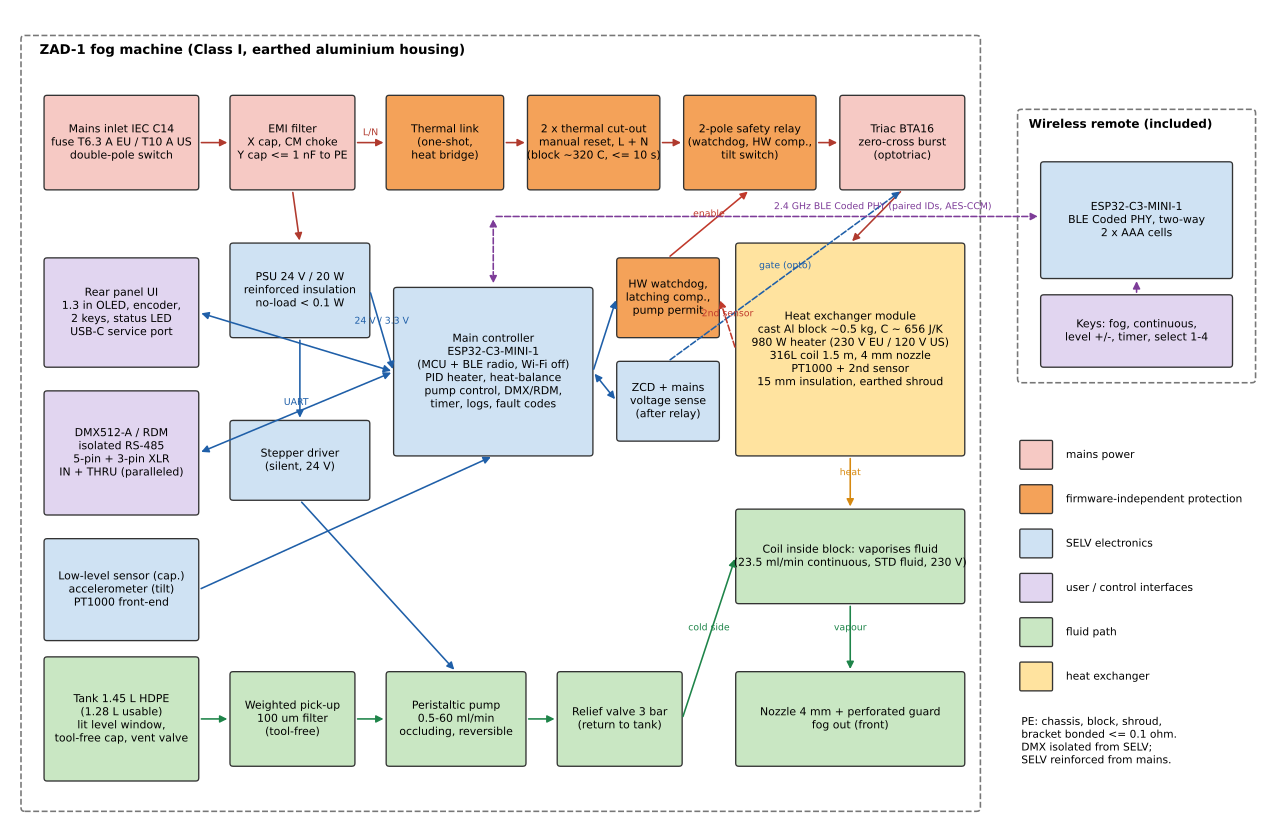
1. Product in one paragraph
ZAD-1 is a 1000 W, ≈ 2.7 kg, 300 × 170 × 185 mm fog machine for ANSI E1.5 water-glycol fluids. A 0.5 kg cast aluminium exchanger with a cast-in stainless coil and a 980 W heater reaches READY in ≈ 2.8 min. A silent stepper peristaltic pump meters 0.5-60 ml/min. The firmware matches pump flow to the heat the exchanger can deliver, so output never stops for reheating: at 100 % it derates smoothly to ≈ 23.5 ml/min continuous (standard fluid, 230 V). The unit can be controlled from DMX512-A with RDM (5-pin and 3-pin XLR in and thru, isolated), from the included two-way 2.4 GHz remote (up to 4 machines, status LEDs), or from its own OLED/encoder panel with a built-in timer. It needs no app, account or internet connection. It is a Class I appliance in an earthed, powder-coated aluminium housing. Overheat protection is electromechanical and does not depend on firmware. Two mains variants exist: EU 220-240 V and US 120 V.
2. Physical layout (concept envelope, ASSUMPTION until CAD)
 side view, x -> front (nozzle)                     top: wide-mouth fill cap at x~90, folding handle x 20-120
 z (mm)
 185 .   ___handle___
 165 +--------------------------------------------------------------+
     | PSU   main PCB      ||  .----- insulated exchanger -----.   |
     | UI board on the     ||  | Al block + coil + heater,     |===| nozzle 4 mm + perforated guard -> fog
 100 | rear panel: OLED,   ||  | 250-290 C, stainless shroud   |   |
     | encoder, XLR x4,    ||  '-------------------------------'   |
     | IEC inlet, USB-C    ||    peristaltic pump (soft mounts)    |
  60 | .---- tank 1.45 L, lit level window ----.  heat shield ||   |
  12 | '---------------------------------------'                   |
   0 +--feet---------------------------------------------feet-----+
     0                                   170                    300 mm
- Envelope including feet and folded handle: 300 × 170 × 185 mm = 9.4 L (ZAD-SIZ-01 target ≤ 12 L, ZAD-SIZ-02 target ≤ 320 mm). The bracket, cord and remote are excluded.
- Cold rear zone: tank, electronics, user interface, connectors, handle. Hot front zone: exchanger and nozzle. A stainless heat shield separates them. The handle and controls are ≥ 150 mm from the outlet (ZAD-SAF-03).
- Tank at the bottom rear, the lowest point of the fluid path, so gravity never feeds the coil (ZAD-PRF-07). Wide-mouth cap on top at the rear, far from the nozzle, for hot refill without tools (ZAD-UX-03). An RGB LED lights the translucent level window, which is visible from 3 m.
- Centre of mass (CALCULATION): empty (157, −1, 89) mm, full (133, 0, 74) mm. The minimum tip angle is 38° empty and 43° full (ZAD-SAF-04 target ≥ 20°).
- Hanging bracket: a U-yoke on the side walls with knob screws and tilt steps of 15°, a Ø 13 mm clamp hole and a safety-cable eyelet (ZAD-FUN-08).
3. Fluid path and anti-spit measures (ZAD-PRF-07, ZAD-FUN-06, ZAD-FUN-08, ZAD-SAF-05)
Tank (1.45 L, 1.28 L usable) → weighted flexible pick-up with 100 µm filter, reachable through the cap without tools → capacitive low-level sensor (stop with 100 ml left) → stepper peristaltic pump (3.2 mm tube, 0.41 ml/rev) → relief valve 3 bar (returns to the tank) → 316L coil cast into the block → 4 mm nozzle, thermally coupled to the block → perforated stainless guard.
| cause of spitting or dripping | measure in ZAD-1 |
|---|---|
| block too cold for the flow | pump interlocked below T_min; heat-balance controller derates flow before the block reaches T_min + 5 K (SIMULATION: lowest block temperature 234-235 °C vs T_min 230 °C at 230 V and 207 V, even with a 10 % error in fluid energy) |
| pulsating flow (vibratory pumps) | peristaltic flow with 3 rollers at 5-146 rpm; no slugs |
| siphon or gravity drain-down after stop | tank lower than the coil; peristaltic pump occludes the line when stopped |
| liquid left in the coil inlet boils out after stop | pump reverses 0.5 ml after every stop (suck-back) to pull the liquid front back to the cold inlet |
| condensate in the nozzle | nozzle bolted to the block (stays > 200 °C while READY); drip lip and condensate gutter inside the guard, also at ±30° tilt |
| air bubbles | low-level stop before air enters; observer detects air (no heat absorbed) and stops within about 5 s |
| tilt | weighted pick-up follows the fluid; accelerometer inhibits the pump beyond ±35°; coil orientation drains to the outlet in both tilt directions |
| transport and side-lying | sealed tank with inward-only vent valve and 50 mbar outward relief; occluding pump; tank/pump bay drains out of the bottom away from live parts |
Hydraulics (CALCULATION): back-pressure ≈ 0.13 bar at the continuous rate and ≈ 0.71 bar at 60 ml/min, below the ≈ 2 bar capability of the pump (ASSUMPTION, to be confirmed from pump data). Nozzle exit velocity ≈ 58 m/s continuous, so jet noise ≈ 27 dB(A) at 1 m.
4. Thermal design
| item | value | label |
|---|---|---|
| block | cast AlSi, 0.50 kg, Ø 62 × 85 mm | ASSUMPTION |
| coil | 316L, 1.5 m, 5 × 0.7 mm, 15 ml internal volume | ASSUMPTION / CALCULATION |
| heater | 980 W, Ø 8 mm sheath, 550 mm heated length, 7.1 W/cm² (9.0 W/cm² at 253 V and +5 %) | ASSUMPTION / CALCULATION |
| total heat capacity | 656 J/K | CALCULATION |
| insulation | 15 mm AES fibre blanket (k = 0.07 W/mK with seams) in a stainless shroud | ASSUMPTION |
| losses at setpoint (25 °C ambient) | QD 30.7 W, STD 33.7 W, DENSE 36.7 W; shroud ≈ 102 °C | CALCULATION |
| setpoint / T_min by fluid type | QD 250/215 °C, STD 270/230 °C, DENSE 290/245 °C; READY at setpoint − 5 K | ASSUMPTION |
| firmware hard limit / HW comparator / cut-out | 300 °C / ≈ 310 °C / ≈ 320 °C manual reset, plus thermal link | ASSUMPTION (see safety-concept-fmea.md) |
5. Control strategy (firmware, ZAD-PRF-03, -05, -06, ZAD-SAF-07)
States: OFF (mains switch, 0 W) → STANDBY (heater relay open, radio and DMX listening, ≈ 0.25 W) → HEATING (progress shown as %) → READY (T ≥ setpoint − 5 K) ⇄ FOGGING → DERATED (output below command because of the heat limit; shown on display, remote and RDM) → FAULT (relay open, pump stopped, code shown). Further states: CLEAN (guided purge) and AUTO-OFF (idle timer back to STANDBY; off / 15 / 30 / 60 / 120 min, default 60).
Heat-balance flow control (implemented in the lumped model run_100pct() of concept_estimates.py):
q_ff    = (P_heater_est(V_rms) - P_loss_est(T)) / e_fluid          feed-forward from measured mains voltage,
                                                                   EOL-calibrated heater resistance, loss map
q_allow = q_ff + Kp * (T - T_floor),   T_floor = T_min + 5 K        feedback on block temperature
q_pump  = clip(min(q_command, q_allow), 0, 60 ml/min);  q_pump = 0 if T < T_min (interlock)
heater  = 100 % while fogging below setpoint, PID otherwise
Results (SIMULATION, STD fluid): after a 100 % command from first READY, 19.7 ml is vaporised in the first 30 s. The output then settles at 23.6 ml/min (230 V) or 19.0 ml/min (207 V). The longest pause is 0 s in every case, including a 10 % error in the fluid energy (21.5 and 17.3 ml/min, with the block ≥ 234 °C). The firmware also runs a flow observer, q_obs = (P_heater·duty − P_loss − C·dT/dt) / e_fluid. It corrects tube slip and wear (ZAD-PRF-06), and detects air, pump failure or a blocked outlet as a difference between commanded and absorbed flow.
Other rules: no pumping unless READY (ZAD-SAF-07). On DMX loss (no valid frame for 1.0 s) output stops, unless the user selected hold (ZAD-SAF-07 target ≤ 2 s). Continuous mode started from the remote auto-stops after 10 min (adjustable). When the low-level sensor trips, the pump stops with 100 ml left, so no air enters. After refill, fogging resumes automatically with no priming (ZAD-FUN-06 target). The fluid-type setting (QD / STD / DENSE) selects the temperature window and e_fluid (ZAD-PRF-08).
6. Electrical architecture (ZAD-PWR-01, ZAD-SAF-06)
- Mains path: IEC C14 inlet with fuse and double-pole switch → EMI filter (X capacitor, common-mode choke, Y capacitors ≤ 1 nF to PE) → (a) heater path: thermal link → two manual-reset cut-outs (L and N) → 2-pole safety relay → zero-cross triac (insulated tab, on an internal aluminium spreader) → heater; (b) 24 V/20 W PSU module.
- Isolation: mains ↔ SELV is reinforced (PSU module, optotriac, relay coil-to-contact, creepage ≥ 8 mm at 250 V; ASSUMPTION to be checked against EN 60335-1 Table 17/18). SELV ↔ DMX has functional isolation (≥ 1.5 kV, digital isolator + isolated supply) against ground loops.
- Earthing: PE stud on the chassis; exchanger block, shroud, heat shield, all housing parts and the bracket are bonded ≤ 0.1 Ω (ZAD-SAF-06). Leakage budget 0.227 mA at 1.06 × 230 V (CALCULATION/ASSUMPTION: Y capacitor 0.077 mA + hot heater insulation 0.10 mA + PSU 0.05 mA).
- Currents (CALCULATION): EU 4.35 A rated, 5.0 A at 1.15 × input; US 8.33 A rated, 9.58 A at 1.15 × input (≤ 12 A, ZAD-PWR-02). Triac dissipation at full duty: 4.4 W (EU), 9.2 W (US).
| part | EU variant (220-240 V~ 50/60 Hz) | US variant (120 V~ 60 Hz) |
|---|---|---|
| heater | 980 W at 230 V, R_hot ≈ 54.0 Ω | 980 W at 120 V, R_hot ≈ 14.7 Ω |
| fuse in inlet | T6.3 A H 250 V, 5 × 20 mm | T10 A 250 V, 5 × 20 mm (UL 248-14) |
| cord | 3 m H05VV-F 3G1.0, Schuko (CEE 7/7) → C13 | 3 m SJT 3 × 16 AWG, NEMA 5-15P → C13 |
| labels and manual | CE, WEEE bin, EU languages | FCC, NRTL mark, EN/FR (Canada) |
| shared | pump, PSU (universal input), PCB, radio, housing, exchanger casting | same |
7. Interfaces
DMX512-A (ANSI E1.11): 5-pin and 3-pin male IN plus female THRU, paralleled, with no internal termination (the user terminates the line). Start address 1-512 is set on the OLED; there are no DIP switches. Personalities:
| personality | ch 1 | ch 2 | ch 3 |
|---|---|---|---|
| 1 ch | output 0-100 % (0-5 = off) | ||
| 2 ch | output 0-100 % | mode: 0-15 direct, 16-127 run unit timer at its level, 128-255 run unit timer at ch-1 level | |
| 3 ch | output 0-100 % | timer interval 1-600 s | timer duration 1-120 s |
RDM (ANSI E1.20): discovery, DEVICE_INFO, DMX_START_ADDRESS, DMX_PERSONALITY(_DESCRIPTION), IDENTIFY_DEVICE (display flashes, tank LED blinks), SENSOR_DEFINITION/SENSOR_VALUE (block temperature, fluid level state, mains voltage), STATUS_MESSAGES (heating, ready, derated, low fluid, fault codes), DEVICE_HOURS, SOFTWARE_VERSION_LABEL, plus manufacturer PIDs for fluid type, timer and auto-off.
Remote (2.4 GHz BLE Coded PHY, two-way): keys for momentary fog, continuous on/off, level +/−, timer start/stop, and machine select 1-4 / ALL (group). One bi-colour LED per machine shows green = READY, amber = heating, red = low fluid, red blinking = fault; a link LED shows the connection. Status is polled after every key press and for 10 s afterwards. The remote is factory-paired to its machine and can store 4 machines. Re-pairing: key combination on the remote and the PAIR menu on the unit within 30 s at ≤ 1 m. Frames use AES-CCM with a per-pair key and a 32-bit counter (replay protection), so neighbouring machines are never triggered (ZAD-FUN-03, -04). Link margin with BLE Coded PHY at 125 kbps (CALCULATION, datasheet sensitivity −104 dBm): 26.3 dB at 30 m, 21.8 dB at 50 m, 15.8 dB at 100 m. The antenna sits behind the polycarbonate display window, because the aluminium housing would block it (6 dB aperture loss assumed).
Unit UI (ZAD-FUN-07, ZAD-FUN-05): OLED shows warm-up %, READY, output %, DMX address and personality, timer (interval 1-600 s, duration 1-120 s, level 1-100 %), fluid type, auto-off, fault codes and hours. An encoder and 2 keys (FOG, MENU) operate it. Settings are stored in flash. USB-C service port (behind a cap): signed-firmware update, log and hours read-out (ZAD-SRV-03).
Diagnostics: fault codes E01 PT1000 open, E02 PT1000 short, E03 no temperature rise, E04 over-temperature (firmware), E05 hardware comparator/relay trip, E06 cut-out open, E07 pump/air (observer), E08 low fluid, E09 tilt, E10 mains out of range, E11 watchdog reset, E12 relay stuck, E13 blocked outlet suspected. Hours counters (power-on, heating, fogging, litres pumped) and a 32-entry fault log are kept in flash.
8. Mass budget (CALCULATION from ASSUMPTION part masses, estimates/concept_estimates.py §11)
| group | kg |
|---|---|
| exchanger + heater + coil + nozzle + insulation + shroud | 0.91 |
| housing sheet parts + heat shield | 0.88 |
| tank, cap, pick-up | 0.19 |
| peristaltic pump | 0.20 |
| main PCB + UI, PSU | 0.17 |
| inlet, switch, wiring, XLR × 4 | 0.20 |
| nozzle guard, feet, handle, fasteners | 0.12 |
| dry mass (ZAD-WGT-01) | 2.67 |
| with 1.28 L of fluid | 3.97 |
9. Changes adopted after the safety and regulatory reviews
The safety FMEA (safety-concept-fmea.md, 49 failure modes) found five single faults without an adequate measure
in the first baseline. The fixes below are adopted (cost line SAFE+ ≈ €2.5 per unit at 1,000, ASSUMPTION):
| # | gap in the first baseline | adopted change |
|---|---|---|
| P1 | firmware hung with the pump running: the watchdog drops the heater but the pump keeps feeding a cooling block, so liquid is ejected | hardware pump permit: the stepper-driver enable is gated by the watchdog and by the second-sensor window comparator, independent of firmware |
| P2/P3 | relay or triac failure not detected; comparator could re-arm | heater current and relay-output sensing; latching over-temperature comparator with power-up self-test |
| P4 | EN 60335-1 test 19.5 (element end shorted to sheath, reversed polarity) not covered by line-only switching | 2-pole safety relay and manual-reset cut-outs in both L and N (or a 2-pole capillary limiter); cut-out response ≤ 10 s required, because with all electronics disabled the block reaches ≈ 351 °C with a 10 s response but ≈ 382 °C with 30 s, against ≈ 370 °C auto-ignition of PG/TEG/glycerol (CALCULATION in the FMEA) |
| P5 | coil or joint leak inside the shroud soaks the hot fibre insulation (self-heating fire below auto-ignition) | no fluid joints inside the insulation (coil ends leave the block before the shroud), foil-encapsulated insulation, shroud drain to the outside bottom |
| P6 | blocked outlet: the relief valve returns hot fluid into the HDPE tank | relief return below the liquid level, tank NTC (pump stop at 50 °C) |
| P7 | tip-over while hot leaves the heater on | tilt switch in the relay chain plus accelerometer: heater off on tip-over |
| fluids | ANSI E1.5 allows diethylene glycol (AIT ≈ 229 °C) and dipropylene glycol (≈ 310 °C) | DEG- and DPG-based fluids excluded from the approved-fluid list (manual, label, warranty) |
| leakage | 0.25 mA target is tight | Y capacitance ≤ 1 nF line-to-PE (DRV-11), heater leakage specified to the supplier |
| US fuse | T10 A runs at ≈ 93 % at 132 V | fuse rating and holder to be re-checked against UL 248-14 derating in detailed design |
Regulatory decisions (from regulatory-route.md, manager disposition at its top):
- EU: RED 2014/53/EU only (LVD/EMC objectives via Art. 3(1)(a)/(b)), Module A, EN 60335-1 used alone plus a risk assessment, no protective electronic circuit and no software class B needed.
- US/Canada: FCC Part 15B SDoC; the machine uses the module grant FCC ID 2AC7Z-ESPC3MINI1. The handheld remote gets its own FCC ID change (the grant is mobile/fixed only). NRTL listing to UL 998 / CSA C22.2 No. 104 with the ANSI E1.29 fog-specific additions (fallback UL 499 / CSA C22.2 No. 64).
- DMX: 5-pin and 3-pin ports kept; E1.11 conformance claimed for the 5-pin ports and the interface, and the 3-pin ports declared as a deviation.
02-concept/benchmark-fluids-components.md
Benchmark, fog fluids and key purchasable components (concept-phase research note)
Run: r20261030-0409-v000-zadymiarka-concept-2 · Author role: research engineer · Date of all web reads and price reads: 2026-10-30 (unless a cell says otherwise) · Offline parts DB: lcsc info build 4325c9c05dd3280c, newest row 2026-10-29T11:52Z, age 0.65 d.
How to read this note
- Every number carries a label: SOURCE (document or page read; id
[S#]points to the Sources list at the end, which holds the full URL;lcsc Cxxxx= offline LCSC/JLCPCB price DB, data age given), CALCULATION (shown, re-runnable) or ASSUMPTION (stated reason).n/a= not found; nothing was guessed. - Prices are quoted in the currency of the page (USD, EUR, GBP, PLN ...). No FX conversion was done; the cost model must apply its own FX rate. LCSC/JLCPCB prices are USD list prices of the JLCPCB part catalogue; LCSC's own web ladder (read via
wmsc.lcsc.comJSON for three parts) differs by < 1 %. - "Search snippet" = the figure was seen in a web-search result summary and the page was not opened by me; it is marked as such and should be re-checked before it goes into a BOM.
- Hard rule kept: public web only, read-only; no company was contacted, no quote was requested, no account created.
0. Key findings in 12 points
- Competitors' headline "fluid consumption" (30-150 ml/min) is a peak rate. Antari's own manual says continuous output without reheat pauses is only possible up to ~30 % volume on its 1.25-2.5 kW Z-1200/1500/3000 II machines; Look gives 35 ml/min continuous vs 120 ml/min max on the Viper NT (1300 W) [S7, S15].
- Continuous rate per watt of the pro machines is 37-45 W per (ml/min) (Look Viper NT 37, Antari Z-1500 II 45, Z-3000 II 42; CALCULATION in 1.5). Our target (1000 W / 22 ml/min = 45.5 W per ml/min) is in the same band, but the energy balance (2.2-2.4 kJ/ml, CALCULATION in 2.2) says 22 ml/min needs about 830-880 W net, i.e. roughly 84-88 % of a 1000 W input must reach the fluid. There is almost no loss budget.
- Only three machines in the set warm up in <= 3.5 min (Antari Z-800 745-800 W 2 min; BeamZ S700 700 W 3-3.5 min; Eurolite NSF-250 1000-1080 W 3 min). Heater energy during warm-up is 89-194 kJ for those vs 357-756 kJ for the 5-9 min machines (CALCULATION in 1.5), i.e. an exchanger of about 0.4-0.9 kg aluminium-equivalent vs 1.7-3.7 kg.
- 1000 W-class DMX machines weigh 6.3-8.9 kg and cost USD 233-380 (street); our <= 3 kg / EUR 229 incl. VAT is a clear step below every DMX machine found.
- Budget wireless remotes are weak (Eurolite NSF-250: 433.92 MHz, up to 5 m line of sight); no source read states two-way status or pairing IDs on a competitor remote.
- Fluids: SDS data show three families - propylene glycol (+ glycerol) / water (Antari FLC 33 % PG, 65 % water; Antari FLG group 38-41 % PG, 6-8 % glycerol, 52-57 % water), PG + triethylene glycol (Martin/JEM, Le Maitre Global Deluxe, Rosco, Look) and diethylene glycol (Chauvet EU FFDJ5, <= 40 %). Energy per ml varies 1.7-2.4 kJ/ml across them (CALCULATION), density 1.01-1.12 g/ml. Older Antari SDS revisions name ethylene glycol - check SDS revision before approving a fluid.
- No manufacturer publishes a per-fluid heat-exchanger temperature window. The only published figure is Antari's "average operating temperature 250 C" (Z-1000 III manual). A set-point window of 220-280 C with 250 C default is an ASSUMPTION (2.3).
- Kamoer stepper peristaltic pumps (KPHM100-ST, KAS-ST, KFS, KCS) cover 5-65/88/135 ml/min with BPT tube life >= 1000 h and motor life 6000 h, but no maximum outlet pressure is published (all flow data are "without pressure"); 1-2 bar suitability is unverified and needs a bench test.
- Vibratory pumps (ULKA EX5/EP5, 650 cc/min free flow, 15 bar, 48 W at 230 V / 41 W at 120 V, duty 2/1 or 1/1 min on/off) cost EUR 25-35 but need separate 230 V and 120 V versions and line-frequency-dependent metering.
- Electronics: all core ICs are in the LCSC/JLCPCB DB with stock (IRM-30-24 USD 8.16 flat vs USD 11.40-12.90 at DigiKey; ESP32-C3-MINI-1-N4 USD 2.04 at 1000; TMC2209-LA-T USD 1.64 at 1000). Dual 3-pin + 5-pin Neutrik XLR in/thru alone is USD 9.78 at 1000 (CALCULATION), about 15 % of the EUR 60 unit-cost target (ASSUMPTION: about 1.1 USD per EUR). The listed electronics, XLR and a generic inlet sum to USD 32.91 at 1000 pcs (cost hot-spot note under the price table in 3.8).
- Safety parts: a manual-reset cut-out at 300-330 C exists only as capillary limiters (E.G.O. 55.13452.010 AUD 91.94 qty 1; JUMO AED 1,764), bimetal manual-reset parts stop at 250 C; competitors use 190-215 C thermoswitches (Eurolite). Tf 240 C thermal links cost USD 0.53-0.87 (Cantherm SDF DF240S) but open at 240 C. Probes: sheathed PT1000 for >= 400 C costs EUR 38.50-77 at qty 1. No OEM price for a finished cast heat exchanger was found (spare blocks EUR 35-240; OEM die-cast block with stainless pipe USD 5-15 at MOQ 500).
- Mains side: a Hongfa HF115F-I relay (16 A, 5 kV coil-contact, "reinforce insulation") is the right relay, not the plain HF115F listed in the DB; Finder 40.61 and Omron G2RL-1A-E also state reinforced insulation (8 mm). Schurter DD11 inlet with double-pole switch needs a separate fuse drawer (USD 15-22 total) vs USD 3.2-4.0 for a generic module with lower dielectric rating.
1. Competitor benchmark
1.1 Selection
Ten machines, budget to pro, chosen because a manufacturer document or a live retailer page could be read today. Not tabulated because no primary or live source could be read: Martin/JEM ZR33 (discontinued; martin.com redirects to the JEM support page [S60]; only retailer figures: 1500 W, 7-8 min, 9.5 L, 19 kg, 1000 m3/min), Le Maitre, Rosco (V-Hazer is a haze machine: 900 W, 7-10 min initial heat-up, 0.9 L/h max [S38]), Showtec, Chauvet "Geyser", Cameo "Instant Fog 1200 Pro" (no such product found; the Cameo range found is Instant Fog 1700 Pro / 1700 T Pro and Phantom F5/H2), Antari "F-1".
1.2 Table 1A - electrical and performance as stated by the vendor
All cells SOURCE as cited in the last column unless tagged. "Volume figures" (cfm, m3/min) have no common test method; they are given only for completeness.
| ID | Machine (tier) | Heater / rated input (W) | Warm-up (min) | Stated fluid use at max output (ml/min) | Continuous / burst statement | Volume figure (no common method) | Source |
|---|---|---|---|---|---|---|---|
| M1 | BeamZ S700 / S700LED (budget, no DMX) | 700 W heater; rated input n/a | 3.5 (S700LED page; retailer snippets say 3 for plain S700) | n/a | re-heat 1 min | 75 m3/min | [S18] |
| M2 | Antari Z-800 MK3 (compact, no DMX) | 745 W heating element, 750 W consumption (MK3); Z-800 II: 800 W rated | ~2 (MK3 and Z-800 II manual) | 13 | Z-800 II: 60 min operating time at max output on 0.8 L | n/a (page value is a placeholder) | [S9], [S5] |
| M3 | Antari Z-1000 II (1 kW DMX, older; discontinued) | 1000 W at 120 V, 1050 W at 240 V (rated power) | ~6 | 56 | manual: re-heating cycles "approx. 1-2 minutes"; "recycling period after long bursts when no fog can be produced" | n/a (retailers 10,000-12,000 cfm; not primary) | [S5] |
| M4 | Antari Z-1000X MK3 (1 kW DMX + RDM, current) | 1000 W (bullet) vs 900 W (spec table) on the same page; heater W n/a | ~6 | ~60 | n/a; Z-1000 III manual: "can maintain maximum output for 30 seconds or more", "average operating temperature = 250 C" | page value 0 m3 is a placeholder = n/a | [S8], [S6] |
| M5 | ADJ Fog Fury Jett (vertical, DMX) | 700 W heater, 730 W consumption (ADJ manual); Thomann: 650 W / 680 W | 9 | 120 | duty cycle "not to exceed 6 hours continuously powered on" | 20,000 cfm (manual); Thomann 566 m3/min | [S10], [S11] |
| M6 | Eurolite NSF-250 LED DMX hybrid spray fogger | 1080 W consumption; heating element 1000 W (spare-part listing) | ~3 | ~70 | n/a | ~800 m3/min | [S12], [S13] |
| M7 | Chauvet DJ Hurricane 1301 (discontinued 2020) | 1,202 W (10 A at 120 V) | 5.5 in spec list; "5 min" in text | 125 (page: "Fluid consumption") | n/a | 20,000 cfm | [S1] (page text via fetch tool) |
| M8 | Chauvet DJ Hurricane 1800 Flex | 1,190 W both voltages (10 A at 120 V, 5 A at 230 V; fuse T 13 A) | 5 (manual Rev. 3) | 30 (manual Rev. 3) | n/a | 25,000 cfm | [S3], [S2] |
| M9 | Cameo Instant Fog 1700 T Pro (touring) | 1700 W heater, 1800 W consumption | ~7 | 150 | "approx. 40 seconds at 100 % output, non-stop at 50 % output; reheating time 60 seconds" | page value 0 m3 is a placeholder = n/a | [S14] |
| M10 | Look Solutions Viper NT (pro) | 1300 W (230 V or 120 V) | ~7 | 120 max / 35 continuous | fog time at 100 % ~30 s; "< 50 % output: continuous output" | n/a (projection max 15 m) | [S15], [S16] |
Additional Antari data used in 1.4 (SOURCE [S7], manual for Z-1200 II / Z-1500 II / Z-3000 II): Z-1500 II 1500 W, warm-up ~10 min, 110 ml/min, 6 L; Z-3000 II 2500 W, ~12 min, 200 ml/min, 6 L. Same manual: "When setting a fog output volume higher than 30 % for continuous operation, the fog machine occasionally needs to stop the fog output to reheat. When NON STOP BURST is selected, the fog machine adjusts the fog output volume and heater temperature automatically and does not need to stop the fog output to reheat."
1.3 Table 1B - physical, controls, street price
| ID | Tank (L) | Weight (kg) | Dimensions L x W x H (mm) | Remote (type; direction) | DMX / RDM | Street price (read 2026-10-30) | Source |
|---|---|---|---|---|---|---|---|
| M1 | 0.4 | 2.4 | 260 x 145 x 130 | page contradicts itself: "remote control with 3 m cable" vs "remote control (wireless)"; one-way | no DMX mentioned | EUR 56 (bol.com listing with 400 ml fluid and fritz-events.nl, plain S700, remote on 5 m cable); EUR 65.95 teufelaudio.nl dated 2026-06-20 - search snippets, pages not opened | [S18], [S19] |
| M2 | 0.8 (fixed) | 4.20 (MK3); 3.5 (Z-800 II) | 315 x 128 x 218 | wired on/off cable remote included; no timer, no radio remote | no DMX | USD 196 (Thomann US, 230 V product) | [S9], [S5] |
| M3 | 1.7 | 6.6 | 433 x 198 x 214 | Z-10 wired remote (10 m, toggle for continuous on) and mounting brackets in the box; optional Z-40 wired timer remote (10 m; interval 10-250 s, duration 10-120 s) and Z-50 wireless remote "up to 50 m"; direction n/a | 1 channel, XLR 3-pin; RDM n/a | n/a (not at Thomann; successors Z-1000 III / X MK3) | [S5] |
| M4 | 1.7 (removable) | 7.75 | 433 x 198 x 214 (page says "43.3 x 19.8 x 21.4 mm", read as cm) | optional radio remote; on/off cable remote listed; direction n/a | DMX in/out XLR 3-pin; "controllable via DMX, RDM and standalone"; channel count n/a | USD 322 (Thomann US, 230 V product) | [S8] |
| M5 | 3 (external canister) | 7.1 | 397 x 302 x 191 | wireless remote FFJWR included (RF); direction n/a | 3-pin XLR in/out; 1, 2, 3, 5 or 7 channels; RDM n/a | USD 233 (Thomann US, 230 V product); GBP 209 (Thomann UK widget, incl. VAT) | [S10], [S11], [S14] |
| M6 | 2.5 (removable) | 6.4 | 370 x 320 x 200 | wireless remote included, 433.920 MHz FM, "up to 5 m with line-of-sight", 12 V LR27 battery; one-way (no status described) | 8 channels; RDM n/a | USD 242 (Thomann US, 230 V product); EUR 319.00 excl. 19 % VAT list price of the set with 5 L fluid (Steinigke) | [S12], [S13] |
| M7 | 3.3 | 6.3 | 420 x 314 x 302 | wired timer remote FC-T (4.6 m) included; FC-W wireless optional | DMX n/a (not on page) | n/a (discontinued) | [S1] |
| M8 | 3.8 | 8.9 (manual); 8.7 (retailer) | 518 x 302 x 274 | wired timer remote FC-T (15 ft, 4.5 m) included; FC-W wireless optional; direction n/a | 1 channel, 3-pin XLR; RDM n/a | USD 379.99 (iDJNow); USD 399.99 at Sweetwater / Full Compass / SoundPro per search snippet (MAP) | [S3], [S4] |
| M9 | 5 (canister insert) | 25 | 550 x 265 x 465 (W x H x D) | none included (timer, cable and radio remote all "No") | 3- and 5-pin XLR in/out; RDM n/a | GBP 532 incl. VAT (Thomann UK, "in stock within 7-9 weeks"); EUR 629.90 (thomann.de) and USD 593 (Thomann US) per search snippet | [S14] |
| M10 | 5 | 8.6 without canister (sheet); 17 incl. tank (manual) | 470 x 230 x 240 | XLR analog remote (option); radio remote (option); direction n/a | 5-pin XLR DMX, 0-10 V analog; RDM n/a | USD 1,750.00 (Look Solutions USA price list); USD 1,685.99 at Full Compass per search snippet | [S15], [S16], [S17] |
1.4 Source discrepancies found (do not mix these figures silently)
- Hurricane 1800 Flex: manual Rev. 3 [S3] says 5 min, 30 ml/min, 1,190 W, 8.9 kg; retailer page [S4] says 3 min, 80 ml/min, 1,560 W (12.9 A at 120 V), 8.7 kg. Likely a newer revision; the manual figures are used above.
- Antari Z-1000X MK3: 1000 W (bullet) vs 900 W (table) on one Thomann page [S8].
- ADJ Fog Fury Jett: 700/730 W (ADJ manual [S10]) vs 650/680 W (Thomann [S11]).
- Hurricane 1301: warm-up 5.5 min (spec list) vs "5 min" (text) on the same page [S1].
- Look Viper NT: weight 8.6 kg without canister (sheet [S15]) vs 17 kg incl. tank (manual [S16]); fog time at 100 % "approx. 30 s" (sheet) vs "approx. 40 s" in an older US manual (search snippet).
- BeamZ S700LED page: wired vs wireless remote, see M1 [S18].
1.5 Observations relevant to our targets
- Stated ml/min is a peak, not a continuous rate. Antari: continuous without reheat only up to 30 % volume on the Z-1200/1500/3000 II; the "NON STOP BURST" mode derates volume and heater temperature automatically [S7]. Look Viper NT: 120 ml/min max, 35 ml/min continuous (29 %) [S15]. Cameo: 40 s at 100 %, then 60 s reheat, non-stop at 50 % [S14]. Antari DMX machines "can maintain maximum output for 30 seconds or more" [S6]. This is exactly the behaviour ZAD-PRF-03/-04 target; derating (not pausing) is only offered in Antari's higher-end firmware.
- Watts per continuous ml/min (CALCULATION from the sources above): Look Viper NT 1300 W / 35 = 37.1; Antari Z-1500 II 1500 W / (0.30 x 110 = 33) = 45.5; Antari Z-3000 II 2500 W / (0.30 x 200 = 60) = 41.7 (assumes the 30 % volume threshold equals the continuous rate: ASSUMPTION); ours 1000 W / 22 = 45.5. Peak figures: 6.1 (ADJ Jett 730 W / 120), 9.6 (Hurricane 1301), 10.8 (Viper NT max), 12 (Cameo), 15.4 (Eurolite NSF-250), 16.7-17.9 (Antari Z-1000 X MK3 / II), 39.7 (Hurricane 1800 Flex manual: 1190 / 30), 57 (Antari Z-800 MK3: 745 / 13). The spread of 6 to 57 W per ml/min shows that the vendors do not use one method.
- Compact class. Only the Antari Z-800 (3.5-4.2 kg, 745-800 W, 0.8 L, 13 ml/min, ~2 min, no DMX, USD 196) and BeamZ S700 (2.4 kg, 700 W, 3-3.5 min, EUR 56, no DMX) are below 4.5 kg. Our <= 3 kg target with 22 ml/min and DMX is +70 % stated output of the Antari Z-800 at lower weight.
- Warm-up vs heater power (CALCULATION: stated W x stated warm-up, no losses, exchanger to 250 C, cp_Al = 0.90 kJ/kgK): Z-800 89 kJ -> 0.43 kg Al-equivalent; BeamZ S700 126 kJ (3 min) to 147 kJ (3.5 min) -> 0.61-0.71 kg; Eurolite NSF-250 194 kJ -> 0.94 kg; Antari Z-1000 360 kJ -> 1.74 kg; Hurricane 1800 Flex 357 kJ -> 1.72 kg; ADJ Jett 394 kJ -> 1.90 kg; Hurricane 1301 397 kJ -> 1.92 kg; Viper NT 546 kJ -> 2.64 kg; Cameo 756 kJ -> 3.65 kg. Target <= 3 min at 1000 W = 180 kJ -> <= 0.87 kg Al-equivalent. Only the Eurolite NSF-250 (3 min, 1000-1080 W) is in that range among the 1 kW machines.
- Peak from stored heat (CALCULATION, ASSUMPTION fluid 2.3 kJ/ml from 2.2): 25 ml in 30 s = 57 kJ; the heater adds 30 kJ at 1000 W; the remaining ~27 kJ must come from stored heat, i.e. about 38 K of droop on 0.8 kg of aluminium (27 kJ / (0.9 x 0.8)). That bounds ZAD-PRF-04 against the warm-up mass in item 4.
- Weight and price positioning. 1000 W-class DMX machines weigh 6.3-8.9 kg (Eurolite 6.4, Antari 6.6-7.75, Hurricane 6.3-8.9) and cost USD 233-380; pro machines 8.6-25 kg and GBP 532 / USD 1,750. Antari's compact no-DMX Z-800 MK3 is USD 196; our EUR 229 incl. VAT with DMX and wireless remote sits below every DMX machine in the set (cheapest DMX: ADJ Jett USD 233, 700 W, 9 min).
- Remote and DMX. Included wireless remotes are one-way RF with short range on budget machines (Eurolite 5 m); Antari's optional Z-50 claims 50 m; Chauvet ships a 4.5 m wired timer remote. No source read describes two-way status or per-machine pairing on a competitor remote. DMX is mostly 1 channel with 3-pin XLR (Antari: 0-128 off, 129-255 maximum output; Chauvet 1 ch); more channels only at ADJ (1-7) and Eurolite (8); RDM only on the Antari Z-1000X MK3 (Thomann text).
- Vendors admit spitting and give a short cleaning interval. Antari manual: "All fog machines may sputter small amounts of fog occasionally during operation and for a minute or so after being turned off"; cleaning "after every 40 hours of continuous operation" with 80 % distilled water / 20 % acetic acid [S5]. Our targets (zero droplets, 100 h cleaning interval) are differentiators, not table stakes.
2. Fog fluids
2.1 Composition from safety data sheets (SDS)
Types: Q = quick / extra-quick dissipating, S = standard, L = long-hang / dense / heavy. "Mass fraction" is as printed; a range or "<" is quoted as printed.
| Brand and product (type) | Document, date | Glycols named | Mass fractions | Water | Density / SG | Flash / ignition / boiling | Source |
|---|---|---|---|---|---|---|---|
| Antari FLC fog liquid (Q, "super light") | SDS v1, 28-Mar-2017 (EU format) | propylene glycol 57-55-6; glycerol 56-81-5 | PG 33 %, glycerol 2 % | 65 % | n/a | flash point given for pure components only: PG 99 C closed cup, glycerol 160 C closed cup; auto-ignition "not determined" | [S22] |
| Antari FLC, older revision | SDS rev 1.0, 26-Aug-2013 | "Ethykene Glycol" 107-21-1 (ethylene glycol), glycerin | 33.0 % + 2.0 % | 65.0 % | n/a | flash n/a | [S23] |
| Antari FLG-XXXX, FLP, FLY, FLW, FLM, SFL (FLG = heavy, L; one SDS for the whole group) | SDS "updated 1st September, 2026" | propylene glycol 57-55-6; glycerol 56-81-5 | PG 38-41 %, glycerol 6-8 % | 52-57 % | n/a | flash point 95 C open cup; auto-ignition n/a; pH 5.5-6.5 | [S21] |
| Antari FLG-5, older revision | SDS rev 1.0, undated | "Ethykene Glycol" 107-21-1, glycerin | 40 % + 15 % | 45 % | n/a | flash n/a | [S24] |
| Chauvet DJ FFDJ5 "Fog Fluid DJ Chauvet" (EU, S) | SDS v1, 13-Mar-2025, made by Premium Factory SAS | diethylene glycol 111-46-6 (Acute Tox. 4 oral, H302); other components not listed | <= 40 % | not stated | "no data available" | flash and auto-ignition "no data available" | [S25] |
| Chauvet DJ FJU (US, S) | SDS Aug 2014 | "polyfunctional alcohol"; composition withheld as intellectual property | n/a | "main component" | SG 1.04 | flash n/a | [S26] |
| Look Solutions Quick-Fog (Q), Regular-Fog (S), Slow-Fog (L), Tiny Fluid, Cryo Fog, Unique fluid | SDS 1-Jan-2021 (one SDS for all) | "contains one or more of": triethylene glycol 112-27-6, monopropylene glycol 57-55-6, dipropylene glycol 110-98-5 | no fractions | demineralised water | > 1.0 g/cm3 | boiling > 100 C; "not flammable"; storage < 60 C; pH 6-8 | [S27] |
| Look Solutions, 2012 revision | MSDS 4-Jan-2012 | adds butylene glycol 584-03-2 | no fractions | - | - | flash > 177 C; ignition temperature > 370 C | [S28] |
| Martin / JEM Pro-Fog Fluid Extra Quick Dissipating (Q), Quick Dissipating (Q), Pro-Fog (S), High Density (L), Low-Fog types; discontinued Pro Smoke Super (ZR) | SDS 111N, 7-Feb-2025 (one SDS for all types) | monopropylene glycol 57-55-6; triethylene glycol 112-27-6 | "other ingredients 5 % - 40 %" (both glycols together, one range for all types) | "largest single component" (demineralised) | relative density 1.050 at 20 C | boiling 101.6-201.6 C; flash > 103 C; auto-ignition "no data" | [S29] |
| Le Maitre Quick / Extra Quick (Q) | SDS 23-Apr-2012 | "high purity polyglycol", EINECS 200-338-0 (= propylene glycol) | no fractions | demineralised water | ~1.02 g/cm3 | boiling range 187-285 C; flash "no data" | [S32] |
| Le Maitre Standard (S) | SDS 23-Apr-2012 | "high purity polyglycol", EINECS 246-770-3 (identified as dipropylene glycol from the EC number: ASSUMPTION) | no fractions | demineralised water | ~1.01 g/cm3 | boiling range 187-285 C; flash "no data" | [S31] |
| Le Maitre Low Smoke Fluid | SDS 28-Jan-2025 | EINECS 200-338-0 (propylene glycol) | no fractions | demineralised water | ~1.02 g/cm3 | boiling range 187-285 C | [S33] |
| Le Maitre Global Deluxe (L, dense) | SDS 28-Jan-2025 | MPG 57-55-6; triethylene glycol 112-27-6 | MPG < 70 %, TEG < 15 % | < 40 % | n/a | flash n/a | [S30] |
| Rosco Fog Fluid (S) | SDS dated 06/30/22 (v1) | triethylene glycol 112-27-6; 1,3-butylene glycol 107-88-0; propylene glycol 57-55-6 | "N/Av" | deionized water | SG 1.055-1.075; pH 4.0-8.0 | boiling > 100 C; flash n/a | [S34] |
| Rosco Fog Fluid, 2001 MSDS | MSDS 1-Jun-2001 | same three glycols | n/a; "volatiles 65.6 % by volume" | deionized water | SG ~1.12; vapour pressure ~8.4 mmHg | boiling 212-470 F (100-243 C); "no flash point by Cleveland Open Cup or Pensky-Martin Closed Cup"; auto-ignition "not determined" | [S35] |
Reading the table (CALCULATION/observation):
- Glycol families in use: propylene glycol (+ glycerol), PG + triethylene glycol (+ butylene glycol at Rosco), dipropylene glycol (Le Maitre Standard, Look), diethylene glycol (Chauvet EU). The wetted-material list of the machine must therefore tolerate PG, DPG, DEG, TEG, glycerol, 1,3-butylene glycol, pH 4-8 and water at up to ~65 mass %.
- Mass fractions by fluid type are published only by Antari (FLC 33/2/65; FLG group 38-41/6-8/52-57) and Le Maitre (Global Deluxe only). Martin, Look and Rosco give no per-type split. Long-hang/dense fluids are the ones with the lower water content (Le Maitre Global Deluxe < 40 % water vs 52-65 % at Antari).
- Flash points are 95-103 C (Antari FLG group, Martin) up to > 177 C (Look 2012); auto-ignition is given only by Look 2012 (> 370 C). A heat exchanger at 250 C is above every published flash point, which is normal for flash-vaporising machines; the reservoir and pump side stay near ambient.
- Fluid safety classification: Chauvet FFDJ5 SDS gives DEG with Acute Tox. 4 (H302) in the component table, while the mixture is "not classified". ANSI E1.5 lists DEG as an allowed component (2.4).
2.2 Energy per ml of fluid (CALCULATION, supports ZAD-PRF-02/-04)
Method: heat 1 ml from 20 C liquid to vapour at 1 atm and exit temperature T_exit; water from CoolProp (IAPWS, ddpy); glycol values are ASSUMPTIONS from handbook data (PG: cp 2.5 kJ/kgK, vapourisation 830 kJ/kg at 188 C, vapour cp 1.9 kJ/kgK; DPG: bp 232 C, 520 kJ/kg; TEG: bp 285 C, 470 kJ/kg; glycerol: bp 290 C, 880 kJ/kg; mixture density from the SDS column above). Glycols with boiling point above T_exit are counted as heated only (lower bound). Script run 2026-10-30 with /opt/dd/venv/bin/python -I.
| Fluid class (composition used) | kJ/kg at 250 C | kJ/ml at 250 C | Power for 22 ml/min at 250 C | Power for 15 ml/min | kJ/ml at 190 C | Power for 22 ml/min at 190 C |
|---|---|---|---|---|---|---|
| Antari FLC type (65 W / 33 PG / 2 GLY, 1.02 g/ml) | 2342 | 2.39 | 876 W | 597 W | 2.27 | 832 W |
| Antari FLG type (54.5 W / 39.5 PG / 6 GLY, 1.05 g/ml) | 2150 | 2.26 | 828 W | 564 W | 2.13 | 782 W |
| Le Maitre Global Deluxe-like (30 W / 60 PG / 10 TEG, 1.05 g/ml) | 1743 | 1.83 | 671 W | 458 W | 1.71 | 625 W |
| Chauvet FFDJ5-like (60 W / 40 DPG as proxy for DEG, 1.04 g/ml; ASSUMPTION) | 2159 | 2.25 | 823 W | 561 W | 1.90 | 696 W |
Consequences: 22 ml/min of a PG/glycerol fluid needs 780-880 W of net heat into the fluid; the dense TEG-type fluid needs ~625-670 W. With a 1000 W rated input including pump and electronics (ZAD-PWR-02) the required net transfer efficiency for the standard fluid is about 84-88 %. The energy per ml is dominated by the latent heat of the water share, so a fluid with less water lowers the heater demand but also yields less visible fog per ml.
2.3 Published heat-exchanger temperature or temperature window
| Source | What it says | Value | Label |
|---|---|---|---|
| Antari Z-1000 III manual, section 10.2 [S6] | "Antari fog machines with onboard DMX conform to the following performance specifications: 1. Average operating temperature = 250 C; 2. Fogger can maintain maximum output for 30 seconds or more" | 250 C average; 30 s | SOURCE |
| Antari Z-series II manual [S5] | Nozzle: "output nozzle becomes very hot during operation (200 C)" (Z-1000 II manual); a low-fog manual states 300 C at the nozzle (search snippet, not opened) | 200 C nozzle | SOURCE |
| Look Viper NT manual [S16] | "microprocessor controlled" temperature, "heater block with thermostat", "pump with temperature switch"; professional fog generators must be used "at the correct vaporization temperatures as well as with the correctly mixed fog fluid"; no value, no user setting | n/a | SOURCE |
| Smoke Factory Spock manual [S37] | firmware ("new programming") controls the temperature so that "the heat exchanger has always the perfect temperature for the fluid to vaporize"; fluids Fast-Fog Extra III (extremely fast dissolving), Fast-Fog, Super-Fog (long lasting standard), Heavy-Fog; no degrees given | n/a | SOURCE |
| Rosco V-Hazer manual [S38] | "operating temperature, pump pressure and output nozzle ... are tuned to the Rosco V-Hazer Fluid"; initial heating cycle 7-10 min | n/a | SOURCE |
| Smoke Factory Tour Hazer II / II-E, Froggys Fog Titan 1200, Antari Z-3000 II | no user-settable temperature and no per-fluid window in the manuals searched (the Z-3000 II adjusts "fog output volume and heater temperature automatically" in NON STOP BURST) | n/a | SOURCE [S7] |
| Fluid boiling data from SDS | Le Maitre 187-285 C (PG/DPG types); Martin 101.6-201.6 C; Rosco 100-243 C (2001) | see 2.1 | SOURCE |
Result: no manufacturer publishes a heat-exchanger temperature per fluid type in the manuals read (Antari, Look Viper NT, Smoke Factory, Rosco, Froggys Fog). The Martin/JEM and MDG machine manuals were not read. A search for decomposition-temperature literature was not completed (the web-search tool returned an error for that query).
Design window used in the concept (ASSUMPTION, reason: Antari's published 250 C average, PG boiling point 188 C, TEG 285 C, E1.5 clause 3.3 on thermal-degradation products): set-point adjustable 220-280 C by fluid type with a 250 C default (PG/glycerol fluids 230-250 C; DPG/TEG-rich dense fluids 260-280 C), hard limit by the manual-reset cut-out at ~300-330 C (3.4). This must be verified in the prototype by checking fog quality and by an aldehyde screening or supplier statement; it is not a measured value.
2.4 ANSI E1.5 - scope summary (SOURCE [S36], read in full)
- Title and edition: ANSI E1.5-2009 (R2014), "Entertainment Technology - Theatrical Fog Made With Aqueous Solutions Of Di- And Trihydric Alcohols" (ESTA, reaffirmed by ANSI 9 June 2014; first edition approved 12 May 2003; later reaffirmations 2018 per a copy on looksolutionsusa.com, not read in full).
- Scope: the composition of the fog (not of the machine): theatrical fogs and mists unlikely to harm healthy performers, technicians or audience aged 18-64; limited to fogs made from water plus one or more dihydric or trihydric alcohols ("glycol fogs"). No limits are implied for other populations. Intended for theatres, arenas and places of assembly; may serve as guidance elsewhere with a similar population.
- Allowed components (3.1): triethylene glycol 112-27-6; monopropylene glycol 57-55-6; diethylene glycol 111-46-6; dipropylene glycol (25265-71-8, 106-62-7, 110-98-5, 108-61-2); 1,2-butylene glycol 584-03-2; 1,3-butylene glycol 107-88-0; glycerin 56-81-5. Fogs made with other chemicals (colouring agents, scents, bactericides) are "not necessarily considered a health risk" but "do not meet the requirements of this standard".
- Concentrations in the air breathed (3.2): total alcohols <= 10 mg/m3 TWA (8 h); never above 40 mg/m3 peak; glycerin-only fog never above 50 mg/m3.
- Decomposition products (3.3): formaldehyde, acrolein, acetaldehyde and other thermal degradation products must stay below the lowest permissible level of the governing occupational-health authority (OSHA, HSE). Contaminants such as acetone and ethylene glycol (3.4) likewise.
- Not covered: fluid mass fractions, machine temperature, fluid dissipation behaviour, output measurement. Compliance is a manufacturer claim; ESTA states it does not certify. For our design E1.5 constrains which fluids may be approved (3.1 list; no ethylene glycol, no unlisted additives) and requires that the heat exchanger does not raise thermal-degradation products, which supports the temperature limit in 2.3.
3. Key purchasable components - specifications and prices
Price cell notation: a / b / c = unit price at qty 1 / 100 / 1000. "n/a" = not available. All LCSC rows: lcsc Cxxxx, JLCPCB list price in USD, DB row data 2026-10-29 (0.7 d old); stock as of that read. Product URL pattern https://www.lcsc.com/product-detail/Cxxxx.html (page returned HTTP 200 for C6280124).
3.1 Peristaltic stepper metering pumps (candidates for 1-60 ml/min)
| Model (motor) | Tube (ID x OD, material) | Flow stated | Max outlet pressure | Tube life stated | Motor life | Noise stated | Weight | Price qty 1 (read 2026-10-30) | Source |
|---|---|---|---|---|---|---|---|---|---|
| Kamoer KPHM100-ST (24 V stepper, 28-size, 1 A, max 250 rpm) | 3 x 5 mm PharMed BPT | stepper version max 65 ml/min (datasheet); Amazon listing says 0-180 ml/min (inconsistent; DC versions to 100 ml/min) | n/a (flow "measured with pure water without pressure at 20 C") | >= 1000 h at 420 rpm, pure water, no pressure, "until the pump tube cracks" | 6000 h (listing) | "low noise", dB n/a | 244 g | PLN 150.08 (Amazon.com, Kamoer store; + PLN 51.46 shipping/import to PL) | [S40], [S45] |
| Kamoer KFS (24 V stepper) | tube size not read; BPT or silicone | 9-65 ml/min | n/a | S (silicone) 200 h; BPT 1000 h | 6000 h | <= 60 dB (distance and weighting n/a) | ~235 g | n/a | [S42] |
| Kamoer KAS-ST (24 V or 12 V stepper, 42-size 1.2 A, tested at 300 rpm) | e.g. 2 x 4 mm BPT or silicone (several sizes, 3 or 6 rollers) | 5-88 ml/min | n/a (flow "without pressure") | BPT >= 1000 h; silicone >= 200 h | n/a | <= 53 dB at 50 cm | ~225 g | n/a | [S41] |
| Kamoer KCS-SA-B-B166 (24 V stepper, 6 rollers, 20 W) | 3.2 x 6.4 mm BPT | 0.01-135 ml/min (KCS Mini 0.01-155 ml/min on Kamoer site) | n/a | BPT 1000 h (series datasheets) | 6000 h | < 60 dB | 560 g | PLN 350.72 (Amazon.com; + PLN 67.14 shipping/import) | [S46] |
| Kamoer NKP / KCP-C head (12 V or 24 V DC brushed, reference only) | 3 x 5 mm silicone or BPT | NKP 10-60 ml/min (>= 55 ml/min DC, S08 silicone); KCP-C-S10B 19-65 ml/min | n/a | silicone ~200 h; BPT 1000 h | 800 h | <= 40 dB (KCP-C sheet) | ~100 g | PLN 39.42 (Amazon.com, 12 V NKP, 3 x 5 mm) | [S43], [S44], [S47] |
| Kamoer KHS2 | n/a | 30-310 ml/min | n/a | n/a | n/a | n/a | n/a | n/a | [S42] (product-centre listing, search snippet) |
Notes
- Pressure gap (SOURCE + ASSUMPTION): none of the Kamoer documents read states a maximum outlet pressure; every flow table is for water at atmospheric pressure. Suitability for 1-2 bar back-pressure (coil plus nozzle) is therefore UNVERIFIED (ASSUMPTION: needs a bench test of flow vs back-pressure and of tube life with fluid at up to 40-60 C pump-housing temperature). "KPP" and "KHS" data sheets and Boxer / Williamson data were not found in this pass.
- Operating temperature: Kamoer working environment 0-40 C, humidity < 80 % [S43]; ZAD-REL-02 asks for full performance at 40 C ambient (target) next to a 250 C exchanger, so the pump needs thermal isolation.
- Noise (CALCULATION, free-field, ASSUMPTION that the quoted dB are SPL at the stated distance): KAS-ST 53 dB at 0.5 m -> ~47 dB at 1 m (53 - 20 log10(2)); KFS and KCS "<= 60 dB" with distance not stated -> up to 54 dB at 1 m if measured at 0.5 m. Against ZAD-UX-01 (<= 45 dB(A) at 1 m target, 55 threshold), the pump alone may use up most of the budget.
- Flow resolution / ripple (CALCULATION): KPHM100 stepper: 65 ml/min at 250 rpm = 0.26 ml per revolution, so 2 ml/min (ZAD-PRF-05 target) = 7.7 rpm = 26 full steps/s on a 200-step motor, easily resolved with TMC2209 microstepping. With 3 rollers there are 3 roller transitions per revolution, i.e. one every 2.6 s at 2 ml/min (87 microlitres between transitions); ripple at that rate is a design item for the fluid path, not a limit of the driver. Flow is independent of mains voltage (24 V from the PSU), so one pump serves the EU and the US variant.
- Price at 100/1000: n/a (no quote requests allowed). For the cost model use ASSUMPTION: 70 % of the qty-1 price at 100 pcs and 45-60 % at 1000 pcs for OEM purchase (no source; to be replaced by a quote in the next phase).
- Life vs requirement (CALCULATION): BPT tube life >= 1000 h (at 420 rpm, no pressure) vs ZAD-REL-01 target >= 2000 h: the tube is a consumable at about 1000 h unless run at lower rpm ("the slower the pump head speed, the longer the pump tube life", datasheet note); motor life 6000 h for the stepper versions, 800 h for the brushed NKP (rules out NKP for a 1000-2000 h life).
3.2 Alternatives: vibratory pumps and micro gear pumps
| Pump | Voltage / frequency, power | Max flow (free) | Max pressure | Duty (on/off) | Max water temp | Price | Source |
|---|---|---|---|---|---|---|---|
| ULKA / CEME EX5 (brass outlet) 230 V | 230 V / 50 Hz, 48 W | 650 cc/min | 15 bar | 2 / 1 min | 35 C | PLN 137.00 (Hydronics Depot, in stock, 2026-10-30) | [S48] |
| ULKA EP5 (plastic outlet) 230 V 50 Hz / 220 V 50-60 Hz | 48 W | 650 cc/min | 15 bar | 2 / 1 min | 25 C (220 V version) | EUR 30.23 (artsound.gr, ULKA EP-5 230 V 48 W; search snippet) | [S49] |
| ULKA EX5 / EP5 120 V 60 Hz | 120 V / 60 Hz, 41 W | 650 cc/min | 15 bar | EX5-120 V: 1 / 1 min | 25 C | PLN 112.00 (Hydronics Depot EX5-120V, in stock, page read 2026-10-30); USD 44.00 (Kanen Coffee), CAD 38.99, USD 39.33 (Nomar Supply, out of stock) - search snippets | [S57], [S49] |
| ULKA NME4 fog-machine pump, 230 V (low-pressure family) | 230 V, 16 W | 53 cc/min | 2.5 bar | n/a | n/a | EUR 20.08 incl. GR VAT (artsound.gr, archive snapshot 2025-06-30) | [S58] |
| ULKA NMEHP Type 1/S, 230 V 50 Hz (fog pump, continuous duty) | 230 V / 50 Hz, 27 W (spec table; title says 21 W) | 200 cc/min | 2.5 bar | ED 100 % | 35 C | EUR 22.00 incl. GR VAT (archive snapshot 2025-06-30) | [S58] |
| ULKA NMEHP Type 1 (220 V / 60 Hz version) | 220 V / 60 Hz, 21 W | 200 cc/min | 4.7 bar | ED 100 % | 35 C | EUR 22.00 incl. GR VAT (archive snapshot 2025-06-30) | [S58] |
| ULKA EP-8 / EP-77 (fog-machine pumps) | 230 V, 26-28 W | n/a | 2.5 bar (EP-8), 4 bar (EP-77) | n/a | n/a | EUR 24.98 / EUR 24.80 incl. GR VAT (archive snapshot 2025-06-30) | [S58] |
| Chinese fog-machine pumps 40DCB (18-31 W) / 55DCB (48 W), 220-240 V or 110 V | 18-48 W | 80-100 ml/min (30DCB/40DCB, 18 W); 350-400 ml/min (55DCB, 48 W) | >= 1.5 MPa (55DCB listing) | n/a | n/a | PKR 4,000 (etco.pk, 55DCB); INR 1,249 (sbldjlight.com); Alibaba price n/a (search snippets) | [S49] |
| Micro gear pumps 24 V (price only) | 24 V DC, 30-70 W | 20-1000 ml/min (Topsflo MG204XK/DC24WI, 0.27 ml/rev, 10 bar); Aitoserlea MPD025 0.65 ml/rev, 5 bar | see left | n/a | n/a | eBay magnetic gear pump USD 308.04 + USD 73.00 shipping; Made-in-China small 24 V magnetic metering pumps USD 20-50 and USD 109-169; AliExpress MPB030 USD 223.42, MPB010 USD 171.29; plastic ZC-A250/A260 gear pumps USD 22-38 (not real metering pumps) - all search snippets | [S49] |
Notes
- ULKA noise level (dB), life (hours) and flow at 1-2 bar are not published in the pages read (n/a). The espresso types EX5/EP5 are rated 2/1 or 1/1 min on/off at 15 bar; at 22 ml/min they would run at about 3.4 % of free flow (22 / 650, CALCULATION), thermal duty then likely below rating (ASSUMPTION; verify). The fog-machine family NME/NMEHP is a better fit on paper (16-27 W, free flow 53-200 cc/min, pressure 2.5-4.7 bar, NMEHP listed with ED 100 % continuous duty) but its flow at 1-2 bar back-pressure is not given; the artsound.gr prices are from an archive snapshot of 2025-06-30 (live page blocked) and must be re-checked. A 120 V / 60 Hz NME-family version was not found (only the 220 V / 60 Hz NMEHP Type 1).
- Vibratory pumps pulse with the line frequency ("pulse in synchronization with AC line frequency", 1st-line.com snippet) and 120 V and 230 V versions are different parts, so the EU and US variants need different pumps and metering depends on mains voltage and back-pressure: ZAD-PRF-06 (<= 5 %) needs a flow sensor or voltage compensation. Price advantage vs stepper peristaltic: EUR 25-35 vs ~PLN 150 (about 4.5-5x lower, CALCULATION on nominal figures, no FX).
- Gear pumps: nominal 20 ml/min is the bottom of their speed range (internal leakage, poor accuracy); prices of USD 100-330 for real metering gear pumps are well above the cost target (no datasheet read).
3.3 Cast aluminium fog-machine heaters / heat exchangers, 900-1500 W
Method: spare-part shops and Chinese/Indian marketplace listings, read 2026-10-30. Alibaba and AliExpress item pages returned no text; rows from eBay, RS and some shops are search snippets and are marked. Only the Topright listing shows a price ladder; no fog-specific heater listing had a 1 / 100 / 1000 ladder. Row A1 was re-read by me; the other rows were read by a research sub-agent with verbatim quotes kept in the working notes (treat as SOURCE, re-check before ordering).
| ID | Item (brand, MPN or title) | Power / voltage | Construction and weight as stated | Price (qty tier, currency) | Supplier / URL | Label |
|---|---|---|---|---|---|---|
| A1 | EUROLITE E6508363 "Heating element 1000W NSF-250 LED DMX" | 1000 W; voltage not on the part page (machine: 230 V) | construction n/a; 1.23 kg; the 215 C thermoswitch is a separate spare ("Thermoswitch 215 C NSF-250 DMX") | EUR 39.09 excl. 19 % VAT, qty 1 | Steinigke, https://www.steinigke.com/mpne6508363-heating-element-1000w-nsf-250-led-dmx.html | SOURCE (read by me) |
| A2 | EUROLITE E6508374 "Heating element 1200W Dynamic Fog 1200" | 1200 W | 1.83 kg packed | EUR 44.52 excl. VAT, qty 1 | Steinigke, https://www.steinigke.com/mpne6508374-heating-element-1200w-dynamic-fog-1200.html | SOURCE |
| A3 | EUROLITE E6509303 "Heating element 1000W NH-110" (hazer heater) | 1000 W | 0.26 kg packed; hazer element, not a block | EUR 146.79 excl. VAT, qty 1 | Steinigke, https://www.steinigke.com/mpne6509303-heating-element-1000w-nh-110.html | SOURCE |
| A4 | Antari Z-1000 MKII heater, ANTE3046390 | 1000 W (from a Steinigke text, snippet) | n/a | EUR 178.02 incl. 23 % VAT (RRP 237.37), qty 1 | Huss Licht & Ton, https://www.huss-licht-ton.de/index.php/en/Antari-Spare-Parts/cat/961.html?pageresults=100000 | SOURCE |
| A5 | Antari E3047788 heating element 1200 W Z-1200II | 1200 W | 4.10 kg | EUR 238.74 excl. 19 % VAT, qty 1 | Steinigke, https://www.steinigke.at/en/mpne3047788-antari-heating-element-1200w-z-1200ii.html | SOURCE |
| A6 | Heater for Z-1200II (SPAN-Z1200II-H) | 230 V; 1200 W implied by name | n/a | EUR 149.00 incl. VAT + shipping, delivery 8-10 weeks | m-s-v.eu, https://m-s-v.eu/en/Heater-for-Z-1200II-Antari-fog-machine-230V/SPAN-Z1200II-H | SOURCE |
| A7 | AUCD heating core HC-1500 | 1500 W, 110 V | "heating rod is a cast product", "Mineral Insulated", ~860 g, 11.5 x 6.5 x 4.5 cm, "Working Temp: 200-250 Degrees Celsius"; no thermostat stated | PLN 130.30, qty 1 (+ PLN 53.60 shipping) | Amazon.com, https://www.amazon.com/Fogging-Machine-Atomizer-Sprayer-Heating/dp/B089SY8WBF | SOURCE |
| A8 | AUCD heating core HC-900 | 900 W, 110 V | same wording, ~450 g, 8.5 x 5.6 x 3.4 cm | PLN 106.60, qty 1 | Amazon.com, https://www.amazon.com/Heating-Atomizer-Sprayer-Fogging-Machine/dp/B089SWHLRS | SOURCE |
| A9 | Sharelife SM-H900 | 900 W, 110-120 V | ~450 g, 12.8 x 6.5 x 4.5 cm; "no with temperature control line" | PLN 153.99, qty 1 | Amazon.com, https://www.amazon.com/Sharelife-110-120V-Machine-Heating-Replacement/dp/B08726GCFX | SOURCE |
| A10 | Topright "230V 1000W Casting Hot Plate Heating Element Heater Die Cast Aluminum Heater" (generic, not fog-specific) | 1000 W, 230 V | aluminium with a tubular element cast in; NiCr or FeCrAl; "Max. Operation Temperature 400-500 C"; flat plate, not a heat-exchanger block | USD 7.00 (1-9) / 6.00 (10-99) / 5.00 (100+) | Made-in-China, https://cntopright.en.made-in-china.com/product/oxQrXBNKrIks/China-230V-1000W-Casting-Hot-Plate-Heating-Element-Heater-Die-Cast-Aluminum-Heater.html | SOURCE |
| A11 | EP Trend EPT-ET072R, custom die-cast aluminium heater with internal stainless pipe (OEM, to drawing) | 500-2000 W; 110/120/220/230/240 V | "SS316 internal water pipe" and, in the spec line, "8 mm diameter stainless steel 304 tube" (the two conflict); thermostat n/a | USD 5.00-15.00 per piece, MOQ 500 (sample USD 2) | Made-in-China, https://eptltd.en.made-in-china.com/product/rnyplFkdnGVh/China-Custom-OEM-Die-Cast-Aluminium-Heater-for-Coffee-Vending-Machine-Water-Dispenser-OEM-Drawing.html | SOURCE |
| A12 | Vinay Enterprises "Fog Smoke Machine Heating Rod Heater 400w, 900w, 1200w, 1500w" | 220 V | 1200 W: 12.3 x 6.5 x 4.7 cm, ~872 g; 1500 W ~1081 g | INR 450 per piece (IndiaMART, wattage not stated); INR 1,300-3,150 per piece, MOQ 5 (ExportersIndia) | https://www.indiamart.com/proddetail/fog-smoke-machine-heating-rod-heater-400w-900w-1200w-1500w-24234908030.html | SOURCE |
| A13 | ADJ 9900003457 "Heaterblock Accu Fog 1000" | 1000 W implied by name | n/a | EUR 127.48 incl. tax; "not in stock" | adjparts.eu, https://www.adjparts.eu/heaterblock-complete-accufog1000.html | SOURCE |
| A14-A17 | snippet-only: eBay FH1200 1200 W (USD 49.39 + USD 19.99 shipping); eBay.de 1000 W with thermal sensor (EUR 34.50); Alibaba MINGLANG "900W 220V Aluminum Heater" (USD 6.50, MOQ 1); AliExpress cast-aluminium 1200/1500 W (USD 45-67, inconsistent) | 900-1500 W | n/a | see left | https://www.alibaba.com/showroom/fog-heater.html , https://www.aliexpress.com/w/wholesale-fog-machine-heater.html | SOURCE (search snippet, not page-verified) |
Observations (CALCULATION, ASSUMPTION that block mass is mostly aluminium):
- Commercial 900-1500 W blocks weigh 0.45 kg (AUCD 900 W), 0.86-1.08 kg (1200-1500 W rods), 1.23 kg (Eurolite 1000 W) and 4.10 kg (Antari 1200 W). Energy to heat the block alone to 250 C: 0.45 kg -> 93 kJ (103 s at 900 W); 1.23 kg -> 255 kJ (255 s = 4.3 min at 1000 W) using cp_Al 0.90 kJ/kgK and dT 230 K. Eurolite states ~3 min for the whole NSF-250, so either the effective heat capacity is lower than all-aluminium or READY is declared below 250 C (ASSUMPTION: the thermoswitch of that machine is rated 215 C).
- Prices: spare-part retail EUR 35-240 for fog heater blocks; marketplace 110 V heating cores PLN 107-154; OEM die-cast aluminium heater blocks with an internal stainless pipe are listed at USD 5-15 per piece at MOQ 500 (EP Trend) without coil, tolerance or pressure data; a cast-in tubular heater plate is USD 5-7. The OEM price of a finished exchanger with cast-in coil is therefore a quote item (n/a here).
- The AUCD listings state a "working temp 200-250 C" for cast mineral-insulated cores (110 V). No listing gave coil bore, wall thickness or pressure rating.
3.4 Manual-reset thermal cut-outs (~300-330 C) and thermal links (>= 240 C)
Pages read 2026-10-30 by a research sub-agent (verbatim quotes kept; treat as SOURCE and re-check before ordering). Thermik, Sensata/Klixon, Honeywell and Ubukata: no manual-reset part above 250 C was found (n/a); the Thermik series 01 high-temperature range (205-250 C) is auto-reset (search snippet).
B1 - manual-reset limiters near 300-330 C
| ID | Maker, MPN | Switching temperature / reset / rating / approvals | Price (qty tier) | Supplier / URL | Label |
|---|---|---|---|---|---|
| B1-1 | JUMO capillary safety limiter 603021/70-2-064-00-2000-40-10-00-00-000-00-6/000 (ATHf-70, RS 357-7755) | 300 C max (min 50 C); manual reset; SPST; 10 A, 230 V ac; DGRL, EAC, DIN EN 14597 (no VDE or UL listed); tolerance n/a | AED 1,763.90 (1-4), 1,692.10 (5-11), 1,618.64 (12+), ex VAT | RS UAE, https://ae.rsdelivers.com/product/jumo/603021/70-2-064-00-2000-40-10-00-00-000-00-6/000/jumo-capillary-thermostat-300-c-max-manual-reset-a/3577755 | SOURCE |
| B1-2 | E.G.O. EF55.11564.030 (55.11564.030) "oven limit" | 320 C; manual reset; SPST; 16 A 240 V; capillary 1470 mm, bulb 160 x 3.1 mm; tolerance and approvals n/a | n/a ("Login or Register to view price") | Blackwoods, https://www.blackwoods.com.au/electrical/appliance/appliance-spares-accessories/e-g-o-ef55-11564-030-thermostat-manual-reset-16a-240v-320-deg-c-s-p-s-t-rc67/p/02049150 | SOURCE |
| B1-3 | E.G.O. 55.13452.010 adjustable manual-reset thermostat | 50-300 C (one table says 53-300); SPST 16 A / 240 V; capillary 870 mm, bulb 160 x 3 mm; approvals n/a; one shop's table says "Reset Type: Automatic", contradicting its own title | AUD 91.94 (Statewide, qty 1); AUD 114.00 excl. GST (System Control, qty 1) | https://www.statewideapp.com.au/ego-thermostat-adjustable-50-300c-manual-reset-eg5513452010 | SOURCE |
| B1-4 | E.G.O. 300 C manual-reset high-limit sold as TurboChef 102075 | 300 C; manual reset; capillary 24 in, bulb 6-1/4 in x 1/8 in; E.G.O. MPN, tolerance and approvals n/a | USD 139.49 (list USD 182.33), qty 1 | schedule73parts, https://www.schedule73parts.us/products/tbc102075 | SOURCE |
| B1-5 | KSD301 "auto reset or manual reset" (Dongguan Heng Hao, HENHGAO) | 250 V 16 A; temperature table runs to 300 C +-5 C (reset 270 C +-10 C) but the header says "Action Temperature 0~250 C" (self-contradicting; confirm with seller); UL, CQC, TUV, RoHS claimed | 0.18 (currency not stated), MOQ 1000 | https://www.ksdbimetalthermostat.com/sale-49183383-ksd301-250v-16a-ksd302-ksd303-bimetal-temperature-control-switch.html | SOURCE (weak) |
| B1-6 | Microtherm TK32 bimetal manual-reset | 16 A at 250 VAC; "+30 C up to max. +250 C"; tolerance +-3 or +-6; VDE and UL | n/a | https://microtherm.de/files/microtherm/downloads/MIC_datasheet_halfinchl_TK_web_20230525.pdf | SOURCE |
| B1-7 | E.G.O. 55.32555.800 "309 degree manual reset", 3-phase 20 A (eBay) | 309 C | USD 378.00 | https://www.ebay.com/itm/135089225856 | SOURCE (search snippet) |
B2 - one-shot thermal links, Tf >= 240 C, >= 10 A / 250 V AC
| ID | Maker, MPN | Tf / holding Th / rating / approvals | Price (qty tier) | Supplier / URL | Label |
|---|---|---|---|---|---|
| B2-1 | Cantherm SDF DF240S (Digi-Key 317-1142-ND) | Tf 240 C (+0/-5 C); Th 200 C; UL/cUL 250 V / 10 A, VDE 250 V / 15 A; UL, cUL, VDE, CCC, PSE | USD 0.87 (1), 0.6133 (100), 0.53339 (1,000), 0.48985 (5,000) | Digi-Key, https://www.digikey.com/en/products/detail/cantherm/SDF-DF240S/317-1142-ND/1014771 (page loads; ladder read by the sub-agent) | SOURCE |
| B2-2 | Thermodisc / Therm-O-Disc Microtemp G4A01240C | Tf 240 C (+0/-5 C); Th 200 C; Tm 450 C; 10 A / 250 VAC; UL/CSA, VDE, CCC | USD 1.49 (1), 1.15 (100), 0.859 (1,000) (Newark feed shown by an aggregator; feed date unknown) | https://www.digipart.com/part/G4A01240C | SOURCE (aggregator) |
| B2-3 | NEC / SCHOTT SEFUSE SF240E | Tf 240 C; operating 237 +-2 C; Th 190 C; Tm 350 C; 10 A, 250 V; UL, CSA, VDE, BEAB at series level | PLN 26.03 per pack of 5 (Amazon.com; origin and age of stock uncertain) | https://www.amazon.com/SF240E-SEFUSE-Cutoffs-Thermal-Degree/dp/B07S64FD5K | SOURCE |
| B2-4 | Dongguan Tianrui TR-TF063 "Sefuse SF240E 250V 10A 240C" (SF240E-type) | 250 V AC 10 A; "Temperature 70c-260c"; "Standard: UL" without a certificate number | USD 0.05 per piece, MOQ 2,000 | https://fuse-china.en.made-in-china.com/product/tFynEcjUYGWz/China-Sefuse-Sf240e-250V-10A-240c-Jet-Thermal-Fuse.html | SOURCE (supplier claim) |
| B2-5 | uxcell a14031700ux0252 (RY/TF type) | Tf 240 C; 10 A; 250 V; approvals n/a | n/a (does not ship to this location) | https://www.amazon.com/uxcell-Cut-Off-Temperature-Thermal-Fuses/dp/B00LX5HQ6M | SOURCE |
| B2-6 | Cantherm RT240 (15 A); OptiFuse K10B-240 (10 A) | 250 V, 240 C axial TCOs | USD 1.06; USD 2.14 (qty 1) | Digi-Key listing (same URL as B2-1) | SOURCE |
Notes (SOURCE from the datasheets/pages above unless tagged):
- A manual-reset limiter at 300-330 C is a capillary-type part: bimetal-disc manual-reset parts in the VDE-rated datasheets read stop at +250 C (Microtherm TK32); a Calco datasheet gives ceramic-body KSD301 manual-reset units a maximum operating temperature of 220 C (sub-agent reading, not re-read). The only >= 300 C items found are capillary limiters (JUMO, E.G.O.) at retail prices of AUD 92-114, USD 139 and AED 1,764 at qty 1 (not converted here). Even the cheapest of these (E.G.O. 55.13452.010) is of the same order as the whole EUR 60 unit-cost target at retail (ASSUMPTION: rough FX), so for the cost model a 300-330 C manual-reset cut-out is a quote item with high single-source risk (ASSUMPTION: the OEM volume price is unknown; none was found).
- Competitors protect at much lower temperatures: the Eurolite NSF-250 heater spare list names a "Thermoswitch 215 C NSF-250 DMX" (Steinigke machine page, read by the sub-agent) and Eurolite lists a "Thermoswitch 190 C N-19" for EUR 4.33 incl. GR VAT (artsound.gr archive snapshot 2025-06-30, read by me). That puts the competitor cut-out 85-140 K below the 300-330 C concept value; either the control point is cooler than the exchanger core or the concept limit is far above what competitors need (ASSUMPTION; to be settled by the FMEA).
- A Tf 240 C link opens below a 300-330 C limiter. Th of the 240 C links is 190-200 C, so the link must sit at a cooler spot than the limiter bulb or the operating window must stay below about 200 C at the link.
- Cantherm DF260S and DF280S exist but are PSE-only in the datasheet table; the RS "Limitor SF240E" page returned 403 (price and approvals n/a). Thermodisc Microtemp G4 tops out at Tf 257 C.
LCSC/JLCPCB DB check (SOURCE lcsc query 2026-10-30): KSD301-type bimetal thermostats in the DB top out at 150-160 C (C48392785 KSD301T-160B5, USD 0.5388 / 0.3112 / 0.2686); KSD9700 series 50-125 C; no manual-reset >= 250 C thermostat and no thermal fuse with Tf >= 240 C could be identified in the DB (the "SETfuse" family lists 200 C as a maximum-exposure figure, not a trip temperature).
3.5 PT1000 probes rated >= 400 C
Read 2026-10-30 by a research sub-agent unless noted; the LCSC DB holds no sheathed high-temperature PT1000 probe.
| ID | Maker, MPN / title | Class, range, sheath, lead (as stated) | Price (qty tier) | Supplier / URL | Label |
|---|---|---|---|---|---|
| C1 | Therma GmbH art. 353 "Mantel, ohne Leitung, Pt1000" | Class B, A or AA to DIN EN 60751; range for the 3 mm sheath -70...+550 C but the table limits Class A to +300 C; sheath 1.4541 (AISI 321); diameter 2.0 or 3.0 mm; 50-1000 mm; no lead (glass-fibre and PTFE lead variants EUR 68.25 and EUR 67.80) | EUR 58.59 (3-9), 57.38 (10-24), 54.36 (25+); B2B, VAT basis not stated | https://www.thermagmbh.de/shop/produkt/widerstandsthermometer/mantel-widerstandsthermometer/mantel-ohne-leitung-pt1000/ | SOURCE |
| C2 | RS PRO RTMS-M03 (RS 350-359) | class n/a ("DIN/EN60751"); -50...400 C; mineral-insulated; 3 x 100 mm; 3-wire, 2 m glass-fibre lead; page text "AISI316 (DIN 1.4301)" (1.4301 is 304: conflict) | EUR 38.50 excl. VAT, 1+ (archive snapshot dated 2026-04-23, not a live read) | https://de.rs-online.com/web/p/widerstands-temperatursensoren/0350359 | SOURCE (snapshot) |
| C3 | Evosensors P4A-316SS-125-PK-4-M12P-X | Class A; -70...500 C; 316 SS mineral-insulated cable; 1/8 in x 4 in (about 3.2 x 102 mm); M12 moulded connector, plastic body rated 90 C | PLN 252.00, qty 1 | https://evosensors.com/products/rtd-probe-with-m12-molded-connector-4-inches-long-stainless-steel-1-8-diameter-pt1000-4-wire-class-a | SOURCE |
| C4 | Process Parameters PPL13-P | Class B, A, 1/3, 1/5 or 1/10 DIN; -200...+600 C but lead-limited (glass-fibre with SS overbraid 0...350 C); 316 SS or Inconel 600 | from GBP 45.00 | https://www.processparameters.co.uk/pt100-temperature-sensors/mineral-insulated-rtd-probe-ppl13-p/ | SOURCE |
| C5 | Thermosense PSHIK (Pt1000 MI with head) | grades B ... 1/10; -75...+500 C; 316 SS 4.5, 6.0 or 8.0 mm; terminal head with ceramic block | n/a | https://www.thermosense.co.uk/product/pshi_mineral_insulated_rtd_pt100_pt1000_sensor_standard_head.html | SOURCE |
| C6 | Wuhan Elite Industry "Thermocouple RTD PT1000 Type Temperature Sensor" (generic) | mixes thermocouple and RTD text; RTD -200...+650 C; "Accuracy Class I, II"; stainless or ceramic sheath; weak lead | USD 5.00-65.00, MOQ 5 | https://htelite8.en.made-in-china.com/product/sSwxOEaCAiUL/China-Thermocouple-Rtd-PT1000-Type-Temperature-Sensor.html | SOURCE (supplier claim) |
| C7 | FuehlerSysteme MWT/E | -70...+500 C; 2 m glass-fibre lead | from EUR 77.14 excl. VAT | https://www.fuehlersysteme.de/Mantle-Resistance-Thermometer_16 | SOURCE (search snippet) |
Notes: Heraeus, IST, JUMO, Omega and Sensing Devices sheathed probes: n/a (IST and Heraeus only appeared as chip elements). Class A above +300 C is questionable (Therma's own table), expect Class B at 400 C unless a wire-wound element is confirmed. The lead and connector must also survive the exchanger temperature: Evosensors' M12 plastic body is rated 90 C and Process Parameters' glass-fibre lead 0...350 C. Verified probes cost EUR 38.50-77 at qty 1 (EUR 54-59 at 10-25+ for the Therma probe); the cost model needs an OEM quote (the Made-in-China USD 5-65 line is an unverified supplier claim).
3.6 Electronics from the offline LCSC/JLCPCB database
| Function | Part, maker, MPN | lcsc | Package | Stock | USD a / b / c (qty 1 / 100 / 1000) | Key facts (SOURCE) |
|---|---|---|---|---|---|---|
| AC-DC 24 V module | Mean Well IRM-30-24 | C6280124 | PCB 69.5 x 39 x 24 mm | 14,906 | 8.1555 / 8.1555 / 8.1555 (LCSC web ladder: 8.1975 at qty 1, single tier) | 24 V, 1.3 A, 31.2 W; 85-305 VAC, 47-440 Hz; efficiency 88.5 %; Class II (no FG pin); no-load < 0.1 W (LCSC-hosted IRM-30 datasheet, older revision [S51]; the 2026-04-03 sheet [S50] text does not give a no-load figure: n/a); withstand I/P-O/P 4.2 kVac; leakage < 0.25 mA at 277 VAC; inrush 45 A cold start at 230 V; working temp -30...+85 C with derating; approvals listed: IEC/UL/EN 62368-1, EN 60335-1, EN/IEC 61558-1/-2-16, EAC, BSMI; OVC III; 94 g; MTBF 7.713 Mh (Telcordia) [S50]. Alternative IRM-20-24 (C194964): 6.3885 flat, 20 W |
| Radio MCU module | Espressif ESP32-C3-MINI-1-N4 | C2838502 | SMD 16.6 x 13.2 mm | 22,692 | 3.0526 / 2.1339 / 2.0438 (LCSC ladder: 3.0672 / 2.1441 / 2.0141 at 1300) | FCC ID 2AC7Z-ESPC3MINI1 (grant 06/16/2021, Timco, single modular, 15C 2402-2480 MHz conducted 0.005 W and 2412-2462 MHz 0.071 W; mobile/fixed use, 20 cm separation) [S53]; CE: EU-Type Examination Certificate E1177-210536, 2 June 2021, notified body 1177 TIMCO, RED 2014/53/EU Annex III Module B, EN 300 328 V2.2.2, EN 55032/55035 [S54]; IC 21098-ESPC3MINI1 (search result); datasheet: Bluetooth 5, LE speeds 125 kbps, 500 kbps, 1 Mbps, 2 Mbps (125/500 kbps are the LE Coded PHY rates; the datasheet text does not use the words "Coded PHY": ASSUMPTION), BLE sensitivity -104 dBm at 125 kbps, -99 dBm at 500 kbps, -96 dBm at 1 Mbps (30.8 % PER), TX control range up to 20 dBm [S52]; -40...+85 C. Variants: -1-H4 C2934569 3.0706 / 2.3845 / 2.2747 (stock 2,715); -1U-N4 C2911374 (ext. antenna) 3.1542 / 2.4451 / 2.3321 |
| Stepper driver | Trinamic TMC2209-LA-T | C2150710 | QFN-28 5x5 | 20,663 | 2.8266 / 1.7753 / 1.6377 (LCSC: 2.8518 / 1.7911 / 1.6523 at 1000) | 4.75-29 V motor supply, 2 A (peak), 256 microsteps interpolation, STEP/DIR + UART, StealthChop (LCSC attributes). Alternatives: TMC2208-LA-T C115944 2.4876 / 1.7425 / 1.6213; TMC2226-SA-T C705366 4.8491 / 3.2721 / 3.0215; DRV8825PWPR C81582 2.3894 / 1.6835 / 1.5558 |
| Heater triac (insulated tab) | ST BTA16-600BRG | C9100 | TO-220AB | 7,762 | 0.8451 / 0.5323 / 0.5061 | 16 A, 600 V; "Insulated tab (BTA series, rated at 2500 VRMS)" (datasheet [S55]). Clone BTA16-600BRG(UMW) C7471857 0.5257 / 0.2834 / 0.2359 (stock 4,974; datasheet not read) |
| Triac driver (opto) | Lite-On MOC3063 (zero-cross, 600 V, 5 kV) | C78487 | DIP-6 | 9,121 | 0.21 / 0.1706 / 0.1253 | SMD: MOC3063S-TA1 C77950 0.2156 / 0.1668 / 0.1217 (stock 10,936); random-phase option MOC3023 (Lite-On C94019 0.2085 / 0.1695 / 0.1191) |
| 16 A PCB relay, 24 V coil, reinforced insulation | Hongfa JQX-115F-I/024-1HS3A (= HF115F-I) | C2827473 | DIP | 12 (very low) | 2.4107 / 1.5001 / 1.3347 | HF115F-I datasheet: 16 A 250 VAC, coil-contact 5000 VAC, creepage 10 mm, "reinforce insulation" (3.7 E). The plain HF115F/024-1HS3A (C2976789, 2.8446 / 1.7703 / 1.5738, stock 161) is not the "-I" version. Alternative with 40 A rating: Hongfa HF165FD-G/24-HY1STF C139499, 24 V coil 900 mW, 277 VAC 40 A (LCSC attributes), 2.7316 / 1.6999 / 1.5116, stock 889, 32.2 x 27.5 mm (reinforced-insulation data not read) |
| 1.3" OLED 128x64 SH1106 | HS HS13L01B4S01 (SPI) | C5139765 | module 29.42 x 14.7 mm active | 31 (low) | 5.2028 / 3.5456 / 3.2426 | 1.65-3.3 V, SPI, SH1106 (LCSC attributes). I2C version HS13L03W2C01 C7465997: 4.872 / 3.4047 / 3.1361, stock 475 |
| Rotary encoder | Alps Alpine EC11E15244G1 | C370970 | through-hole | 4,773 | 2.3959 / 1.8522 / 1.3446 | datasheet not read. Cheaper: EC11L1525G01 C2991196: 1.2414 / 0.9319 / 0.6731 (stock 8,340) |
| RS-485 transceiver 3.3 V | MaxLinear SP3485EN-L/TR | C8963 | SOIC-8 | 367,441 | 0.2642 / 0.1763 / 0.1435 | alternatives: SN65HVD3082EDR C6912 0.2544 / 0.1946 / 0.1392; THVD1450DR C2671361 1.0367 / 0.6944 / 0.6502; 5 V MAX485ESA(UMW) C668206 0.2172 / 0.1638 / 0.1145 |
| Digital isolator (DMX) | TI ISO7721DR | C366164 | SOIC-8 | 23,824 | 0.6633 / 0.4226 / 0.3914 | TI: 3000 VRMS (D package) and 5000 VRMS (DW/DWV) isolation, reinforced and basic variants [S56]. Wide-body ISO7721DWR C524805 1.9931 / 1.2397 / 1.1186. Cheaper: Chipanalog CA-IS3722HS C428879 0.4029 / 0.2146 / 0.1949 (isolation rating n/a, datasheet not read) |
| Isolated DC-DC (DMX side supply) | EVISUN B0505S-1WR3 | C7465178 | SIP | 139,259 | 0.7583 / 0.4815 / 0.3996 | isolation voltage n/a (datasheet not read) |
| Integrated isolated RS-485 (alternative to the three-chip set) | Analog Devices ADM2587EBRWZ-REEL7 | C12081 | SOIC-20 | 5,129 | 8.4323 / 6.305 / 6.305 | isolation n/a (datasheet not read). Module option TD501D485H (VISOM) C882122: 4.1024 / 2.6792 / 2.45 |
| XLR 3-pin male panel | Neutrik NC3MAH | C5154126 | right-angle PCB | 1,528 | 2.0537 / 1.3265 / 1.1923 | cheaper series: NC3MAAH C368463 1.6672 / 0.922 / 0.8221 (stock 849; mounting to be checked) |
| XLR 3-pin female panel | Neutrik NC3FAH1 | C368476 | right-angle PCB | 1,586 | 2.2174 / 1.4576 / 1.3184 | cheaper: NC3FAAH C368521 1.659 / 0.9613 / 0.8582 (stock 2,065) |
| XLR 5-pin male panel | Neutrik NC5MAH | C368509 | right-angle PCB | 84 (low) | 6.4671 / 3.9959 / 3.6569 | |
| XLR 5-pin female panel | Neutrik NC5FAH | C368501 | right-angle PCB | 369 | 6.4016 / 3.955 / 3.616 | |
| IEC C14 inlet + fuse holder (generic) | RT-C14B-D20-13-R (10 A, 250 V, "fuse holder, with switch position") | C18221896 | panel | 203 | 1.2283 / 0.9941 / 0.9515 | switch is a separate part; variant with switch: RT-C14B-H1+SS11-1BB C22379821 1.6852 / 1.0973 / 0.9908 (stock 35); DB-14-F1 C3012023 (fuse holder only) 1.0449 / 0.6387 / 0.5683 |
| IEC C14 inlet + fuse + switch (Schurter) | Schurter KM00.1205.11 (10 A, 250 V, fuse holder, with switch) | C17471559 | panel | 50 | 14.4703 / 11.7403 / 11.7403 | Schurter DD11.0121.1111 C17332945 13.1634 / 12.7688 / 12.7688 (stock 20); DD11.0111.1110 C3096084 18.9705 / 15.2449 / 15.2449 (stock 17); KMF1.1141.11 C17566935 30.0099 flat |
DMX and XLR cost arithmetic (CALCULATION from the table): three-chip isolated DMX interface SP3485 + CA-IS3722HS + B0505S-1WR3 = 0.1435 + 0.1949 + 0.3996 = USD 0.74 at 1000 pcs; ADM2587E alone USD 6.31 (8.5x). XLR set 3-pin in + thru + 5-pin in + thru (NC3MAH + NC3FAH1 + NC5MAH + NC5FAH) = 1.1923 + 1.3184 + 3.6569 + 3.616 = USD 9.78 at 1000 pcs (3-pin pair only 2.51; 5-pin pair only 7.27).
Link-budget check for the radio (CALCULATION, supports ZAD-FUN-03; ASSUMPTION TX +9 dBm at the antenna and 0 dBi antennas): free-space loss at 50 m and 2.44 GHz = 20 log10(50) + 20 log10(2.44e9) - 147.55 = 74.2 dB; with BLE 125 kbps sensitivity -104 dBm the margin is 9 + 104 - 74.2 = 38.8 dB for fading, body loss and enclosure; at 0 dBm TX it is 29.8 dB. The module grant allows mobile and fixed use at 20 cm; a hand-held remote worn near the body needs its own RF-exposure evaluation (ASSUMPTION from the grant text).
3.7 Mains-side parts: relay isolation, inlets, cord sets, connector prices at other suppliers
Pages read 2026-10-30 by a research sub-agent (verbatim quotes kept; treat as SOURCE, re-check before ordering). Blocked to scripts: Mouser, Newark/Farnell/CPC, RS, Future, Full Compass (their figures below are search snippets where marked). Alibaba pages returned no text; Made-in-China listings are supplier claims.
A. Mean Well IRM-30-24, non-LCSC prices
| Supplier | Price (currency, qty tier) | URL | Label |
|---|---|---|---|
| DigiKey US (1,860 in stock, 17 wk lead) | USD 12.90 (1), 12.30 (5), 11.80 (10), 11.40 (25) | https://www.digikey.com/en/products/detail/mean-well-usa-inc/IRM-30-24/7704670 | SOURCE |
| Alimentatorishop (IT) | EUR 13.51 (1-4), 13.24 (5-9), 12.97 (10-19), 12.70 (20+); VAT basis not stated | https://www.alimentatorishop.com/de/stromversorgungen-automatisierung/irm-30-24-meanwell-eingekapseltes-netzteil-30w-24v-eingang-100-240-vac | SOURCE |
| TRC Electronics (US, tariff included) | USD 16.53 (1), 15.76 (5), 15.12 (10), 14.61 (20) | https://www.trcelectronics.com/products/mean-well-irm-30-24 | SOURCE |
| zasilacze-meanwell.pl | PLN 54.12 gross (44.00 net), qty 1 | https://www.zasilacze-meanwell.pl/4119-irm-30-24-modul-ac-dc-30w-24v-13a.html | SOURCE |
| TME and RS via Octopart cache (about 15 h old) | TME PLN 51.110 / 46.760 / 45.170 / 45.170 / 45.170 (column labels lost, probably 1/10/100/1000/10000); RS PLN 67.510 flat | https://octopart.com/irm-30-24-mean+well-50976019 | SOURCE (cache) |
| LCSC / JLCPCB (for comparison) | USD 8.1555 flat at 1 / 100 / 1000; LCSC web ladder USD 8.1975 at 1 | lcsc C6280124 |
SOURCE |
Spec notes: Mean Well catalog and series page: "No load power consumption < 0.075~0.3 W" (catalog) and "< 0.075 W ~ 0.1 W" (series page), "Isolation Class II", "3 years warranty", "Pass LPS" [catalog https://www.meanwell.com/Upload/PDF/catalog.pdf]. The 2026-04-03 spec sheet says working temperature -30...+85 C and 85-305 Vac; TME, DigiKey, TRC and Alimentatorishop still show -30...+70 C and (TME, Alimentatorishop) 85-264 Vac - an older revision; the derating curve is graphical and was not read. No distributor ladder at 100 / 1000 from a readable non-LCSC shop was found; the TME cache hints at about -12 % from 1 to 100.
B. XLR panel connectors, other suppliers (USD)
| Part | TME (PL) ladder | Redco (US, min 100) | Other | URL | Label |
|---|---|---|---|---|---|
| Neutrik NC3MAH (3-pin male, PCB, 6 A) | 2.17 (1), 1.93 (25), 1.65 (100), 1.47 (200), 1.23 (500), 1.02 (1000) | 1.08 | Full Compass 1.40 (snippet) | https://www.tme.eu/en/details/ntr-nc3mah/xlr-connectors/neutrik/nc3mah/ | SOURCE |
| Neutrik NC3FAH-0 (3-pin female, latchless) | 1.90 (1), 1.54 (10), 1.36 (100), 1.25 (500), 1.20 (1000) | - | Don'Audio EUR 0.82 (VAT basis n/a) | https://www.tme.eu/en/details/ntr-nc3fah-0/xlr-connectors/neutrik/nc3fah-0/ | SOURCE |
| Neutrik NC3FAH1 (3-pin female, shell to pin 1) | 1.98 (1), 1.81 (10), 1.64 (100), 1.54 (500) | - | Don'Audio EUR 1.31 | https://www.tme.eu/en/details/ntr-nc3fah1/xlr-connectors/neutrik/nc3fah1/ | SOURCE |
| Neutrik NC3FAH (3-pin female, no ground contact) | not listed at TME | 1.76 | - | https://www.redco.com/NC3FAH-A-SERIES-3-PIN-XLR-FEMALE.html | SOURCE |
| Neutrik NC5MAH (5-pin male, PCB, 3 A) | 5.97 (1), 4.78 (25), 4.34 (100), 4.06 (300) | 4.51 | Full Compass 4.14 (snippet) | https://www.tme.eu/en/details/ntr-nc5mah/xlr-connectors/neutrik/nc5mah/ | SOURCE |
| Neutrik NC5FAH (5-pin female, PCB, 3 A) | 6.04 (1), 4.76 (50), 4.45 (100), 3.86 (500) | 4.83 | Full Compass 4.63 (snippet) | https://www.tme.eu/en/details/ntr-nc5fah/xlr-connectors/neutrik/nc5fah/ | SOURCE |
| Neutrik NC3FAAH-0 / NC3FAAH1 (cheaper AA series, 3-pin female) | - | 0.90 / 0.97 | PCB footprint said to match the A series (snippet) | https://www.redco.com/Female-PC-Mount-XLR/ | SOURCE (to be checked) |
| Cliff XACF-PC (CP300151), 3-pin female PCB | 5.20 (1), 4.25 (20), 3.31 (100) | - | hole pitch 18 x 24 mm (not Neutrik's 19.8 x 19.8) | https://www.tme.eu/en/details/cp300151/xlr-connectors/cliff/xacf-pc-cp300151/ | SOURCE |
Not usable as equivalents: Hicon HI-X3CF (cable plug), Switchcraft D3F/D3M (solder-cup panel type), no Amphenol "AC3MMH/AC3FF" part found. Neutrik publishes no list prices. Generic Chinese panel XLRs at USD 0.10-0.90 (MOQ 100-1000) are search snippets only and none claims the NC3FAH footprint.
C. IEC C14 inlet with fuse holder and double-pole switch
| Part | Key spec | Price (currency, qty tier) | Supplier / URL | Label |
|---|---|---|---|---|
| Schurter DD11 series (datasheet 01.09.2025) | C14 + 2-pole rocker switch + 1- or 2-pole 5 x 20 mm fuse holder, 10 A / 250 VAC, 50/60 Hz; dielectric > 2.5 kVAC L-N and > 3 kVAC L/N-PE; -25...85 C; approvals VDE 40046933, UL E93617, CCC; fuse drawer NOT included | n/a (datasheet) | https://www.schurter.com/en/datasheet/typ_DD11.pdf | SOURCE |
| Schurter DD11.0114.1111 (1-pole fuse, illuminated, V-Lock, DPST) | fuses not included | USD 15.90 (1), 14.84 (5), 13.52 (10), 12.66 (25), 9.95 (50), 9.32 (100); 78 in stock | TME, https://www.tme.eu/en/details/dd11.0114.1111/iec-60320-connectors/schurter/ | SOURCE |
| Schurter DD11.0124.1111 (2-pole fuse L and N) | DPST | USD 16.46 (1), 14.63 (5), 12.35 (10), 11.58 (50); 0 in stock | TME, https://www.tme.eu/en/details/dd11.0124.1111/iec-60320-connectors/schurter/ | SOURCE |
| Schurter DD11.0114.1110 / DD11.0124.1110 (no V-Lock) | approvals "cULus, ENEC"; drawer sold separately | USD 16.81 (1), 1,298 in stock / USD 26.75 (1), 22.734 (10), 19.3257 (100), 17.25358 (500), 16 wk lead | DigiKey, https://www.digikey.com/en/products/detail/schurter-inc/DD11-0124-1110/1646871 | SOURCE |
| Schurter fuse drawers 4301.1401 / 4301.1403 | 2-pole Fingergrip / 2-pole Extra-Safe | USD 6.23 / 5.91 (1) | DigiKey (same page) | SOURCE |
| Schurter KM00.1205.11 (snap-in, 1-pole fuse, with switch; KM datasheet -25...70 C) | 10 A / 250 VAC | USD 14.47 (1), 11.74 (100, 1000) | lcsc C17471559 (stock 50) |
SOURCE |
| Win-Kare 0717-1S-PQ1.0, generic C14 + fuse holder + double-pole rocker | 10 A 250 V AC; "Electric Strength AC 2,000 V 1 min" (inlet), "AC 1,500 V 1 min" (switch); certification field "VDE" while the highlights say "UL and VDE" (unverified) | USD 4.00 (10-499), 3.80 (500-1,999), 3.50 (2,000-4,999), 3.20 (5,000+) | Made-in-China, https://u1104017.en.made-in-china.com/product/VdzAWKZPLkcg/China-IEC-250V-10A-Power-Entry-Module-En60320-C14-Fusehoulder-Power-Socket-Switch.html | SOURCE (supplier claim) |
| Legion RT-C14B-D20-13-R, generic C14 + fuse holder, "with switch position" (no switch) | 10 A 250 V | USD 1.2283 (1), 0.9941 (100), 0.9515 (1000) | lcsc C18221896 |
SOURCE |
| Bulgin PX0580/28; Qualtek 703W-00/03 | plain C14 inlets, no fuse holder, no switch (not a match) | Bulgin EUR 2.8322 (1) ... 2.3324 (100) incl. VAT, Buerklin | https://www.buerklin.com/en/p/bulgin/device-connectors/px0580-28/41F1705/ | SOURCE |
Notes: The generic module's dielectric values (2,000 V / 1,500 V) are below Schurter's (> 2.5 kVAC / > 3 kVAC) and its approval claims are unverified. Schurter DD11 plus a fuse drawer is USD 15-22 at qty 1-100 at distributors vs USD 3.2-4.0 for the generic module (CALCULATION from the table); relative to the EUR 60 unit-cost target the inlet module is therefore a 6-35 % item depending on source.
D. Detachable mains cord sets, 3 m
| Part | Key spec | Price (currency, qty tier) | Supplier / URL | Label |
|---|---|---|---|---|
| (EU) KabelScheune KGS.SC.30, Schuko to C13, H05VV-F 3 x 1 mm2, 3 m | black, straight | EUR 9.27 incl. VAT, excl. shipping | https://www.kabelscheune.de/Netzkabel-Kaltgeraetekabel/Kaltgeraetekabel-gerade-Netzkabel-mit-C13-Buchse-schwarz.html | SOURCE |
| (EU) Schrack Q7130059, Schuko to C13, 3 m | cross-section not stated | EUR 11.87 list excl. VAT | https://www.schrack.at/shop/netzkabel-schuko-c13-kaltgeraete-schwarz-3-0m-q7130059.html | SOURCE |
| (EU) Henri.de 41-679-00103, 90 degree Schuko, 3 m | H05VV 3 x 0.75 mm2 (below 1.0 mm2) | EUR 7.95 (list 8.95) | https://www.henri.de/Haustechnik/Kabel/Netzkabel-Europa/Kaltgeraetekabel/27681/3m-Netzkabel-C13-Kaltgeraete-Kabel-Schwarz.html | SOURCE |
| (EU, bulk) Ningbo Weidan D03-QT3-1.8 "VDE approved" Schuko to C13 (probably 1.8 m) | certification field "ISO9001" only | USD 0.50 (1,000-9,999), 0.45 (10,000+) | https://weidantech.en.made-in-china.com/product/AezJLspGqNrY/China-VDE-Approved-Germany-Schuko-to-Iec-C13-Power-Cord.html | SOURCE (supplier claim) |
| (EU, bulk) Lanka Industrial Automation, Schuko to C13 3 m, 3G 1.5 mm2 | "ISO9001, CCC" (no VDE shown) | USD 0.98-1.76, MOQ 300 | https://hxincable.en.made-in-china.com/product/OdMtciLUfHps/China-Replacement-Straight-Schuko-Cee-7-7-EU-Plug-H07rn-F-H05VV-F-3G-1-5mm2-Power-Cord-to-Stripped-Female-End-or-C13-Connector-3m.html | SOURCE (supplier claim) |
| (US) PC Cables 01204, NEMA 5-15P to C13, 10 ft (3.05 m), 18 AWG SVT, UL listed | 125 V 10 A | USD 5.75 (1-9), 5.60 (10-99), 5.50 (100-999) | https://www.pccables.com/Products/10FT-Standard-Power-Cord-NEMA-5-15P-To-C13-Black-18-AWG-Cable-CUL | SOURCE |
| (US, bulk) Star Link IT P515C13-10A3, 10 ft 18 AWG SJT | "ISO9001, CCC" (no UL shown) | USD 5.30, MOQ 100 | https://starlinkit.en.made-in-china.com/product/zFLGBwyMQNYo/China-NEMA-5-15p-to-IEC320-C13-18AWG-125V-10A-Power-Cord-10FT-3m-Black.html | SOURCE (supplier claim) |
| (US, bulk) Lanka LKC-01, US plug to C13, 14/12/16 AWG | 250 V 15 A; "ISO9001, CCC" | USD 1.29-1.99, MOQ 300 | https://hxincable.en.made-in-china.com/product/YOvfFgBynrRJ/China-Us-NEMA-5-15p-Male-Plug-to-IEC-320-C13-Female-End-Mains-Leads-Canada-Power-Cord-Cable.html | SOURCE (supplier claim) |
No verified qty-100/1000 ladder exists for a 3 m, 3 x 1.0 mm2, VDE-certified Schuko cord or a 3 m, 18 AWG SVT, UL-listed cord; those cells are n/a. The bulk certification fields are mostly ISO9001/CCC, i.e. no VDE or UL file number was shown; ask for them before ordering.
E. 16 A PCB relays - reinforced-insulation statements (datasheets)
| Relay | Statement (verbatim in quotes) | Price (currency, qty tier) | Source | Label |
|---|---|---|---|---|
| Hongfa HF115F-I (order code HF115F-I/012-1HS3A; LCSC name JQX-115F-I/024-1HS3A for the 24 V coil) | "5kV dielectric strength (between coil and contacts)"; "Creepage distance: 10mm"; "Meeting VDE 0700, 0631 reinforce insulation"; "Dielectric strength between coil & contacts 5000VAC 1min"; between open contacts 1000 VAC; surge coil-contacts 10 kV (1.2/50 us); contact rating 16 A 250 VAC; coil about 400 mW; approvals UL E134517, VDE 116934, CQC; no separate clearance, pollution degree or overvoltage category stated | TME USD 2.55 (1), 2.35 (5), 2.20 (25), 1.94 (100), 1.30 (1000) for HF115F-I/012-1HS3 (0 in stock); lcsc C2827473 (24 V, stock 12) USD 2.4107 / 1.5001 / 1.3347 |
http://www.hongfaamerica.com/hq/PDF/HF115F-I_en.pdf ; https://www.tme.eu/en/details/hf115f-i_012-1hs3/miniature-electromagnetic-relays/hongfa-relay/ | SOURCE |
| Finder 40.61 (1 CO, 16 A; 40.52 is only 8 A, 2-pole) | "Insulation between coil and contact set: Reinforced (8 mm); Overvoltage category III; rated impulse voltage 6 kV (1.2/50 us); dielectric strength 4000 V AC" (EN 61810-1 table); coil 1.2 VA / 0.65 W | n/a | https://cdn.findernet.com/app/uploads/S40EN.pdf | SOURCE |
| Omron G2RL-1A-E (SPST-NO, 16 A at 250 VAC) | coil-contact "Reinforced"; "Creepage distance 8 mm min.; clearance distance 8 mm min."; pollution degree 3, overvoltage category III; 5,000 VAC; impulse 10 kV; coil about 400 mW; UL 41643, VDE 119650 (an older copy listed 10 mm / 10 mm: design to 8 mm) | n/a | https://components.omron.com/us-en/system/files/datasheet_pdf/J117-E1.pdf (read via a mirror) | SOURCE |
| TE RT424 (2-pole, 8 A: not 16 A) | "5kV/10mm coil-contact, reinforced insulation" | n/a | search snippet only | SOURCE (snippet) |
Note: the plain HF115F/024-1HS3A in the LCSC DB (C2976789) is not the "-I" version and no reinforced-insulation statement was read for it; use C2827473 (JQX-115F-I/024-1HS3A, low stock 12) or order HF115F-I via TME/Hongfa channels. Hongfa publishes creepage 10 mm but no clearance value; Finder 40.61 and Omron G2RL state reinforced insulation with 8 mm clearance and creepage in an EN 61810-1 style table.
3.8 Compact price table for the cost model
One line per part; unit prices at qty 1 / 100 / 1000 in the stated currency (no FX applied); "n/a" = no price at that quantity was found. Label SOURCE = read on the page/DB shown; ASSUMPTION = no source, rule given in the note under the table. LCSC rows are JLCPCB list prices (DB row data 2026-10-29), URL pattern https://www.lcsc.com/product-detail/Cxxxx.html.
| # | Part | Manufacturer | MPN | Supplier | qty 1 | qty 100 | qty 1000 | Currency | Date read | URL | Label |
|---|---|---|---|---|---|---|---|---|---|---|---|
| 1 | Stepper peristaltic pump, 3x5 mm BPT tube, 24 V, <= 65 ml/min | Kamoer | KPHM100-ST (KPHM100-STB10) | Amazon.com (Kamoer store) | 150.08 | 105 | 68-90 | PLN | 2026-10-30 | https://www.amazon.com/peristaltic-Stepper-KPHM100-Service-high-Precision/dp/B0B99ZH9C1 | SOURCE qty 1; ASSUMPTION 100/1000 (note a) |
| 2 | Stepper peristaltic pump, 6 rollers, 3.2x6.4 mm BPT, <= 135 ml/min | Kamoer | KCS-SA-B-B166 | Amazon.com (Kamoer store) | 350.72 | 246 | 158-210 | PLN | 2026-10-30 | https://www.amazon.com/min-135ml-peristaltic-Stepper-Adjustable-high-Precision/dp/B0D1R26JR7 | SOURCE qty 1; ASSUMPTION 100/1000 (note a) |
| 3 | Vibratory pump EX5, 230 V 50 Hz, 48 W | ULKA / CEME | EX5 (CEME 10132007PA) | Hydronics Depot | 137.00 | n/a | n/a | PLN | 2026-10-30 | https://hydronicsdepotinc.com/products/ulka-ex5-230v | SOURCE |
| 4 | Vibratory pump EX5, 120 V 60 Hz, 41 W | ULKA / CEME | EX5-120V (CEME 10132307PA) | Hydronics Depot | 112.00 | n/a | n/a | PLN | 2026-10-30 | https://hydronicsdepotinc.com/products/ulka-ex5-120v | SOURCE |
| 5 | Vibratory pump EP-5, 230 V, 48 W (EU retail) | ULKA | EP-5 | artsound.gr (archive snapshot) | 30.23 | n/a | n/a | EUR incl. GR VAT | snapshot 2025-06-30 | https://www.artsound.gr/product-category/spare-parts/pumps-heaters/ | SOURCE (old) |
| 6 | Fog-machine pump NME4, 230 V, 16 W, 2.5 bar, 53 cc/min | ULKA | NME4 | artsound.gr (archive snapshot) | 20.08 | n/a | n/a | EUR incl. GR VAT | snapshot 2025-06-30 | same URL as 5 | SOURCE (old) |
| 7 | Fog heater block 1000 W (spare for NSF-250), 1.23 kg | Eurolite | E6508363 | Steinigke | 39.09 | n/a | n/a | EUR excl. 19 % VAT | 2026-10-30 | https://www.steinigke.com/mpne6508363-heating-element-1000w-nsf-250-led-dmx.html | SOURCE |
| 8 | Cast-in tubular heater plate 1000 W 230 V (not a fog block) | Topright Industrial | "230V 1000W Casting Hot Plate ... Die Cast Aluminum Heater" | Made-in-China | 7.00 (1-9) | 5.00 (100+) | 5.00 (100+) | USD | 2026-10-30 | https://cntopright.en.made-in-china.com/product/oxQrXBNKrIks/China-230V-1000W-Casting-Hot-Plate-Heating-Element-Heater-Die-Cast-Aluminum-Heater.html | SOURCE (supplier claim) |
| 9 | Die-cast Al heater with internal stainless pipe, 500-2000 W, OEM to drawing | EP Trend | EPT-ET072R | Made-in-China | n/a (sample USD 2) | n/a (MOQ 500) | 5.00-15.00 (MOQ 500) | USD | 2026-10-30 | https://eptltd.en.made-in-china.com/product/rnyplFkdnGVh/China-Custom-OEM-Die-Cast-Aluminium-Heater-for-Coffee-Vending-Machine-Water-Dispenser-OEM-Drawing.html | SOURCE (supplier claim) |
| 10 | Manual-reset adjustable thermostat 50-300 C, capillary, 16 A 240 V | E.G.O. | 55.13452.010 | Statewide (AU) | 91.94 | n/a | n/a | AUD | 2026-10-30 | https://www.statewideapp.com.au/ego-thermostat-adjustable-50-300c-manual-reset-eg5513452010 | SOURCE |
| 11 | Manual-reset capillary safety limiter 300 C max, 10 A 230 V | JUMO | 603021/70-2-064-00-2000-40-10-00-00-000-00-6/000 | RS UAE | 1,763.90 (1-4) | n/a | n/a | AED excl. VAT | 2026-10-30 | https://ae.rsdelivers.com/product/jumo/603021/70-2-064-00-2000-40-10-00-00-000-00-6/000/jumo-capillary-thermostat-300-c-max-manual-reset-a/3577755 | SOURCE |
| 12 | Thermal link Tf 240 C, 10 A 250 V (UL/VDE) | Cantherm | SDF DF240S | Digi-Key | 0.87 | 0.6133 | 0.53339 | USD | 2026-10-30 | https://www.digikey.com/en/products/detail/cantherm/SDF-DF240S/317-1142-ND/1014771 | SOURCE |
| 13 | Thermal link Tf 240 C, Tm 450 C, 10 A 250 V | Thermodisc (Microtemp) | G4A01240C | DigiPart (Newark feed) | 1.49 | 1.15 | 0.859 | USD | 2026-10-30 | https://www.digipart.com/part/G4A01240C | SOURCE (aggregator) |
| 14 | PT1000 sheathed probe, 1.4541, up to +550 C (Class A to +300 C), no lead | Therma GmbH | art. 353 | Therma shop | 58.59 (3-9) | n/a | n/a | EUR (B2B, VAT n/s) | 2026-10-30 | https://www.thermagmbh.de/shop/produkt/widerstandsthermometer/mantel-widerstandsthermometer/mantel-ohne-leitung-pt1000/ | SOURCE |
| 15 | PT1000 mineral-insulated probe, -50...400 C, 3 x 100 mm | RS PRO | RTMS-M03 (RS 350-359) | RS DE (snapshot) | 38.50 | n/a | n/a | EUR excl. VAT | snapshot 2026-04-23 | https://de.rs-online.com/web/p/widerstands-temperatursensoren/0350359 | SOURCE (snapshot) |
| 16 | AC-DC module 24 V 1.3 A 31.2 W | Mean Well | IRM-30-24 | LCSC / JLCPCB C6280124 | 8.1555 | 8.1555 | 8.1555 | USD | 2026-10-30 (DB 2026-10-29) | https://www.lcsc.com/product-detail/C6280124.html | SOURCE |
| 16b | same, distributor price (DigiKey ladder: 12.90 at 1, 11.40 at 25) | Mean Well | IRM-30-24 | DigiKey US | 12.90 | n/a | n/a | USD | 2026-10-30 | https://www.digikey.com/en/products/detail/mean-well-usa-inc/IRM-30-24/7704670 | SOURCE |
| 17 | Wi-Fi/BLE module, FCC ID 2AC7Z-ESPC3MINI1, RED certificate E1177-210536 | Espressif | ESP32-C3-MINI-1-N4 | LCSC / JLCPCB C2838502 | 3.0526 | 2.1339 | 2.0438 | USD | 2026-10-30 (DB 2026-10-29) | https://www.lcsc.com/product-detail/C2838502.html | SOURCE |
| 18 | Silent stepper driver | Trinamic (ADI) | TMC2209-LA-T | LCSC / JLCPCB C2150710 | 2.8266 | 1.7753 | 1.6377 | USD | 2026-10-30 (DB 2026-10-29) | https://www.lcsc.com/product-detail/C2150710.html | SOURCE |
| 19 | Triac 16 A 600 V, insulated tab | STMicroelectronics | BTA16-600BRG | LCSC / JLCPCB C9100 | 0.8451 | 0.5323 | 0.5061 | USD | 2026-10-30 (DB 2026-10-29) | https://www.lcsc.com/product-detail/C9100.html | SOURCE |
| 20 | Optotriac, zero-cross, 600 V | Lite-On | MOC3063 | LCSC / JLCPCB C78487 | 0.21 | 0.1706 | 0.1253 | USD | 2026-10-30 (DB 2026-10-29) | https://www.lcsc.com/product-detail/C78487.html | SOURCE |
| 21 | 16 A PCB relay, 24 V coil, reinforced insulation (HF115F-I) | Hongfa | JQX-115F-I/024-1HS3A | LCSC / JLCPCB C2827473 (stock 12) | 2.4107 | 1.5001 | 1.3347 | USD | 2026-10-30 (DB 2026-10-29) | https://www.lcsc.com/product-detail/C2827473.html | SOURCE |
| 21b | same family, 12 V coil, distributor | Hongfa | HF115F-I/012-1HS3 | TME (0 in stock) | 2.55 | 1.94 | 1.30 | USD | 2026-10-30 | https://www.tme.eu/en/details/hf115f-i_012-1hs3/miniature-electromagnetic-relays/hongfa-relay/ | SOURCE |
| 22 | OLED 1.3" 128x64 SH1106, SPI | HS | HS13L01B4S01 | LCSC / JLCPCB C5139765 (stock 31) | 5.2028 | 3.5456 | 3.2426 | USD | 2026-10-30 (DB 2026-10-29) | https://www.lcsc.com/product-detail/C5139765.html | SOURCE |
| 23 | Rotary encoder | Alps Alpine | EC11E15244G1 | LCSC / JLCPCB C370970 | 2.3959 | 1.8522 | 1.3446 | USD | 2026-10-30 (DB 2026-10-29) | https://www.lcsc.com/product-detail/C370970.html | SOURCE |
| 24 | RS-485 transceiver 3.3 V | MaxLinear | SP3485EN-L/TR | LCSC / JLCPCB C8963 | 0.2642 | 0.1763 | 0.1435 | USD | 2026-10-30 (DB 2026-10-29) | https://www.lcsc.com/product-detail/C8963.html | SOURCE |
| 25 | Digital isolator, 2 ch, 3000 VRMS (D-8) | Texas Instruments | ISO7721DR | LCSC / JLCPCB C366164 | 0.6633 | 0.4226 | 0.3914 | USD | 2026-10-30 (DB 2026-10-29) | https://www.lcsc.com/product-detail/C366164.html | SOURCE |
| 26 | Isolated DC-DC 5 V to 5 V, 1 W | EVISUN | B0505S-1WR3 | LCSC / JLCPCB C7465178 | 0.7583 | 0.4815 | 0.3996 | USD | 2026-10-30 (DB 2026-10-29) | https://www.lcsc.com/product-detail/C7465178.html | SOURCE |
| 27 | XLR 3-pin male panel/PCB | Neutrik | NC3MAH | LCSC / JLCPCB C5154126 | 2.0537 | 1.3265 | 1.1923 | USD | 2026-10-30 (DB 2026-10-29) | https://www.lcsc.com/product-detail/C5154126.html | SOURCE |
| 27b | same, TME | Neutrik | NC3MAH | TME | 2.17 | 1.65 | 1.02 | USD | 2026-10-30 | https://www.tme.eu/en/details/ntr-nc3mah/xlr-connectors/neutrik/nc3mah/ | SOURCE |
| 28 | XLR 3-pin female panel/PCB | Neutrik | NC3FAH1 | LCSC / JLCPCB C368476 | 2.2174 | 1.4576 | 1.3184 | USD | 2026-10-30 (DB 2026-10-29) | https://www.lcsc.com/product-detail/C368476.html | SOURCE |
| 29 | XLR 5-pin male panel/PCB | Neutrik | NC5MAH | LCSC / JLCPCB C368509 (stock 84) | 6.4671 | 3.9959 | 3.6569 | USD | 2026-10-30 (DB 2026-10-29) | https://www.lcsc.com/product-detail/C368509.html | SOURCE |
| 30 | XLR 5-pin female panel/PCB | Neutrik | NC5FAH | LCSC / JLCPCB C368501 | 6.4016 | 3.955 | 3.616 | USD | 2026-10-30 (DB 2026-10-29) | https://www.lcsc.com/product-detail/C368501.html | SOURCE |
| 31 | IEC C14 inlet + fuse holder + double-pole rocker (generic) | Win-Kare | 0717-1S-PQ1.0 | Made-in-China | n/a (MOQ 10: 4.00) | 4.00 | 3.80 | USD | 2026-10-30 | https://u1104017.en.made-in-china.com/product/VdzAWKZPLkcg/China-IEC-250V-10A-Power-Entry-Module-En60320-C14-Fusehoulder-Power-Socket-Switch.html | SOURCE (supplier claim) |
| 32 | IEC C14 inlet + fuse holder + double-pole switch (fuse drawer extra, USD 6.23 at DigiKey) | Schurter | DD11.0114.1111 | TME | 15.90 | 9.32 | n/a | USD | 2026-10-30 | https://www.tme.eu/en/details/dd11.0114.1111/iec-60320-connectors/schurter/ | SOURCE |
| 33 | Mains cord, Schuko to C13, H05VV-F 3x1 mm2, 3 m | KabelScheune | KGS.SC.30 | KabelScheune | 9.27 | n/a | n/a | EUR incl. VAT | 2026-10-30 | https://www.kabelscheune.de/Netzkabel-Kaltgeraetekabel/Kaltgeraetekabel-gerade-Netzkabel-mit-C13-Buchse-schwarz.html | SOURCE |
| 33b | Mains cord, Schuko to C13, "VDE approved" (probably 1.8 m), bulk | Ningbo Weidan | D03-QT3-1.8 | Made-in-China | n/a | n/a | 0.50 | USD | 2026-10-30 | https://weidantech.en.made-in-china.com/product/AezJLspGqNrY/China-VDE-Approved-Germany-Schuko-to-Iec-C13-Power-Cord.html | SOURCE (supplier claim; certificate not shown) |
| 34 | Mains cord, NEMA 5-15P to C13, 10 ft, 18 AWG SVT, UL listed | PC Cables | 01204 | PC Cables | 5.75 | 5.50 | n/a (5.50 for 100-999) | USD | 2026-10-30 | https://www.pccables.com/Products/10FT-Standard-Power-Cord-NEMA-5-15P-To-C13-Black-18-AWG-Cable-CUL | SOURCE |
| 34b | Mains cord, NEMA 5-15P to C13, 10 ft 18 AWG SJT, bulk | Star Link IT | P515C13-10A3 | Made-in-China | n/a | 5.30 (MOQ 100) | n/a | USD | 2026-10-30 | https://starlinkit.en.made-in-china.com/product/zFLGBwyMQNYo/China-NEMA-5-15p-to-IEC320-C13-18AWG-125V-10A-Power-Cord-10FT-3m-Black.html | SOURCE (supplier claim; no UL shown) |
Notes to the price table
- (a) Kamoer: no volume price was available. ASSUMPTION for the cost model only: 100 pcs = 70 % of the qty-1 price, 1000 pcs = 45-60 % (typical OEM tiers; no source; replace by a quote in the next phase).
- Rows 1-2 and 14-15: the Amazon.com prices exclude shipping/import to Poland (PLN 51.46 and PLN 67.14); not included.
- Rows 5-6: the live artsound.gr page is blocked; the figures are an archive.org snapshot of 2025-06-30, about 16 months old.
- Not priced (no source found): fog-heater block with cast-in coil from an OEM; a 300-330 C manual-reset limiter at OEM volume; high-temperature PT1000 at OEM volume; wireless-remote parts; PCB, passives, enclosure, fuse drawer for the DD11.
Cost hot spots (CALCULATION from the USD qty-1000 column; passives, PCB, enclosure, pump, heater, sensor, cords and remote excluded): IRM-30-24 8.1555 + ESP32-C3-MINI-1-N4 2.0438 + TMC2209 1.6377 + BTA16 0.5061 + MOC3063 0.1253 + relay 1.3347 + OLED 3.2426 + encoder 1.3446 + SP3485 0.1435 + ISO7721DR 0.3914 + B0505S 0.3996 + four Neutrik XLR 9.7836 + generic inlet 3.80 = USD 32.91. The four XLR connectors (9.78) and the PSU (8.16) are the two largest lines; the OLED (3.24) is next. Dropping the 3-pin pair (2.51) or the 5-pin pair (7.27) changes the total by that amount (ZAD-FUN-01 target needs both).
4. Gaps and what to do next
- Peristaltic pump back-pressure rating (1-2 bar), Kamoer KPP/KHS/KCS Mini pressure data and any Boxer/Williamson data: not found; bench test plus a supplier question in the next phase (no company was contacted in this run).
- ULKA/CEME noise (dB), life (h) and flow-vs-pressure at 1-2 bar: not found (CEME datasheet "Family pump EFM" exists per a search snippet; not read).
- Heat-exchanger temperature per fluid type: not published by any manufacturer read; the 220-280 C window is an ASSUMPTION; MDG, Martin/JEM and Le Maitre machine manuals were not read.
- Competitors: Martin/JEM ZR33, Le Maitre, Rosco fog machines, Showtec not tabulated (no verified live source); no competitor RDM/remote-direction data beyond the table; two street prices (BeamZ, Hurricane 1800 Flex at 399.99 retailers) are search snippets.
- Datasheets not read (marked n/a above): Alps EC11, Chipanalog CA-IS3722, EVISUN B0505S, ADM2587E, BTA16 clone, HS OLED.
- Volume prices (100 / 1000) for Kamoer and ULKA pumps: no source; ASSUMPTIONs flagged in the price table.
5. Sources
Competitor benchmark
- [S1] Chauvet DJ Hurricane 1301 page, https://www.chauvetdj.com/products/hurricane-1301/ (read 2026-10-30, via fetch tool)
- [S2] Chauvet DJ Hurricane 1800 Flex page, https://www.chauvetdj.com/products/hurricane-1800-flex/ (read 2026-10-30, via fetch tool)
- [S3] Hurricane 1800 Flex User Manual Rev. 3, https://www.chauvetdj.com/wp-content/uploads/2015/12/Hurricane_1800_Flex_UM_Rev3.pdf
- [S4] iDJNow listing, https://www.idjnow.com/chauvet-dj-hurricane-1800-flex-dmx-controllable-fog-machine.html (USD 379.99, 2026-10-30)
- [S5] Antari Z-Series II manual (Z-800 II, Z-1000 II, Z-1020), https://www.antari.com/usermanual/Z/Z-1000II/Z-1000II.pdf
- [S6] Antari Z-1000 III manual, https://www.antari.com/usermanual/Z/Z-1000III/Z-1000III.pdf
- [S7] Antari Z-1200 II / Z-1500 II / Z-3000 II manual, https://www.antari.com/usermanual/Z/Z-3000II/Z-3000II.pdf
- [S8] Thomann US, Antari Z-1000X MK3, https://www.thomannmusic.com/antari_z_1000x_mk3.htm (USD 322, 2026-10-30)
- [S9] Thomann US, Antari Z-800 MK3, https://www.thomannmusic.com/antari_z_800_mk3.htm (USD 196, 2026-10-30)
- [S10] ADJ Fog Fury Jett user manual (rev 03/16/2022), https://d295jznhem2tn9.cloudfront.net/ItemRelatedFiles/8747/ADJ%20Fog%20Fury%20Jett%20-%20User%20Manual%202022-03-16.pdf
- [S11] Thomann US, ADJ Fog Fury Jett, https://www.thomannmusic.com/adj_fog_fury_jett.htm (USD 233, 2026-10-30)
- [S12] Thomann US, Eurolite NSF-250 LED hybrid spray fogger, https://www.thomannmusic.com/eurolite_nsf_250_led_hybrid_spray_fog.htm (USD 242, 2026-10-30)
- [S13] Steinigke, Eurolite set NSF-250 + fluid 5 l, https://www.steinigke.com/mpn20000081-eurolite-set-nsf-250-+-smoke-fluid-dsa-5l.html (EUR 319.00 excl. VAT, 2026-10-30)
- [S14] Thomann UK, Cameo Instant Fog 1700 T Pro, https://www.thomann.co.uk/cameo_instant_fog_1700_t_pro.htm (GBP 532 incl. VAT, 2026-10-30; fetch of the thomann.de/gb URL was served from thomann.co.uk); EUR 629.90 / USD 593 from search snippets of thomann.de and thomannmusic.com
- [S15] Look Solutions Viper NT information sheet, https://www.looksolutions.com/uploads/pdf/en_fr/info_viper.nt_e.pdf
- [S16] Look Solutions Viper NT operating manual, https://www.looksolutions.com/uploads/pdf/en_fr/bed_vipernt_1e.pdf
- [S17] Look Solutions USA machines price list, https://looksolutionsusa.com/product-category/machines/ (Viper NT USD 1,750.00, Viper S 650 W USD 1,375.00, 2026-10-30)
- [S18] beamZ S700LED product page, https://www.beamzlighting.com/product/s700led-smoke-machine-with-ice-effect/
- [S19] bol.com listing https://www.bol.com/nl/nl/p/rookmachine-beamz-s700-rookmachine-700w-incl-400ml-rookvloeistof/9200000021937443/ and https://www.fritz-events.nl/beamz-s700-rookmachine-700w.html (prices from search snippets, pages not read)
- [S60] Martin JEM relocation notice, https://www.martin.com/en-us/product-details/jem-zr33-hi-mass (redirects to https://www.martin.com/resource/jem-products-have-moved.html)
Fluids and standards
- [S21] Antari SDS FLG/FLP/FLY/FLW/FLM/SFL (updated 1 Sept 2026), https://www.antari.com/SDS/FLY/FLY.pdf
- [S22] Antari FLC SDS (28-Mar-2017), https://prostage.no/media/multicase/documents/pdf%20antari/antari%20flc%20safety%20data%20sheet.pdf
- [S23] Antari FLC MSDS rev 1.0 (26-Aug-2013), http://cdb.s3.amazonaws.com/ItemRelatedFiles/9898/antari_flc_fog_fluid_msds.pdf
- [S24] Antari FLG-5 SDS (older), https://partydj.be/PDF-files/Handleidingen/Special-Effects/Antari/FLG-5-safety-data-sheet.pdf
- [S25] Chauvet FFDJ5 SDS (13-Mar-2025), https://www.chauvetdj.com/wp-content/uploads/2024/11/SDS-FOG-FLUID-CHAUVET-FFDJ5-EN.pdf
- [S26] Chauvet FJU SDS (2014), https://www.chauvetdj.com/wp-content/uploads/2015/12/Chauvet-Fog-Fluid-FJU_MSDS_V2_2014.pdf
- [S27] Look Solutions fluid SDS (1-Jan-2021), https://looksolutionsusa.com/wp-content/uploads/2021/02/MSDS-SDS-fluid-2021.pdf
- [S28] Look Solutions fluid MSDS (4-Jan-2012), https://shop.bmisupply.com/Resources/en/ItemDocuments/190UN3151/Look.Solutions.MSDS.pdf
- [S29] Martin Effect Fluids SDS 111N (7-Feb-2025), https://martin.com/km/site_elements/safety-data-sheet-martin-effect-fluids-8c45948f-11fe-4b29-8b47-a0a7af885465
- [S30] Le Maitre Global Deluxe SDS, https://lemaitreltd.com/products/smoke-fog-haze/smoke-fog-haze-fluids/global-deluxe-smoke-fluid/global-deluxe-fluid-safety-data-sheet/
- [S31] Le Maitre Standard SDS, https://lemaitreltd.com/products/smoke-fog-haze/smoke-fog-haze-fluids/standard-smoke-fog-fluid/standard-smoke-fluid-safety-data-sheet/
- [S32] Le Maitre Quick/Extra Quick SDS, https://lemaitreltd.com/products/smoke-fog-haze/smoke-fog-haze-fluids/quick-extra-quick-dissipating-smoke-fog-fluids/quick-extra-quick-fluid-safety-data-sheet/
- [S33] Le Maitre Low Smoke Fluid SDS, https://lemaitreltd.com/products/smoke-fog-haze/smoke-fog-haze-fluids/low-smoke-fluid/low-smoke-safety-data-sheet/
- [S34] Rosco Fog Fluid SDS (06/30/22), https://us.rosco.com/sites/default/files/content/resource/2023-08/Rosco_Fog_Fluid_SDS_063022_V1.pdf
- [S35] Rosco Fog Fluid MSDS (1-Jun-2001), https://www.smokemachines.net/data/rosco/fogfluid.pdf
- [S36] ANSI E1.5-2009 (R2014), https://tsp.esta.org/tsp/documents/docs/ESTA_E1-5_2009_R2014.pdf
- [S37] Smoke Factory Spock manual, https://smoke-factory.de/pdf/betriebsanleitung_spock.pdf
- [S38] Rosco V-Hazer manual, https://www.rosco.com/sites/default/files/content/resource/2016-08/V-Hazer_Manual.pdf
Components
- [S40] Kamoer KPHM100 data sheet (summary page), https://pdf.directindustry.com/pdf/kamoer-fluid-tech-shanghai-co-ltd/kamoer-kphm100-peristaltic-pump-data-sheet/242598-1016662.html
- [S41] Kamoer KAS-ST data sheet, https://pdf.directindustry.com/pdf/kamoer-fluid-tech-shanghai-co-ltd/kas-st-peristaltic-pump-data-sheet/242598-1017432.html
- [S42] Kamoer KFS technical parameters, https://kamoer.com/us/product/params.html?id=1001 ; Kamoer product centre (KCS Mini, KHS2), https://www.kamoer.com/us/product/index.html (search snippet)
- [S43] Kamoer KCP-C technical parameters, http://kamoer.com/us/product/params.html?id=4004
- [S44] Kamoer NKP product manual Edition A/8 (via search snippet), https://m.media-amazon.com/images/I/81sFtvb8fNL.pdf
- [S45] Amazon.com Kamoer KPHM100-STB10, https://www.amazon.com/peristaltic-Stepper-KPHM100-Service-high-Precision/dp/B0B99ZH9C1 (PLN 150.08, 2026-10-30)
- [S46] Amazon.com Kamoer KCS, https://www.amazon.com/min-135ml-peristaltic-Stepper-Adjustable-high-Precision/dp/B0D1R26JR7 (PLN 350.72, 2026-10-30)
- [S47] Amazon.com NKP page showing Kamoer NKP 12 V at PLN 39.42, https://www.amazon.com/5-pack-Kamoer-Peristaltic-Metering-Straight/dp/B0FQCKJQBY
- [S48] Hydronics Depot, ULKA EX5-230V, https://hydronicsdepotinc.com/products/ulka-ex5-230v (PLN 137.00, 2026-10-30)
- [S49] Search-snippet sources for ULKA EP5/EX5 120 V, Chinese fog pumps and gear pumps: https://hydronicsdepotinc.com/products/ulka-ep5-220v , https://hydronicsdepotinc.com/products/ulka-ex5-120v , https://www.kanencoffee.com/store/p/ulka-ex5-vibratory-pump , https://www.artsound.gr/product-category/spare-parts/pumps-heaters/ , https://etco.pk/etco-product/smoke-pump-48w/ , https://sbldjlight.com/product/smoke-pump-48w-rs-1349-smoke-machine/ , https://m.topsflo.com/micro-gear-pump/mg200xk-dc24wi.html , https://m.made-in-china.com/wholesale/micro-gear-pump-price.html
- [S50] Mean Well IRM-30 spec sheet (2026-04-03), https://www.meanwell.com/Upload/PDF/IRM-30/IRM-30-SPEC.PDF
- [S51] IRM-30 datasheet hosted by LCSC (older revision), https://datasheet.lcsc.com/datasheet/pdf/e6bad2cbf94674276a6f3f11e0733a1c.pdf?productCode=C6280124
- [S52] ESP32-C3-MINI-1 datasheet, https://www.espressif.com/sites/default/files/documentation/esp32-c3-mini-1_datasheet_en.pdf
- [S53] ESP32-C3-MINI-1 FCC grant, https://documentation.espressif.com/ESP32-C3-MINI-1%20FCC%20Certification.pdf
- [S54] ESP32-C3-MINI-1 CE (RED) EU-type examination certificate, https://documentation.espressif.com/ESP32-C3-MINI-1-CE%20Certification.pdf
- [S55] ST BTA16 datasheet hosted by LCSC, https://datasheet.lcsc.com/datasheet/pdf/b87c093223292e26510f02f0a3dbe9ba.pdf?productCode=C9100
- [S56] TI ISO772x datasheet, https://www.ti.com/lit/ds/symlink/iso7721.pdf
- Offline parts DB:
lcscCLI over/opt/dd/parts/cache.sqlite3(JLCPCB list prices, USD), usage per/opt/dd/PARTS.md; LCSC web ladder viahttps://wmsc.lcsc.com/ftps/wm/product/detail?productCode=Cxxxxfor C6280124, C2838502, C2150710. - [S57] Hydronics Depot ULKA EX5-120V, https://hydronicsdepotinc.com/products/ulka-ex5-120v (PLN 112.00, 120 V / 60 Hz / 41 W, 650 cc/min, 15 bar, ON/OFF 1/1 min, 2026-10-30)
- [S58] artsound.gr "Fog Parts Pumps - Heaters" list, archive.org snapshot of 2025-06-30 (the live site was blocked), https://web.archive.org/web/20250630061653id_/https://www.artsound.gr/product-category/spare-parts/pumps-heaters/ (ULKA NME4/NMEHP/EP-8/EP-77/EP-5/EX-5, JXJD 40DCB, Eurolite pump and "Thermoswitch 190 C N-19" EUR 4.33)
- Sections 3.3, 3.4, 3.5, 3.7 and price-table rows 7-15 and 31-34: every URL is given in the tables; the pages were read on 2026-10-30 by two research sub-agents working from my brief (public web only, read-only, no files written, forbidden site excluded). I re-read the Steinigke page of row A1 and confirmed that the Digi-Key page of row B2-1 loads; other rows rely on the sub-agents' verbatim quotes and should be re-checked before ordering.
- Unverified-by-me search snippets are marked "search snippet" in the tables (BeamZ prices, Hurricane 1800 Flex retailer prices at USD 399.99, Cameo EUR/USD prices, Look Full Compass price, ULKA 120 V retail prices, Chinese pump and gear-pump prices, E.G.O. 55.32555.800 on eBay, FuehlerSysteme).
02-concept/concept-alternatives-and-decision.md
ZAD-1 compact fog machine: concept alternatives, decision and rationale
Tier: concept. Numbers are labelled SOURCE / CALCULATION / SIMULATION / ASSUMPTION. Calculated values come from
estimates/concept_estimates.py (results in estimates/concept_estimates.results.json) and
../09-bom-cost/cost_model.py. Nothing has been built or measured: all physical tests are NOT RUN.
1. What drives the concept
- Energy per ml sets the continuous output. Vaporising standard water-glycol fog fluid from 20 °C needs about
2.42 kJ/ml (CALCULATION from
thermoproperty data, reference fluid STD = 70 % water, 25 % propylene glycol, 5 % triethylene glycol (ASSUMPTION); quick-dissipating fluid 2.62 kJ/ml, dense fluid 2.23 kJ/ml). The 22 ml/min target (ZAD-PRF-02) therefore needs about 890 W of net heat in the fluid, and the ≤ 1000 W rated input (ZAD-PWR-02) leaves almost no room. Continuous output is fixed by net heater power minus losses. Neither a larger block nor a stronger pump can raise it. - Thermal mass trades warm-up against the burst. Warm-up (ZAD-PRF-01) grows linearly with the heat capacity C of the exchanger; the 30-s burst (ZAD-PRF-04) grows only with C × allowed droop. Table 1 shows the trade-off (SIMULATION, STD fluid, 230 V).
- Reheat pauses are a control problem, not a power problem. Budget machines interlock the pump with an on/off thermostat, so they stop for 20-60 s. If pump flow is always matched to the available heat, the output never stops; it only derates to the continuous rate (ZAD-PRF-03).
- Spitting comes from liquid reaching the outlet: the block below the vaporisation temperature, pulsating flow, siphoning or drain-down after stop, and condensate in the nozzle (ZAD-PRF-07). The fluid path and the controller must remove each cause.
- Price: unit cost target €60 (threshold €85) at 1,000 units, retail €229 incl. VAT, with DMX, RDM, a two-way remote, ≤ 3 kg and ≤ 45 dB(A).
Table 1: heat capacity trade-off (SIMULATION, tradeoff_C* in the results file)
| exchanger heat capacity C (J/K) | 450 | 550 | 656 (chosen) | 750 | 900 | 1100 |
|---|---|---|---|---|---|---|
| warm-up to READY, 230 V (min) | 1.91 | 2.33 | 2.78 | 3.18 | 3.82 | 4.67 |
| fluid vaporised in first 30 s at 100 % (ml) | 17.4 | 18.5 | 19.7 | 20.7 | 22.1 | 23.7 |
With the assumed spit-free droop (block 265 → 235 °C for STD fluid) even C = 1100 J/K does not reach the 25 ml burst target (23.7 ml), and it already misses the 3-min warm-up target (4.67 min). We choose C ≈ 656 J/K. This meets the warm-up target with margin at 230 V (2.78 min; 2.92 min with the heater at −5 % tolerance) and passes the burst threshold (19.7 ml vs 12 ml). The burst target is not met; see §5.
2. System concept alternatives
| A: classic thermostat machine, upsized | B: heat-balance controlled cast exchanger + metering pump | C: low-mass flow-through vaporiser | D: two-stage evaporator + superheater | |
|---|---|---|---|---|
| Heat source | 1.2 kg cast Al block, 980-1200 W cast-in heater | 0.5 kg cast Al block (C ≈ 656 J/K), 980 W cast-in heater | thick-film heater on a stainless tube (C ≈ 150 J/K, ASSUMPTION) | two cast blocks: 150-180 °C evaporator + 250-290 °C superheater, two heaters |
| Pump / metering | AC vibratory solenoid pump, fixed pulse rate | 24 V stepper peristaltic pump (positive displacement) | stepper peristaltic or micro gear pump | stepper peristaltic |
| Control | bimetal thermostat, pump interlocked (stops when cold) | PT1000 + PID heater; pump flow follows available heat (feed-forward + feedback) | fast PID on wall temperature, flow follows power | two PID loops |
| Warm-up, 230 V | ≈ 5.5 min at 980 W (CALCULATION, C ≈ 1300 J/K) ✗ | 2.78 min (SIMULATION) ✓ | ≈ 0.7 min (CALCULATION) ✓✓ | ≈ 3 min (ASSUMPTION) |
| Continuous, STD fluid, 230 V | 23.5 ml/min at 980 W, but output pauses | 23.5 ml/min, no pause (SIMULATION) | 23.5 ml/min | ≈ 23 ml/min (extra losses of a second block) |
| 30-s burst | ≈ 26 ml (large stored heat) ✓ | 19.7 ml (threshold ✓, target ✗) | ≈ 13 ml (heater 11.7 ml + 1.9 ml stored, CALCULATION), marginal vs the 12 ml threshold | ≈ 20 ml |
| Spitting risk | high: pump pulses, thermostat lag, no flow control | low: interlock + derating + smooth flow + suck-back | high: no thermal buffer against flow or voltage transients | lowest: liquid fully boiled before the superheater |
| Noise while fogging | 50-55 dB(A) vibratory pump (ASSUMPTION) | ≈ 39 dB(A) (CALCULATION/ASSUMPTION) | ≈ 39 dB(A) | ≈ 39 dB(A) |
| Mass (dry) | ≈ 3.6 kg | ≈ 2.7 kg | ≈ 2.3 kg | ≈ 3.1 kg |
| Unit cost at 1,000 (EUR) | ≈ 69 | ≈ 81 | ≈ 94 (thick-film heater €20-35, ASSUMPTION) | ≈ 90 |
| Main risk | fails ZAD-PRF-01/-03/-07, the brief's core pains | pump tube life; spit-free droop to be proven | burst threshold; leakage current of hot thick-film dielectric | cost and complexity, two safety chains |
Weighted evaluation. Weights are the summed priorities of the requirements each criterion represents; scores run from 1 (poor) to 5 (best) and are engineering judgement (ASSUMPTION) based on the estimates above.
| criterion (requirements) | weight | A | B | C | D |
|---|---|---|---|---|---|
| continuous output, no pauses (ZAD-PRF-02, -03) | 10 | 2 | 5 | 4 | 5 |
| no spitting (ZAD-PRF-07) | 5 | 2 | 4 | 2 | 5 |
| warm-up (ZAD-PRF-01) | 4 | 1 | 4 | 5 | 3 |
| 30-s burst (ZAD-PRF-04) | 3 | 5 | 3 | 1 | 3 |
| low output, stability (ZAD-PRF-05, -06) | 5 | 1 | 5 | 4 | 4 |
| power limits (ZAD-PWR-02, -03) | 6 | 2 | 5 | 4 | 4 |
| noise (ZAD-UX-01, -02) | 5 | 2 | 4 | 4 | 4 |
| mass and size (ZAD-WGT-01, ZAD-SIZ-01, -02) | 8 | 2 | 4 | 5 | 3 |
| unit cost (ZAD-CST-01, -02) | 7 | 5 | 3 | 2 | 2 |
| safety and compliance risk (ZAD-SAF-01, -06, ZAD-CRT-01) | 8 | 3 | 4 | 3 | 4 |
| reliability and service (ZAD-REL-01, -03, ZAD-SRV-01) | 6 | 2 | 4 | 3 | 4 |
| weighted total (max 335) | 67 | 163 | 279 | 233 | 254 |
3. Sub-system choices (morphological matrix)
| function | options considered | chosen | why |
|---|---|---|---|
| heat source | cast-in tubular heater in Al; cartridge heaters in machined block; thick-film; induction | cast-in sheathed tubular heater, 980 W (EU 230 V / US 120 V) | proven in fog machines, earthed sheath, 7.1 W/cm² surface load at 550 mm heated length (CALCULATION), cheap from fog-heater suppliers |
| fluid channel | cast-in 316L coil; copper coil; machined channel with lid | cast-in 316L coil 1.5 m, 5 × 0.7 mm | no seals at 300 °C; glycol and cleaning-fluid compatible; 15 ml internal volume |
| pump | AC vibratory solenoid; stepper peristaltic; BLDC micro gear; DC diaphragm | 24 V stepper peristaltic, 3.2 mm tube, 0.41 ml/rev | positive displacement independent of mains voltage; 0.5-60 ml/min (1.2-146 rpm) gives the 2 ml/min low end; quiet; occludes when stopped (no siphon, no drip path); reversible for suck-back; same part in both variants. Runner-up: micro gear pump (+€15-25) if tube life fails. |
| flow measurement | open-loop strokes; thermal flow sensor; heat-balance observer | positive displacement + heat-balance observer | firmware computes actual vaporisation from heater power − losses and corrects slip/tube wear; no extra sensor |
| temperature sensing | bimetal thermostat; K thermocouple; PT1000 RTD | PT1000 (control) + K thermocouple (independent hardware comparator) | linear, no cold-junction compensation; second sensor gives a firmware-independent channel |
| heater switching | relay only; triac zero-cross burst; SSR module | zero-cross triac (insulated tab) + series safety relay | silent, no contact wear in control; relay only opens on faults or standby |
| protection | thermal fuse only; manual-reset cut-out + thermal link + HW comparator + watchdog | all four | no single fault leads to overheating; safety does not rely on firmware (see safety-concept-fmea.md) |
| remote link | 433 MHz one-way key fob; 868/915 MHz two-way; 2.4 GHz BLE two-way; Wi-Fi app | 2.4 GHz BLE Coded PHY, two-way, ESP32-C3 modules in unit and remote | one global radio SKU (sub-GHz would need EU/US variants); pre-certified modules reduce radio testing; 21.8 dB margin at 50 m (CALCULATION); no app or account (ZAD-UX-05) |
| controller | ESP32-C3; STM32G0 + radio module; nRF52840 module | ESP32-C3-MINI-1 | MCU and radio in one pre-certified module; mature open-source DMX/RDM stack (to be confirmed for C3); lowest cost |
| DMX isolation | none; isolated transceiver with integrated DC-DC; digital isolator + RS-485 + transformer driver | digital isolator + RS-485 + small isolated supply | about 45 mW in standby (vs about 0.3 W for integrated-power parts), about €2 |
| display | 7-segment LED; 1.3" OLED; TFT | 1.3" OLED + encoder | readable menus for address, timer, fluid type, fault codes; dimmed and pixel-shifted against burn-in |
| housing | powder-coated steel; aluminium sheet; injection-moulded PC/ABS-FR | 1.2 mm aluminium sheet, powder coated, earthed | ≈ 0.9 kg vs ≈ 1.8 kg steel; no mould (saves €15-25k tooling, ZAD-CST-04); intrinsically fire-resistant near 300 °C parts |
| tank | catalogue bottle; blow-moulded HDPE; welded PP shells | custom blow-moulded translucent HDPE 1.45 L | translucent lit level window; mould ≈ €4.5k |
| low-voltage supply | on-board flyback; certified encapsulated module | 24 V / 20 W certified module | reinforced insulation and approvals inherited; no-load < 0.1 W (to be confirmed from datasheet) |
| cooling | fan; passive chimney | passive chimney, no fan | silent READY (ZAD-UX-02); housing hot spot ≈ 22 K (CALCULATION, ZAD-SAF-02) |
4. Decision
Concept B is selected: heat-balance controlled cast exchanger with a stepper peristaltic metering pump, with
the sub-system choices of §3. The architecture is described in architecture.md, the block diagram is
block-diagram.svg, and the key numbers are in key-estimates.md.
Rationale in one line per requirement group:
- Output (ZAD-PRF-01..-07): concept B is the only alternative that meets warm-up, continuous rate and the no-pause rule together within 1000 W. The positive-displacement pump makes the low end (≤ 2 ml/min) and stability (≤ 5 %) a matter of motor speed, not of mains voltage or back-pressure.
- Power, noise, mass (ZAD-PWR-, ZAD-UX-, ZAD-WGT-01): 1000 W rated, ≈ 37 W ready-hold, ≈ 0.25 W standby, ≈ 39 dB(A), ≈ 2.7 kg (CALCULATION).
- Safety and compliance (ZAD-SAF-, ZAD-CRT-): electromechanical protection independent of firmware, Class I
with an earthed metal housing, and pre-certified radio modules. This is the simplest route through EN 60335-1,
RED and FCC/NRTL (
regulatory-route.md). - Cost (ZAD-CST-*): ≈ €81 at 1,000 units (CALCULATION from ASSUMPTION prices). This is above the €60 target and within the €85 threshold. Positive margin in all channels at €229.
5. What this decision gives up, and the open decisions
| item | consequence | handling |
|---|---|---|
| 30-s burst target 25 ml (ZAD-PRF-04) | 19.7 ml at first READY, 21.0 ml from settled setpoint (SIMULATION) | accepted. Burst is limited by the spit-free droop, which is an ASSUMPTION; if tests show a larger droop is clean, the burst rises with no hardware change |
| unit-cost target €60 (ZAD-CST-01) | ≈ €81 | cost-down list in key-estimates.md §6 (e.g. on-board PSU −€2, Chinese XLRs already assumed, single PCB −€1, pump price negotiation) |
| one-off target €30k (ZAD-CST-04) | ≈ €57.3k | dominated by NRTL listing and EU tests; threshold €60k met |
| peristaltic pump pressure rating (DRV-05) | no Kamoer datasheet publishes a maximum outlet pressure; flow data are at zero back-pressure (SOURCE, benchmark §3.1) | bench test of flow vs 0-2 bar early in EVT; fallback: ULKA NMEHP-type fog pump (continuous duty, 2.5-4.7 bar, 200 cc/min; SOURCE benchmark §3.2) with variant-specific 230/120 V versions and metering by the heat-balance observer |
| pump tube life vs 2000 h (ZAD-REL-01) | 2000 h at continuous rate = 6.9 M revolutions (CALCULATION); Kamoer states PharMed BPT tube life ≥ 1000 h at 420 rpm without pressure and longer at lower speed (SOURCE, benchmark §3.1); ZAD-1 runs 57 rpm | tube is a 2-minute tool-free wear part with a spare in the box; endurance test; fallback: micro gear pump |
| spit-free temperature windows per fluid type | ASSUMPTION (QD 215-250 °C, STD 230-270 °C, DENSE 245-290 °C) | first prototype task: fluid matrix test with 3 brands × 3 types |
| ESP32-C3 RDM timing | ASSUMPTION that the open-source stack meets E1.20 timing on C3 | early firmware spike; fallback: dedicated small MCU for DMX/RDM (+€1) |
02-concept/estimates/concept_estimates.summary.md
concept_estimates.py - results
Generated by ddpy concept_estimates.py. Inputs labelled SOURCE/ASSUMPTION, outputs CALCULATION/SIMULATION.
| name | value | unit | label | note |
|---|---|---|---|---|
| fluid_QD_T_set | 250.0 | C | ASSUMPTION | block setpoint for this fluid-type setting |
| fluid_QD_T_min | 215.0 | C | ASSUMPTION | lowest block temperature without spitting at peak flow; verify by test |
| fluid_STD_T_set | 270.0 | C | ASSUMPTION | block setpoint for this fluid-type setting |
| fluid_STD_T_min | 230.0 | C | ASSUMPTION | lowest block temperature without spitting at peak flow; verify by test |
| fluid_DENSE_T_set | 290.0 | C | ASSUMPTION | block setpoint for this fluid-type setting |
| fluid_DENSE_T_min | 245.0 | C | ASSUMPTION | lowest block temperature without spitting at peak flow; verify by test |
| fluid_QD_energy_per_ml | 2618.28 | J/ml | CALCULATION | 20 C liquid -> vapour at 230 C; density 1004 kg/m3 |
| fluid_QD_density | 1003.75 | kg/m3 | CALCULATION | ideal mixing of thermo liquid densities at 20 C |
| fluid_STD_energy_per_ml | 2416.24 | J/ml | CALCULATION | 20 C liquid -> vapour at 250 C; density 1013 kg/m3 |
| fluid_STD_density | 1013.24 | kg/m3 | CALCULATION | ideal mixing of thermo liquid densities at 20 C |
| fluid_DENSE_energy_per_ml | 2231.07 | J/ml | CALCULATION | 20 C liquid -> vapour at 270 C; density 1032 kg/m3 |
| fluid_DENSE_density | 1031.98 | kg/m3 | CALCULATION | ideal mixing of thermo liquid densities at 20 C |
| fluid_STD_energy_per_ml_exit-30K | 2357.06 | J/ml | CALCULATION | sensitivity to the assumed vapour exit temperature |
| fluid_STD_energy_per_ml_exit+30K | 2476.47 | J/ml | CALCULATION | sensitivity to the assumed vapour exit temperature |
| water_energy_per_ml_ref | 2886.84 | J/ml | CALCULATION | pure water to 250 C vapour, plausibility check (~2.9 kJ/ml) |
| heater_power_nominal | 980.0 | W | ASSUMPTION | design value at nominal voltage (both variants) |
| lv_input_power_active | 10.59 | W | CALCULATION | pump + electronics through the PSU |
| rated_input_power_calc | 990.59 | W | CALCULATION | heater + LV loads; rating plate value 1000 W (ZAD-PWR-02) |
| EU_heater_R_hot | 53.98 | ohm | CALCULATION | V^2/P at 230 V |
| EU_rated_current | 4.35 | A | CALCULATION | rated input 1000 W / nominal voltage |
| EU_heater_power_at_207V | 793.8 | W | CALCULATION | nominal resistance |
| EU_heater_power_at_253V | 1185.8 | W | CALCULATION | nominal resistance |
| EU_current_at_1p15_rated_input | 5.0 | A | CALCULATION | heating-test condition (input raised to 1.15 x rated) |
| EU_triac_dissipation_full_duty | 4.35 | W | CALCULATION | on-state drop x rated current; insulated tab on internal Al heat spreader |
| US_heater_R_hot | 14.69 | ohm | CALCULATION | V^2/P at 120 V |
| US_rated_current | 8.33 | A | CALCULATION | rated input 1000 W / nominal voltage |
| US_heater_power_at_108V | 793.8 | W | CALCULATION | nominal resistance |
| US_heater_power_at_132V | 1185.8 | W | CALCULATION | nominal resistance |
| US_current_at_1p15_rated_input | 9.58 | A | CALCULATION | heating-test condition (input raised to 1.15 x rated) |
| US_triac_dissipation_full_duty | 9.17 | W | CALCULATION | on-state drop x rated current; insulated tab on internal Al heat spreader |
| US_max_allowed_input | 1440.0 | W | SOURCE | ZAD-PWR-02: 12 A continuous on a 15 A circuit |
| heater_surface_load_nominal | 7.09 | W/cm2 | CALCULATION | 8 mm sheath, 550 mm heated length, cast into Al |
| heater_surface_load_253V_plus5pct | 9.01 | W/cm2 | CALCULATION | worst case 253 V and +5 % tolerance |
| exchanger_heat_capacity | 655.86 | J/K | CALCULATION | sum m*cp of block, coil, heater, nozzle, insulation share |
| exchanger_mass_hot_parts | 0.793 | kg | CALCULATION | |
| coil_internal_volume | 15.27 | ml | CALCULATION | |
| insulation_conductance | 0.1658 | W/K | CALCULATION | |
| shroud_area | 0.0465 | m2 | CALCULATION | |
| ready_loss_QD_25C | 30.74 | W | CALCULATION | exchanger losses at 250 C, 25 C ambient; shroud 97 C |
| ready_loss_STD_25C | 33.69 | W | CALCULATION | exchanger losses at 270 C, 25 C ambient; shroud 102 C |
| ready_loss_DENSE_25C | 36.66 | W | CALCULATION | exchanger losses at 290 C, 25 C ambient; shroud 107 C |
| shroud_temperature_STD | 101.94 | C | CALCULATION | |
| ready_hold_power_STD | 36.93 | W | CALCULATION | ZAD-PWR-03 metric: exchanger losses + electronics + switching |
| warmup_EU_QD_230V | 2.55 | min | SIMULATION | 20 C start to READY (245 C) at 980 W heater |
| warmup_EU_QD_207V | 3.16 | min | SIMULATION | 20 C start to READY (245 C) at 794 W heater |
| warmup_EU_STD_230V | 2.78 | min | SIMULATION | 20 C start to READY (265 C) at 980 W heater |
| warmup_EU_STD_207V | 3.45 | min | SIMULATION | 20 C start to READY (265 C) at 794 W heater |
| warmup_EU_DENSE_230V | 3.02 | min | SIMULATION | 20 C start to READY (285 C) at 980 W heater |
| warmup_EU_DENSE_207V | 3.74 | min | SIMULATION | 20 C start to READY (285 C) at 794 W heater |
| warmup_EU_STD_230V_heater_minus5pct | 2.92 | min | SIMULATION | heater at -5 % power tolerance |
| warmup_US_STD_120V | 2.78 | min | SIMULATION | 20 C start to READY (265 C) at 980 W heater |
| warmup_US_STD_108V | 3.45 | min | SIMULATION | 20 C start to READY (265 C) at 794 W heater |
| warmup_US_STD_120V_heater_minus5pct | 2.92 | min | SIMULATION | heater at -5 % power tolerance |
| continuous_EU_QD_230V | 21.75 | ml/min | CALCULATION | (heater 980 W - losses 31 W) / 2618 J/ml |
| continuous_EU_QD_207V | 17.49 | ml/min | CALCULATION | (heater 794 W - losses 31 W) / 2618 J/ml |
| continuous_EU_STD_230V | 23.5 | ml/min | CALCULATION | (heater 980 W - losses 34 W) / 2416 J/ml |
| continuous_EU_STD_207V | 18.87 | ml/min | CALCULATION | (heater 794 W - losses 34 W) / 2416 J/ml |
| continuous_EU_DENSE_230V | 25.37 | ml/min | CALCULATION | (heater 980 W - losses 37 W) / 2231 J/ml |
| continuous_EU_DENSE_207V | 20.36 | ml/min | CALCULATION | (heater 794 W - losses 37 W) / 2231 J/ml |
| continuous_EU_STD_230V_heater_minus5pct | 22.34 | ml/min | CALCULATION | heater at -5 % tolerance |
| continuous_US_STD_120V | 23.5 | ml/min | CALCULATION | (heater 980 W - losses 34 W) / 2416 J/ml |
| continuous_US_STD_108V | 18.87 | ml/min | CALCULATION | (heater 794 W - losses 34 W) / 2416 J/ml |
| continuous_US_STD_120V_heater_minus5pct | 22.34 | ml/min | CALCULATION | heater at -5 % tolerance |
| peak30s_QD_230V | 17.12 | ml | SIMULATION | fluid vaporised in first 30 s at 100 % from first READY (T_set-5 K) |
| peak30s_STD_230V | 19.71 | ml | SIMULATION | fluid vaporised in first 30 s at 100 % from first READY (T_set-5 K) |
| peak30s_DENSE_230V | 22.36 | ml | SIMULATION | fluid vaporised in first 30 s at 100 % from first READY (T_set-5 K) |
| run30min_STD_230V_e100_longest_gap | 0.0 | s | SIMULATION | longest pump stop during 30 min at 100 % command |
| run30min_STD_230V_e100_min_rate_after30s | 23.63 | ml/min | SIMULATION | output derates but never stops |
| run30min_STD_230V_e100_end_rate | 23.63 | ml/min | SIMULATION | settled continuous rate |
| run30min_STD_230V_e100_lowest_block_T | 235.0 | C | SIMULATION | T_min for STD = 230 C |
| run30min_STD_230V_e110_longest_gap | 0.0 | s | SIMULATION | longest pump stop during 30 min at 100 % command |
| run30min_STD_230V_e110_min_rate_after30s | 21.48 | ml/min | SIMULATION | output derates but never stops |
| run30min_STD_230V_e110_end_rate | 21.48 | ml/min | SIMULATION | settled continuous rate |
| run30min_STD_230V_e110_lowest_block_T | 233.93 | C | SIMULATION | T_min for STD = 230 C |
| run30min_STD_207V_e100_longest_gap | 0.0 | s | SIMULATION | longest pump stop during 30 min at 100 % command |
| run30min_STD_207V_e100_min_rate_after30s | 19.0 | ml/min | SIMULATION | output derates but never stops |
| run30min_STD_207V_e100_end_rate | 19.0 | ml/min | SIMULATION | settled continuous rate |
| run30min_STD_207V_e100_lowest_block_T | 235.0 | C | SIMULATION | T_min for STD = 230 C |
| run30min_STD_207V_e110_longest_gap | 0.0 | s | SIMULATION | longest pump stop during 30 min at 100 % command |
| run30min_STD_207V_e110_min_rate_after30s | 17.28 | ml/min | SIMULATION | output derates but never stops |
| run30min_STD_207V_e110_end_rate | 17.28 | ml/min | SIMULATION | settled continuous rate |
| run30min_STD_207V_e110_lowest_block_T | 234.14 | C | SIMULATION | T_min for STD = 230 C |
| peak30s_STD_230V_from_setpoint | 20.99 | ml | SIMULATION | burst started from settled READY (block at setpoint) |
| tradeoff_C450_warmup | 1.91 | min | SIMULATION | STD, 230 V |
| tradeoff_C450_peak30s | 17.36 | ml | SIMULATION | STD, 230 V |
| tradeoff_C550_warmup | 2.33 | min | SIMULATION | STD, 230 V |
| tradeoff_C550_peak30s | 18.53 | ml | SIMULATION | STD, 230 V |
| tradeoff_C650_warmup | 2.76 | min | SIMULATION | STD, 230 V |
| tradeoff_C650_peak30s | 19.64 | ml | SIMULATION | STD, 230 V |
| tradeoff_C750_warmup | 3.18 | min | SIMULATION | STD, 230 V |
| tradeoff_C750_peak30s | 20.68 | ml | SIMULATION | STD, 230 V |
| tradeoff_C900_warmup | 3.82 | min | SIMULATION | STD, 230 V |
| tradeoff_C900_peak30s | 22.09 | ml | SIMULATION | STD, 230 V |
| tradeoff_C1100_warmup | 4.67 | min | SIMULATION | STD, 230 V |
| tradeoff_C1100_peak30s | 23.7 | ml | SIMULATION | STD, 230 V |
| pump_ml_per_rev | 0.4102 | ml/rev | CALCULATION | |
| pump_rpm_min_0p5 | 1.22 | rpm | CALCULATION | 0.5 ml/min |
| pump_rpm_low_2 | 4.88 | rpm | CALCULATION | 2.0 ml/min |
| pump_rpm_cont | 57.29 | rpm | CALCULATION | 23.5 ml/min |
| pump_rpm_max_60 | 146.28 | rpm | CALCULATION | 60.0 ml/min |
| pump_revs_2000h_at_continuous | 6.88 | Mrev | CALCULATION | tube life requirement for ZAD-REL-01 target |
| nozzle_exit_velocity_cont | 57.58 | m/s | CALCULATION | 4 mm bore, vapour at 1 atm |
| backpressure_cont | 0.1321 | bar | CALCULATION | nozzle + vapour friction in hot half of coil; pump limit ~2 bar |
| nozzle_exit_velocity_peak60 | 147.01 | m/s | CALCULATION | 4 mm bore, vapour at 1 atm |
| backpressure_peak60 | 0.7063 | bar | CALCULATION | nozzle + vapour friction in hot half of coil; pump limit ~2 bar |
| noise_jet_LpA_1m | 27.45 | dB(A) | CALCULATION | order-of-magnitude, peak frequency near 2-3 kHz so A-weighting ~0 dB |
| noise_pump_LpA_1m | 38.0 | dB(A) | ASSUMPTION | stepper peristaltic, StealthChop-type driver, rubber mounts |
| noise_boiling_LpA_1m | 33.0 | dB(A) | ASSUMPTION | coil boiling crackle damped by the cast block |
| noise_total_fogging_LpA_1m | 39.47 | dB(A) | CALCULATION | energetic sum; uncertainty about +-5 dB at concept stage |
| noise_ready_LpA_1m | 20.0 | dB(A) | ASSUMPTION | no fan, pump off, zero-cross triac: no running source; below room noise |
| standby_dc_load | 0.094 | W | CALCULATION | |
| standby_input_power | 0.2459 | W | CALCULATION | ZAD-PWR-04 metric; off mode = 0 W via double-pole mains switch |
| housing_outer_area | 0.2458 | m2 | CALCULATION | |
| EU_internal_dissipation_heating_test | 50.25 | W | CALCULATION | |
| EU_internal_air_rise | 18.63 | K | CALCULATION | |
| EU_housing_mean_rise | 13.97 | K | CALCULATION | mean accessible surface rise |
| EU_housing_hotspot_rise | 22.36 | K | CALCULATION | top cover above exchanger; hot-spot factor 1.6 ASSUMPTION |
| US_internal_dissipation_heating_test | 55.8 | W | CALCULATION | |
| US_internal_air_rise | 20.4 | K | CALCULATION | |
| US_housing_mean_rise | 15.3 | K | CALCULATION | mean accessible surface rise |
| US_housing_hotspot_rise | 24.48 | K | CALCULATION | top cover above exchanger; hot-spot factor 1.6 ASSUMPTION |
| handle_rise | 8.38 | K | CALCULATION | rear handle on standoffs away from exchanger; limit 30 K metal |
| internal_air_at_40C_ambient | 60.4 | C | CALCULATION | ZAD-REL-02: electronics rated >= 70 C (PSU derates above 50-60 C) |
| mass_empty | 2.67 | kg | CALCULATION | product without bracket, cord, remote |
| com_empty_xyz | [157, -1, 89] | mm | CALCULATION | |
| tip_angle_min_empty | 38.07 | deg | CALCULATION | nose_down(front edge) 54; nose_up(rear edge) 57; side_+y 38; side_-y 38 |
| mass_full | 3.97 | kg | CALCULATION | product without bracket, cord, remote |
| com_full_xyz | [133, 0, 74] | mm | CALCULATION | |
| tip_angle_min_full | 43.1 | deg | CALCULATION | nose_down(front edge) 63; nose_up(rear edge) 57; side_+y 43; side_-y 43 |
| tank_internal_volume | 1.45 | L | ASSUMPTION | 150 x 140 x 78 mm inside, blow-moulded HDPE |
| tank_usable_volume | 1.28 | L | CALCULATION | fill line to low-fluid stop (reserve keeps pick-up wet at 30 deg tilt) |
| tank_run_time_continuous | 54.47 | min | CALCULATION | |
| radio_rx_level_30m | -77.73 | dBm | CALCULATION | FSPL 69.7 dB |
| radio_margin_1M_30m | 18.27 | dB | CALCULATION | vs -96 dBm BLE 1 Mbps sensitivity (SOURCE: ESP32-C3-MINI-1 datasheet) |
| radio_margin_coded_30m | 26.27 | dB | CALCULATION | vs -104 dBm BLE 125 kbps Coded PHY (SOURCE: ESP32-C3-MINI-1 datasheet) |
| radio_rx_level_50m | -82.17 | dBm | CALCULATION | FSPL 74.2 dB |
| radio_margin_1M_50m | 13.83 | dB | CALCULATION | vs -96 dBm BLE 1 Mbps sensitivity (SOURCE: ESP32-C3-MINI-1 datasheet) |
| radio_margin_coded_50m | 21.83 | dB | CALCULATION | vs -104 dBm BLE 125 kbps Coded PHY (SOURCE: ESP32-C3-MINI-1 datasheet) |
| radio_rx_level_100m | -88.19 | dBm | CALCULATION | FSPL 80.2 dB |
| radio_margin_1M_100m | 7.81 | dB | CALCULATION | vs -96 dBm BLE 1 Mbps sensitivity (SOURCE: ESP32-C3-MINI-1 datasheet) |
| radio_margin_coded_100m | 15.81 | dB | CALCULATION | vs -104 dBm BLE 125 kbps Coded PHY (SOURCE: ESP32-C3-MINI-1 datasheet) |
| leakage_Y2 capacitor L-PE 1 nF | 0.0766 | mA | CALCULATION | |
| leakage_heater MgO insulation at 290 C (spec to supplier) | 0.1 | mA | ASSUMPTION | |
| leakage_PSU module primary-secondary (SELV bonded to PE) | 0.05 | mA | ASSUMPTION | |
| leakage_total_EU | 0.2266 | mA | CALCULATION | at 1.06 x 230 V; target 0.25 mA, threshold 0.5 mA |
02-concept/key-estimates.md
ZAD-1 key estimates (concept tier)
Scripts, all re-runnable offline with the toolchain Python (ddpy <script> from its folder):
estimates/concept_estimates.py→estimates/concept_estimates.results.json(145 values) andestimates/concept_estimates.summary.md(the full table with inputs, labels and notes).../09-bom-cost/cost_model.py→../09-bom-cost/cost.json,cost_model.results.json,cost.md,concept-bom.csv.
Labels: inputs are SOURCE or ASSUMPTION; outputs are CALCULATION (closed form) or SIMULATION (lumped transient model). There are no MEASUREMENTS. The estimates are about ±10-20 % accurate. The largest uncertainties are the spit-free temperature window per fluid, the insulation conductivity, the pump noise and the part prices.
1. Fluid energy (basis of every output figure)
| fluid type (composition, ASSUMPTION) | energy to vaporise, J/ml | density, kg/m³ |
|---|---|---|
| QD quick-dissipating (85 % water, 15 % PG) | 2618 | 1004 |
| STD standard, rating fluid (70 % water, 25 % PG, 5 % TEG) | 2416 (2357-2476 for vapour exit ±30 K) | 1013 |
| DENSE long-hang (55 % water, 30 % PG, 10 % TEG, 5 % glycerol) | 2231 | 1032 |
| check: pure water to 250 °C vapour | 2887 | 998 |
Method: latent heat at 20 °C plus ideal-gas heat capacity integrated to the exit temperature (setpoint − 20 K).
Property correlations are from the thermo package; mixing enthalpy is neglected (a few J/g).
Cross-check with real fluids (SOURCE: SDS data in benchmark-fluids-components.md §2). Branded fluids contain more
glycol than our STD assumption: Antari FLC (quick) has 33 % PG + 2 % glycerol (65 % water), the Antari FLG family
52-57 % water, JEM 5-40 % glycols. Their energy need is 1.7-2.4 kJ/ml (CALCULATION in that document). Our STD
assumption (70 % water, 2.42 kJ/ml) therefore sits at the energy-hungry end, so the output figures are conservative
for most branded fluids. QD (85 % water) stands for extra-quick fluids.
Temperature windows: no fluid maker publishes one. Antari states an average operating temperature of 250 °C (SOURCE, benchmark §2.3), and the research note suggests 220-280 °C. Our STD setpoint of 270 °C is on the hot side. If the fluid test allows 250 °C for STD fluid, warm-up drops to about 2.55 min (as the QD setting) and losses by about 3 W (CALCULATION, same model).
2. Performance (STD fluid unless stated)
| quantity | 230 V (EU) / 120 V (US) | 207 V / 108 V (−10 %) | requirement |
|---|---|---|---|
| heater power (nominal resistance) | 980 W | 794 W | — |
| warm-up 20 °C → READY (STD, 265 °C) | 2.78 min (2.92 min at −5 % heater) | 3.45 min | ZAD-PRF-01 target ≤ 3, threshold ≤ 5 |
| warm-up, QD / DENSE settings | 2.55 / 3.02 min | 3.16 / 3.74 min | — |
| continuous output | 23.5 ml/min (22.3 at −5 % heater) | 18.9 ml/min | ZAD-PRF-02 target ≥ 22, threshold ≥ 15 |
| continuous, QD / DENSE fluid | 21.8 / 25.4 ml/min | 17.5 / 20.4 ml/min | — |
| longest pause in 30 min at 100 % | 0 s (SIMULATION, also with +10 % fluid energy error) | 0 s | ZAD-PRF-03 target 0 s |
| first 30 s at 100 % from first READY | 19.7 ml (21.0 ml from settled setpoint) | — | ZAD-PRF-04 target ≥ 25, threshold ≥ 12 |
| lowest stable rate | 0.5 ml/min (pump 1.2 rpm, continuous flow) | same | ZAD-PRF-05 target ≤ 2 |
| ready-hold input power | 36.9 W | — | ZAD-PWR-03 target ≤ 80 |
| standby input power | 0.25 W | — | ZAD-PWR-04 target ≤ 0.5 |
| rated input | 991 W calculated → 1000 W on the rating plate | — | ZAD-PWR-02 target ≤ 1000 |
| current | 4.35 A EU / 8.33 A US | — | US ≤ 12 A |
3. Thermal, noise, mechanics
| quantity | value | label | requirement |
|---|---|---|---|
| housing mean / hot-spot temperature rise, EN 60335-1 heating test (EU) | 14.0 K / 22.4 K | CALCULATION (hot-spot factor 1.6 ASSUMPTION) | ZAD-SAF-02 target ≤ 20 K, threshold ≤ 60 K |
| same, US variant (higher triac loss) | 15.3 K / 24.5 K | CALCULATION | ZAD-SAF-02 |
| handle temperature rise | 8.4 K | CALCULATION | ≤ 30 K metal |
| internal air at 40 °C ambient | 60.4 °C (parts rated ≥ 70 °C) | CALCULATION | ZAD-REL-02 |
| noise while fogging, 1 m | 39.5 dB(A) (jet 27.5, pump 38, boiling 33) | CALCULATION from ASSUMPTION sources, ±5 dB | ZAD-UX-01 target ≤ 45 |
| noise when READY | ≈ 20 dB(A): no running source (no fan, pump off) | ASSUMPTION | ZAD-UX-02 target ≤ 30 |
| dry mass / full | 2.67 kg / 3.97 kg | CALCULATION | ZAD-WGT-01 target ≤ 3 |
| envelope | 300 × 170 × 185 mm = 9.4 L | ASSUMPTION (concept layout) | ZAD-SIZ-01 ≤ 12 L, ZAD-SIZ-02 ≤ 320 mm |
| minimum tip angle empty / full | 38° / 43° | CALCULATION | ZAD-SAF-04 target ≥ 20° |
| tank usable volume / run time at continuous | 1.28 L / 54 min | CALCULATION | ZAD-PRF-09 target ≥ 1.2 L |
| pump speed at 2 / 23.5 / 60 ml/min | 4.9 / 57 / 146 rpm (0.41 ml/rev) | CALCULATION | ZAD-PRF-05, -06 |
| pump revolutions in 2000 h at continuous rate | 6.9 M rev | CALCULATION | ZAD-REL-01 (tube life to be proven) |
| back-pressure continuous / 60 ml/min | 0.13 / 0.71 bar | CALCULATION | pump limit ≈ 2 bar |
| heater surface load nominal / worst case | 7.1 / 9.0 W/cm² | CALCULATION | ZAD-REL-01 |
| radio margin at 50 m (BLE Coded / 1M PHY) | 21.8 / 13.8 dB | CALCULATION | ZAD-FUN-03 target ≥ 50 m |
| earth leakage at 1.06 × 230 V | 0.227 mA | CALCULATION/ASSUMPTION | ZAD-SAF-06 target ≤ 0.25 mA |
4. Cost and price (EUR excl. VAT unless stated; ../09-bom-cost/cost.md)
| quantity | value | requirement |
|---|---|---|
| unit cost EU variant at 1,000 (EXW, incl. remote, packaging, 19.5 min labour) | €80.86 (BOM €70.12) | ZAD-CST-01 target ≤ 60, threshold ≤ 85 |
| unit cost at 100 | €154.56 | ZAD-CST-02 target ≤ 110, threshold ≤ 160 |
| one prototype (parts + outside processes) | €537.27 | ZAD-CST-03 target ≤ 400, threshold ≤ 800 |
| one-off costs (tooling, fixtures, EU+US certification, validation) | €57,300 | ZAD-CST-04 target ≤ 30,000, threshold ≤ 60,000 |
| recommended retail price incl. 23 % VAT | €229 | ZAD-CST-05 target ≤ 229 |
| gross margin direct / dealer / Kickstarter €179 | €77.4 (42 %) / €23.1 (20 %) / €32.3 (22 %) | positive in all channels |
| labour per unit at 1,000 | 19.5 min (15 assembly + 4.5 EOL test) | ZAD-MFG-02 target ≤ 20 |
5. Sensitivities worth knowing
- Heater tolerance −5 %: warm-up +0.14 min, continuous −1.2 ml/min (still above 22).
- Low mains (−10 %): heater −19 %, continuous −20 %, warm-up +24 %. The controller derates; it never pauses.
- Fluid energy +10 % (heavier water content than assumed): continuous −9 % (23.6 → 21.5 ml/min, SIMULATION); the block stays above T_min.
- Heat capacity (table in
concept-alternatives-and-decision.md§1): +100 J/K adds ≈ 0.4 min of warm-up and ≈ 1 ml of burst. - Spit-free droop: each extra 10 K of allowed droop adds ≈ 2.7 ml to the 30-s burst (CALCULATION: 656 J/K × 10 K / 2416 J/ml). The fluid test decides this.
6. Cost-down options toward the €60 target (not yet in the baseline)
| option | saving per unit at 1,000 (ASSUMPTION) | cost / risk |
|---|---|---|
| on-board flyback PSU instead of the IRM-20 module (€5.88 SOURCE) | ≈ €3.4 | transformer insulation evaluated in the product tests |
| contract-manufacturer volume prices for OLED, encoder and inlet instead of LCSC/distributor list prices | ≈ €2.5 | needs RFQs (blocked in this run) |
| second-source pump negotiation | ≈ €1.5 | — |
| merge the UI board into the main PCB (rear-panel PCB) | ≈ €1.0 | layout constraint |
| 5-pin XLR only + adapters (full E1.11 conformance) | ≈ €1.4 | loses the ZAD-FUN-01 target |
Together ≈ €8-10, i.e. ≈ €71-73 at 1,000. That still misses the €60 target. Reaching it would need a cheaper remote or display concept, or a higher batch. Risk in the other direction: a catalogue-price pump (€16-21) would push the unit cost above the €85 threshold (REPORT §6, risk 9).
02-concept/regulatory-route.md
ZAD-1 regulatory route: EU, US/Canada and ESTA/ANSI (concept stage)
Manager disposition (concept baseline, 2026-10-30):
- D6 (3-pin XLR): the baseline keeps 5-pin and 3-pin XLR in and thru (ZAD-FUN-01 target, DJ market). Conformance to ANSI E1.11 is claimed for the DMX protocol, the electrical interface and the 5-pin ports only. The 3-pin ports are a documented convenience deviation from the E1.11 connector clause; the spec sheet will say so. Fallback: 5-pin only plus adapters (saves about €2.3 per unit), if a customer or a retailer requires full E1.11 conformance.
- D7 (remote): route R1 is adopted (the remote keeps the ESP32-C3-MINI-1 and gets its own FCC ID change and C2PC plus ISED). The one-off cost model carries €34,800 (lean plan of §4) + €2,800 (R1) = €37,600 for certification.
- D1-D5, D8 and D9 are adopted as written.
| Field | Value |
|---|---|
| Product | ZAD-1 compact mains fog machine. Variants: ZAD-1-EU 220-240 V~ 50/60 Hz and ZAD-1-US 120 V~ 60 Hz, 1000 W rated. Supplied with the ZAD-1R wireless remote (BLE, 2xAAA alkaline). |
| Stage | CONCEPT. This is a plan, not a claim of compliance. No test has been run. Every test in this document has status NOT RUN. |
| Requirements served | ZAD-CRT-01 (§1), ZAD-CRT-02 (§2), ZAD-CRT-03 (§3), ZAD-CST-04 (certification share, §4), ZAD-SAF-06 (§5.1-5.4), ZAD-SAF-08 (§1.6, §2.5, §3, §5.6), ZAD-PWR-04 (§1.1 row 10, §5.7). Also feeds ZAD-SAF-01 (§1.4), ZAD-SAF-07 / ZAD-FUN-01 / ZAD-FUN-02 (§3), ZAD-MFG-03 (§1.2 row S13), ZAD-REL-04 (§4). |
| Research date | 2026-10-30 (official lists and texts checked on the web that day) |
| Number labels | SOURCE = published figure, with the URL in §Sources ([S#]). CALCULATION = worked out here, inputs shown. ASSUMPTION = engineering or cost estimate, to be replaced by lab quotes or measurements. Currency: EUR excl. VAT; 1 USD = 0.90 EUR (ASSUMPTION). |
0. Decisions at a glance
| # | Decision | Why |
|---|---|---|
| D1 | Both ZAD-1 and ZAD-1R contain a 2.4 GHz transmitter (ESP32-C3-MINI-1), so both are radio equipment. RED 2014/53/EU is the only CE directive for safety, EMC and radio. The LVD 2014/35/EU safety objectives apply through RED Art. 3(1)(a), with no voltage limit, so they also cover the 3 V remote. The EMC 2014/30/EU essential requirements apply through RED Art. 3(1)(b). The LVD and EMC directives are therefore not listed in the DoC: EMCD Art. 2(2)(a) excludes equipment covered by the radio directive. | RED Art. 3(1), 17; EMCD Art. 2(2)(a) |
| D2 | Module A (RED Annex II, internal production control), no notified body. This is allowed because EN 300 328 V2.2.2 is applied in full for Art. 3(2). Art. 3(1)(a)/(b) may always use Module A. | RED Art. 17(2)-(4) |
| D3 | Safety: EN 60335-1 (the OJ-cited edition) used alone, plus a written risk assessment, plus fog-specific checks taken from ANSI E1.29. No Part 2 "by analogy". Every fog-machine DoC found does the same (§1.3). | [S2][S3][S40]-[S47] |
| D4 | Over-temperature protection in the clause 19 abnormal tests relies only on electromechanical devices: a manual-reset cut-out plus a thermal link. The hardware comparator, relay and watchdog are extra layers that compliance does not depend on. Result: no protective electronic circuit (PEC) and no Annex R software class B (§1.4). | EN 60335-1 cl. 19, Annex R |
| D5 | RED Art. 3(3)(d)/(e)/(f), Delegated Regulation (EU) 2022/30 and EN 18031-x do not apply: ZAD-1 cannot communicate over the internet. This is documented and locked by design. The Cyber Resilience Act (EU) 2024/2847 applies from 11 Dec 2027, and its reporting duty from 11 Sep 2026. Plan for it now. | [S25][S27][S28][S29] |
| D6 | DMX: 5-pin XLR IN/THRU only, plus an included 5-pin to 3-pin adapter pair. ANSI E1.11-2024 does not allow 3-pin XLR DMX ports (§3). This changes the ZAD-FUN-01 target, which asks for 3-pin ports; the design team must decide. | [S51] §7.1 |
| D7 | US: FCC Part 15 Subpart B SDoC (Class B) for both units. Part 15C for the machine is covered by Espressif's modular grant FCC ID 2AC7Z-ESPC3MINI1. That grant is mobile/fixed only (20 cm), so the handheld remote needs a change of FCC ID plus a Class II permissive change, or a module with a portable grant (§2.1). | [S65] |
| D8 | NRTL listing (cETLus / cULus / cMETus) to ANSI/UL 998 (6th ed.) / CSA C22.2 No. 104:20 (binational), with the ANSI E1.29-2009 (R2024) fog-specific additions. Fallback: UL 499 + CSA C22.2 No. 64 (§2.3). | [S55][S57][S58][S60] |
| D9 | One-off certification budget (EU + US/CA + ISTA + pre-compliance): expected ≈ EUR 40,600 including 10 % contingency. Range EUR 25,300-78,900 (ASSUMPTION; derivation in §4). A lean variant is about EUR 35,000. | §4 |
1. European Union (ZAD-CRT-01)
1.1 Applicable legal acts
| # | Act | Applies? | Why / scope | ZAD-1 design and documentation measure | Key dates and limits |
|---|---|---|---|---|---|
| 1 | Radio Equipment Directive 2014/53/EU (RED) | YES, both ZAD-1 and ZAD-1R | Each unit has an intentional 2.4 GHz BLE transmitter. Art. 3(1)(a) covers health and safety, including the LVD 2014/35/EU safety objectives with no voltage limit. Art. 3(1)(b) covers EMC as set out in Directive 2014/30/EU. Art. 3(2) covers efficient use of spectrum. Art. 3(3) applies only through delegated acts (row 11). | Module A. EU DoC per Annex VI (§1.5). Simplified DoC in the manual (Annex VII). Manual must state the frequency band 2400-2483.5 MHz and the max RF power (Art. 10(8)). Type and serial number plus manufacturer name and postal address on the product (Art. 10(6)-(7)). CE mark on the product (data plate) and on the packaging. Technical file kept 10 years (§1.7). | In force. RED summary list checked 7 Sep 2026 [S8] |
| 2 | Low Voltage Directive 2014/35/EU | Not applied separately | The product is radio equipment, so the LVD safety objectives (Annex I) are mandatory through RED Art. 3(1)(a). | LVD-cited standards (EN 60335-1, EN 62233, EN 62479) are used as the technical specifications for Art. 3(1)(a). | — |
| 3 | EMC Directive 2014/30/EU | Not applied separately | EMCD Art. 2(2)(a) excludes equipment covered by the radio directive (references to Directive 1999/5/EC are read as references to the RED). The EMC requirements apply through RED Art. 3(1)(b). | EMCD-cited product standards (EN 55014-1/-2, EN 61000-3-2/-3-3) are used together with EN 301 489-1/-17. | — |
| 4 | RoHS 2011/65/EU + Delegated Directive (EU) 2015/863 | YES | EEE (Annex I; the category does not change the limits). Limits per homogeneous material: Pb, Hg, Cr(VI), PBB, PBDE, DEHP, BBP, DBP, DIBP 0.1 %; Cd 0.01 % (SOURCE [S86]). | Technical documentation per EN IEC 63000:2018 (supplier declarations, material data, risk-based XRF and lab tests). Lead-free brass (e.g. CW511L) for wetted fittings, so that no Annex III exemption (e.g. 6(c)) is needed. Conservative: design to need no exemptions at all. RoHS is listed in the DoC. | In force |
| 5 | WEEE 2012/19/EU | YES | Annex III category 5, "Small equipment (no external dimension more than 50 cm)". ZAD-1R is also category 5 [S37]. | Crossed-out wheeled-bin symbol with date bar and producer ID per EN 50419:2022, the edition referenced via Directive (EU) 2024/884 [S38]. Register as producer in every Member State (MS) before the first sale. For distance sales into an MS where we are not established, appoint an authorised representative (Art. 17(2), written mandate Art. 17(3)) [S37]. Give user information per Art. 14. | In force |
| 6 | Batteries Regulation (EU) 2023/1542 | YES (2xAAA alkaline supplied with ZAD-1R) | We are the "producer" (Art. 3(1)(47)): we are first to make the batteries available in each MS, "including those incorporated in appliances" [S23]. | Register as battery producer in every MS of sale (Art. 55, from 18 Aug 2025). Separate-collection (bin) symbol on the batteries/packaging (Art. 13(4), from 18 Aug 2025). Buy CE-marked brand cells with the battery maker's EU DoC (Art. 18); if we import the cells ourselves, the importer checks of Art. 41 apply. Manual: removal/replacement and safety information. Battery compartment opened with a coin or screwdriver; cells user-replaceable (Art. 11, from 18 Feb 2027; derogations now set by Delegated Reg. (EU) 2026/1770). | General label, "non-rechargeable" and min. average duration: from 18 Aug 2026 or 18 months after the Art. 13(10) implementing act, whichever is later; that act was not found, so this date is not yet triggered. QR code from 18 Feb 2027. All SOURCE [S23] |
| 7 | REACH (EC) 1907/2006 | YES (articles) | Art. 33: inform recipients if any article contains an SVHC above 0.1 % w/w. The Candidate List has 253 entries, last updated 4 Feb 2026 (SOURCE [S31], secondary; ECHA site not readable by script). SCIP notification under Waste Framework Directive Art. 9(1)(i), inserted by Directive (EU) 2018/851, applies from 5 Jan 2021 [S34]. Annex XVII applies in full. | Collect full material declarations (IPC-1752A) for every part. Entry 50 (PAH): ≤ 1 mg/kg for each listed PAH in rubber/plastic parts with direct and prolonged or short-term repetitive skin contact (feet, encoder knob, remote housing, cord sheath) [S32]. Entry 51 phthalates: for EEE in RoHS scope these are governed by RoHS (51(4)(h)) [S33]. Also screen entry 63 (lead in consumer articles) and entry 23 (cadmium). | Candidate List re-checked at every DoC revision |
| 8 | POPs (EU) 2019/1021 | YES | Bans articles containing listed POPs above the unintentional trace levels. Recent amendments relevant to cords and plastics: PFHxS (EU) 2023/1608; PFOS (EU) 2025/718; PFOA (EU) 2025/1399; UV-328 (EU) 2025/843 (100 → 10 → 1 mg/kg in 2025/2027/2029); Dechlorane Plus (EU) 2025/1930 (1 000 mg/kg until 15 Apr 2028, then 1 mg/kg); PBDEs incl. decaBDE (EU) 2025/1482 [S35]. MCCPs: Delegated Regulation C(2026) 6262 is not yet in the OJ. It is to apply from 16 Dec 2026 with a limit of 1 000 mg/kg (0.1 %), and its PVC-cable derogation covers only construction and medical uses [S36]. | Specify SCCP/MCCP-free PVC (or TPE) for both mains cords and the internal wiring. Supplier POPs declarations. PFAS-free certificates (PFOA/PFHxS) for any PTFE/PFA tubing, seals or sleeving. | MCCP from 16 Dec 2026 (pending OJ) |
| 9 | General Product Safety Regulation (EU) 2023/988 (GPSR) | YES, partly | It is a consumer product. Art. 2(1): for products under Union harmonisation legislation, "Chapter II does not apply insofar as the risks … covered by Union harmonisation legislation are concerned; Chapter III, Section 1, Chapters V and VII and Chapters IX to XI do not apply." Art. 19 (distance sales) and Art. 20 (accidents via the Safety Business Gateway) do apply [S22]. GPSR applies from 13 Dec 2024. | Online offer (shop, Kickstarter, marketplaces) shows the manufacturer's name and postal and electronic address, product identification with a picture, and warnings/safety information in the language of the MS (Art. 19). Accident notification procedure (Art. 20). The risk analysis also covers non-RED aspects: fog-fluid chemical exposure (E1.5), slippery residue, smoke-detector triggering (ZAD-SAF-08). An EU-established economic operator must be named per Regulation (EU) 2019/1020 Art. 4; this is satisfied if the brand owner is in the EU. | In force |
| 10 | Ecodesign standby/off: Commission Regulation (EU) 2023/826 | Treated as YES (conservative) | Scope is "equipment" listed in Annex II, mains-dependent, ≤ 250 V (Art. 2(1)). A fog machine is not named. The only plausible entry is Annex II point 4, "other toys and leisure equipment" [S20]. No official ruling was found on fog/stage machines, so the conservative choice is to comply. Commission guidance: "A remote control which is shipped with a device does not create a network". However, wired links such as USB or RS232 do form networks [S21]. So the BLE remote link is not a network, but the DMX/RDM port probably is a network port: ZAD-1 is then "networked equipment". | Off mode: double-pole mains switch, 0 W (physical disconnection). Standby/networked standby (heater off, DMX + BLE listening): design ≤ 0.5 W (ZAD-PWR-04 target), below the 0.80 W and 2.00 W limits. The standby limit must be met "when all wired network ports are disconnected and all wireless network ports are deactivated" [S20]. Power management: heater idle auto-off ON by default, ≤ 20 min, active at first use and after factory reset. The user may extend or disable it only after a warning on the display. Measure per EN 50564:2011. Publish the information on a free-access website and in the manual. | SOURCE [S20] Annex III, from 9 May 2025: off ≤ 0.50 W; standby with reactivation only ≤ 0.50 W; standby with information/status display ≤ 0.80 W; networked standby (non-HiNA) ≤ 2.00 W; power management to standby or networked standby ≤ 20 min. From 9 May 2027: off ≤ 0.30 W (HiNA 7 W, n/a). ZAD-1R is battery-only and outside scope. |
| 11 | RED Delegated Regulation (EU) 2022/30 + EN 18031-1/-2/-3:2024 | NOT APPLICABLE (documented) | Art. 1(1): applies to "radio equipment that can communicate itself over the internet, whether it communicates directly or via any other equipment" [S28]. The RED Guide (07.07.2026) §12.1 says such equipment is out of scope when it "does not operate a protocol (open or proprietary) that allows communication over the internet". It also says the manufacturer's risk assessment "shall determine if the radio equipment is not capable to communicate with the internet or be accessed from the internet" [S29]. | Write the scope assessment into the technical file. Wi-Fi driver/stack is not linked into the firmware image (Wi-Fi never initialised). No IP stack. BLE accepts bonded remotes only (LE Secure Connections, filter accept list, no connectable advertising after pairing, no generic phone-usable GATT service). USB-C service port: signed DFU images only. Any future firmware that adds Wi-Fi, an app or a gateway triggers a re-assessment against EN 18031-1/-2 before release. | DR applies from 1 Aug 2025. EN 18031-x cited with restrictions by Implementing Decision (EU) 2025/138 of 28 Jan 2025 [S30][S8]. DR 2022/30 is repealed with effect from 11 Dec 2027 by Delegated Reg. (EU) 2026/339 [S27] |
| 12 | Cyber Resilience Act (EU) 2024/2847 | YES from 11 Dec 2027 | Art. 2(1): covers products whose use includes "a direct or indirect logical or physical data connection to a device or network". Art. 3(9): a physical connection includes "wires or radio waves". The Commission FAQ names USB, fieldbus and Bluetooth as examples [S25][S26]. ZAD-1 has BLE, DMX/RDM and USB, so it is in scope. Default category: Module A (Art. 32(1)(a)). | Now: ESP32-C3 secure boot v2 + flash encryption, signed firmware (USB DFU), BLE LE Secure Connections, no default passwords, SBOM per release, a vulnerability-handling process with a public contact, and a declared support period. From 11 Sep 2026 (Art. 14): report actively exploited vulnerabilities and severe incidents via the single reporting platform; this also covers units already on the market. | Art. 71(2): applies from 11 Dec 2027; Art. 14 from 11 Sep 2026 [S25] |
| 13 | Packaging and Packaging Waste Regulation (EU) 2025/40 (PPWR) + national EPR | YES | Applies from 12 Aug 2026. Packaging technical documentation (Annex VII) and an EU DoC for the packaging (Art. 39) are required before the packaging is placed on the market (Art. 15(2)), i.e. now. Heavy metals: sum of Pb+Cd+Hg+Cr(VI) ≤ 100 mg/kg (Art. 5(4)). Empty-space ratio ≤ 50 % for grouped, transport and e-commerce packaging (Art. 24(1): by 1 Jan 2030 or 3 years after the implementing act, whichever is later). Harmonised sorting label (Art. 12(1): from 12 Aug 2028 or 24 months after the implementing acts, whichever is later) [S24]. | Corrugated board + moulded-pulp inserts, no EPS, mineral-oil-free inks, minimal void (also helps ISTA 3A). Packaging DoC and technical file. Register as packaging producer in each MS of first supply (e.g. DE LUCID + dual-system contract, FR Triman/Info-tri + eco-organism, PL BDO). | SOURCE [S24] |
| 14 | Machinery Directive 2006/42/EC / Machinery Regulation (EU) 2023/1230 | Assessed NOT applicable (conservative note) | The only moving part is an enclosed 24 V peristaltic metering pump; the hazards are electrical, thermal and chemical. Of 8 fog-machine conformity documents found, 7 use LVD/EMC or RED and 1 (Swefog K1 hazer) cites 2006/42/EC [S41]. Fog machines are not in the MD Art. 1(2)(k) exclusion list, so the classification is arguable. No authoritative Commission statement was found [S48]. Draft EN IEC 60335-1:2023/FprAB:2026 adds an "Annex ZF: criteria for allocating EN IEC 60335 series products under LVD, MR, RED" [S11]. | Keep an EN ISO 12100-style risk assessment in the technical file (needed anyway when EN 60335-1 is used alone). Ask the test lab for a written classification opinion. If machinery is concluded, RED + MD (and the MR from 20 Jan 2027) would both be listed. No extra tests are expected, but the DoC and the route change. | Watch FprAB:2026 Annex ZF |
| 15 | Product Liability Directive (EU) 2024/2853 | Information | Applies to products placed on the market after 9 Dec 2026 [S39]. Software and updates are covered. | A complete technical file and a firmware-update policy reduce liability exposure. | 9 Dec 2026 |
| 16 | Checked and not applicable | — | Toy Safety (not a toy). Common-charger amendment (EU) 2022/2380 (no rechargeable battery, category not listed). European Accessibility Act (product type not listed). ATEX (not for explosive atmospheres; the manual says so). Energy labelling and ESPR (EU) 2024/1781 (no delegated act for this product). CLP (EC) 1272/2008 / REACH Art. 31 apply to the fog FLUID if we sell it (SDS, CLP label, UFI/PCN if classified); the machine itself is an article. | — | — |
1.2 Harmonised standards and test plan
OJ status was checked in the Commission summary lists:
- LVD list generated 4 Nov 2024 [S2], plus the later amending decisions up to (EU) 2025/1488 [S1][S3].
- EMC list generated 19 Sep 2022 [S5]. No amending decision after (EU) 2022/910 is listed by the Commission or by nlfnorm.cz [S4][S6].
- RED list "generated 7 September 2026" [S8].
- RoHS list [S9].
Under the RED, presumption of conformity comes only from standards cited under the RED (EN 300 328, EN 301 489-17, EN 18031). The LVD- and EMCD-cited standards below are applied as technical specifications under Module A (RED Art. 17(2)). This is permitted for Art. 3(1)(a)/(b).
Every test below has status NOT RUN. All costs and durations are ASSUMPTION unless marked otherwise. Cost IDs (C#) refer to §4.
| ID | Standard: edition currently cited in the OJ (SOURCE) | Covers | ZAD-1 design measure | Pre-compliance test (own or rented) | Accredited-lab test | Cost EUR (ASSUMPTION) / duration | Status |
|---|---|---|---|---|---|---|---|
| S1 | EN 60335-1:2012 + AC:2014 + A11:2014 + A13:2017 + A1:2019 + A14:2019 + A2:2019 + A15:2021. First cited OJ L 457, 21.12.2021 [S2]. Kept in the OJ with a restriction by Implementing Decision (EU) 2025/1457 of 16 Jul 2025: "the part of clause 20.2 which refers to the test probe that is similar to test probe B" confers no presumption [S3]. The newer EN IEC 60335-1:2023 + A11:2023 is NOT cited (checked to (EU) 2025/1457; secondary sources say the same for the 30 Apr 2026 consolidation) [S11]. | RED 3(1)(a): electrical, thermal, mechanical and fire safety. Used alone, without a Part 2 (§1.3). | Class I. Reinforced insulation mains↔SELV/DMX/BLE. Earth bonding ≤ 0.1 Ω. Electromechanical cut-out chain (§1.4). Pump enclosed: clause 20.2 also checked with a child-finger probe (e.g. IEC 61032 probe 18) because of the OJ restriction. Hot outlet guarded (ZAD-SAF-03). Insulating materials per cl. 30.2.3 (unattended). Certified components (§5.5). | Own bench: earth bond 25 A; hipot (1250 V basic / 3000 V reinforced, values to be confirmed in cl. 16.3); leakage at 1.06 × 240 V hot; thermocouple heating test at ≈ 1.15 × rated input (≈ 1150 W, CALCULATION 1.15 × 1000 W); clause 19 faults (control shorted, triac short, MCU hung, pump stalled, empty tank, blocked nozzle, relay welded). | Full test report on 2-3 EU-variant samples, including cl. 11, 13, 15 (spillage/overfill), 16, 19, 20, 21, 22, 24, 27, 29, 30. Ask the lab to also list the EN IEC 60335-1:2023 deltas. | C3 3,000-8,000 (exp. 4,000); 4-6 weeks. Optional IECEE CB C4 0-3,000. | NOT RUN |
| S2 | EN 62233:2008 + AC:2008, OJ C 249, 08.07.2016 (LVD) [S2] | RED 3(1)(a): low-frequency EMF of the appliance | Heater supply and return wired as a twisted pair, smallest loop area. No mains motor. | None (low risk) | Measurement per EN 62233 | C5 300-800 (exp. 300); 1-2 days | NOT RUN |
| S3 | EN 62479:2010, OJ C 249, 08.07.2016, listed under the LVD. It is not in the RED list [S2][S8]. Alternative EN IEC 62311:2020: not found in either OJ list (EN 62311:2008 is LVD-listed). | RED 3(1)(a): RF exposure (EMF route), both units | BLE only. Machine ≤ +5 dBm conducted, remote ≤ -2 dBm conducted (ASSUMPTION settings, §5.8). Both far below the EN 62479 low-power level of 20 mW. | Read the conducted power in the module test mode | Desk assessment from conducted power + antenna gain (3.96 dBi, SOURCE [S66]) | C9 200-600 (exp. 200); remote's assessment is in C8; 1 day | NOT RUN |
| S4 | EN 55014-1:2017 + A11:2020, OJ L 366, 04.11.2020 (EMCD) [S5]. Newer EN IEC 55014-1:2021 not cited [S5][S6]. No EN 55014 edition is cited under the RED. | RED 3(1)(b): emissions, incl. discontinuous disturbance (clicks) | Zero-cross triac (very low conducted noise and clicks). Relay operates only on enable/disable. Inlet filter: X-capacitor + CM choke; Y-capacitors minimised (leakage budget §5.4). PSU module is Class B [S15]. ESP32 module shielded; solid ground plane. | Rented chamber, 2 days: conducted scan 150 kHz-30 MHz with LISN; radiated pre-scan 30-1000 MHz; click count. | Test to EN IEC 55014-1:2021 and report compliance with the OJ edition too (conservative). | In C6 (EMC package 1,500-4,500, exp. 2,500); 1 week | NOT RUN |
| S5 | EN 55014-2:1997 + AC:1997 + A1:2001 + A2:2008, OJ C 293, 12.08.2016 (EMCD) [S5]. Newer EN IEC 55014-2:2021 not cited. | RED 3(1)(b): immunity, Category IV (electronic control, clock > 15 MHz) | Watchdog-driven relay and filtered comparator: no uncommanded heating or pumping. TVS + common-mode filtering on DMX and USB. DMX isolated (E1.11 §5.7). | ESD gun ±4/±8 kV; burst on mains (rented generator) | ESD, EFT, surge, conducted RF, radiated RF, dips/interruptions; criteria: no fog or heat without command | In C6; 1 week | NOT RUN |
| S6 | EN 61000-3-2:2014, OJ C 173, 13.05.2016 [S5]. Newer EN IEC 61000-3-2:2019 + A1:2021 not cited. | RED 3(1)(b): harmonic currents, Class A (whole appliance; absolute limits, e.g. 2.30 A at the 3rd harmonic: paywalled standard, Table 1, to be confirmed) | Integral-cycle (burst) firing at zero cross, so the heater current is sinusoidal. The 36 W PSU's harmonic currents are small next to the limits (ASSUMPTION ≤ 0.2 A each). No phase-angle control anywhere. | Power analyser in-house | Harmonics at rated conditions | In C6 | NOT RUN |
| S7 | EN 61000-3-3:2013, OJ C 173, 13.05.2016 [S5]. A1:2019 / A2:2021 not cited. | RED 3(1)(b): flicker | CALCULATION (analytical method [S14]: t_f = 2.3·d^3.2; Pst = (Σt_f/600 s)^(1/3.2)). Heater 980 W at 230 V gives R = 53.98 Ω and ΔI = 4.26 A. With Z_ref R = 0.4 Ω, ΔU = 1.70 V, so d = 0.74 % and t_f = 0.88 s per change. Plt ≤ 0.65 allows ≤ 17 changes/min. → Fixed time-proportioning period ≥ 10 s gives Pst ≈ 0.58 (a 2 s period gives 0.96: fail risk). dmax 0.74 % is far below 4 %. | 2-hour flicker run at READY-hold and at 50 % output | Flickermeter measurement Pst/Plt/dc/dmax | In C6 | NOT RUN |
| S8 | EN 300 328 V2.2.2 (2019-07), OJ L 34, 06.02.2020, Implementing Decision (EU) 2020/167. Still current in the RED list of 7 Sep 2026 [S8]. | RED 3(2): radio spectrum, both units | BLE, non-FHSS. Declared max output < 10 dBm e.i.r.p., so the Medium Utilisation and adaptivity requirements do not apply (cl. 4.3.2.5.1, 4.3.2.6.1, SOURCE [S10]). Receiver category 2 (> 0 and ≤ 10 dBm e.i.r.p.) applies to both units: the remote at -2 dBm conducted + 3.96 dBi ≈ +2 dBm e.i.r.p. (CALCULATION). Category 3 would need ≤ 0 dBm e.i.r.p. [S10]. Module unchanged, antenna keep-out per Espressif, Wi-Fi never enabled. | Conducted power and spectrum check in module RF test mode | Reduced set re-using the module report: output power, PSD, OCBW, unwanted emissions (radiated, in host), RX spurious, receiver blocking | C7 machine 1,200-3,500 (exp. 1,500); remote in C8; 1-2 weeks | NOT RUN |
| S9 | EN 301 489-17 V3.3.1, cited under the RED by Implementing Decision (EU) 2025/893 from 15.05.2025, with notices: no presumption for emissions below 9 kHz, and none "if its clause 6 is applied" [S8]. EN 301 489-1 V2.2.3 (2019-11) is not a separate entry in the RED list; it is applied as referenced by Part 17 [S8]. | RED 3(1)(b): EMC of radio equipment, both units | As S4/S5. The BLE link must not trigger fog during immunity tests (ZAD-SAF-07 logic). | Together with S4/S5 | Combined with the S4-S7 session | In C6 / C8 | NOT RUN |
| S10 | EN IEC 62368-1 (for the battery-powered remote): edition to be confirmed in the OJ. The LVD summary list of 4 Nov 2024 shows EN 62368-1:2014 + AC:2015 [S2]. | RED 3(1)(a): remote ZAD-1R (3 V, PS1/ES1) | Battery compartment, polarity marking, no hazardous energy | — | Short report | In C8 | NOT RUN |
| S11 | EN IEC 63000:2018, OJ L 155, 18.05.2020, Implementing Decision (EU) 2020/659 (RoHS) [S9] | RoHS technical documentation | Supplier DoCs + material declarations. Lead-free brass. Non-phthalate, SCCP/MCCP-free cords. | XRF screening of about 15 risk parts | 3-5 wet-chemistry tests (phthalates and MCCP in PVC cords/inlet; PAH in feet and knob; Pb in brass) | C11 800-3,000 (exp. 1,200); 2 weeks | NOT RUN |
| S12 | EN 50564:2011 (measuring low-power modes). Citation under (EU) 2023/826: edition to be confirmed. EN IEC 63474:2026 (networked standby) exists; its OJ status is unconfirmed [S13]. | Ecodesign 2023/826 | Off = mains switch. Standby budget ≤ 0.5 W (ZAD-PWR-04). | Power analyser with 10 mW resolution | Off/standby/networked-standby measurement at 230 V 50 Hz | C10 200-700 (exp. 300); 1 day | NOT RUN |
| S13 | EN 50106:2008: routine (production) tests for EN 60335-1 appliances. The Commission LVD summary list shows it as listed (OJ C 249, 08.07.2016) [S2]. The brief calls it "not harmonised". Either way it gives no presumption for the design; it governs production control. No newer edition was found [S12]. | Production control, Module A; ZAD-MFG-03 | 100 % end-of-line test: earth continuity, electric strength, functional. Leakage added as a ZAD target. Limits from EN 50106 Annex A (purchased standard). | — | — (EOL tester counted under production fixtures, not certification) | — | NOT RUN |
| S14 | EN 18031-1/-2/-3:2024, cited with restrictions by (EU) 2025/138 [S30] | RED 3(3)(d)/(e)/(f) | Not applied (row 11 of §1.1) | — | — | 0 | n/a |
| S15 | ANSI E1.29-2009 (R2024) fog emission tests (not an EU standard) [S55] | RED 3(1)(a) health + GPSR risk analysis (fog by-products); reused for the NRTL | Fluid-type temperature settings kept at the lowest temperature that still gives a dry fog. Approved-fluid list (E1.5). | — | Air sampling for formaldehyde, acrolein and acetaldehyde during fogging (E1.29 2.2.6). Microbial test, or a written waiver argument (fluid flash-vaporised at ≥ 250 °C) agreed with the NRTL. | C12 1,000-3,500 (exp. 1,500); 2-3 weeks | NOT RUN |
1.3 EN 60335-1 alone, or a Part 2 by analogy?
What real fog machines declare (research by document; tags as found):
| Brand / model | Standards declared | Tag |
|---|---|---|
| Antari Z-380/Z-390 (lab DoC template, ASP Technology 2016) | LVD + EMC: EN 60335-1:2012+A11:2014 (no Part 2), EN 62233:2008, EN 55014-1/-2, EN 61000-3-2/-3-3 [S40] | CONFIRMED from document |
| JEM ZR25/35/45 EU (DMX), DoC 22 Aug 2025 | LVD: EN 60335-1:2012 + … + A15:2021, no Part 2 [S43] | SECONDARY (file now 404) |
| Stairville AF-150 DMX (Thomann) | EMC, LVD, RoHS: EN 55014-1:2017+A11:2020, EN 55014-2, EN 60335-1:2012 + … + A14:2019 [S44] | SECONDARY |
| BeamZ S700 / S1500 / S2000 | LVD + EMC: EN 60335-1, EN 55014-1/-2, EN 61000-3-2/-3-3 [S45] | SECONDARY |
| Swefog K1 hazer | Machinery 2006/42/EC + EMC: EN 60335-1, EN 55014-1/-2 [S41] | CONFIRMED from document |
| Rosco Vapour (DMX) | EN 60335-1, EN 50366, EN 61000-6-1/-6-3, EN 61000-3-2/-3-3; cETLus to UL 60335-1 / CSA E60335-1 [S46] | SECONDARY |
| Eurolite NSF-100 with WRC-4 radio remote | RED 2014/53/EU (standards list not published) [S47] | SECONDARY |
| Chauvet, ADJ, Look, Cameo, Showtec, MDG, Le Maitre, Ultratec | Only "CE" on spec pages | NOT FOUND |
Result: every document found uses EN 60335-1 alone, often with EN 62233. None cites EN 60335-2-15, -2-98 or -2-101. No fog-machine DoC citing EN 300 328 or EN 301 489 was found; the radio-remote models do not publish their lists.
Decision: use Part 1 alone.
- EN 60335-2-15 covers appliances for heating liquids (kettles, boilers). A fog machine vaporises the fluid; it does not heat a liquid for use.
- EN 60335-2-98 covers humidifiers.
- EN 60335-2-101 covers vaporizers for insecticides and fragrances.
- Claiming any of them "by analogy" would bring in requirements that do not fit, and would not add presumption.
The gaps in Part 1 are covered by the risk assessment and by engineering checks:
- Overfill/spill of the tank (cl. 15).
- Dry run with an empty tank.
- Hot-liquid ejection (ZAD-PRF-07).
- Tilted operation (ZAD-FUN-08, ZAD-SAF-05).
- Aldehyde emissions (E1.29).
Safety item for the risk assessment (raise in the clause 19 review):
- Published auto-ignition temperatures of some E1.5-permitted glycols are close to or below the block temperatures:
- diethylene glycol 224 °C;
- dipropylene glycol 310 °C (one supplier gives 350 °C);
- propylene glycol 371 °C (SOURCE [S84]).
- ZAD-1 runs at 250-290 °C, and the cut-out is at about 320 °C.
- Water-based fog is water-rich, and the fluid is inside a closed coil. However, the nozzle surface in a fault (block at the cut-out temperature) must be shown not to ignite the plume.
- Conservative choices:
- (a) Verify in a clause 19 fault test with the worst-case approved fluid.
- (b) Exclude DEG-containing fluids from the approved list.
- (c) Consider a cut-out ≤ 300 °C if (a) fails.
1.4 Clause 19, protective electronic circuits (PEC) and Annex R
- Protection chain:
- MCU PID + zero-cross triac (functional control).
- Hardware over-temperature comparator + external watchdog, which drop the series mains relay.
- Manual-reset bimetal cut-out, about 320 °C (EN 60730-2-9, non-self-resetting).
- One-shot thermal link (EN 60691) on the block.
- EN 60335-1 tests that decide it:
- 19.4: heating appliance at the clause 11 conditions, with every control that limits temperature during clause 11 short-circuited, in turn.
- 19.11.2: fault conditions in electronic circuits (component shorts/opens, triac short, MCU outputs stuck).
- Design rule: in every clause 19 case, the clause 19 limits must be met with layers 1 and 2 disabled, so that layers 3 and 4 carry the safety alone. Then the comparator/relay/watchdog is not relied on and is not a PEC.
- Consequence 1: the elevated EMC immunity tests of 19.11.4 do not apply.
- Consequence 2: no Annex R software evaluation.
- Ask the lab to run each fault with the electronic layers disabled, and record this in the report.
- Additional checks:
- The cut-out must have the cycle endurance required by EN 60335-1 cl. 24.1.4 for non-self-resetting cut-outs (value from the purchased standard).
- Standard organic thermal links are rarely rated above about 240 °C (ASSUMPTION). Place the link where its rating and the fault temperature match, or use a certified high-temperature link.
- Pump on while heater fails: safe (the fluid cools the block). Pump off while heater stuck on: the cut-out operates.
- Reset must need a deliberate action (tool or hidden button).
- If a PEC were needed (e.g. the cut-out could not hold the limits on its own):
- The PEC must keep a safe state during the EN 60335-1 cl. 19.11.4 immunity tests: ESD, radiated and conducted RF, fast transients, surges, and voltage dips/interruptions, at the levels given in the standard.
- If the PEC uses software, it must be software class B to Annex R, with the Table R.1 fault/error controls: CPU registers, program counter, interrupts, clock, invariable memory (CRC), variable memory (RAM test), addressing, internal data paths, external communication, timing, I/O and A/D.
- Typical impact: +3-6 weeks and EUR 3,000-8,000 extra lab cost (ASSUMPTION), plus firmware effort. This is avoided by design.
1.5 Draft EU Declaration of Conformity (ZAD-1)
EU DECLARATION OF CONFORMITY                       No. <ZAD-DoC-001>, revision <A>
(DRAFT – not valid until signed after all test reports PASS)

1. Radio equipment: Fog generator ZAD-1, variant ZAD-1-EU (220-240 V~ 50/60 Hz, 1000 W),
   supplied with wireless remote ZAD-1R.
   Serial numbers: <ZAD1E-YYWW-000001> to <ZAD1E-YYWW-00xxxx>
   Firmware: <x.y.z> (and later versions that do not affect compliance)
2. Manufacturer: <legal name>, <street, postcode, city, country>, <e-mail>, <website>
   [Authorised representative: <name, address> or "not applicable"]
3. This declaration of conformity is issued under the sole responsibility of the manufacturer.
4. Object of the declaration: compact fog machine for water-based fog fluids conforming to
   ANSI E1.5; 2.4 GHz Bluetooth LE radio (module Espressif ESP32-C3-MINI-1);
   DMX512-A/RDM interface. [photo]
5. The object of the declaration described above is in conformity with the relevant Union
   harmonisation legislation:
   - Directive 2014/53/EU (radio equipment)
   - Directive 2011/65/EU as amended by Commission Delegated Directive (EU) 2015/863 (RoHS)
   - Commission Regulation (EU) 2023/826 (off mode, standby and networked standby)
6. References to the harmonised standards used, or to other technical specifications:
   Art. 3(1)(a): EN 60335-1:2012+AC:2014+A11:2014+A13:2017+A1:2019+A14:2019+A2:2019+A15:2021
                 (clause 20.2 complemented per Implementing Decision (EU) 2025/1457);
                 EN 62233:2008+AC:2008; EN 62479:2010
   Art. 3(1)(b): ETSI EN 301 489-1 V2.2.3 (2019-11); ETSI EN 301 489-17 V3.3.1;
                 EN IEC 55014-1:2021; EN IEC 55014-2:2021; EN 61000-3-2:2014; EN 61000-3-3:2013
                 [final editions as tested]
   Art. 3(2):    ETSI EN 300 328 V2.2.2 (2019-07)
   RoHS:         EN IEC 63000:2018
   (EU) 2023/826: EN 50564:2011
7. Notified body: not applicable (Module A, Annex II of Directive 2014/53/EU).
8. Accessories and components, including software: wireless remote ZAD-1R (own EU DoC
   No. <ZAD-DoC-002>); detachable mains cord H05VV-F 3G1.0 mm², CEE 7/7 to IEC 60320 C13,
   3 m; firmware <x.y.z>.
9. Additional information: —
   Signed for and on behalf of: <company>
   <place>, <date>          <name, function>          <signature>
ZAD-1R gets its own DoC with the same structure. Its standards:
- EN 300 328 V2.2.2
- EN 301 489-1 V2.2.3 / -17 V3.3.1
- EN IEC 62368-1 (edition as tested)
- EN 62479:2010
- EN IEC 63000:2018
It lists the RED and RoHS only. Its batteries carry the battery maker's own DoC.
Simplified DoC for the manuals (RED Annex VII): "Hereby, <manufacturer> declares that the radio equipment type ZAD-1 [ZAD-1R] is in compliance with Directive 2014/53/EU. The full text of the EU declaration of conformity is available at the following internet address: <URL>."
1.6 EU markings and instructions (ZAD-SAF-08)
- Rating plate (ZAD-1-EU), per EN 60335-1 cl. 7 and RED Art. 10(6)-(7):
- manufacturer name/trade mark and postal address;
- model ZAD-1;
- serial/batch number;
- "220-240 V~ 50/60 Hz 1000 W";
- CE mark (≥ 5 mm);
- WEEE bin with bar (EN 50419:2022).
- Fuse marking at the fuse holder: "T6.3AH250V".
- Hot-surface symbol IEC 60417-5041 at the nozzle (ZAD-SAF-03).
- ZAD-1R: CE mark, model, batch number, polarity marks; the bin symbol on the cells or packaging (Batteries Reg. Art. 13(4)).
- Instructions (RED Art. 10(8) and EN 60335-1 cl. 7.12), in each MS language:
- simplified DoC;
- frequency band 2400-2483.5 MHz and max RF power;
- children/reduced-capability statement per the EN 60335-1 EN-specific wording;
- cleaning;
- fuse replacement;
- E1.14 content (§3);
- warnings on smoke detectors and fire alarms, ventilation, slippery residue, minimum distances to people and flammables (value from the clause 11 and nozzle-plume test, ASSUMPTION pending test), hot surfaces, approved fluids only (E1.5), exposure guidance (E1.5: ≤ 10 mg/m³ 8-h average, ≤ 40 mg/m³ peak, SOURCE [S53]), and an asthma notice;
- power-management/auto-off information ((EU) 2023/826);
- battery removal ((EU) 2023/1542);
- WEEE take-back.
- Online listings: the GPSR Art. 19 data set (row 9 of §1.1).
1.7 Technical file outline (RED Annex V + RoHS + Ecodesign + GPSR + PPWR)
- General description, variants (EU/US), photos (external, internal, labels), firmware versions affecting compliance.
- Conceptual design and manufacturing drawings: schematics, PCB layouts (insulation barrier and creepage map), BOM with certified components and certificates (inlet/fuse holder/switch, cord sets, cut-out, thermal link, relay, optotriac, PSU, wiring, PCB laminate UL 94/GWFI data).
- Descriptions needed to understand 1 and 2: operation, safety concept (§1.4), FMEA (ZAD-SAF-01).
- Risk assessment:
- RED essential requirements;
- EN ISO 12100-style analysis (fog, chemical, thermal, mechanical, tilt);
- machinery classification note (§1.1 row 14);
- DR 2022/30 / CRA scope assessment (§1.1 rows 11-12);
- GPSR non-harmonised aspects.
- List of standards applied (§1.2), with a justification wherever a non-OJ edition or a non-cited standard was used.
- Test reports: S1-S12, S15, pre-compliance logs, flicker calculation (S7), RF exposure assessment (S3), radio module reports and Espressif integration guidance.
- RoHS file per EN IEC 63000 (supplier declarations, material data, XRF/lab results). REACH/SCIP/POPs/Prop 65 evidence.
- Ecodesign 2023/826 file: measured off/standby/networked standby, power-management settings, website information.
- Copies of the EU DoCs (ZAD-1, ZAD-1R), the simplified DoC, user manual, labels and packaging artwork.
- Production control: EN 50106 EOL test procedure and limits (ZAD-MFG-03), serial-number scheme, change control (any firmware change touching RF or safety triggers a re-assessment).
- Batteries (supplier DoC, registration numbers) and WEEE/packaging registrations. PPWR packaging technical documentation and packaging DoC (Art. 39).
- From 11 Dec 2027: CRA technical documentation (Annex VII of the CRA), SBOM, vulnerability-handling process.
- Retention: 10 years after the last unit is placed on the market (RED Art. 10(3)).
2. United States and Canada (ZAD-CRT-02)
2.1 FCC (47 CFR)
| Item | Rule | ZAD-1-US (machine) | ZAD-1R (remote) |
|---|---|---|---|
| Unintentional radiator (digital device) | Part 15 Subpart B, Class B (sold for residential use). Procedure: SDoC (§2.906, §2.1071-2.1077). | Conducted emissions §15.107 (150 kHz-30 MHz). Radiated emissions §15.109 up to the §15.33(b) limit. Method ANSI C63.4. The §15.103(d) "appliance" exemption is not relied on: ZAD-1 also has DMX, USB and radio functions (conservative). | Radiated emissions §15.109 (battery-powered, so no conducted test) |
| Intentional radiator, 2.4 GHz | Part 15 Subpart C §15.247, via the modular grant (§15.212) | FCC ID 2AC7Z-ESPC3MINI1: DTS, "Single Modular", 15C. BLE listed at 0.005 W conducted (SOURCE [S65]). The host keeps the module unmodified, uses the integral antenna and the layout keep-out, and stays at or below the granted power (firmware cap). | The grant note says: "This device is to be used only for mobile and fixed applications … 20 cm … Separate approval is required for all other operating configurations, including portable configurations with respect to 2.1093" (SOURCE [S65]). A handheld remote is portable. Route R1 (baseline): a change in FCC ID (§2.933) under our own grantee code + a Class II permissive change, with Espressif's authorisation and a SAR-exemption evaluation. Precedent: FCC ID 2BGE7-P300, built on 2AC7Z-ESPC3MINI1 and given a C2PC for portable use in Feb 2025 (SECONDARY [S68]). Route R2 (cheaper): use a BLE module in the remote whose modular grant already covers portable use; check the grant notes before choosing. |
| Host integration | KDB 996369: D01 v04r02, D02 v02r02, D03 v01r01, D04 Module Integration Guide v02, D05 v01 (KDB record 15 Nov 2024, SOURCE [S69]) | Host check: radiated spurious, restricted-band and band-edge emissions of the combination while the BLE transmits at max power on low/mid/high channels. Part 15B for the host. Confirm every grant condition. | Covered by the R1 C2PC test report |
| RF exposure | §1.1307(b), §1.1310, §2.1091 (mobile), §2.1093 (portable); KDB 447498 (D01 v06 / D04 Interim v01) [S70] | Mobile device: in normal use (floor or truss, DMX or remote control) people are > 20 cm away. Place the module at the end away from the encoder/handle. MPE-based exemption §1.1307(b)(3)(i)(C): ERP ≤ 19.2·R² W = 0.768 W at 0.2 m; ZAD-1 radiates ≈ 0.01 W, so it is exempt (CALCULATION; Table 1 formula SOURCE [S87]). | Portable, separation ≤ 5 mm. Cap the conducted power at ≤ -2 dBm (0.63 mW) including tune-up tolerance (ASSUMPTION setting), so it qualifies for the 1 mW blanket exemption §1.1307(b)(3)(i)(A): "available maximum time-averaged power is no more than 1 mW, regardless of separation distance" (SOURCE [S87]). Check: the §1.1307(b)(3)(i)(B) threshold at 0.5 cm, 2.44 GHz is P_th = 3060·(0.5/20)^1.90 = 2.75 mW (CALCULATION). Link budget at this power is still fine with BLE Coded PHY (ZAD-FUN-03 to verify by test). |
| Labelling and user information | §15.19(a)(3) two-condition statement; §15.21 modification warning; §15.105(b) Class B notice in the manual; §2.1077 compliance information; "Contains FCC ID: 2AC7Z-ESPC3MINI1" on the host label (§15.212 / KDB 784748) | Rating label carries the FCC statement + "Contains FCC ID: 2AC7Z-ESPC3MINI1" | Label in the battery compartment: the new FCC ID (R1) or "Contains FCC ID" (R2). The statements go in the manual if the label is too small (§15.19(a)(5)). |
| Responsible party | §2.909(b), §2.1077(a)(3): the SDoC responsible party "must be located in the United States"; for imported equipment it is the importer [S75] | Name a US importer/distributor or a US agent (C20) | same |
| Test-lab eligibility | §2.906(a)(1) (from 7 Aug 2025): SDoC testing "must not be performed at a measurement facility that is owned by, controlled by, or under the direction of a prohibited entity". §2.948(a): accreditation is needed only for certification testing [S75]. Third Report & Order, ET Docket 24-136 (adopted 29 Oct 2026 per press reports, SECONDARY): FCC recognition of labs and TCBs in non-reciprocal economies, including China, ends 1 Dec 2028. The accompanying FNPRM proposes requiring SDoC testing in FCC-recognised labs [S76]. | Conservative choice: do the FCC/ISED tests in an FCC-recognised lab in an MRA economy (EU, e.g. together with the EU EMC session, or Taiwan), not at a Chinese-owned facility. This is future-proof for re-tests after 2028. | same |
2.2 ISED Canada
| Item | Standard (current issue, SOURCE) | ZAD-1 | ZAD-1R |
|---|---|---|---|
| Digital apparatus (unintentional) | ICES-003 Issue 7 (15 Oct 2020; mandatory 15 Oct 2021; still current) [S71] | Class B, same test data as FCC 15B. Label "CAN ICES-003(B)/NMB-003(B)". | Same |
| Radio module | IC: 21098-ESPC3MINI1, HVIN ESP32-C3-MINI-1. Latest certificate is a C2PC of 24 Jul 2024. It lists BLE at 0.012 W, a 3.96 dBi PCB antenna, RSS-247 Issue 3, RSS-102 Issue 6 and RSS-Gen Issue 5 [S66]. | Host label "Contains IC: 21098-ESPC3MINI1" | Portable use: needs a multiple listing / C2PC with RSS-102 evaluation (route R1), or a module certified for portable use (R2). |
| Radio standards | RSS-247 Issue 4 (24 Jul 2025; Amendment 1, 8 Oct 2026; 6-month transition) [S72]. RSS-Gen Issue 6 (30 Jul 2026; Amendment 1, 15 Sep 2026; transition to about Jul 2027) [S73]. RSS-102 Issue 6 (15 Dec 2023; mandatory 15 Dec 2024) [S74]. | Open point: the module certificate lists RSS-247 Issue 3. Get Espressif's statement on Issue 4 before the Canadian launch. Licence-exempt notice in English and French in the manual (RSS-Gen). | RSS-102 Issue 6 Table 11: SAR exemption at 2450 MHz, ≤ 5 mm = 3 mW, "adjusted for tune-up tolerance" (SOURCE [S74]). ≤ -2 dBm conducted + 3.96 dBi gives ≈ 1.6 mW e.i.r.p. (CALCULATION: -2 + 3.96 = 1.96 dBm), so it is exempt. |
| Certification body | — | No new ISED certification for the machine (certified module, within its conditions) | Route R1 needs a Canadian representative for the ISED application (ASSUMPTION; to be confirmed with the certification body) |
2.3 NRTL safety listing (US OSHA NRTL + Canadian SCC-accredited certification)
Why it is needed:
- In Canada, electrical products must be certified by an SCC-accredited body before sale and use (CE Code Part I Rule 2-024 and provincial rules; SECONDARY [S80]).
- In the US, workplace buyers (schools, churches, bars, theatres) need "approved" (NRTL-listed) equipment under OSHA rules, and venues, insurers and retailers ask for it.
Research: which standards real fog-machine listings use
| Product | Listing | Standard | Tag |
|---|---|---|---|
| Chauvet Professional Amhaze Stadium (and Amhaze ECO) | MET Listing E115095 | UL 499 + CSA C22.2 No. 64-10 [S57] | CONFIRMED (official page) |
| Martin JEM Compact Hazer Pro | US safety pending | UL 998 + CSA C22.2 No. 104-01 (humidifier standards) [S58] | CONFIRMED (manual) |
| Rosco Vapour | cETLus | UL 60335-1 / CSA E60335-1 [S46] | SECONDARY |
| Chauvet DJ Hurricane Haze 4D / 2D | cULus / MET | not stated [S59] | CONFIRMED (mark only) |
| Ultratec Radiance, MDG theONE, Rosco V-Hazer, ADJ Fog Fury 3000, Antari F-80Z | QPS / CSA-UL / ETL / cETLus | not stated [S59] | CONFIRMED (mark only) |
| Chauvet DJ Hurricane 1000/1800 Flex, Look, Le Maitre, Froggy's Fog, Blizzard | — | no North American listing found | NOT FOUND |
Standards status:
- ANSI E1.29-2009 (R2024) is the ESTA product-safety standard for theatrical fog generators. It is built on UL 998: cl. 2.1 says the UL 998 humidifier requirements "shall be used to evaluate the theatrical fog generators", with the fog-specific changes of cl. 2.2 [S55].
- E1.29 is not on OSHA's list of appropriate test standards. UL 499, UL 998 and UL 60335-1 are [S60]. An NRTL therefore lists to UL 998 or UL 499, not to E1.29 alone.
- Current editions:
- UL 998, 6th ed. (2020, revised 5 Jul 2022) = CSA C22.2 No. 104:20 (R2025), binational [S64];
- UL 499, Ed. 14 (2014), revised 17 Nov 2025 [S61];
- CSA C22.2 No. 64:19 (R2024), 8th ed. (the CSA store may show it as withdrawn: edition to be confirmed) [S63];
- CSA C22.2 No. 88:19 (R2024) (industrial heating equipment) [S62].
Chosen route: ANSI/UL 998 (6th ed.) / CSA C22.2 No. 104:20 (R2025), with the ANSI E1.29-2009 (R2024) cl. 2.2 modifications applied. Mark: cETLus, cULus or cMETus. Reasons:
- It is binational: one document and one evaluation cover the US and Canada.
- E1.29, the industry's own fog-generator safety standard, tells evaluators to use exactly this base, so the entertainment market will recognise it.
- It is on the OSHA list.
- There is precedent (JEM).
- It brings in the fog-specific tests (aldehydes, microbial, fluid effects on components, no knot as strain relief).
Fallbacks:
- UL 499 + CSA C22.2 No. 64 (Chauvet Professional/MET precedent), if the NRTL finds the humidifier scope unsuitable.
- UL 60335-1 + CSA C22.2 No. 60335-1, which could reuse the EN 60335-1 data. However, no Part 2 fits, so the NRTL must accept Part 1 alone. Ask before choosing.
Get a written scope agreement from the NRTL before sample submission.
Main NRTL tests (typical for UL 998/E1.29 programmes; final list from the NRTL quotation; status NOT RUN):
- input power and current at 120 V;
- normal temperature test at continuous fogging;
- leakage current at 1.06 × rated voltage (ZAD target ≤ 0.25 mA);
- dielectric voltage-withstand;
- humidity conditioning, then leakage and dielectric again;
- abnormal operation: dry tank, pump stalled, blocked nozzle, control shorted, triac shorted, relay welded;
- overflow/spillage and tip-over/tilt with fluid;
- cord strain relief and push-back (no knot, E1.29);
- stability and hanging bracket;
- grounding continuity;
- marking permanence;
- component and material review (UL-recognised inlet, fuse holder, switch, fuse, cut-out, thermal link, relay, optotriac, PSU to UL 62368-1, wiring, PCB laminate);
- E1.29 extras: fog fluid evaluated wherever UL 998 asks about fluid effects; formaldehyde/acrolein/acetaldehyde air sampling (C12); microbial test or waiver; French markings (E1.29 Annex B); manual per E1.14.
Cost and timeline:
- Listing project (construction review, tests, report): C18, EUR 6,000-14,000 (exp. 8,000). ASSUMPTION; the secondary estimate is USD 7-9k for the first year [S85].
- Initial production inspection: EUR 1,600 + travel (Intertek ETL 2026 rate card, Swedish entity, SOURCE [S81]), giving C19 exp. EUR 2,000.
- Recurring: certification fee EUR 310 per quarter + follow-up inspection EUR 920 per quarter + travel (SOURCE [S81]). That is EUR 4,920 per year + travel (CALCULATION 4 × (310 + 920)), not counted as one-off.
- Duration: 8-14 weeks from complete samples and documents to listing (ASSUMPTION). The IPI happens at the start of mass production, before the first marked shipment. After that, quarterly unannounced follow-up inspections at the Guangdong factory.
2.4 Other US/Canada points
| Topic | Finding | ZAD-1 action |
|---|---|---|
| California Proposition 65 | Short-form amendments took effect 1 Jan 2025. A short-form warning must now name a chemical. Products manufactured and labelled before 1 Jan 2028 may keep the old short form (§25603(c)) [S77]. | Screen materials (lead in brass/solder, DINP/DEHP in PVC cords, BPA, antimony trioxide) in C11. The fog itself can contain thermal-decomposition aldehydes. Formaldehyde and acetaldehyde are Prop 65 carcinogens. Conservative: give a warning naming formaldehyde and acetaldehyde, unless the C12 test plus an exposure assessment shows levels below the safe harbour. The warning must be on the package/label and shown before purchase online. |
| US federal energy rules | None applies. The DOE external-power-supply rules cover external supplies only, and the ZAD-1 PSU is internal (10 CFR 430.2 [S78]). No DOE product class for fog machines was found. The remote uses primary cells (no battery-charger rule). California Title 20 itself was not checked (NOT FOUND). | None. The standby design still follows (EU) 2023/826. |
| CPSC (US) | No CPSC rule specific to this product was found, so no General Certificate of Conformity is required (ASSUMPTION based on the absence of a rule). The CPSA §15(b) duty to report defects applies. | Recall and complaint procedure (shared with GPSR Art. 20) |
| Canada consumer law | Consumer Packaging and Labelling Act: "The product identity must be shown in English and French", and so must the net-quantity declaration [S79]. CCPSA general prohibition and incident reporting. Quebec French-language rules for product inscriptions and manuals (ASSUMPTION, check before launch). | Bilingual (EN/FR) packaging, labels and warnings (also E1.29 Annex B French markings) |
| State packaging/battery EPR (US, CA) | Several US states and Canadian provinces have packaging/battery stewardship laws with small-producer thresholds (ASSUMPTION; not researched in detail) | Check thresholds before the first US/CA shipment |
2.5 US/Canada markings and manual statements
- Rating label (ZAD-1-US):
- name, model, serial;
- "120 V~ 60 Hz 1000 W 8.3 A" (rating per baseline; heater 980 W at 120 V draws 8.17 A, CALCULATION);
- NRTL mark with control number;
- "Contains FCC ID: 2AC7Z-ESPC3MINI1" and "Contains IC: 21098-ESPC3MINI1";
- §15.19 statement;
- "CAN ICES-003(B)/NMB-003(B)";
- fuse "T10A 250V";
- cautionary markings per UL 998/E1.29 in English and French (hot surface, use only approved fluid, disconnect before filling/servicing);
- Prop 65 warning if adopted (§2.4).
- Manual:
- §15.21 and §15.105(b) texts;
- §2.1077 compliance information with the US responsible party;
- RSS-Gen notice in English and French;
- E1.14 inclusions (§3).
3. ESTA/ANSI entertainment standards (ZAD-CRT-03)
The current designations below are from ESTA's published-documents list [S50]. Texts were read from ESTA PDFs [S51]-[S55]. ANSI E1.20-2025 was confirmed from the listing only; its text was not read.
| Standard (current edition) | Title / scope | Key requirements relevant to ZAD-1 | ZAD-1 design measure | Status |
|---|---|---|---|---|
| ANSI E1.11-2024 [S51] | USITT DMX512-A | §7.1.1: portable products "shall use 5-pin XLR connectors". §7.1.2 (NCC exception) applies only if a 5-pin XLR physically cannot fit, and then "the alternate connector shall not be any type of XLR". §10.1: only conforming equipment may be marked "DMX512-A". IN = plug (male), THRU = socket (female). Pass-through must be a "direct passive link for all signals" (§4.8.2), transparent when unpowered (§4.10). Termination 120 Ω +5/-10 % (§4.9). Isolated receiver (§5.6/5.7: ≥ 22 MΩ to chassis, withstand 30 VAC/42 VDC). ≤ 1 unit load. ESD ≥ 4 kV contact / 8 kV air (§6.2). Declare loss-of-signal and power-up behaviour, NULL start-code response and slot footprint in the manual (§9.2, 9.3, 10.5). | 5-pin XLR IN (male) / THRU (female) only. Delete the 3-pin XLR ports; ship a 5-pin→3-pin and 3-pin→5-pin adapter pair (this meets the ZAD-FUN-01 threshold). Isolated RS-485 receiver; passive THRU (no relay or buffer in the line); no built-in terminator (or switchable with a visible state indicator); TVS to E1.11 ESD levels. Manual: DMX loss → output stops within ≤ 2 s (ZAD-SAF-07). E1.11 Note 1 suggests holding output for 1 min "in the absence of overriding safety issues"; stopping is the declared safety choice, and a hold mode is available. Mark the ports with the Enhanced Function marking for RDM (§10.2). | Design rule; conformance test at DVT (NOT RUN) |
| ANSI E1.20-2025 (replaces E1.20-2010) [S50] | RDM over DMX512 | Responder must support discovery (DISC_UNIQUE_BRANCH, DISC_MUTE, DISC_UN_MUTE), DEVICE_INFO, SOFTWARE_VERSION_LABEL, IDENTIFY_DEVICE, DMX_START_ADDRESS, SUPPORTED_PARAMETERS, PARAMETER_DESCRIPTION (2010 list; SECONDARY). The 2025 edition adds further PIDs (SECONDARY [S56], not verified). | RDM responder with sensors (block temperature, fluid level), STATUS_MESSAGES for fault codes, DEVICE_HOURS (ZAD-FUN-02, ZAD-SRV-03). The company must obtain an ESTA manufacturer ID for the RDM UID (business action, not done here). Test with an RDM controller/tester at DVT. | NOT RUN |
| ANSI E1.27-1-2006 (R2021) [S52] | Portable control cables for DMX512 | "Portable cables shall use 5-pin XLR connectors". Male XLR at the transmitter end, female at the receiver end. "No connection to the shell". Pin 1 is data common. Cable marking "ANSI E1.27-1". Adapters "are beyond the scope of this standard". | No DMX cable is supplied. The included adapters are not claimed to E1.27-1. Panel connectors follow E1.11 gender. | n/a (no cable) |
| ANSI E1.5-2009 (R2024) [S53] | Theatrical fog made with aqueous solutions of di- and trihydric alcohols | Permitted glycols: triethylene, propylene, diethylene, dipropylene, 1,2- and 1,3-butylene glycol, and glycerin. Colourings, scents and bactericides do not comply. Exposure: ≤ 10 mg/m³ 8-h average, peak ≤ 40 mg/m³ (glycerin-only fog ≤ 50 mg/m³). Decomposition products (formaldehyde, acrolein, acetaldehyde) and contaminants (ethylene glycol) below OSHA/HSE limits. | Approved-fluid statement: E1.5-conforming water-based fluids only (ZAD-PRF-08), each with a fluid-type temperature setting. Exclude DEG fluids (§1.3 ignition note). Never sell scented, coloured or oil-based fluid for ZAD-1. Exposure guidance in the manual (ZAD-SAF-08). | Design rule |
| ANSI E1.14-2018 (R2023) [S54] | Recommendations for fog equipment manuals | Manual inclusions (cl. 5): introduction, warnings (normal use and reasonably foreseeable misuse; warnings in hard copy with the product), public notifications (sign legible at 1.8 m), manufacturing standards and regulatory compliance, operating instructions (operation, complete cleaning instructions, maintenance schedule), explanation of results, contact information, technical specification, warranty, statement of responsibility; cl. 6 updates. | The manual follows the E1.14 headings in the same order. A printed warning sheet goes in the box. A printable public-notice sign is provided. The cleaning/purge procedure covers ZAD-SRV-02. Required by E1.29 cl. 2.2.8. | Content rule |
| ANSI E1.23-2023 [S50] | Design, execution, and maintenance of atmospheric effects (replaces the 2010 "theatrical fog effects" edition) | A user/venue-side standard for planning fog effects and checking exposure | The manual refers users to E1.23 and gives the data they need: output in ml/min (ZAD-CRT-04), fluid type, minimum distances | Reference only |
| ANSI E1.29-2009 (R2024) [S55] | Product safety standard for theatrical fog generators (water, glycol, glycerin or refined mineral-oil aerosols), ≤ 600 V, professional use | Uses ANSI/UL 998 as the base (cl. 2.1). Changes: no knot as cord strain relief; fog fluid evaluated wherever fluid effects are assessed; fans guarded regardless of size; microbial test (waived if the fluid is held ≥ 80 °C for ≥ 5 min or ≥ 70 °C for ≥ 30 min before fog can be made); 15-minute air sampling for formaldehyde, acrolein and acetaldehyde, which must stay below 8-h exposure limits; markings including French (Annex B); manual per E1.14. | NRTL route of §2.3. Moulded strain relief at the inlet (detachable cord, so the relief is in the cord set). C12 emission test. No fan. Bilingual markings. | Test NOT RUN |
| ANSI E1.37-5-2024 (general-purpose RDM messages); ANSI E1.37-4-2026 (firmware upload over RDM) [S50] | Optional RDM extensions | Only if wanted | Not planned: firmware updates go through USB-C (ZAD-SRV-03) | n/a |
| ANSI E1.40-2016 (R2021) [S50] | Planning of theatrical dust effects | Not applicable to fog | — | n/a |
4. One-off certification cost and timeline (ZAD-CST-04, certification share)
Base case:
- EU tests at an ILAC/CNAS-accredited lab of an international group in Guangdong, close to the contract manufacturer.
- FCC/ISED tests at an FCC-recognised lab in an MRA economy (§2.1).
- One NRTL with a China office.
All figures are EUR excl. VAT, ASSUMPTION unless marked. Every test is NOT RUN.
| ID | Item | Low | Expected | High | Duration | Basis |
|---|---|---|---|---|---|---|
| C1 | Pre-compliance EMC: 2 rented chamber days, LISN, flicker/harmonics run | 1,500 | 2,000 | 4,000 | 2 weeks | ASSUMPTION |
| C2 | Pre-compliance safety bench: thermocouples, variac, hipot/leakage tester hire, consumables | 300 | 600 | 1,500 | 2-3 weeks | ASSUMPTION |
| C3 | EN 60335-1 full test report, EU variant (S1) | 3,000 | 4,000 | 8,000 | 4-6 weeks | ASSUMPTION |
| C4 | IECEE CB certificate (optional; useful if the NRTL route becomes UL 60335-1) | 0 | 0 | 3,000 | +1-2 weeks | ASSUMPTION |
| C5 | EN 62233 (S2) | 300 | 300 | 800 | 1-2 days | ASSUMPTION |
| C6 | EMC machine EU: EN IEC 55014-1/-2, EN 61000-3-2/-3-3, EN 301 489-1/-17 (S4-S7, S9) | 1,500 | 2,500 | 4,500 | 1-2 weeks | ASSUMPTION |
| C7 | EN 300 328 V2.2.2 host test, machine (S8) | 1,200 | 1,500 | 3,500 | 1-2 weeks | ASSUMPTION |
| C8 | Remote ZAD-1R EU set: EN 300 328, EN 301 489-1/-17, EN IEC 62368-1, EN 62479 | 1,500 | 2,000 | 4,500 | 2 weeks | ASSUMPTION |
| C9 | EN 62479 desk assessment, machine (S3) | 200 | 200 | 600 | 1 day | ASSUMPTION |
| C10 | Standby/off measurement EN 50564, (EU) 2023/826 (S12) | 200 | 300 | 700 | 1 day | ASSUMPTION |
| C11 | Chemicals: XRF + 3-5 lab tests + EN IEC 63000 file (also covers REACH, POPs, Prop 65 screening) | 800 | 1,200 | 3,000 | 2 weeks | ASSUMPTION |
| C12 | Fog emission test, E1.29 cl. 2.2.6 (aldehydes; microbial or waiver); used for EU and NRTL | 1,000 | 1,500 | 3,500 | 2-3 weeks | ASSUMPTION |
| C13 | EPR set-up, first year: WEEE + batteries + packaging registrations and authorised representatives in about 5 MS | 1,500 | 2,500 | 6,000 | 4-8 weeks | ASSUMPTION |
| C14 | External review of technical file, manual and labels (optional) | 0 | 0 | 3,000 | 1-2 weeks | ASSUMPTION |
| C15 | FCC Part 15B + ICES-003, machine US variant | 900 | 1,700 | 3,000 | 1 week | SECONDARY price point USD 1,900 = EUR 1,710 for a pre-certified ESP32 host, Part 15B only [S82]; rest ASSUMPTION |
| C16 | Machine host-integration check (KDB 996369 D04) + RF-exposure file | 500 | 1,000 | 2,000 | 1 week | ASSUMPTION |
| C17 | Remote, route R1: change of FCC ID + C2PC (TCB) + ISED multiple listing/C2PC + Part 15B + RSS-102 exemption | 2,500 | 4,000 | 7,000 | 4-6 weeks | ASSUMPTION. Route R2 (portable-approved module) about 1,200, saving ≈ 2,800 |
| C18 | NRTL listing US+CA (UL 998/CSA C22.2 No. 104 + E1.29), tests and report | 6,000 | 8,000 | 14,000 | 8-14 weeks | ASSUMPTION; SECONDARY USD 7-9k first year [S85] |
| C19 | NRTL initial production inspection (Guangdong) | 1,800 | 2,000 | 3,000 | 1 day + scheduling | SOURCE EUR 1,600 + travel [S81]; travel ASSUMPTION |
| C20 | US responsible party/agent, first year (if no US entity) | 0 | 800 | 1,500 | — | ASSUMPTION |
| C21 | ISTA 3A transport test (parcel), one packaged SKU (ZAD-REL-04). 3A is chosen over ISTA 2A because Kickstarter and web-shop units travel as single parcels; add ISTA 6-Amazon SIOC only if Amazon becomes a channel. | 600 | 800 | 1,800 | 1-2 weeks | SECONDARY USD 675 per ISTA 3-series test = EUR 608 [S83] + sample freight (ASSUMPTION) |
| Subtotal EU (C1-C14) | 13,000 | 18,600 | 46,600 | CALCULATION | ||
| Subtotal US/CA (C15-C20) | 11,700 | 17,500 | 30,500 | CALCULATION | ||
| Transport test (C21) | 600 | 800 | 1,800 | CALCULATION | ||
| Total before contingency | 25,300 | 36,900 | 78,900 | CALCULATION | ||
| Contingency 10 % of expected (one re-test round) | — | 3,690 | — | ASSUMPTION | ||
| TOTAL one-off certification | 25,300 | ≈ 40,600 | 78,900 | CALCULATION (36,900 × 1.10 = 40,590) |
Recurring costs (not one-off):
- NRTL: EUR 4,920 per year + travel (SOURCE-based CALCULATION, §2.3).
- WEEE/battery/packaging EPR fees and authorised-representative fees: about EUR 1,000-3,000 per year (ASSUMPTION).
- US agent fee (ASSUMPTION).
Timeline (T0 = DVT samples frozen, built with production-intent parts):
| Weeks | Activity |
|---|---|
| T-6 to T0 | Pre-compliance on EVT units (C1, C2). Flicker period chosen (S7). Insulation map and creepage review. NRTL and EU-lab quotes and NRTL scope agreement. EPR and CRA process set-up starts. |
| T0 to T+6 | EU safety, EMC and radio (C3-C10); chemicals (C11); fog emission (C12); FCC/ISED (C15-C17, R1 ≈ 4-6 weeks incl. TCB) |
| T0 to T+14 | NRTL project (C18) |
| T+4 to T+6 | ISTA 3A on final packaging (C21) |
| ≈ T+7 | EU DoC signed → EU shipments (Kickstarter EU) |
| ≈ T+14 to T+16 | NRTL listing + IPI at mass-production start (C19) → US/CA shipments |
Critical path: NRTL, about 16 weeks from DVT freeze (ASSUMPTION).
Effect on ZAD-CST-04 (CALCULATION):
- The target is ≤ EUR 30,000 for tooling + certification. Certification alone is already ≈ EUR 40,600 expected, so the target is not reachable with this scope.
- The threshold is ≤ EUR 60,000. It is reachable only if tooling and other one-offs stay ≤ 60,000 − 40,600 = EUR 19,400.
- cost.md must carry these lines.
How the design keeps certification cost down:
- Pre-certified radio modules (ESP32-C3-MINI-1, FCC/IC modular): no notified body, no FCC certification for the machine, and reduced EN 300 328 testing.
- No PEC and no Annex R software class B (§1.4): saves about EUR 3,000-8,000 and 3-6 weeks (ASSUMPTION).
- Certified PSU module (IRM-30 class: EN 62368-1, EN 60335-1, EN 61558-2-16, UL 62368-1, SOURCE [S15]), plus certified inlet, switch, fuse holder, cut-out, thermal link, relay, optotriac and cords: components are not tested again.
- One mains design and one PCB for both variants. Only the cord, fuse and label differ, so the EU report covers the platform and the NRTL tests only the 120 V variant.
- BLE capped below 10 dBm e.i.r.p.: no MU/adaptivity tests (S8).
- Zero-cross burst firing with a ≥ 10 s period: harmonics and flicker pass by design (S6, S7).
- No internet, Wi-Fi or app: no EN 18031 assessment until the CRA.
- Pre-compliance first, so that each accredited test runs once.
Lean variant (≈ EUR 35,000, CALCULATION 40,600 − 2,800 − 1,000 − 2,000 = 34,800):
- remote module with a portable grant (−2,800, C17);
- launch in about 3 MS first (−1,000, C13);
- one lab group for EU + FCC + NRTL tests with a bundle discount (≈ −2,000, ASSUMPTION).
5. Design measures the hardware team must respect
These rules serve ZAD-SAF-06, ZAD-SAF-08 and ZAD-PWR-04. Values from paywalled standards are tagged; confirm them against the purchased copies.
5.1 Insulation coordination (mains ↔ SELV/DMX/BLE: reinforced insulation, working voltage ≤ 250 V)
- Clearance ≥ 3.0 mm. EN 60335-1 cl. 29.1 Table 16: reinforced insulation uses the next rated-impulse step, 2500 V → 4000 V, giving 3.0 mm (SOURCE [S16][S17]; the standard text is paywalled). Design target ≥ 4.0 mm (ASSUMPTION margin).
- Creepage ≥ 5.0 mm at pollution degree 2, material group IIIa/IIIb (FR-4, CTI 175): 2 × 2.5 mm basic (SOURCE [S16][S17]).
- Use ≥ 8.0 mm (2 × 4.0 mm, pollution degree 3) wherever fog fluid or condensate can reach: pump bay, tank side, near the outlet. Otherwise seal the electronics compartment from the fluid path; that is the conservative choice.
- Route a slot under the optotriac and relay barrier.
- Solid insulation, reinforced: ≥ 2 mm, or thin-sheet layers that meet cl. 29.3 (value to be confirmed in the standard).
- Hipot (type test): 3000 V reinforced, 1250 V basic, for 230 V (EN 60335-1 cl. 16.3 Table 7; to be confirmed in the standard).
- Barrier components:
- PSU with reinforced insulation, 4.2 kVac I/P-O/P (SOURCE [S15]);
- optotriac rated reinforced (IEC 60747-5-5 / VDE 0884-11 + UL 1577) in a wide package (≥ 8 mm external creepage);
- relay coil-to-contact reinforced (EN 61810-1);
- any Y-capacitor across the barrier must be class Y1.
- PT1000 on the earthed block: separation from the heater relies on the heater sheath insulation plus the protective-earthed block. Either confirm this with the lab, or use a sensor sheath rated ≥ 1.5 kV.
5.2 Fire (EN 60335-1 cl. 30; unattended appliance, cl. 30.2.3)
ZAD-1 runs unattended on a timer or under DMX, so cl. 30.2.3 applies.
- Insulating parts supporting connections that carry > 0.2 A, and parts within 3 mm of them, need:
- GWFI ≥ 850 °C, and
- GWIT ≥ 775 °C, or a glow-wire test at 750 °C with flames ≤ 2 s (SOURCE [S18][S19]).
- This applies to: the inlet/fuse/switch combination, terminal blocks, relay/triac PCB area, heater/cut-out connectors and cable ties near connections.
- Ball pressure test for parts that support live parts (cl. 30.1).
- Near the 250-290 °C block, use only ceramics, mica, glass-fibre silicone sleeving rated ≥ 300 °C (ASSUMPTION rating), or PFAS-certified PTFE.
5.3 Earthing (EN 60335-1 cl. 27)
- ≤ 0.1 Ω from the C14 earth pin to every accessible metal part and to the heat-exchanger block.
- Test current 25 A: 1.5 × 4.35 A = 6.5 A is below 25 A, so 25 A applies (CALCULATION; rule per cl. 27.5).
- Design target ≤ 0.05 Ω (ASSUMPTION margin).
- Construction:
- dedicated earth stud (not shared with a fixing screw), crimped ring tag, serrated washer and locknut;
- star bonding to the block, shroud, housing panels and hanging bracket;
- green/yellow conductors;
- the earth conductor breaks last under strain.
- The same limit applies for the NRTL grounding-continuity test. The 100 % EOL test follows EN 50106 (ZAD-MFG-03).
5.4 Leakage budget (ZAD-SAF-06: target ≤ 0.25 mA at 1.06 × rated voltage)
Test voltage: 1.06 × 240 V = 254.4 V for EU; 1.06 × 120 V = 127.2 V for US.
| Contributor | Budget at 254 V 50 Hz | Basis |
|---|---|---|
| Heater sheath insulation, hot (block 290 °C) | ≤ 0.10 mA | ASSUMPTION. Put it in the heater purchase specification: leakage ≤ 0.10 mA at 254 V and 300 °C |
| PSU module primary↔secondary Y-capacitance, reaching accessible SELV metal (USB-C shell) | ≤ 0.08 mA | The IRM-30 datasheet allows up to < 0.25 mA at 277 Vac (SOURCE [S15]), which would use the whole budget. Either choose a module specified ≤ 0.1 mA, or measure the chosen module hot, or keep the USB-C port behind a tool-removable cover so it is not accessible. |
| Inlet EMI filter Y-capacitor(s) to PE, max 220 pF on the live side | ≤ 0.02 mA | CALCULATION: 2π·50·220 pF·254 V = 0.0176 mA (at 127.2 V 60 Hz: 0.0105 mA) |
| Triac snubber, relay, wiring, other | ≤ 0.01 mA | ASSUMPTION |
| Margin | 0.04 mA | CALCULATION 0.25 − 0.21 |
At 127.2 V and 60 Hz the capacitive parts scale by about 0.6 (CALCULATION: 127.2/254.4 × 60/50 = 0.60), so the US variant has more margin. For comparison, the standard limits (EN 60335-1 cl. 13.2/16.2 for Class I portable appliances, 0.75 mA; NRTL typically 0.5 mA for cord-connected appliances) are looser than the ZAD target (values to be confirmed in the standards).
5.5 Components and materials
- Certified components (certificate copies go in the technical file and the NRTL file):
- C14 inlet + fuse holder + double-pole switch: ENEC/VDE + UL/cUL;
- fuses: EN 60127-2 / UL 248-14;
- cut-out: EN 60730-2-9 + UL 873/60730;
- thermal link: EN 60691 + UL 60691;
- relay: EN 61810-1 + UL 508;
- optotriac;
- PSU;
- cord sets: HAR H05VV-F with VDE/ENEC plug; US SJT with UL 817 cord set;
- internal wiring: UL 758 AWM, rated temperature appropriate to location;
- PCB laminate: UL 796, V-0.
- EU cord: a CEE 7/7 plug covers DE, FR, PL, NL, ES, AT and BE. For IT, DK, CH, UK and IE, plan extra cord variants (ASSUMPTION; market decision).
- Chemicals:
- lead-free brass;
- non-phthalate (DINCH/DOTP) SCCP/MCCP-free PVC, or TPE, for cords;
- PAH-tested feet and knobs;
- PFAS-free certificates for fluoropolymers;
- no decaBDE or other brominated flame retardants;
- supplier declarations for RoHS, REACH (253 SVHC), POPs and Prop 65.
5.6 Markings and instructions (ZAD-SAF-08)
- The EU set is in §1.6, the US/CA set in §2.5, and the E1.14/E1.29 content in §3.
- Hot-surface symbol at the nozzle; the outlet is guarded so IEC 61032 probe B cannot reach it (ZAD-SAF-03).
- "Use only E1.5 water-based fog fluid".
- Smoke-detector and fire-alarm warning.
- Slippery-residue warning.
- Minimum distance to people and flammables (value from test).
- Disconnect before filling or servicing.
- Fuse rating at the holder.
- Language versions: all EU languages of sale, plus EN/FR for Canada.
- Laser-etched or polyester rating label that passes the marking-durability rub test (water + petroleum spirit per EN 60335-1 cl. 7.14; NRTL permanence test).
5.7 Standby and power management (ZAD-PWR-04, (EU) 2023/826)
- Off mode = double-pole mains switch ahead of the PSU: 0 W.
- Standby (heater off, DMX receiver + BLE listening): ≤ 0.5 W design budget. Limits are 0.80 W with display / 2.00 W networked (SOURCE [S20]).
- Turn off the OLED and the RS-485 driver bias where allowed, and keep the RS-485 receiver at low power.
- Idle auto-off: default ON, ≤ 20 min; changing it needs a warning on the display. The setting survives power-off; factory reset restores the default.
5.8 Radio and firmware (RED 3(2), FCC/ISED, CRA)
- Machine: BLE ≤ +5 dBm conducted (≈ 9 dBm e.i.r.p. with the 3.96 dBi antenna, CALCULATION) to stay below 10 dBm e.i.r.p. (EN 300 328) and within the 5 mW FCC grant.
- Remote: ≤ -2 dBm conducted, including tune-up tolerance (FCC 1 mW exemption, ISED 3 mW exemption).
- Power caps are fixed in firmware and not user-adjustable.
- Wi-Fi code is not linked in.
- Secure boot, flash encryption and signed USB updates (CRA).
- Bonded-only BLE.
- DMX loss → output stops ≤ 2 s (ZAD-SAF-07).
- Pump never runs unless READY.
6. Open points and items not confirmed
- ZAD-FUN-01 conflict. The target asks for 3-pin XLR DMX ports, which ANSI E1.11-2024 §7.1 does not allow. Recommendation: 5-pin only + adapters. The design team must decide.
- ZAD-1R radio approval. The ESP32-C3-MINI-1 FCC grant excludes portable use. Choose route R1 (FCC ID change + C2PC, which needs Espressif's authorisation; a business step not taken here) or R2 (a portable-approved module).
- RSS-247 Issue 4. The module's IC certificate cites Issue 3. Get Espressif's statement on Issue 4 before the Canadian launch.
- (EU) 2023/826 scope. There is no official ruling on fog machines; ZAD-1 is treated as in scope (conservative). No harmonised measurement standard was confirmed in the OJ (EN 50564:2011 is used).
- OJ editions. No EMC amending decision after (EU) 2022/910 was found, so EN IEC 55014-1/-2:2021, EN IEC 61000-3-2:2019+A1:2021 and EN 61000-3-3:2013/A1/A2 are treated as not cited. The OJ edition of EN IEC 62368-1 (remote) is to be confirmed. Re-check all lists at DoC signature.
- Machinery classification: arguable (§1.1 row 14). Get a written lab opinion.
- NRTL standard: UL 998/CSA C22.2 No. 104 + E1.29 is the chosen route, based on precedent and E1.29. Get the NRTL's written agreement. The CSA C22.2 No. 64 edition and status are to be confirmed (fallback only).
- FCC Third R&O (29 Oct 2026): the adoption and exact rule text are from press reports (SECONDARY). Re-check before booking FCC tests.
- Glycol auto-ignition vs block/cut-out temperature (§1.3): a fault test with the worst-case approved fluid is needed. The approved-fluid list may need to exclude DEG.
- Paywalled standard values (creepage/clearance tables, hipot voltages, leakage limits, cut-out cycles, EN 50106 limits) are quoted from secondary sources or from memory as noted. Confirm them against the purchased standards before the design freeze.
- Costs: all are ASSUMPTION except the Intertek rate card [S81] and the secondary price points [S82][S83][S85]. Replace them with three written quotes (EU lab, FCC lab, NRTL); requesting quotes is a business step not taken here.
- Not covered: UK (UKCA/PSTI), Switzerland, Australia and other markets.
Sources
All accessed 2026-10-30. Official EUR-Lex texts were read through the Publications Office repository (publications.europa.eu/resource/celex/…) where EUR-Lex blocked scripts.
- [S1] European Commission, harmonised standards, Low voltage (LVD): https://single-market-economy.ec.europa.eu/single-market/european-standards/harmonised-standards/low-voltage-lvd_en
- [S2] LVD summary list (generated 4.11.2024), xlsx: https://single-market-economy.ec.europa.eu/document/download/1ef6946b-6bb6-4f18-bacd-7640e47d5da0_en?filename=2014_35_EU_Low_Voltage_Summary%20list%20of%20harmonised%20standards_Generated%20on%204.11.2024.xlsx
- [S3] Commission Implementing Decision (EU) 2025/1457 of 16 July 2025 (EN 60335-1 restriction, cl. 20.2): https://eur-lex.europa.eu/eli/dec_impl/2025/1457/oj (text via http://publications.europa.eu/resource/celex/32025D1457); also checked (EU) 2025/1488 and (EU) 2025/1464
- [S4] European Commission, harmonised standards, EMC: https://single-market-economy.ec.europa.eu/single-market/european-standards/harmonised-standards/electromagnetic-compatibility-emc_en
- [S5] EMC summary list (generated 19.9.2022), xlsx: https://single-market-economy.ec.europa.eu/document/download/0af395ce-e9e0-417c-a7d4-988f5ef3ef7d_en?filename=2014_30_EU_EMC_Summary%20list%20of%20harmonised%20standards_Generated%20on%2019.9.2022.xlsx
- [S6] nlfnorm.cz harmonised-standards database, EN 55014-1:2017 record (amendments of (EU) 2019/1326 up to (EU) 2022/910): https://www.nlfnorm.cz/en/ehn/6661
- [S7] European Commission, harmonised standards, Radio equipment: https://single-market-economy.ec.europa.eu/single-market/european-standards/harmonised-standards/radio-equipment_en
- [S8] RED summary list (file header "Generated 7 September 2026"), xlsx: https://single-market-economy.ec.europa.eu/document/download/1b07bf21-0158-466f-9865-2fcba3bf67d6_en?filename=SummaryListForLegislation_generated%2013.10.2025.xlsx
- [S9] European Commission, harmonised standards, RoHS (Implementing Decision (EU) 2020/659; summary list PDF): https://single-market-economy.ec.europa.eu/single-market/goods/european-standards/harmonised-standards/restriction-use-certain-hazardous-substances-rohs_en and https://single-market-economy.ec.europa.eu/document/download/bce01d75-c495-40db-b422-77aa8599bd74_en
- [S10] ETSI EN 300 328 V2.2.2 (2019-07): https://www.etsi.org/deliver/etsi_en/300300_300399/300328/02.02.02_60/en_300328v020202p.pdf
- [S11] EN IEC 60335-1:2023/FprAB:2026 (iTeh record, Annex ZF): https://standards.iteh.ai/catalog/standards/clc/098e2071-55cd-403c-b4d2-6c6689c4156f/en-iec-60335-1-2023-fprab-2026 ; status summaries: https://www.ibf-solutions.com/en/news-and-knowledge/official-journals/standards-for-the-low-voltage-directive
- [S12] EN 50106:2008: https://standards.iteh.ai/catalog/standards/clc/9b3f6dfc-af46-41a2-8b01-f3a9c5b3eb45/en-50106-2008 ; SIS: https://www.sis.se/en/produkter/domestic-and-commercial-equipment-entertainment-sports/home-economics-in-general/ssen501062/
- [S13] EN IEC 63474:2026 (networked standby measurement): https://standards.iteh.ai/catalog/standards/clc/a0fe4e91-3cde-405a-b70c-22717d1a2832/en-iec-63474-2026
- [S14] IEC 61000-3-3:2013 preview (analytical flicker method, limits): https://cdn.standards.iteh.ai/samples/19367/fbf1fcffc30b43e28407edc627d0d5c9/IEC-61000-3-3-2013.pdf
- [S15] Mean Well IRM-30 series datasheet: https://www.meanwell.com/Upload/PDF/IRM-30/IRM-30-SPEC.PDF
- [S16] DigiKey, "How to meet IEC 60335 power supply requirements…": https://www.digikey.com/en/articles/how-to-meet-iec-60335-power-supply-requirements-for-home-appliances-and-iot-devices
- [S17] MinMax, clearance and creepage in PCB design: https://www.minmaxpower.com/en/resource/clearance-creepage-pcb-design
- [S18] Schurter white paper "Components and IEC 60335-1": https://www.farnell.com/datasheets/1712864.pdf
- [S19] LANXESS, IEC 60335-1 glow-wire requirements: https://techcenter.lanxess.com/scp/emea/en/docguard/TI_2006-011_EN_IEC_60335_Advanced_standard_for_domestic_appliances.pdf?docId=109963
- [S20] Commission Regulation (EU) 2023/826: https://eur-lex.europa.eu/eli/reg/2023/826/oj
- [S21] Commission guidance, off mode / standby / networked standby: https://energy-efficient-products.ec.europa.eu/document/download/62dd1683-63f2-4e02-8a88-f55cb521b9bd_en?filename=Guidance%20document_Lot%2026_Networked%20Standby_clean%20FIN_0.pdf
- [S22] GPSR (EU) 2023/988: https://eur-lex.europa.eu/eli/reg/2023/988/oj
- [S23] Batteries Regulation (EU) 2023/1542: https://eur-lex.europa.eu/eli/reg/2023/1542/oj
- [S24] PPWR (EU) 2025/40: https://eur-lex.europa.eu/eli/reg/2025/40/oj
- [S25] Cyber Resilience Act (EU) 2024/2847: https://eur-lex.europa.eu/eli/reg/2024/2847/oj
- [S26] Commission CRA implementation FAQ: https://digital-strategy.ec.europa.eu/en/library/cyber-resilience-act-implementation-frequently-asked-questions
- [S27] Delegated Regulation (EU) 2026/339 (repeal of 2022/30 from 11 Dec 2027): https://eur-lex.europa.eu/eli/reg_del/2026/339/oj
- [S28] Delegated Regulation (EU) 2022/30: https://eur-lex.europa.eu/eli/reg_del/2022/30/oj
- [S29] RED Guide, version 07.07.2026: https://single-market-economy.ec.europa.eu/document/download/a0c7e4c5-27db-4c59-9c43-a380ed21563f_en?filename=RED%20Guide%20-%20version%2007.07.2026%20-%20with%20COVER.pdf
- [S30] Implementing Decision (EU) 2025/138 (EN 18031-1/-2/-3): https://eur-lex.europa.eu/eli/dec_impl/2025/138/oj
- [S31] ECHA press release, Candidate List update (253 entries; secondary confirmation of count): https://echa.europa.eu/-/echa-adds-two-hazardous-chemicals-to-the-candidate-list-1
- [S32] Regulation (EU) No 1272/2013 (REACH Annex XVII entry 50, PAH): https://eur-lex.europa.eu/eli/reg/2013/1272/oj
- [S33] Regulation (EU) 2018/2005 (entry 51 phthalates): https://eur-lex.europa.eu/eli/reg/2018/2005/oj
- [S34] Directive (EU) 2018/851 (SCIP basis): https://eur-lex.europa.eu/eli/dir/2018/851/oj
- [S35] POPs Regulation (EU) 2019/1021 and amendments (EU) 2023/1608, 2025/718, 2025/1399, 2025/843, 2025/1930, 2025/1482: https://eur-lex.europa.eu/eli/reg/2019/1021/oj
- [S36] Council document ST 13064/26 (MCCP delegated regulation C(2026) 6262): https://data.consilium.europa.eu/doc/document/ST-13064-2026-INIT/en/pdf
- [S37] WEEE Directive 2012/19/EU: https://eur-lex.europa.eu/eli/dir/2012/19/oj
- [S38] Directive (EU) 2024/884 (EN 50419:2022 reference): https://eur-lex.europa.eu/eli/dir/2024/884/oj
- [S39] Product Liability Directive (EU) 2024/2853: https://eur-lex.europa.eu/eli/dir/2024/2853/oj
- [S40] Antari Z-380/Z-390 DoC/EMC report (ASP Technology): https://prostage.no/media/multicase/documents/pdf%20antari/z-390-an_ce%20emc,%20asp_c1.pdf
- [S41] Swefog K1 owner's manual with DoC: https://swefog.com/wp-content/uploads/2018/06/Owners-manual-K1-Rev-2-2021-02-19.pdf
- [S42] Fog, Smoke & Haze Factory Spaceball II DoC (Thomann): https://images.thomann.de/pics/atg/atgdata/document/misc/233340_konformitaetserklaerungspaceball2.pdf
- [S43] JEM ZR series EU DoC (now 404): https://jemprofessional.com/wp-content/uploads/2025/10/JEM-ZR-Series_EU-DoC-EN.pdf ; JEM Hazer Pro: https://jemprofessional.com/jem-hazer-pro/
- [S44] Stairville AF-150 DMX DoC (snippet): https://device.report/m/f281fea42b24219c39d8c9c1f63fb9618118031addde4d13d497f385f9d3ec57.pdf
- [S45] BeamZ manuals: https://www.emimikos.gr/Documents/BEAMZ-S1500-Manual_En.pdf ; https://media.djmania.net/manuales/pdf/Manual_BeamZ_S2000.pdf
- [S46] Rosco Vapour user guide: https://us.rosco.com/sites/default/files/content/resource/2019-01/Vapour_FogMachine_UserGuide_v1_rev3.pdf
- [S47] Eurolite NSF-100: https://www.manualslib.com/manual/1508286/Eurolite-Nsf-100.html ; https://www.steinigke.de/en/mpn51701961-eurolite-nsf-100-led-dmx-hybrid-spray-fogger.html
- [S48] Guide to application of the Machinery Directive 2006/42/EC, edition 2.1: https://www.cencenelec.eu/media/CEN-CENELEC/Areas%20of%20Work/CEN%20sectors/Mechanical%20and%20Machines/Mechanical%20engineering/Doc%20and%20materials/edition-2-1-of-the-md-guide.pdf
- [S49] Safety Gate fog machine alert A12/1693/19 (LVD/EN 60335-1), secondary: https://www.bromley.gov.uk/leaflet/328565/22/680/d
- [S50] ESTA TSP published documents list: https://tsp.esta.org/tsp/documents/published_docs.php
- [S51] ANSI E1.11-2024: https://tsp.esta.org/tsp/documents/docs/ANSI%20E1.11%20-%202024.pdf
- [S52] ANSI E1.27-1-2006 (R2016 copy; current R2021): https://tsp.esta.org/tsp/documents/docs/E1-27-1_2006R2016.pdf
- [S53] ANSI E1.5-2009 (R2014 copy; current R2024): https://tsp.esta.org/tsp/documents/docs/ESTA_E1-5_2009_R2014.pdf ; https://webstore.ansi.org/standards/esta/ansie12009r2024
- [S54] ANSI E1.14-2018 (R2023): https://tsp.esta.org/tsp/documents/docs/ANSI_E1-14_2018_R2023.pdf
- [S55] ANSI E1.29-2009 (R2018 copy; current R2024): https://tsp.esta.org/tsp/documents/docs/ESTA_E1-29_2009_R2018.pdf
- [S56] E1.20-2025 PID changes (secondary, unverified): https://github.com/HakanL/Haukcode.ArtNet/issues/32
- [S57] Chauvet Professional Amhaze Stadium (MET E115095, UL 499, CSA C22.2 No. 64-10): https://www.chauvetprofessional.com/products/amhaze-stadium/
- [S58] Martin JEM Compact Hazer Pro manual (UL 998, CSA C22.2 No. 104-01): https://adn.harmanpro.com/site_elements/resources/7319_1595015927/UM_JEMCompactHazerPro_EN_B_original.pdf
- [S59] Listing marks without standard: https://www.chauvetdj.com/products/hurricane-haze-4d/ ; https://www.chauvetdj.com/products/hurricane-1000/ ; https://ultratecfx.com/wp-content/uploads/2022/04/Radiance-Hazer.pdf ; https://www.mdgfog.com/en/theone ; https://us.rosco.com/en/product/v-hazer ; https://www.adj.com/products/fog-fury-3000 ; https://www.idjnow.com/antari-f-80z-fog-machine.html
- [S60] OSHA NRTL program, list of appropriate test standards: https://www.osha.gov/nationally-recognized-testing-laboratory-program/list-standards
- [S61] UL 499 Ed. 14: https://www.shopulstandards.com/ProductDetail.aspx?UniqueKey=47760 ; Intertek notice: https://www.intertek.com/siteassets/resources/sun/2025/ul-499-sun-rev-11-17-2025-ed-7-31-2028.pdf
- [S62] CSA C22.2 No. 88:19 (R2024): https://www.csagroup.org/store/product/2426855/
- [S63] CSA C22.2 No. 64:19 (R2024): https://www.csagroup.org/store/product/2427107/
- [S64] UL 998 / CSA C22.2 No. 104:20 (binational): https://webstore.ansi.org/standards/csa/csac221042020 ; https://www.csagroup.org/store/product/2427124/ ; https://store.accuristech.com/standards/ul-998?product_id=3046201
- [S65] Espressif, ESP32-C3-MINI-1 FCC grant (FCC ID 2AC7Z-ESPC3MINI1, grant notes): https://documentation.espressif.com/ESP32-C3-MINI-1%20FCC%20Certification.pdf
- [S66] Espressif, ESP32-C3-MINI-1 ISED certificate (IC 21098-ESPC3MINI1): https://www.espressif.com/sites/default/files/ESP32-C3-MINI-1%20IC%20Certification.pdf
- [S67] ESP32-C3-MINI-1 datasheet v2.2: https://documentation.espressif.com/esp32-c3-mini-1_datasheet_en.pdf
- [S68] Precedent FCC ID 2BGE7-P300 (C2PC for portable use), secondary: https://fccid.io/2BGE7-P300
- [S69] FCC KDB 996369: https://apps.fcc.gov/oetcf/kdb/forms/FTSSearchResultPage.cfm?id=44637&switch=P
- [S70] FCC KDB 447498: https://apps.fcc.gov/oetcf/kdb/forms/FTSSearchResultPage.cfm?switch=P&id=20676 ; secondary: https://verkotan.com/2022/changes-in-rf-exposure-guidance/
- [S71] ISED ICES-003 Issue 7: https://ised-isde.canada.ca/site/spectrum-management-telecommunications/en/devices-and-equipment/interference-causing-equipment-standards-ices/ices-003-information-technology-equipment-including-digital-apparatus
- [S72] ISED RSS-247: https://ised-isde.canada.ca/site/spectrum-management-telecommunications/en/devices-and-equipment/radio-equipment-standards/radio-standards-specifications-rss/rss-247-digital-transmission-systems-dtss-frequency-hopping-systems-fhss-and-licence-exempt-local
- [S73] ISED RSS-Gen: https://ised-isde.canada.ca/site/spectrum-management-telecommunications/en/devices-and-equipment/radio-equipment-standards/radio-standards-specifications-rss/rss-gen-general-requirements-compliance-radio-apparatus
- [S74] ISED RSS-102: https://ised-isde.canada.ca/site/spectrum-management-telecommunications/en/devices-and-equipment/radio-equipment-standards/radio-standards-specifications-rss/rss-102-radio-frequency-rf-exposure-compliance-radiocommunication-apparatus-all-frequency-bands
- [S75] eCFR 47 CFR §2.906, §2.948, §2.1077: https://www.ecfr.gov/current/title-47/part-2/section-2.906 ; https://www.ecfr.gov/current/title-47/part-2/section-2.948 ; https://www.ecfr.gov/current/title-47/part-2/section-2.1077
- [S76] FCC draft fact sheet, Third R&O ET Docket 24-136: https://docs.fcc.gov/public/attachments/DOC-425721A1.pdf ; press (secondary): https://law360.com/articles/2544150/fcc-agrees-to-rules-targeting-some-foreign-test-labs ; earlier enforcement: https://docs.fcc.gov/public/attachments/DOC-414863A1.pdf
- [S77] Prop 65, 27 CCR §25603: https://www.law.cornell.edu/regulations/california/27-CCR-25603 ; OEHHA final text: https://oehha.ca.gov/media/downloads/crnr/finalregtext112624approval.pdf
- [S78] 10 CFR 430.2: https://www.ecfr.gov/current/title-10/part-430/section-430.2
- [S79] Competition Bureau Canada, CPLA guide: https://competition-bureau.canada.ca/en/guide-consumer-packaging-and-labelling-act-and-regulations
- [S80] CE Code Rule 2-024 (secondary): https://electricalindustry.ca/latest-articles/standata-2-024-equipment-hv-splice-kits/
- [S81] Intertek ETL certification rates 2026 (Sweden): https://www.intertek.se/siteassets/business-lines/electrical/etl-certification-process/etl-certification-rates-2026_general-information-2025-11-20.pdf
- [S82] FCC Part 15B cost examples (secondary): https://markready.io/learn/fcc-certification-cost ; https://docs.particle.io/hardware/certification/certification/
- [S83] ISTA test prices (secondary, vendor list price): https://smallbusiness.sealedair.com/products/ista-procedure-3-series ; https://www.cdf1.com/ista-testing-a-guide-to-packaging-transit-testing/
- [S84] Auto-ignition temperatures: https://en.wikipedia.org/wiki/Dipropylene_glycol ; https://en.wikipedia.org/wiki/Diethylene_glycol ; https://cameochemicals.noaa.gov/chris/PPG.pdf
- [S85] ETL first-year cost estimate (secondary): https://seller.alibaba.com/blogs/2026/southeast-asia/electrical-products/etl-certification-guide-alibaba-b2b
- [S86] RoHS Directive 2011/65/EU and Delegated Directive (EU) 2015/863: https://eur-lex.europa.eu/eli/dir/2011/65/oj ; https://eur-lex.europa.eu/eli/dir_del/2015/863/oj
- [S87] 47 CFR §1.1307 (RF exposure exemptions; Table 1 to (b)(3)(i)(C)): https://www.ecfr.gov/current/title-47/part-1/section-1.1307
02-concept/safety-concept-fmea.md
ZAD-1: Concept safety architecture, single-fault FMEA and fault-test list
Manager disposition (concept baseline, 2026-10-30): this analysis was written against the first baseline. The design changes P1-P7 of §7 are adopted in the concept (see
architecture.md§9 and the cost line SAFE+ in../09-bom-cost/cost.md): hardware pump permit, heater current and relay-output sensing, a latching comparator with power-up self-test, two-pole disconnection (2-pole relay and manual-reset cut-outs in L and N, or a 2-pole capillary limiter if the heat-bridge cut-out cannot respond within 10 s), a shroud with no fluid joints inside, sealed insulation and a drain, relief return below the liquid level with a tank temperature sensor, and heater off on tip-over. DEG- and DPG-based fluids are excluded from the approved list. Later baseline details override older values here: nozzle bore 4 mm, PSU 24 V / 20 W module. Test numbers inside this document are local; in../01-requirements/requirements.mdthey map to T-19 (abnormal operation), T-20 (heating), T-24 (electrical) and T-23 (tilt/leak). All tests are NOT RUN.
| Field | Value |
|---|---|
| Product | ZAD-1 compact mains fog machine (working name). EU 220-240 V~ 50/60 Hz and US 120 V~ 60 Hz variants |
| File | deliverables/02-concept/safety-concept-fmea.md |
| Stage | Concept. The numbers are preliminary. There is no CAD, schematic, BOM or prototype yet |
| Date | 2026-10-30 |
| Author role | Safety engineer |
| Inputs | INPUT/requirements.md (ZAD-SAF-01..08, ZAD-PRF-07, ZAD-FUN-06, ZAD-FUN-08, ZAD-REL-04 and the related ids cited below); the ZAD-1 concept design baseline as briefed to the safety engineer |
| Nature | Concept-stage hazard analysis. It is not a certification claim. Every test listed is NOT RUN |
Labelling conventions
- Every number has a label:
- SOURCE: a URL, or the file
INPUT/requirements.md. Reference ids [Rn] are listed with their URLs in §8. - CALCULATION: the formula and inputs are in §4.6, ids C1..C17.
- ASSUMPTION: this includes the preliminary design-baseline values, which are marked "ASSUMPTION, baseline".
- SOURCE: a URL, or the file
- Status words are PASS / PARTIAL / FAIL / BLOCKED / NOT RUN. Here PASS/PARTIAL/FAIL are verdicts of the analysis on the concept. Every test is NOT RUN.
- "EN 60335-1" means EN 60335-1:2012 + A11 + A13 + A1 + A14 + A2 + A15. That is the edition cited in the Official Journal under the LVD, with a restriction on clause 20.2. EN IEC 60335-1:2023 + A11:2023 is published but, according to the sources found, is not yet cited [R16]. The compliance plan fixes which edition applies.
- Clause and table numbers were checked against three documents: a public copy of EN 60335-1:2002 [R13], the IEC 60335-1:2010/AMD1:2013 sample [R14], and an IEC 60335-1 CB test-report form [R15]. Limit values must be re-checked against the purchased edition before the lab test plan is frozen.
- No IEC 60335-2-x Part 2 specific to fog machines was identified (ASSUMPTION). This analysis therefore applies Part 1 alone.
0 Summary of findings
- Over-temperature and fire, with the baseline's five heater layers. The layers are: firmware PID; firmware 300 °C limit; window watchdog → relay; analog comparator on a second sensor → relay; manual-reset cut-out; plus a thermal link.
- For the single fault "heater switch stuck on", the block peaks at ≈ 328 °C at the second sensor (≈ 338 °C in the hottest zone) (CALCULATION C3). The lowest auto-ignition temperature (AIT) of the approved glycols is 370 °C (SOURCE §4.1). The margin is 32-42 K: PASS (analysis).
- With all electronics disabled (the worst case of the 19.4 test), the result depends on the cut-out's tolerance and thermal time constant τ. At τ = 10 s the peak is 351 °C, 19 K margin: PARTIAL. At τ = 30 s the peak is 382 °C: FAIL (CALCULATION C3).
- Single faults with NO adequate protective measure in the baseline:
- G1: Firmware hung, or pump driven at max (ZAD-SAF-01 faults #4 and #5). The watchdog relay removes heater power, but nothing outside the firmware stops the pump. The block cools and liquid is ejected after ≈ 18-48 s (CALCULATION C4). FMEA F09, F23: FAIL.
- G2: Coil or joint leak inside the insulated shroud. Glycol soaking hot porous fibre insulation can self-heat and ignite below its AIT [R21]. The heat balance cannot detect this leak. F29: FAIL.
- G3: Tip-over while hot. The baseline only stops fogging. The heater keeps the outlet at 250-290 °C (ASSUMPTION, baseline) against the floor or drapes. F44: FAIL.
- G4: EN 60335-1 test 19.5, with one end of the heater element bonded to its earthed sheath, both polarities. EU plugs are reversible. With a line-only relay and the cut-out and link in the same leg, the heater runs uncontrolled: FAIL. With a 2-pole relay, only the electronic comparator is left: PARTIAL. F19.
- Items rated PARTIAL in the baseline:
- Blocked outlet: the relief valve vents hot fluid into the HDPE tank, and detection rests on an estimate (F27).
- Latent faults of the relay, watchdog and comparator: no power-up proof test is specified (F05, F08, F11, F14).
- Mid-element earth fault: there is no heater current sensing (F19).
- Approved fluids: ANSI E1.5 also permits diethylene glycol (AIT 229 °C) and dipropylene glycol (AIT 310 °C per ICSC). Both are below or close to ZAD-1 operating temperatures (SOURCE §4.1).
- A 320 °C bimetal disc cut-out is not a standard catalogue part. Ceramic KSD301-type parts are specified to about 220-300 °C [R17].
- The thermal link on a heat bridge cannot trip below 358-391 °C (CALCULATION C8), so it is an anti-runaway device only.
- The US fuse (T10 A) is loaded to 93 % at 132 V (CALCULATION C7).
- The leakage estimate is 0.29 mA against the 0.25 mA target (CALCULATION C6).
- Protective electronic circuits and software class. With the recommended changes P1-P4, no software is relied upon for safety. The firmware stays functional software, so Annex R class B is not needed.
- The comparator/relay chain and the proposed hardware pump permit are protective electronic circuits (PECs) that contain no software. Tests 19.11.3 and 19.11.4 apply to them.
- Without P1, the firmware's pump-stop function becomes a programmable PEC. Then 22.46 and Annex R Table R.1 (class B) apply to the ESP32-C3 firmware (see §1.4).
- Top design changes (details in §7):
- P1: a hardware pump permit.
- P2: heater current sensing plus relay-output sensing.
- P3: a latching comparator plus power-up proof tests.
- P4: a 2-pole capillary manual-reset safety limiter with its bulb in the block, replacing the 320 °C bimetal disc, and a mandatory 2-pole relay.
- P5: a leak-tolerant shroud.
- P6: relief return below the liquid level, plus a tank temperature sensor.
- P7: heater off on tip-over.
- P8: an internal-air temperature sensor.
- P9: approved-fluid list without DEG/DPG.
- P10-P16: electrical robustness items.
1 Safety architecture
1.1 Energy sources and hazard drivers (concept values)
| Quantity | Value | Label |
|---|---|---|
| Mains | 220-240 V~ 50/60 Hz (EU); 120 V~ 60 Hz (US) | SOURCE: INPUT/requirements.md (ZAD-PWR-01) |
| Rated input | ≈ 1000 W: heater 980 W plus ≈ 20 W pump and electronics | ASSUMPTION, baseline |
| Heater hot resistance | 54.0 Ω (EU), 14.69 Ω (US) | CALCULATION C1 |
| Heat capacity of the block | 680 J/K | ASSUMPTION, baseline |
| Stored heat at 270 / 290 °C (from 20 °C) | 170 kJ / 184 kJ | CALCULATION C15 |
| Block temperatures | setpoints 250 / 270 / 290 °C; firmware limit 300 °C; comparator ≈ 310 °C; cut-out ≈ 320 °C | ASSUMPTION, baseline |
| Heating rate if the heater is stuck on | 1.35 K/s at 1.0 × rated input; 1.57 K/s at 1.15 ×; 1.70 K/s at 1.24 × | CALCULATION C2 |
| Coil liquid volume | 15.3 ml | CALCULATION C9 |
| Water saturation pressure at 290 / 320 °C (trapped fluid) | 74.4 / 112.8 bar | CALCULATION C9 (CoolProp) |
| Pump pressure; relief valve | ≤ 2 bar; ≈ 3 bar | ASSUMPTION, baseline |
| Fluid in tank | ≤ 1.25 L water/glycol | ASSUMPTION, baseline |
| Glycol flash points / AITs | 101-176 °C / 229-420 °C | SOURCE §4.1 |
| Mass hung on truss | ≈ 4-5 kg (≤ 4 kg dry per ZAD-WGT-01 threshold, + ≈ 1.3 kg fluid) | ASSUMPTION |
1.2 Protective layers
"FW-indep." means the layer still acts if the firmware is hung or wrong. "T1-indep." means it still acts if the PT1000 (T1) is wrong.
| Layer | Function | Sensor → actuator | FW-indep. | T1-indep. | Fail direction / proof | Baseline status |
|---|---|---|---|---|---|---|
| L1 Firmware temperature control | PID to the fluid setpoint (250/270/290 °C); READY window | T1 → zero-cross triac via optotriac | No | No | Functional only | Present |
| L2 Firmware diagnostics and hard limit | Hard limit 300 °C. Plausibility checks: T1 range, T1/T2 cross-check, heat-up rate, "heating while triac off". Reaction: triac off + relay off + pump off | T1 (+ T2 read-back, recommended) → triac, relay | No | Partly (via T2 cross-check) | Functional + diagnostic | Partly present: hard limit yes; cross-checks not specified → P3 |
| L3 External window watchdog | Relay held only while firmware kicks the watchdog inside the window | Kick pulses → relay coil | Yes (timing faults only, not wrong values) | Yes | De-energise to trip. No proof test specified → P3 | Present |
| L4 Analog over-temperature comparator | Relay opens if T2 > ≈ 310 °C | T2 (thermocouple or high-temperature NTC) → relay coil | Yes | Yes | Should trip if the sensor is open (design rule); latching recommended. No proof test → P3 | Present; non-latching; NTC open = fail-dangerous unless detected |
| L5 Manual-reset thermal cut-out | Breaks the heater at ≈ 320 °C; non-electronic | Bimetal on the block → own contact | Yes | Yes | Contacts open on trip; latent if welded | Present, single leg. Part availability and τ open (G4/F15) → P4 |
| L6 Thermal link (one-shot) | Last-resort anti-runaway | Heat-bridge stand-off → fusible element | Yes | Yes | Trips at block 358-391 °C (CALCULATION C8) | Present; not an AIT guard |
| E1 Fuse | Short-circuit and gross earth-fault clearing | Inlet fuse T6.3 A H (EU) / T10 A (US), one pole | Yes | n/a | Opens | Present |
| E2 Protective earth | Accessible metal, block (heater sheath), triac heat sink at PE, ≤ 0.1 Ω (ZAD-SAF-06) | Bonding conductors | Yes | n/a | Latent if broken | Present |
| E3 Insulation | Basic insulation + PE on mains parts. Reinforced insulation mains ↔ SELV (PSU, optotriac, relay coil-to-contact) | Passive | Yes | n/a | Hipot verified | Present |
| E4 DMX isolator | Functional isolation of DMX from SELV | Passive | Yes | n/a | Not a safety barrier | Present |
| E5 Installation RCD | Earth-fault disconnection | External to product | n/a | n/a | Information only (§6) | Not product |
| M1 Pump permit (firmware) | Pump runs only when READY (ZAD-SAF-07) | T1 → stepper driver | No | No | — | Present, firmware only → P1 |
| M2 Occluding peristaltic pump | No siphon or gravity flow when stopped | Inherent | Yes | n/a | Latent wear (F24) | Present |
| M3 Suck-back after stop | Drains the nozzle; no drip (ZAD-PRF-07) | Firmware → pump reverse | No | n/a | — | Present |
| M4 Relief valve ≈ 3 bar | Protects the cold side against boiling back-pressure | Mechanical, returns to tank | Yes | n/a | Latent if stuck (F28) | Present; return point → P6 |
| M5 Low-level sensor | Stops pump with a 50 ml reserve (ZAD-FUN-06) | Capacitive → firmware | No | n/a | — | Present |
| M6 Heat-balance flow estimate | Flags pump/tube failure, empty tank, blocked outlet | Heater power − losses → firmware | No | No | Sensitivity uncertain | Present |
| M7 Tilt inhibit ±35° | No fogging beyond ±35° (ZAD-FUN-08) | Accelerometer → firmware | No | n/a | No self-test specified → P16 | Present (heater not switched off → P7) |
| M8 Compartments and drains | Tank/pump bay drains to the outside bottom, away from live parts (ZAD-SAF-05) | Passive | Yes | n/a | Verified by test | Present |
| M9 Tank vent valve | Inward-only vent + ≈ 50 mbar outward relief | Mechanical | Yes | n/a | — | Present |
| M10 Guards and shields | Perforated nozzle guard; stainless heat shield; 15 mm insulation; handle ≥ 150 mm from outlet (ZAD-SAF-03) | Passive | Yes | n/a | — | Present |
1.3 Independence and common-cause review
| Id | Common cause | Layers affected | What still protects | Verdict |
|---|---|---|---|---|
| CC1 | Relay is the shared actuator of L2, L3 and L4; welded contacts defeat all three | L2, L3, L4 | L5 (and L6) | Acceptable only if L5 is effective (P4). Weld is latent until P2/P3 proof test → PARTIAL |
| CC2 | One 24 V PSU feeds the MCU, watchdog, comparator and relay coil | L1-L4 | De-energise-to-trip: losing 24 V opens the relay and stops the pump | PASS |
| CC3 | T1 and T2 share the block and a possibly similar fixing; a clamp plate coming loose could detach both | L1, L2, L4 | Heat-up plausibility (E04, firmware); L5 has its own fixing | PARTIAL: use separate fixings and pockets (P3) |
| CC4 | EMC disturbance upsets the MCU and comparator together | L1-L4 | L5 (non-electronic); 19.11.4 tests on L4/P1 | PASS if L5 is effective |
| CC5 | Over-voltage raises the heating rate for every fault | L4, L5 overshoot | Sized at 1.24 × rated input (CALCULATION C2, C3) | PASS (analysis) |
| CC6 | Fluid ingress or heat reaching the PCB affects MCU and comparator | L1-L4 | Compartments M8, heat shield, L5 | Verify by T-47/T-48 |
| CC7 | Element-to-sheath fault with reversed polarity bypasses every device in one supply leg | L1 (triac), L5, L6 if same leg | Only devices in the other leg | FAIL in baseline → P4 |
1.4 Is a protective electronic circuit (PEC) or software class B needed?
Background references:
- EN 60335-1 19.11.3: if a PEC operates to ensure compliance with clause 19, the relevant test is repeated with a single fault from 19.11.2 a)-g) applied to the PEC.
- 19.11.4: appliances with a PEC are subjected to EMC tests 19.11.4.1-19.11.4.7 after the PEC has operated, and to 19.11.4.8 if they have a programmable component.
- 19.13: "the appliance does not undergo a dangerous malfunction", and "no failure of protective electronic circuits" if the appliance is still operable.
- 22.46: software in programmable PECs must control the fault/error conditions of Table R.1 (that is, class B). This "is not applicable to software used for functional purpose or compliance with clause 11".
All of the above: SOURCE [R15].
| Hazard | What the baseline relies on | Software relied on? | EN 60335-1 consequence | With the recommended changes |
|---|---|---|---|---|
| Over-temperature, fire, decomposition (19.4) | L4 comparator acts first; L5 cut-out if L4 fails | No | L4 operates during 19.4, so the lab will treat it as a PEC: 19.11.3 (faults injected into L4 → L5 must operate) and 19.11.4 (EMC). Firmware L1/L2 counts as functional/clause 11 software, so no Annex R | Same, provided 19.4 also passes with L1-L4 disabled and block ≤ 350 °C (needs τ ≤ 10 s, CALCULATION C3) → T-12b |
| Element end bonded to sheath, reversed polarity (19.5) | Line-only relay: nothing. 2-pole relay: L4 (electronic) only | No | Line-only: FAIL (heater uncontrolled). 2-pole: L4 relied on, and 19.11.3 then leaves no backstop in the second leg → FAIL/PARTIAL | P4 (2-pole STB) gives a non-electronic all-pole disconnection. 19.5 is then not required, because "all-pole disconnection occurs during the test of 19.4" [R15] |
| Hot-liquid ejection (ZAD-SAF-01; "dangerous malfunction" in 19.13) | M1/M6 firmware: pump only when READY; flow derating | Yes | The pump-stop function would be a programmable PEC. 22.46 demands Table R.1 measures (class B: CPU registers and program counter, interrupts, clock, invariable and variable memory, addressing, data paths, external communication, I/O and analog I/O (ASSUMPTION: list from memory of Table R.1/IEC 60730-1 Annex H, to be checked)). It also demands the R.2/R.3 software development process, the 19.11.4.8 supply-reduction test, and the 19.11.4 EMC tests. No vendor class-B self-test library is known to us for the ESP32-C3 (ASSUMPTION, to be checked with Espressif) | P1 hardware pump permit: watchdog-OK AND T2 ≥ T_permit gates the stepper-driver enable and a load switch in the pump's 24 V supply. This is a PEC without software (19.11.3 and 19.11.4 apply; power-up proof test P3). Option P1b, non-electronic: a normally-open bimetal switch that closes on rise, on the block, in series with the pump supply |
| Electric shock | Insulation, PE, fuse | No | Passive; clause 13/16/27 tests | Same; P10 (bond SELV 0 V to PE) |
| Fluid leakage | Compartments, drains, vent valve | No | Passive; 15.2 test | Same; P5 |
| Loss of control (DMX loss, remote) | Firmware stop ≤ 2 s, auto-off | Yes | The harm is exposure, visibility or alarms, not a clause 19 hazard. 22.49/22.50 (remote operation) are construction rules [R15]. Functional software is sufficient (ASSUMPTION, confirm with lab) | Same |
Conclusion. No software class B is needed for the critical hazards if P1 and P4 are implemented:
- Fire and over-temperature then rest on a non-electronic 2-pole limiter.
- Hot-liquid ejection rests on a hardware or non-electronic pump permit.
Two electronic circuits remain PECs: L4 (comparator + latch + relay driver) and P1. They must pass 19.11.3 with faults a)-g) and the 19.11.4 EMC immunity tests at the levels in §5.3, and both are proof-tested at every power-up (P3). If P1 is not implemented, the ESP32-C3 firmware must become class B software under Annex R. We judge that route more expensive and riskier than ≈ €0.5 of hardware (ASSUMPTION).
Open item for the lab (O7). Will 19.11.3 be applied to the P1 permit after a 19.11.2 f) MCU fault? That combination is MCU fault plus permit fault. If yes, add P1b (the non-electronic bimetal permit) as a diverse second channel.
2 Hazard list
| Id | Hazard | Typical cause / scenario | Harm | Main measures (baseline + proposed) | Requirement ids | FMEA rows | Tests |
|---|---|---|---|---|---|---|---|
| H01 | Electric shock | Heater MgO breakdown; PSU/optotriac barrier breakdown; loss of PE; fluid on live parts; transport damage | Shock, possibly fatal | Class I, PE ≤ 0.1 Ω, basic + PE, reinforced mains↔SELV, compartments; P2, P10 | ZAD-SAF-06, ZAD-SAF-01, ZAD-SAF-05, ZAD-FUN-01, ZAD-UX-04, ZAD-MFG-03, ZAD-REL-04 | F19, F20, F22, F31, F32, F36 | T-02..T-06, T-52, T-53, T-65, T-72 |
| H02 | Fire / ignition inside the unit | Heater runaway; glycol on hot block or in insulation; electrical overheating (triac, PSU) with blocked vents | Fire, smoke, molten material | L1-L6, P4, P5, P8; stainless shroud; 19.x tests | ZAD-SAF-01, ZAD-SAF-02 | F02, F04, F06-F08, F15, F17, F29, F39 | T-10..T-13, T-30..T-34, T-46, T-54 |
| H03 | Fire / ignition outside the unit | Tip-over: hot outlet or guard against carpet or drapes; plume and outlet near flammables | Fire | Guard; P7; minimum distances in manual | ZAD-SAF-01, ZAD-SAF-03, ZAD-SAF-04, ZAD-SAF-08 | F44, F46 | T-07, T-57, T-61 |
| H04 | Burns from hot surfaces | Nozzle (≈ block temperature), guard, enclosure near the exchanger, handle in exhaust air | Contact burn | Guard (probe B, ZAD-SAF-03), shield, insulation, handle ≥ 150 mm away; P14 | ZAD-SAF-02, ZAD-SAF-03, ZAD-SAF-08 | F39, F40, F46 | T-01, T-59 |
| H05 | Burns from hot vapour / plume | Person or hand in the plume close to the outlet | Scald | Outlet geometry; minimum distance (manual); plume test | ZAD-SAF-03, ZAD-SAF-08 | — | T-61 |
| H06 | Hot-liquid ejection, spitting, dripping | Overfeed or cold block (firmware hang, pump at max, under-voltage, sensor/ADC fault), air in line, post-stop drip, tilt | Scald to people below a truss; slip | Flow-follows-heat control, READY permit, suck-back, low-level, tilt inhibit; P1 | ZAD-SAF-01, ZAD-PRF-07, ZAD-SAF-07, ZAD-FUN-06, ZAD-FUN-08 | F01, F09, F13, F23-F26, F30, F38, F43 | T-36, T-41..T-45, T-49, T-50 |
| H07 | Fluid leakage onto live or hot parts | Tube burst; coil leak; overfill; cap open; tipping; lying on its side; vent failure | Shock, fire precursor, corrosion | Compartments and drains, sealed cap, vent valve, occluding pump; P5 | ZAD-SAF-05, ZAD-UX-03, ZAD-REL-04, ZAD-FUN-06 | F22, F29, F31-F33 | T-06, T-40, T-46..T-48, T-72 |
| H08 | Glycol thermal decomposition at over-temperature | Block above setpoint (sensor fault, wrong fluid setting, runaway); residue cooking in the coil | Formaldehyde, acetaldehyde, acrolein (glycerol decomposes to acrolein [R6]); E1.5 §3.3 requires decomposition products below OELs [R12] | Fluid-type setpoints, 300 °C firmware limit, L4/L5; P9; emissions test | ZAD-SAF-01, ZAD-PRF-08, ZAD-SAF-08 | F03, F06, F10, F47, F48 | T-12, T-60 |
| H09 | Overturning / falling from truss | Incline, knock; bracket or eyelet failure | Impact injury; hot spill | Stability ≥ 15/20° (ZAD-SAF-04); bracket + safety-cable eyelet (ZAD-FUN-08); manual | ZAD-SAF-04, ZAD-FUN-08, ZAD-SAF-08, ZAD-REL-04 | F44, F45 | T-07, T-57, T-58 |
| H10 | Slippery residue | Fog condensing on floors; drips; spill | Slip and fall | No spitting (ZAD-PRF-07); manual (aim, ventilation, cleaning) | ZAD-SAF-08, ZAD-PRF-07 | F24, F31 | T-42, T-43 |
| H11 | Smoke-detector activation | Fog reaches optical/ionisation detectors; detectors disabled and not restored | False alarm, evacuation; undetected real fire | Information only (manual: coordinate with venue fire safety) | ZAD-SAF-08 | F41, F42 | §6 |
| H12 | Inhalation exposure | Long or dense use in small rooms; non-E1.5 fluids; decomposition | Irritation, asthma trigger | E1.5 fluids only; exposure guidance 10 mg/m³ TWA / 40 mg/m³ peak [R12]; DMX-loss stop and auto-off | ZAD-SAF-08, ZAD-PRF-08, ZAD-SAF-07 | F41, F42, F47 | T-55, T-56, T-60 |
| H13 | Pressure | Blocked outlet: trapped fluid boils to 55-74 bar (CALCULATION C9); relief failure | Burst of a cold-side part; hot spray inside the unit | Coil burst ≈ 1150 bar (CALCULATION C9); 3 bar relief; P6 | ZAD-SAF-01 | F27, F28 | T-45, T-45b |
| H14 | Uncontrolled output, loss of control | DMX loss, false remote trigger, stuck button | Exposure, visibility, alarms | ZAD-SAF-07 stop ≤ 2 s, pairing, auto-off, local priority (22.50) | ZAD-SAF-07, ZAD-FUN-01, ZAD-FUN-03 | F41, F42 | T-55, T-56 |
3 FMEA (single faults)
3.1 Rating scales
S, severity of the worst effect without protection (engineering judgement, ASSUMPTION):
| S | Meaning |
|---|---|
| 10 | Fire spreading from the unit, molten material, or a possibly fatal shock |
| 9 | Hot-liquid ejection onto persons, serious burn, or toxic fumes in hazardous amounts |
| 8 | Fluid/vapour on live or hot parts inside (fire precursor), or minor burn |
| 7 | Damage with smoke or odour, or a hot accessible surface |
| 6 | Exposure, visibility or slip hazard |
| 5 | Loss of function with correct fault indication |
| 3 | Nuisance |
| 1 | No effect |
O, occurrence of the failure mode per unit over a 5-year life (ASSUMPTION):
| O | Probability |
|---|---|
| 1 | < 1e-6 |
| 2 | 1e-6..1e-5 |
| 3 | 1e-5..1e-4 |
| 4 | 1e-4..1e-3 |
| 5 | 1e-3..1e-2 |
| 6 | 1e-2..5e-2 |
| 8 | 0.1..0.3 |
| 10 | > 0.5 (expected use events such as an empty tank or DMX loss) |
D, how reliably the baseline's measures prevent the harm, by detection plus safe reaction or by passive mitigation (judgement, ASSUMPTION):
| D | Meaning |
|---|---|
| 1 | Inherent, or independent and proven at every power-up |
| 2 | Two independent measures, at least one without software |
| 3 | One independent hardware measure, or a passive measure verified by type test |
| 4 | Software measure with a hardware backstop |
| 5 | Software only, deterministic |
| 6 | Software estimate of uncertain sensitivity |
| 7 | Latent, revealed only by a proof test (if implemented) |
| 8 | Latent, revealed only at service or end-of-line (EOL) test |
| 9 | User must notice |
| 10 | No measure |
RPN = S × O × D (CALCULATION). Action rule: RPN ≥ 100, or S ≥ 9 with D ≥ 6, needs a design action or a documented acceptance.
3.2 Fault and warning codes (concept list; firmware to implement)
| Code | Meaning | Reaction |
|---|---|---|
| E01 / E02 | T1 (PT1000) open / short (out of range) | Heater off (triac + relay), pump off, latched |
| E03 | T1/T2 disagreement > 15 K (ASSUMPTION) | Same as E01 |
| E04 | Heat-up implausible (dT/dt < 50 % of P/C at full power, ASSUMPTION) | Same as E01 |
| E05 | Block heating while triac commanded off, or heater current while off (P2) | Same as E01 |
| E06 | Relay self-test failed (voltage at relay output while relay commanded open, P2) | No start |
| E07 | Firmware hard limit 300 °C exceeded | Same as E01 |
| E08 | Hardware comparator tripped (read-back) or comparator self-test failed (P3) | Latched until power cycle |
| E09 | Watchdog self-test failed (P3) | No start |
| E10 | ADC reference-channel check failed | Same as E01 |
| E11 | Heater circuit open: no heating or no heater current (cut-out or link open, element open) | Pump off; service message |
| E12 | Flow deficit or no flow (heat balance, pump/tube, air) | Pump off |
| E13 | Blocked outlet (flow deficit with back-pressure: stall or pressure, P6) | Pump off, heater to hold |
| E14 / W01 | Low fluid (capacitive sensor) | Pump off, auto-resume after refill (ZAD-FUN-06) |
| E15 | Low-level sensor implausible | Pump off |
| E17 | Tipped over > 60° for > 3 s (P7) | Heater off, latched |
| E18 | Mains voltage outside 0.85-1.15 × Vr (P2 measurement) | Warning / derate |
| E19 | Internal air or PCB over-temperature (P8) | Heater power limit, then stop |
| E21 | Tank fluid > 50 °C (ASSUMPTION; P6) | Pump off |
| E22 | Heater over-current or earth fault (P2) | Heater off, latched |
| W02 | Tilt > ±35° | Fog inhibited |
| W03 | DMX signal lost | Output stopped unless hold mode |
| W04 | Remote link lost | Momentary output stopped |
3.3 FMEA table
Rows marked ★ are the seven single faults named in ZAD-SAF-01:
| Mark | ZAD-SAF-01 fault |
|---|---|
| ★1 | Sensor open |
| ★2 | Sensor short |
| ★3 | Heater switch stuck on |
| ★4 | Control firmware hung |
| ★5 | Pump failure (stopped / tube burst / runs at max) |
| ★6 | Empty tank |
| ★7 | Blocked outlet |
Labels: S and D are ASSUMPTION (judgement), O is ASSUMPTION, RPN is CALCULATION. Items in [brackets] are proposed changes from §7, not baseline.
| ID | Item | Failure mode | Effect without protection | Protective measure(s) | Detection / indication | Residual effect | S | O | D | RPN | Test |
|---|---|---|---|---|---|---|---|---|---|---|---|
| F01 | PT1000 T1 | Open circuit ★1 | ADC at full scale. Firmware may read "very hot": heater off while pump runs into a cooling block → spitting. Or reads garbage | Range check → triac + relay + pump off; T1/T2 cross-check; L4, L5 independent | E01 within ≤ 1 s (ASSUMPTION) | Unit stops; no hazard | 9 | 3 | 2 | 54 | T-30 |
| F02 | PT1000 T1 | Short circuit ★2 | Reads ≈ −247 °C → PID at full power → runaway at 1.57 K/s (CALCULATION C2) → above AIT about 50 s after 290 °C; heater burnout, molten Al | Range check → E02; L4 comparator 310 °C on T2; L5 320 °C; L6 | E02 ≤ 1 s | Unit stops | 10 | 3 | 2 | 60 | T-31 |
| F03 | T1 leads / insulation | Drift or leakage path; reads 10-40 K low (ASSUMPTION) | Block hotter than set → more aldehydes (H08); comparator trip above 310 °C | T1/T2 cross-check → E03; L4. Design rule: glass/mica lead insulation (PVC and PTFE unsuitable at ≥ 300 °C) | E03 | Stop; no hazard | 8 | 3 | 3 | 72 | T-32b |
| F04 | T1 mounting | Detached from block, poor contact | Reads low and lagging → overheating up to runaway | Heat-up plausibility → E04; cross-check E03; L4; L5 | E04 / E03 | Peak ≈ 328 °C (CALCULATION C3a) | 10 | 3 | 2 | 60 | T-32 |
| F05 | 2nd sensor T2 + wiring | Open / short / detached (latent: blinds L4) | None until a heater fault occurs; then L4 is missing | Design rule: TC open → upscale burnout → L4 trips. [P3: MCU read-back of T2 for cross-check; power-up injection test] | None in baseline; E03/E08 with P3 | L5 is the only backstop | 10 | 2 | 7 | 140 | T-33, T-70 |
| F06 | Triac / optotriac / gate drive | Short = heater switch stuck on ★3 | Uncontrolled heating 1.57-1.70 K/s (CALCULATION C2) → above AIT, heater burnout | Firmware "heating while triac off" → relay off (E05); hard limit 300 °C; L4 310 °C → relay; L5 320 °C; L6. [P2 heater-current sense; P3 latching; P11 800 V triac] | E05 / E07 / E08 | Peak ≈ 328 °C at T2, ≈ 338 °C hot zone (CALCULATION C3a); margin 32-42 K to 370 °C | 10 | 5 | 2 | 100 | T-12a, T-34 |
| F07 | Triac | Diode-mode failure (19.11.2 e): half-wave stuck on | ≈ 490 W uncontrolled (CALCULATION: 980 W / 2), 0.63 K/s; DC component on mains | As F06 | E05 | As F06, slower | 10 | 3 | 2 | 60 | T-15 |
| F08 | Safety relay | Contacts welded (latent) | L2, L3, L4 lose their actuator | Triac control continues; L5, L6. [P2 relay-output voltage sense + power-up relay test] | None in baseline; E06 with P2 | L5 is the only backstop for the next fault | 10 | 3 | 7 | 210 | T-35, T-70 |
| F09 | MCU firmware | Hung ★4 (deadlock, infinite loop). The step generator or a driver's internal velocity mode keeps running | Heater output frozen on → overheating. Pump keeps running while relay drops → block cools 1.47 K/s at 22 ml/min, 3.88 K/s at 60 ml/min → wet output after ≈ 48 s / 18 s (CALCULATION C4) → hot-liquid ejection | Heater: window watchdog → relay off ≤ 2 s (ASSUMPTION); L4; L5. Pump: no measure independent of firmware in the baseline. [P1 hardware pump permit; driver EN pulled to "disabled"; watchdog kicked only from the control loop, never from a hardware timer] | Display frozen. With P1: pump stops ≤ 2 s | Baseline: not adequate (hot-liquid ejection) | 9 | 4 | 10 | 360 | T-36 |
| F10 | Firmware / data | Wrong setpoint or fluid table (corrupt NVS, bad update) | Block > 300 °C → decomposition; or too cold → spitting | Heater: L4, L5 (hard limit is in the same software). Pump: firmware only [P1]. Boot image integrity check (ASSUMPTION) | E07 / E08 | Heater side adequate; pump side as F23 | 9 | 3 | 4 | 108 | T-37 |
| F11 | External window watchdog | Stuck "permissive" (latent) | A firmware hang no longer drops the relay | L4, L5 for the heater. [P3: power-up test: firmware withholds kicks, relay drop confirmed by P2] | None in baseline; E09 with P3 | — | 9 | 2 | 7 | 126 | T-70 |
| F12 | External window watchdog | False trip or stuck "trip" | Relay drops, heater off | Healthy firmware sees the temperature fall or the relay state (P2) → stops pump by temperature | E06 / E11 | Nuisance stop | 5 | 3 | 3 | 45 | T-70 |
| F13 | MCU ADC | Stuck code, reference drift, multiplexer fault | Reads low → overheating. Reads high or stuck → heater starved while pump runs → spitting | Ratiometric PT1000 + reference-resistor channel → E10 (design rule); heat-balance plausibility (temperature constant at 0 % heater with pump on is impossible) → E12; L4 hot side; [P1 cold side] | E10 / E12 | Baseline: cold side protected by software only | 9 | 3 | 5 | 135 | T-38 |
| F14 | Over-temperature comparator, latch, relay driver | Fails permissive (latent) | L4 lost | L5 remains. [P3 power-up injection: switch a test resistor to simulate > 310 °C, expect relay drop] | None in baseline; E08 self-test with P3 | — | 10 | 2 | 7 | 140 | T-70 |
| F15 | Thermal cut-out (baseline bimetal ≈ 320 °C) | Fails closed: welded contacts or stuck disc (latent) | L5 lost | L4, L6 remain. Part certified to IEC 60730-2-9 (declared cycles). [P4 capillary limiter with fail-safe sensor break; EOL sample calibration] | None in field | Harm needs a second fault | 10 | 2 | 8 | 160 | T-12b, T-71 |
| F16 | Thermal cut-out | Opens early (drift, nuisance) | Heater off | Firmware: warm-up timeout or heater current absent (P2) → pump stays off | E11 | Nuisance; service | 5 | 4 | 3 | 60 | T-12 |
| F17 | Thermal link on heat bridge | Calibration shifts with internal air (trip at block 358-391 °C, CALCULATION C8); ageing near Th → early opening | Not an AIT guard; nuisance one-shot opening | Role limited to anti-runaway (preventing heater burnout or molten Al). [P4: put it in the other supply leg; Th margin check] | None | Accepted as last resort only | 9 | 3 | 8 | 216 | T-12c |
| F18 | Heater element | Open circuit (burnout) | No heat; pump must not run | READY never reached → pump off; warm-up timeout | E11 | Loss of function | 5 | 3 | 2 | 30 | T-12 |
| F19 | Heater MgO insulation | Breakdown to the earthed sheath: (a) near L end, (b) mid element, (c) near N end | (a) Short-circuit current. (b) ≈ 8.5 A to PE on EU at the 50 % point (CALCULATION: 230 V / 27 Ω), only 1.35 × the fuse rating, sustained; local over-power. (c) Normally none, but devices in that leg are bypassed; with reversed polarity and single-leg devices the heater is uncontrolled (19.5) | (a) Fuse + installation RCD. (b) PE ≤ 0.1 Ω; RCD (external); [P2 over-current → E22]. (c) [P4 2-pole limiter + mandatory 2-pole relay] | None for (b), (c) in baseline | (c) FAIL of 19.5 possible in baseline | 10 | 3 | 6 | 180 | T-13, T-52 |
| F20 | Protective-earth path | Lost: cord, inlet, adapter without PE, US "cheater" plug (latent) | Touch current = leakage ≈ 0.29 mA (CALCULATION C6). Hazardous only with a second insulation fault | Class I construction; IEC 60320 cord set; 27.5 test; EOL earth bond; low leakage (P12); manual | None (product cannot detect) | Inherent residual risk of Class I; accepted | 3 | 4 | 10 | 120 | T-53, T-05, T-65 |
| F21 | Pump: motor, driver, rotor, tube | Stopped ★5 | No flow; block holds; coil content boils out | Heat-balance estimate → E12 within ≤ 30 s (ASSUMPTION). [P6 stall detection] | E12 | Loss of fog | 3 | 5 | 4 | 60 | T-39 |
| F22 | Pump tube | Burst / leak in the pump bay ★5 | Up to 1.25 L cold fluid in the bay; could reach live parts if barriers fail; floor slip | Drip-separated bay draining to the outside bottom; only SELV in the bay; heat shield; flow deficit → E12. [P5: bay leak electrodes] | E12 | Fluid outside the unit (slip) | 8 | 4 | 4 | 128 | T-40 |
| F23 | Pump drive (driver velocity mode, step generator, firmware rate) | Runs at max / overfeed ★5 | 60 ml/min (ASSUMPTION) extracts ≈ 2.6 kW (CALCULATION C4) → block falls 2.4-2.7 K/s → wet output in ≈ 18-21 s → hot-liquid ejection | Firmware derate/stop and heat-balance flag only, in the same firmware that may be the cause. [P1: hardware permit on T2 ≥ T_permit] | E12 (firmware) | Baseline: not adequate | 9 | 4 | 8 | 288 | T-41 |
| F24 | Pump occlusion / suck-back | Occlusion lost (worn tube) or suck-back not performed | Post-stop hot drip (ZAD-PRF-07); siphon when the nozzle is below the tank level (hung nozzle-down, ZAD-FUN-08) | Occluding pump (inherent), suck-back (firmware); tube life in the service plan. [Anti-siphon valve option] | None (user sees drips) | Drips; slip | 6 | 4 | 6 | 144 | T-42 |
| F25 | Tank | Empty ★6 | Air enters line → sputtering of hot liquid slugs; dry coil | Capacitive low-level sensor, 50 ml reserve → pump stops before air (ZAD-FUN-06); heat balance → E12 | W01 / E14 | Stops; resumes after refill | 8 | 10 | 2 | 160 | T-43 |
| F26 | Low-level sensor | Stuck "fluid present" / stuck "empty" | Runs dry, as F25 without its primary measure / nuisance | Heat balance (block rises above setpoint at constant pump command) → E12/E15 within ≤ 10 s (ASSUMPTION); power-up plausibility | E15 / E12 | Brief sputter possible | 8 | 3 | 4 | 96 | T-44 |
| F27 | Nozzle / coil outlet | Blocked ★7 (residue, foreign body, cap left on) | Trapped fluid boils: 55-74 bar at 270-290 °C (CALCULATION C9), against coil burst ≈ 1150 bar (CALCULATION C9). The relief returns hot vapour/liquid to the tank; continued pumping heats the tank +11.4 K/min (CALCULATION C5) → HDPE softening, hot fluid at cap/vent during refill | 3 bar relief valve; pump max 2 bar < relief (inherent: the pump cannot feed a pressurised coil); heat-balance flow deficit → E13 (sensitivity uncertain). [P6: relief return below the liquid level via a diffuser + tank NTC (E21) + stall or pressure detection] | E13 | Baseline PARTIAL | 9 | 4 | 5 | 180 | T-45 |
| F28 | Relief valve | Stuck closed (latent) / stuck open | Closed + blocked outlet: boiling back-pressure (up to 74 bar) on the pump tube → burst, hot fluid in the pump bay. Open: bypass, low output | Relief valve with EOL cracking-pressure check; hot-side parts rated ≥ 113 bar = Psat at 320 °C (CALCULATION C9) | None | Harm needs a second fault | 8 | 2 | 8 | 128 | T-45b |
| F29 | Coil / joints inside the shroud | Leak: crack at the cast-in interface, fitting or nozzle joint | Fluid onto a 250-320 °C block, soaking the fibre insulation. Water boils off; low-volatility TEG/glycerol (boiling points 285/290 °C [R4][R6]) remain → self-heating "lagging fire" possible below the AIT [R21]; smoke, flames | Baseline: stainless shroud only. The heat balance cannot see a leak that still absorbs heat on the block. [P5: no joints inside the shroud; non-wicking sealed insulation; shroud drain; casting leak test] | None | Baseline: not adequate | 10 | 3 | 9 | 270 | T-46 |
| F30 | Pickup / inlet filter | Clogged, or pickup uncovered at tilt | Pump starved, air → sputter | Weighted pickup; tilt inhibit; heat balance → E12 | E12 | Brief sputter | 8 | 4 | 4 | 128 | T-44, T-49 |
| F31 | Tank cap / orientation | Cap open or loose; unit tipped or lying on its side (running or in transport) | ≤ 1.25 L spill onto live or hot parts and floor | Drip-separated compartments and drains; sealed cap; 50 mbar vent relief > side-lying head ≈ 18 mbar (CALCULATION C11); tilt → pump stop. [Optional cap-closed switch] | W02 | Floor spill (slip) | 8 | 5 | 4 | 160 | T-47 |
| F32 | Tank filling | Overfill or spill while refilling hot (ZAD-UX-03) | Fluid over the opening into the unit | Fill opening inside the drained tank bay; clause 15.2 test | None | Spill routed to the outside drain | 8 | 6 | 3 | 144 | T-48 (= T-06) |
| F33 | Tank vent valve | Inward vent stuck closed / outward relief stuck closed | Vacuum → pump starvation, tank collapse / pressure → squirt when the cap is opened (hot if F27) | Flow deficit → E12; relief route | E12 | Minor | 6 | 3 | 5 | 90 | T-47 |
| F34 | 24 V PSU | Output lost or low | MCU, watchdog, comparator, relay coil and pump unpowered | De-energise-to-trip: relay opens, pump stops (inherent) | Display dark | Safe stop | 3 | 4 | 1 | 12 | T-51 |
| F35 | 24 V PSU | Output over-voltage | Electronics damage; undefined MCU state | PSU over-voltage protection (ASSUMPTION spec); TVS; dead MCU → watchdog → relay off; L4, L5 | — | Safe stop | 5 | 2 | 3 | 30 | T-51 |
| F36 | PSU / optotriac / relay barrier | Breakdown of reinforced insulation mains → SELV | SELV (USB-C, buttons, DMX side of the isolator) at mains potential → shock | Certified reinforced barriers; clause 29 distances; hipot 3000 V (EU). [P10: bond SELV 0 V to PE at one point (PELV) so a breakdown becomes an earth fault cleared by fuse or RCD] | None | Very low probability | 10 | 1 | 3 | 30 | T-03, T-04 |
| F37 | Mains | Over-voltage 253 V (EU) / 132 V (US) | Heater 1186 W (CALCULATION C1), faster runaway (1.70 K/s at 1.24 ×, CALCULATION C2). US current 9.28 A = 93 % of T10 A (CALCULATION C7) | PID; L4/L5 dimensioned at 1.24 ×. [P13: US fuse and relay rating review] | E18 with P2 | Fuse ageing / nuisance (US) | 5 | 6 | 3 | 90 | T-50 |
| F38 | Mains | Under-voltage 207 V / 108 V | Heater 794 W (CALCULATION C1). If the flow model assumed nominal power → overfeed → spitting | Flow derating driven by block temperature, not by assumed power; [P1 backstop; P2 measured power] | — | Lower output | 8 | 6 | 4 | 192 | T-50 |
| F39 | Passive chimney cooling | Vents blocked, 40 °C ambient, unit inside a case | Internal air rise → PSU, triac, PCB, HDPE tank overheat → secondary faults (e.g. F06); enclosure > 60 K locally | Chimney; component derating; 19.2/19.3 tests. [P8: internal-air/PCB NTC → heater power limit, then stop (E19)] | E19 with P8 | Secondary faults covered by L3-L5 | 7 | 5 | 6 | 210 | T-10, T-11, T-54 |
| F40 | Heat shield / insulation | Missing or misassembled after service | High enclosure and tank temperatures | Poka-yoke assembly, service manual (ZAD-SRV-01); EOL warm-up enclosure check | None | — | 7 | 2 | 8 | 112 | T-65 |
| F41 | DMX input | Signal lost (also corrupt data, wrong address) | Last level held → room fills: exposure above E1.5 peak, alarms, visibility | Stop ≤ 2 s unless hold mode (ZAD-SAF-07); DMX validity checks. [Hold mode time-limited, P15] | W03 (display / RDM) | Output stops | 6 | 8 | 4 | 192 | T-55 |
| F42 | BLE remote | Interference; false trigger from another remote; stuck button | Unintended or endless fogging | Unique-ID pairing with LE Secure Connections bonding (ASSUMPTION); momentary keep-alive; continuous-mode auto-off (ZAD-SAF-07, 22.49); on-unit controls take priority (22.50) [R15] | W04 | Output stops | 6 | 4 | 3 | 72 | T-56 |
| F43 | Accelerometer / tilt | Operated beyond ±35°, or sensor stuck at 0° | Pickup sucks air, vent leakage, nozzle drips | Fog inhibit beyond ±35° (W02); heat balance → E12. [P16 power-up self-test] | W02 | Brief sputter if the sensor is stuck | 8 | 5 | 4 | 160 | T-49 |
| F44 | Orientation | Tipped over or fallen while hot and powered | Hot outlet or guard on carpet/drape → scorching or ignition; leakage; heater keeps holding 250-290 °C | Baseline stops fogging only. [P7: heater off at > 60° for > 3 s (E17); optional mechanical tilt switch in the relay permit chain] | E17 with P7 | Baseline: not adequate (heater) | 9 | 4 | 7 | 252 | T-57 |
| F45 | Hanging bracket / eyelet | Fixing fails on truss | 4-5 kg falls; hot spill | Bracket + safety-cable eyelet (ZAD-FUN-08); static load test; manual | — | Relies on correct rigging by the user | 10 | 2 | 3 | 60 | T-58 |
| F46 | Nozzle guard | Missing or deformed | Hot nozzle (> 70 °C) touchable → burn | Fixed guard (tool needed to remove); 21.1 impact test; marking | — | — | 7 | 3 | 5 | 105 | T-59 |
| F47 | Fluid (user choice) | Non-approved fluid: DEG-based (AIT 229 °C), DPG-based (AIT 310 °C ICSC), oils, additives | Ignition at the outlet or in a leak; toxic decomposition | Approved-fluid list + label at the fill opening; setpoint by fluid type; firmware 300 °C limit. [P9] | None | Information measure only | 9 | 4 | 9 | 324 | T-60 |
| F48 | Fluid-type setting | Wrong setting (dense 290 °C with quick fluid / quick 250 °C with dense fluid) | More aldehydes or acrolein / wet output | Menu confirmation; heat balance (uncertain). [P9: cap the max setpoint after T-60] | None | — | 6 | 5 | 8 | 240 | T-60 |
| F49 | Firmware update (USB-C) | Corrupt or wrong image | All firmware layers compromised | Boot integrity check (ASSUMPTION); L3, L4, L5 independent; [P1] | Boot fault | — | 9 | 2 | 3 | 54 | T-37 |
The FMEA has 49 rows (F01-F49).
3.4 Verdict on the seven ZAD-SAF-01 single faults (baseline, analysis only; tests NOT RUN)
| # | ZAD-SAF-01 fault | FMEA | Baseline verdict | Reason | With changes |
|---|---|---|---|---|---|
| 1 | Sensor open | F01 | PASS | Range check + independent L4, L5 | PASS |
| 2 | Sensor short | F02 | PASS | Range check + L4, L5 | PASS |
| 3 | Heater switch stuck on | F06, F07 | PASS (single fault); PARTIAL for the 19.4 worst case | Peak ≈ 328-338 °C via L4 (CALCULATION C3a). Electronics-off case depends on τ of the cut-out (CALCULATION C3b) | PASS with P3, P4 |
| 4 | Control firmware hung | F09 | FAIL | Heater OK (watchdog), but the pump is not stopped independently → hot-liquid ejection | PASS with P1 |
| 5 | Pump failure | F21, F22, F23 | FAIL (runs at max); PASS (stopped); PARTIAL (tube burst: drain path to verify) | No independent pump permit | PASS with P1, P5 |
| 6 | Empty tank | F25 | PASS | Low-level sensor + heat balance | PASS |
| 7 | Blocked outlet | F27 | PARTIAL | Relief valve vents hot fluid into the HDPE tank; detection is an estimate | PASS with P6 |
Other single faults with no adequate baseline measure: F29 (coil leak in the shroud), F44 (tip-over while hot), and F19(c)/19.5 (element end bonded to the sheath, reversed polarity).
3.5 Expected RPN after the recommended changes (ASSUMPTION ratings; CALCULATION products)
| Row | Change | New S×O×D | RPN |
|---|---|---|---|
| F09 | P1 | 9×4×2 | 72 |
| F23 | P1 | 9×4×2 | 72 |
| F29 | P5 | 10×1×6 | 60 |
| F44 | P7 | 9×4×3 | 108 (accept: passive guard + heater cut) |
| F08 | P2, P3 | 10×3×3 | 90 |
| F19 | P2, P4 | 10×3×3 | 90 |
| F27 | P6 | 9×4×3 | 108 (accept after T-45) |
| F05, F11, F14 | P3 | S×2×3 | 54-60 |
| F17 | P4 (link in the other leg; role documented) | 9×3×6 | 162 (accepted: multiple-fault device) |
| F47 | P9 (label + list; still user-dependent) | 9×3×9 | 243 (residual, information measure) |
4 Temperature limits used and margins
4.1 Glycol data (all are ANSI E1.5 §3.1 components [R12])
The design value is the lowest published AIT.
| Component | AIT used (lowest) | Other published AIT | Flash point | Boiling point | Source (URL) |
|---|---|---|---|---|---|
| Propylene glycol (1,2-propanediol) | 371 °C (NFPA Fire Protection Guide via HSDB) | 420 °C (ICSC 0321) | 101 °C c.c. | 188.2 °C | SOURCE https://pubchem.ncbi.nlm.nih.gov/rest/pug_view/data/compound/1030/JSON?heading=Autoignition+Temperature ; https://chemicalsafety.ilo.org/dyn/icsc/showcard.display?p_card_id=0321&p_version=2&p_lang=en |
| Triethylene glycol | 371 °C (ICSC 1160; NFPA) | — | 165 °C | 285 °C | SOURCE https://chemicalsafety.ilo.org/dyn/icsc/showcard.display?p_card_id=1160&p_version=2&p_lang=en ; https://pubchem.ncbi.nlm.nih.gov/rest/pug_view/data/compound/8172/JSON?heading=Autoignition+Temperature |
| Glycerol | 370 °C (698 °F, USCG CHRIS via CAMEO) | 393 °C (ICSC 0624; HSDB 739 °F) | 176 °C c.c. | 290 °C; decomposes, giving acrolein | SOURCE https://pubchem.ncbi.nlm.nih.gov/rest/pug_view/data/compound/753/JSON?heading=Autoignition+Temperature ; https://chemicalsafety.ilo.org/dyn/icsc/showcard.display?p_card_id=0624&p_version=2&p_lang=en |
| Diethylene glycol | 229 °C (444 °F; CHRIS, HSDB, ICSC agree) | — | 124 °C c.c. (ICSC) | n/r | SOURCE https://pubchem.ncbi.nlm.nih.gov/rest/pug_view/data/compound/8117/JSON?heading=Autoignition+Temperature ; https://pubchem.ncbi.nlm.nih.gov/rest/pug_view/data/compound/8117/JSON?heading=Flash+Point |
| Dipropylene glycol | 310 °C (ICSC) | 371 °C (OECD SIDS via HSDB) | 120 °C c.c. (IUCLID) / 138 °C c.c. (Sigma SDS) | n/r | SOURCE https://pubchem.ncbi.nlm.nih.gov/rest/pug_view/data/compound/134692469/JSON?heading=Autoignition+Temperature ; https://pubchem.ncbi.nlm.nih.gov/rest/pug_view/data/compound/134692469/JSON?heading=Flash+Point |
| 1,2-Butanediol | 390 °C (ICSC 0395) | — | n/r | n/r | SOURCE https://pubchem.ncbi.nlm.nih.gov/rest/pug_view/data/compound/11429/JSON?heading=Autoignition+Temperature |
| 1,3-Butanediol | 393 °C (HSDB) | 394 °C (ICSC 1182) | n/r | n/r | SOURCE https://pubchem.ncbi.nlm.nih.gov/rest/pug_view/data/compound/7896/JSON?heading=Autoignition+Temperature |
n/r = not retrieved; not needed for the margin argument.
Further sources: ANSI E1.5 component list and exposure limits (10 mg/m³ TWA, 40 mg/m³ peak, 50 mg/m³ for glycerin-only fogs; §3.3 decomposition products), SOURCE https://tsp.esta.org/tsp/documents/docs/ESTA_E1-5_2009_R2014.pdf. The current edition is E1.5-2009 (R2024): SOURCE https://tsp.esta.org/tsp/documents/published_docs.php. That a reaffirmation leaves the content unchanged is an ASSUMPTION.
Design criteria.
- Approved-fluid set (P9): E1.5 fluids whose glycols are only propylene glycol, triethylene glycol, glycerol, 1,2-butanediol or 1,3-butanediol. Their lowest AIT is AIT_min = 370 °C (SOURCE above).
- Margin criterion: the worst single-fault peak block temperature must be ≤ AIT_min − 20 K = 350 °C (ASSUMPTION: concept criterion, chosen because the AIT is a hot-flask value and the coil contains no air).
- Flash points (101-176 °C) are all below the block temperature. Any glycol that reaches the block surface or the insulation is above its flash point. Prevention of leaks (P5) is therefore mandatory; it cannot be replaced by temperature margins.
4.2 Block temperature ladder and margins to AIT (CALCULATION)
| Level | Block temperature | Margin to 370 °C (approved set) | Margin to DPG 310 °C | Margin to DEG 229 °C | Verdict |
|---|---|---|---|---|---|
| Setpoint quick / standard / dense | 250 / 270 / 290 °C (ASSUMPTION, baseline) | 120 / 100 / 80 K | 60 / 40 / 20 K | −21 / −41 / −61 K | PASS (approved set); DEG FAIL |
| Firmware hard limit | 300 °C (ASSUMPTION, baseline) | 70 K | 10 K | −71 K | PASS |
| Comparator trip, max | 310 + 5 K tolerance = 315 °C (ASSUMPTION) | 55 K | −5 K | — | PASS; DPG FAIL |
| Single fault, triac stuck on, L4 acts (C3a) | 328 °C at T2 / 338 °C hot zone | 42 / 32 K | −18 / −28 K | — | PASS; DPG FAIL |
| 19.4 with L1-L4 disabled, cut-out 320 + 10 K, τ = 10 s (C3b) | 351 °C / 361 °C hot zone | 19 / 9 K | — | — | PARTIAL (criterion 20 K) |
| Same with τ = 30 s (C3b′) | 382 °C | −12 K | — | — | FAIL |
| Thermal link on heat bridge (C8) | 358-391 °C | −21..+12 K | — | — | Anti-runaway only |
Consequences:
- Exclude DEG-based and DPG-based fluids from the approved list (P9). This narrows ZAD-PRF-08 brand selection to fluids whose SDS lists only the approved glycols (ASSUMPTION: brands to be screened).
- Specify the limiter's sensing time constant as τ ≤ 10 s, with trip tolerance ≤ ±8 K, and confirm both in T-12b. Alternatively lower the limiter to 315 °C.
- Keep the dense setpoint at ≤ 290 °C. Consider 280 °C if T-60 shows high aldehyde levels.
4.3 EN 60335-1 limits used
Normal operation, clause 11.8, Table 3 (temperature rises above ambient; values from IEC 60335-1:2010/AMD1:2013 where amended):
| Part | EN 60335-1 limit | Source | ZAD design limit used |
|---|---|---|---|
| Handles continuously held: bare metal / coated metal (≥ 90 µm powder) / plastic > 0.4 mm | 30 / 34 / 50 K | SOURCE [R14] https://cdn.standards.iteh.ai/samples/18976/c5875d6609f44f9a9e654829eca658b1/IEC-60335-1-2010-AMD1-2013.pdf | 30 K metal / 50 K plastic (SOURCE: ZAD-SAF-02, stricter for coated metal) |
| Handles, knobs held for short periods (controls, encoder): bare / coated metal / plastic | 35 / 39 / 60 K | SOURCE [R14] | 35 / 39 / 60 K |
| External enclosure of motor-operated appliances (applied by analogy; ZAD-1 is a combined appliance): bare / coated metal / glass-ceramic / plastic | 48 / 59 / 65 / 74 K | SOURCE [R14] | 20 K target, 60 K threshold (SOURCE: ZAD-SAF-02); 20 K used for design |
| Pins of appliance inlets, cold condition (IEC C14) | 45 K | SOURCE [R13] https://abheater.com/wp-content/uploads/2022/12/BS-EN-60335-standard.pdf | 45 K, i.e. ≤ 70 °C at 25 °C (CALCULATION) |
| Cold-condition inlet allowed only if external metal parts stay ≤ 75 K in clause 11 (unless the cord cannot touch them) (clause 25) | 75 K | SOURCE [R13] | ≤ 20 K near the inlet |
| Ambient of switches, thermostats, limiters: without / with T-marking | 30 K / T − 25 K | SOURCE [R13] | Same; limiter heads in the cold zone |
| PVC/rubber wiring: without / with T rating | 50 K / T − 25 K | SOURCE [R13] | Same; glass/mica-insulated leads near the block |
| Accessible hot parts | — | — | Surfaces > 70 °C not touchable with IEC 61032 probe B (SOURCE: ZAD-SAF-03) |
Abnormal operation, clause 19.13, Table 9 (all SOURCE [R13], [R15]):
| Criterion | Limit |
|---|---|
| Walls, ceiling and floor of the wooden test corner | ≤ 150 K |
| Supply-cord insulation | ≤ 150 K |
| Supplementary and reinforced insulation other than thermoplastic | ≤ 1.5 × the Table 3 value |
| Emissions and deformation | No flames, molten metal, or poisonous or ignitable gas in hazardous amounts; no enclosure deformation that impairs clause 8; 20.2 still met if operable |
| After cooling | Electric strength per Table 4 |
| Malfunction and PECs | No dangerous malfunction; no PEC failure if still operable |
ZAD product criteria added for every single-fault test (ASSUMPTION, derived from ZAD-SAF-01):
| Criterion | Limit |
|---|---|
| Liquid ejected | No droplet on the 1 m × 2 m absorbent sheet (ZAD-PRF-07 method) |
| Block peak | ≤ 350 °C |
| Accessible enclosure (nozzle guard excepted) | ≤ 60 K rise |
| HDPE tank wall | ≤ 80 °C (ASSUMPTION; HDPE softening margin) |
| Internal components | PSU and PCB within their rated temperatures |
4.4 Accessible-surface and internal margins (CALCULATION)
| Item | Estimate | Limit | Margin | Verdict |
|---|---|---|---|---|
| Shroud surface (internal, not accessible), block 290 °C | 88 °C at 25 °C ambient (C10) | Tank behind the shield ≤ 80 °C | Depends on the shield; radiation must be blocked | Verify T-01 |
| Shroud surface, block 351 °C (19.4 worst case) | 102 °C (C10) | Same | Same | Verify T-12b |
| Enclosure average rise, vents fully blocked (19.2 style) | ≈ 21 K (C12); hot spots × 2-2.5 → 42-53 K (ASSUMPTION factor) | 150 K Table 9; 60 K ZAD product criterion | ≥ 97 K; 7-18 K | PASS / PARTIAL (thin) → P8, T-10, T-11 |
| Enclosure, normal operation with chimney | Not yet computed (geometry pending) | 20 K target / 60 K threshold (ZAD-SAF-02) | — | NOT RUN (thermal estimate deliverable) |
| Carry handle | Not computed; risk of exhaust-air heating if the chimney outlet is near the handle | 30 K metal / 50 K plastic (ZAD-SAF-02) | — | Design rule P14 |
| Inlet pins | Inlet in the cold rear-bottom zone | 45 K | — | Verify T-01 |
4.5 Supply settings for the tests (CALCULATION C13, resistive-load approximation)
ZAD-1 is a combined appliance (heater + pump motor). The clause 11 condition for combined appliances is 0.94-1.06 × rated voltage [R15]. ZAD-SAF-02 instead prescribes 1.15 × rated power input. 1.06 × Vr gives 1.124 × P (CALCULATION), so testing at 1.15 × P covers both. This doc uses 1.15 × P for the clause 11 and 19.4 tests.
| Condition | EU (Vr = 230 V) | US (Vr = 120 V) |
|---|---|---|
| 0.85 × Pr (19.2) | 212.0 V | 110.6 V |
| 1.15 × Pr (clause 11, 19.4) | 246.6 V | 128.7 V |
| 1.24 × Pr (19.3) | 256.1 V | 133.6 V |
| 1.06 × Vr (13.2/16.2 leakage) | 243.8 V | 127.2 V |
| ZAD-PRF-06 band | 207 / 253 V | 108 / 132 V |
4.6 Calculations (inputs labelled; re-runnable)
C1 Heater power. P = 980 W × (V/Vr)².
- EU: 207 V → 794 W; 243.8 V → 1101 W; 253 V → 1186 W.
- US uses the same ratios: 108 V → 794 W; 132 V → 1186 W.
- R_hot = Vr²/P: 54.0 Ω (EU), 14.69 Ω (US).
C2 Stuck-on heating rate. dT/dt = (P − P_loss)/C. C = 680 J/K (ASSUMPTION, baseline); P_loss = 60 W at ≈ 300 °C (ASSUMPTION).
- 1.0 × 980 W → 1.35 K/s
- 1.15 × → 1.57 K/s
- 1.24 × → 1.70 K/s
C3 Peak block temperature. T_peak = T_trip,max + r·τ + ΔT_post.
- r·τ is the first-order sensor lag on a ramp.
- ΔT_post = m_h·c_h·ΔT_core / C = 0.12 kg × 550 J/(kg·K) × 50 K / 680 J/K = 4.9 K (ASSUMPTION inputs).
- Hot zone = sensor location + 10 K (ASSUMPTION).
| Case | Inputs | T_peak |
|---|---|---|
| (a) L4 acts | 315 °C, r = 1.57 K/s, τ_T2 = 5 s | 315 + 7.8 + 4.9 = 328 °C (hot zone 338 °C) |
| (b) Cut-out, τ = 10 s | 330 °C, τ = 10 s | 330 + 15.7 + 4.9 = 351 °C (361 °C) |
| (b′) Cut-out, τ = 30 s | 330 °C, τ = 30 s | 330 + 47.1 + 4.9 = 382 °C |
At 1.24 × the lags are 17.0 K (τ = 10 s) and 51.0 K (τ = 30 s).
C4 Overfeed and cold-block timing.
- Energy per ml, for 75/25 % by mass water/PG (property values ASSUMPTION):
- water 4.18 J/(g·K) × 80 K + 2257 J/g + 2.0 J/(g·K) × 170 K = 2931 J/g;
- PG 2.5 × 168 + 700 + 1.6 × 82 = 1251 J/g;
- mix 2511 J/g × 1.03 g/ml = 2.59 kJ/ml.
- Heat extracted: 22 ml/min → 948 W; 60 ml/min (pump max, ASSUMPTION) → 2587 W.
- Heater off: −(948 + 50)/680 = −1.47 K/s, so 270 → 200 °C in 48 s. At 60 ml/min: −3.88 K/s, 18 s.
- Heater on at 207 V with pump at 60 ml/min: −2.71 K/s, so 250 → 200 °C in 18 s. At 230 V: 21 s.
- Onset of wet output T_wet = 200 °C (ASSUMPTION). If T_wet equals the firmware T_min of
architecture.md(215-245 °C), these times get shorter, so the 18-48 s window is optimistic.
C5 Tank heating by relief return.
- One coil volume (15.3 ml) fully vaporised: 15.3 ml × 2.59 kJ/ml / (1250 g × 3.8 J/(g·K)) = +8.3 K.
- Continuous return at 900 W: 900 / (1250 × 3.8) = 0.19 K/s = 11.4 K/min, so 25 → 80 °C in 4.8 min.
C6 Leakage budget at 1.06 × Vr.
- Y capacitor L-PE: I = 2π·f·C·V. 2.2 nF at 243.8 V, 50 Hz → 0.169 mA. 1.0 nF → 0.077 mA.
- PSU 0.10 mA, capacitive (ASSUMPTION); hot heater 0.10 mA, resistive (ASSUMPTION).
- Total = √((I_Y + I_PSU)² + I_heater²):
- 2.2 nF: 0.287 mA (> 0.25 mA target, < 0.5 mA threshold, < 0.75 mA EN limit);
- 1.0 nF: 0.203 mA.
- US, 2.2 nF at 127.2 V, 60 Hz → 0.105 mA; total with 0.05 + 0.05 mA (ASSUMPTION) → 0.163 mA.
C7 Fuse loading.
- EU: 1186 W / 253 V = 4.69 A + 0.15 A (PSU, ASSUMPTION) = 4.84 A = 77 % of 6.3 A.
- US: 1186 W / 132 V = 8.98 A + 0.3 A = 9.28 A = 93 % of 10 A. At 120 V: 8.17 A.
- Mid-element earth fault: EU 230 V / 27 Ω = 8.5 A = 1.35 × 6.3 A; US 120 V / 7.35 Ω = 16.3 A = 1.63 × 10 A.
C8 Thermal-link heat bridge. T_link = T_air + k·(T_block − T_air).
- Example link: Tf = 240 °C, Th = 215 °C, Tm = 375 °C (SOURCE [R20] http://www.hosho.com.hk/en/product/elmwood/d-series, Elmwood D242).
- No ageing at normal maximum: T_link ≤ Th − 10 K at T_block = 300 °C and T_air = 60 °C (ASSUMPTION) gives k ≤ (215 − 10 − 60)/(300 − 60) = 0.604.
- Trip block temperature = T_air + (Tf − T_air)/k = 358 °C (T_air 60 °C), 381 °C (25 °C), 391 °C (10 °C).
C9 Pressure and volume.
- Water saturation pressure (CoolProp 8.0 in
/opt/dd/venv):
| T | 200 °C | 250 °C | 270 °C | 290 °C | 300 °C | 320 °C | 350 °C |
|---|---|---|---|---|---|---|---|
| Psat | 15.5 bar | 39.8 bar | 55.0 bar | 74.4 bar | 85.9 bar | 112.8 bar | 165.3 bar |
- Coil burst pressure (Barlow, P = 2·S·t/D, t = 0.7 mm, D = 5 mm): 1358 bar at S = 485 MPa, 1148 bar at S = 410 MPa (hot) (S values ASSUMPTION).
- Coil volume: ID = 3.6 mm, area 10.18 mm² × 1.5 m = 15.3 ml.
C10 Shroud.
- UA_ins = k·A_m/t = 0.07 × 0.0333 / 0.015 = 0.155 W/K.
- UA_out = h·A_o = 10 × 0.0498 = 0.50 W/K.
- UA = 0.118 W/K.
- Block 290 °C → 31.4 W, shroud 88 °C. Block 351 °C → 38.6 W, 102 °C.
- Inputs (ASSUMPTION): block 80 × 60 × 45 mm, k = 0.07 W/(m·K), h = 10 W/(m²·K), ambient 25 °C.
C11 Side-lying head. ρ·g·h = 1030 × 9.81 × 0.18 m (h ASSUMPTION) = 1.82 kPa = 18 mbar < 50 mbar relief.
C12 Blocked-vent enclosure.
- ΔT = Q/(h·A) = 62 W / (10 W/(m²·K) × 0.30 m²) = 21 K.
- Q (ASSUMPTION) = 31 W shroud + 20 W thermal bridges + 8 W triac/electronics + 3 W PSU.
C13 Supply voltages. V = Vr·√k (table in §4.5).
C14 Earth-continuity test current. max(1.5 × I_rated, 25 A) = 25 A for both variants. I_rated ≈ 4.4 A EU / 8.5 A US (CALCULATION from 1000 W).
C15 Stored heat. 680 J/K × 250 K = 170 kJ; × 270 K = 184 kJ.
C16 15.2 overfill quantity. max(0.15 × 1.4 L, 0.25 L) = 0.25 L.
C17 RPN. S × O × D per row of §3.3.
5 Fault-test list for the prototype test plan (all NOT RUN)
5.1 General set-up
- Samples: at least 3 prototypes (ASSUMPTION): one for type and normal tests, one for destructive faults (T-12c, T-46), one spare. Test the EU variant at 1.15 × Pr unless stated; repeat the key tests (T-12, T-13, T-36, T-41) on the US variant.
- Instrumentation:
- Type-K thermocouples on: block hot zone, T1 and T2 locations, nozzle, guard, shroud, enclosure (100 mm grid), handle, controls, inlet pins, PSU, triac case, relay, limiter head, PCB, tank wall.
- Logged at ≥ 1 Hz.
- Power analyser.
- Outlet video.
- Absorbent sheet 1 m × 2 m under and in front of the outlet (ZAD-PRF-07 method).
- Test corner and fluid: dull black plywood test corner, ≈ 20 mm (SOURCE [R13]). Use the dense fluid and dense setting (highest temperature) unless stated; full tank.
- Firmware: a test build with fault-injection hooks, which must not ship.
5.2 Type tests: heating, leakage, electric strength, moisture, stability, earth
| ID | Clause / requirement | Set-up | Pass criterion | Status |
|---|---|---|---|---|
| T-01 | Cl. 11 heating; ZAD-SAF-02 | 1.15 × Pr (246.6 V / 128.7 V, CALCULATION C13). 30 min continuous 100 % output, then READY-hold to steady state; in the test corner | Table 3 limits (§4.3); enclosure ≤ 20 K target / ≤ 60 K threshold; handle ≤ 30 K metal / ≤ 50 K plastic (ZAD-SAF-02); inlet pins ≤ 45 K; no protective device operates (11.8) | NOT RUN |
| T-02 | Cl. 13.2 leakage at operating temperature; ZAD-SAF-06 | At the end of T-01; IEC 60990 network or low-impedance ammeter (Class I) between each pole and accessible metal; measured with the EMI filter disconnected (13.1 [R13]) and connected (ZAD) | ≤ 0.75 mA (portable Class I, SOURCE [R13]); ZAD-SAF-06 ≤ 0.25 mA target / ≤ 0.5 mA threshold with all contributors connected | NOT RUN |
| T-03 | Cl. 13.3 electric strength at operating temperature (Table 4) | Immediately after T-02, 1 min. EU (> 150 V ≤ 250 V): basic 1000 V, supplementary 1750 V, reinforced 3000 V. US (≤ 150 V): 1000 / 1000 / 2000 V (SOURCE [R13]). The shared hardware is tested at the EU values | No breakdown | NOT RUN |
| T-04 | Cl. 15.3 humidity (48 h, 93 ± 3 % RH) → 16.2 leakage → 16.3 electric strength (Table 7) | After T-06. 16.2 at 1.06 × Vr. 16.3 EU: basic 1250 V, supplementary 1750 V, reinforced 3000 V; US: 1000 / 1500 / 2500 V (SOURCE [R13]) | 16.2: ≤ 0.75 mA (limit doubled if an RF filter is fitted, but ≤ 0.75 mA with the filter disconnected [R13]); ZAD ≤ 0.25 mA. 16.3: no breakdown | NOT RUN |
| T-05 | Cl. 27.5 earth continuity; ZAD-SAF-06 | Source ≤ 12 V, 25 A (CALCULATION C14), from the inlet PE pin to: every accessible metal part, block, shroud, triac heat sink, nozzle guard, bracket | ≤ 0.1 Ω each (SOURCE [R13]; ZAD-SAF-06) | NOT RUN |
| T-06 | Cl. 15.2 spillage (tank) | Tank filled completely with ≈ 1 % NaCl solution, then a further 0.25 L (CALCULATION C16) poured steadily over 1 min, with the unit hot | Withstands 16.3; no trace of liquid on insulation that reduces clause 29 distances (SOURCE [R13]) | NOT RUN |
| T-07 | Cl. 20.1 stability; ZAD-SAF-04 | 10° and 15° (heating appliances) per [R15], plus ZAD 15° threshold / 20° target; full and empty tank, every direction | No overturn. If it overturns at 15°, a heating test in the overturned position to Table 9 | NOT RUN |
5.3 Abnormal operation (EN 60335-1 clause 19)
| ID | Clause | Set-up | Pass criterion | Status |
|---|---|---|---|---|
| T-10 | 19.2 restricted heat dissipation | 0.85 × Pr (212.0 V / 110.6 V). Chimney inlets and outlets covered with cotton cloth; unit against both test-corner walls. Run (a) READY-hold and (b) 100 % output to steady state | 19.13 / Table 9 (§4.3) + ZAD product criteria (§4.3) | NOT RUN |
| T-11 | 19.3 | As T-10 at 1.24 × Pr (256.1 V / 133.6 V) | As T-10 | NOT RUN |
| T-12a | 19.4, ZAD-SAF-01 ★3 | Triac MT1-MT2 short-circuited, 1.15 × Pr, all other electronics active; at READY and during 100 % output | Relay opens via L4 (E08), latched. Block peak ≤ 350 °C (expected ≈ 328 °C, CALCULATION C3a). No liquid ejected; 19.13 | NOT RUN |
| T-12b | 19.4 worst case: proves no reliance on a PEC | Triac and relay contacts short-circuited (L1-L4 inoperative), 1.15 × Pr and repeated at 1.24 × Pr | Limiter L5/P4 operates; block peak ≤ 350 °C (C3b: needs τ ≤ 10 s); 19.13; limiter τ and trip point recorded | NOT RUN |
| T-12c | Information (sacrificial sample, fire watch) | Triac, relay and L5 all short-circuited | Thermal link opens; record block peak (expected 358-391 °C, CALCULATION C8); no flame outside the enclosure | NOT RUN |
| T-13 | 19.5 element end bonded to sheath | Four runs: each element end bonded to the sheath, each supply polarity; controls not short-circuited. Not required if all-pole disconnection occurs in 19.4 [R15]; run anyway for the baseline | 19.13. In all four runs a non-electronic device disconnects (P4); earth-fault current recorded | NOT RUN |
| T-14 | 19.7 locked rotor (pump stepper) | Rotor locked at rated voltage, for the 19.7 duration | Table 8 winding temperatures (values to be taken from the purchased edition: BLOCKED until then); 19.13 | NOT RUN |
| T-15 | 19.11.2 a)-g) electronic faults | One fault at a time, clause 11 conditions at rated voltage. Instances in §5.4 | 19.13 (incl. no dangerous malfunction) + ZAD criteria. 19.12 if a fuse-link opens | NOT RUN |
| T-16 | 19.11.3 PECs | L4 chain and P1 permit: repeat the test in which each operated (T-12a, T-36, T-41) with each fault a)-g) applied inside the PEC | 19.13; the next layer acts (L5 for L4; for P1, as agreed with the lab, O7) | NOT RUN |
| T-17 | 19.11.4.1-.7 EMC immunity of PECs, applied after the PEC has operated | ESD IEC 61000-4-2 level 4; radiated IEC 61000-4-3 level 3; EFT IEC 61000-4-4 level 3 or 4; surge IEC 61000-4-5 level 3 or 4 (2 kV line-line, 4 kV line-earth; earthed heating elements disconnected); conducted IEC 61000-4-6 level 3; dips IEC 61000-4-11 class 3; mains signals IEC 61000-4-13 class 2 (SOURCE [R15]) | PEC stays in its safe state; heater and pump do not restart; no dangerous malfunction | NOT RUN |
| T-18 | 19.11.4.8 supply reduction | Rated voltage, normal operation. After 60 s, reduce the supply until the ESP32-C3 stops [R15] | Continues normally or needs manual restart; no hazard (no pump on a cold block) | NOT RUN |
| T-19 | 19.12 fuse-link | Wherever a 19.11.2 fault or T-52(a) relies on the inlet fuse: measure the current against the IEC 60127 characteristic | Fuse operates as intended | NOT RUN |
| T-20 | 19.14 relays | The safety relay "operating only to ensure the appliance is energized for normal use is not short-circuited" [R15]; its weld is covered by T-35 and T-12b | n/a (documented) | NOT RUN |
5.4 Instances of the 19.11.2 fault list (T-15)
| Fault class [R15] | ZAD-1 instances |
|---|---|
| a) Short of functional insulation below clause 29 distances | PCB gaps on the 24 V and 3.3 V rails; T1 and T2 inputs to ground |
| b) Open at the terminals of any component | PT1000, T2 sensor, comparator reference, relay coil driver, watchdog output, stepper-driver EN pull resistor, PSU feedback, CT burden (P2) |
| c) Short of capacitors (unless IEC 60384-14) | Filter X capacitors (if not 60384-14), comparator filter capacitor, watchdog timing capacitor |
| d) Short of any two terminals of an electronic component (not between the two circuits of an optocoupler) | Comparator inputs and output; transistor driving the relay coil; driver MOSFET of the pump load switch; zero-cross optotriac output side |
| e) Triac in diode mode | Heater triac (= F07) |
| f) Microprocessor / IC failure, all output combinations | ESP32-C3 outputs: heater gate stuck on; relay drive stuck on; watchdog kicked correctly while pump STEP/velocity commanded at max; pump enabled at a cold block; watchdog chip; stepper-driver IC in velocity mode |
| g) Power switching device fails (partial turn-on) | Heater triac partial conduction; pump-supply load switch |
5.5 ZAD-SAF-01 and FMEA-driven single-fault tests
Each test is run at READY and during 100 % output unless stated, with the §5.1 instrumentation. "No ejection" means 0 droplets on the absorbent sheet (ZAD-PRF-07 method).
| ID | FMEA | Fault / set-up | Pass criterion | Status |
|---|---|---|---|---|
| T-30 | F01 ★1 | PT1000 lead disconnected at the connector | E01 ≤ 1 s (ASSUMPTION); heater and pump off; no ejection; no restart without power cycle | NOT RUN |
| T-31 | F02 ★2 | PT1000 shorted at the connector | E02 ≤ 1 s; block peak ≤ 350 °C; no ejection | NOT RUN |
| T-32 / T-32b | F04 / F03 | Sensor pulled from its pocket and laid beside the block / 1 kΩ-10 kΩ shunt across the PT1000 (drift and leakage) | E04 or E03 before block > 315 °C; L4 as backstop; no ejection | NOT RUN |
| T-33 | F05 | T2 open / shorted at the amplifier input / detached | Open → L4 trips (fail-safe). Short or detached → E03 (with P3) | NOT RUN |
| T-34 | F06 ★3 | Triac short applied while READY, and while fogging at 100 % | As T-12a; with P2, E05 within ≤ 2 s (ASSUMPTION) | NOT RUN |
| T-35 | F08 | Relay contacts bridged before power-on | Power-up self-test → E06 and no heating (needs P2/P3); without P2 recorded as FAIL of diagnostics | NOT RUN |
| T-36 | F09 ★4 | Firmware hang: (a) debugger halt; (b) test build looping with interrupts enabled; (c) looping with interrupts disabled; (d) stepper driver left in internal velocity mode. Each at READY and at 100 % output, full tank, observed 10 min | Relay opens ≤ 2 s; pump stops ≤ 2 s (P1); no ejection; enclosure and tank within ZAD criteria | NOT RUN |
| T-37 | F10, F49 | Test build with setpoint 350 °C; corrupted fluid table; corrupted image via USB-C | Heater limited by L4 or L5 (≤ 350 °C); boot rejects corrupt image; no ejection (P1) | NOT RUN |
| T-38 | F13 | ADC reference resistor opened / shorted; ADC input forced to mid-scale | E10 or E12; heater safe; no ejection | NOT RUN |
| T-39 | F21 ★5 | Pump motor unplugged / driver EN forced off while fogging | E12 ≤ 30 s (ASSUMPTION); no hazard | NOT RUN |
| T-40 | F22 ★5 | Tube cut inside the pump head while pumping at max pressure | Fluid only on the bay drain path; no fluid on live or hot parts (indicator paper); then T-04 16.3 hipot passes; E12 | NOT RUN |
| T-41 | F23 ★5 | Test build commanding maximum pump rate regardless of temperature, at 207 V / 108 V, full tank, from READY, 10 min | Hardware permit stops the pump before the block falls below T_permit; record minimum block temperature; no ejection | NOT RUN |
| T-42 | F24 | Post-stop drip test at +30° and −30° tilt (ZAD-FUN-08), observed 10 min after switch-off; also with an artificially worn tube (reduced occlusion) | ≤ 0 droplets target, ≤ 3 threshold (ZAD-PRF-07); no siphon | NOT RUN |
| T-43 | F25 ★6 | Run to empty at 100 % output (ZAD-FUN-06) | Pump stops before air enters the line (target), or within 10 s of empty (threshold); no ejection; auto-resume after refill | NOT RUN |
| T-44 | F26, F30 | Low-level sensor disconnected / stuck "full"; inlet filter blocked | E15 or E12 ≤ 10 s (ASSUMPTION); ≤ 3 droplets | NOT RUN |
| T-45 | F27 ★7 | Nozzle sealed with a threaded brass plug, at READY and at 100 % output | E13 ≤ 30 s (ASSUMPTION); tank fluid rise ≤ 10 K (ASSUMPTION); no liquid from cap or vent; pump tube intact; relief opening logged | NOT RUN |
| T-45b | F28 | Bench rig: relief-valve cracking pressure; hot-side fittings hydro-tested | Cracks at 3 ± 0.5 bar (ASSUMPTION); hot-side parts hold ≥ 1.5 × 113 bar (ASSUMPTION: 1.5 safety factor on CALCULATION C9) | NOT RUN |
| T-46 | F29 | Sacrificial sample: 10 ml dense fluid injected through a needle into the insulation next to the coil inlet at READY 290 °C; hold 4 h; fire watch; repeat with the P5 design | No glowing, smoke beyond the first minutes, or flame; insulation inspected; with P5 the fluid drains out of the shroud | NOT RUN |
| T-47 | F31, F33 | ZAD-SAF-05: running unit tilted 45° in 4 directions; switched-off unit with full closed tank on each of 6 sides for 10 min; tipped running unit with cap open | No fluid reaches live or hot parts (indicator paper); then 16.3 hipot; ZAD target: no fluid leaves the closed product | NOT RUN |
| T-48 | F32 | = T-06 performed while hot, during a refill | As T-06 | NOT RUN |
| T-49 | F43, F30 | Running at 100 % tilted to ±40°, then accelerometer disconnected or stuck | Fog inhibited ≤ 1 s beyond ±35° (W02); with stuck sensor E12 ≤ 10 s; ≤ 3 droplets | NOT RUN |
| T-50 | F37, F38 | 253 / 207 V (EU) and 132 / 108 V (US): warm-up; 30 min at 100 % with droplet sheet; T-12a repeated at 1.24 × | No spitting; ZAD-PRF-06 band; fuse not stressed (US current logged); T-12a pass | NOT RUN |
| T-51 | F34, F35 | 24 V output shorted or disconnected while fogging; 24 V raised to 30 V on a bench supply | Relay opens, pump stops, no ejection; no unsafe state | NOT RUN |
| T-52 | F19 | Earth fault simulated on a test heater with taps: (a) L-end to sheath; (b) 50 % tap to sheath; (c) N-end to sheath (= 19.5), both polarities | (a) fuse or RCD clears (T-19); (b) E22 heater off (P2); (c) non-electronic disconnection (P4); enclosure ≤ 50 V touch voltage throughout (ASSUMPTION criterion) | NOT RUN |
| T-53 | F20 | PE opened; touch current (IEC 60990) at 1.06 × Vr, hot | ≤ 0.25 mA target, ≤ 0.5 mA threshold (ZAD-SAF-06) | NOT RUN |
| T-54 | F39 | 40 °C ambient (ZAD-REL-02), 1 h at 100 %; then vents covered | Components within ratings; with P8, E19 derate before limits; ZAD criteria | NOT RUN |
| T-55 | F41 | DMX cable pulled / console off / invalid break timing during output | Output stops ≤ 2 s target, ≤ 5 s threshold (ZAD-SAF-07); hold mode documented and time-limited (P15) | NOT RUN |
| T-56 | F42 | Unpaired remote; 2.4 GHz interference; remote button held down, then battery removed | No start from the unpaired remote; momentary output stops ≤ 1 s after link loss (ASSUMPTION); continuous mode auto-off works; unit controls override the remote (22.50) | NOT RUN |
| T-57 | F44 | Unit at READY tipped forward, sideways and backward onto a pine board covered with cotton cloth; observed 30 min | Heater off ≤ 10 s (P7, E17); no scorching or ignition of the cloth; no fluid on live or hot parts | NOT RUN |
| T-58 | F45 | Bracket and safety-cable eyelet: static load 10 × full mass for 1 min (ASSUMPTION: stage-rigging practice; final standard set in the compliance plan) | No fracture; no permanent deformation that loosens the fixing | NOT RUN |
| T-59 | F46 | IEC 61032 probe B at the outlet and all surfaces > 70 °C; clause 21.1 impact on the guard | No hot part touchable (ZAD-SAF-03); guard intact | NOT RUN |
| T-60 | F47, F48 | Fluid qualification: approved fluids at their setting and at the dense (290 °C) setting. Plume sampling for formaldehyde, acetaldehyde and acrolein (E1.5 §3.3) | Below the lowest applicable OEL in the breathing zone at the rated output in a defined room (method in the test plan); results define the approved list and the max setpoint (P9) | NOT RUN |
| T-61 | H05, H03 | Plume temperature mapped on the axis at 100 % output; radiant and convective heating of a cotton target vs distance | Minimum distances to people and flammables for the manual: plume ≤ 48 °C and target rise ≤ 50 K at the stated distances (ASSUMPTION criteria) | NOT RUN |
5.6 Proof tests, end-of-line and transport
| ID | Scope | Set-up | Pass criterion | Status |
|---|---|---|---|---|
| T-65 | EOL (ZAD-MFG-03) | Earth bond 25 A, ≤ 0.1 Ω; hipot at the routine values of EN 60335-1 Annex A (to be taken from the purchased edition; BLOCKED until then); leakage functional check; warm-up time; enclosure temperature spot check at READY (F40); fluid-path pressure-decay leak test; casting/coil leak test (P5); remote pairing; self-test log (T-70) | All within limits; log stored per serial number | NOT RUN |
| T-70 | Power-up proof tests (P3) | Each latent fault injected in turn: watchdog stuck, comparator stuck, relay welded, T2 open or short, pump permit stuck, accelerometer stuck | Expected codes E09 / E08 / E06 / E03 / E-permit / W-accelerometer; no heating or pumping until cleared | NOT RUN |
| T-71 | Limiter incoming inspection | Sample trip-point check in an oil or air bath (AQL per supplier agreement, ASSUMPTION) | Trip within the declared tolerance (≤ ±8 K target) | NOT RUN |
| T-72 | ZAD-REL-04 transport | ISTA 2A or 3A drop and vibration on packaged drained units; then T-05, T-04 (16.3), fluid-path leak test of the drained unit; storage/purge procedure followed | No damage to insulation or barriers; earth ≤ 0.1 Ω; no leak | NOT RUN |
6 Safety information checklist (manual, labels, quick-start): ZAD-SAF-08
Bases:
- ANSI E1.14-2018 (R2023), "Recommendations for Fog Equipment Manuals" (SOURCE: ESTA list https://tsp.esta.org/tsp/documents/published_docs.php). Its clause-by-clause content could not be read: the download needs ESTA registration, so the E1.14 mapping is BLOCKED. The topics below follow its published scope and ZAD-SAF-08.
- EN 60335-1 clause 7: 7.1 rating marking, 7.6 symbols, 7.10 switch marking, 7.12 instructions, 7.13 language, 7.14 durability of marking.
- ANSI E1.5 [R12] and ANSI E1.23-2023 (SOURCE: same ESTA list).
Status of every item: NOT RUN (manual not yet written).
| # | Topic | Required content | Where | Basis |
|---|---|---|---|---|
| 1 | Smoke detectors and fire alarms | Fog triggers optical and ionisation detectors. Coordinate with the venue's fire-safety person before use. Never disable detectors without the venue procedure and a fire watch. Restore them afterwards. Some insurers and authorities require notice | Manual, quick-start | ZAD-SAF-08; E1.14 topic; E1.23 |
| 2 | Ventilation | Use in ventilated rooms; limit duration and density in small rooms; ventilate after use; keep fog away from HVAC intakes that feed detectors | Manual | ZAD-SAF-08; E1.23 |
| 3 | Slippery residue | Condensed fluid makes floors, stages and stairs slippery. Do not aim at floors, stairs or escape routes; clean surfaces; place drip mats under hung units | Manual, quick-start | ZAD-SAF-08 |
| 4 | Minimum distances | To people and to flammables (curtains, decorations, paper), with values from T-61. Never aim at people at close range | Manual, label near the outlet | ZAD-SAF-08, ZAD-SAF-03 |
| 5 | Hot surfaces | Outlet, nozzle guard and front area are hot during use and for ≈ 30 min after (ASSUMPTION; to be measured). IEC 60417-5041 "Caution, hot surface" symbol beside the outlet. Carry only by the handle. Refill: keep hands away from the outlet | Label, manual | ZAD-SAF-03, 7.6 |
| 6 | Approved fluids | Only water-based fluids made to ANSI E1.5. Approved list by brand and type (from T-60). Do not use fluids containing diethylene or dipropylene glycol (§4.1, P9), oils, alcohol, scents or additives, or flammable liquids. Match the fluid-type setting to the fluid | Label at the fill opening, manual, quick-start | ZAD-PRF-08, ZAD-SAF-08, E1.5 |
| 7 | Exposure guidance | E1.5 limits: total glycol ≤ 10 mg/m³ TWA, ≤ 40 mg/m³ peak (≤ 50 mg/m³ for glycerin-only) [R12]. Plan effects per E1.23. Persons with asthma or respiratory conditions; visibility in escape routes; stop if irritation occurs | Manual | ZAD-SAF-08, E1.5, E1.23 |
| 8 | Hanging and safety cable | Use the supplied bracket; always fit a secondary safety cable through the eyelet; rigging only by competent persons; tilt limits ±35° (fog inhibited beyond); empty or close the tank before lifting | Manual, label on the bracket | ZAD-FUN-08, ZAD-SAF-04 |
| 9 | Children and vulnerable persons | The EN 60335-1 7.12 statement on use by children aged 8 years and above and by persons with reduced capabilities under supervision, plus "Children shall not play with the appliance" and cleaning and maintenance rules. Exact wording per the applied edition. Additionally: "Keep out of reach of children while hot" | Manual | 7.12 |
| 10 | Electrical | Connect only to an earthed socket; no adapters without earth ("cheater plugs"); use an RCD/GFCI-protected supply where possible; mains switch and fuse replacement (type and rating per variant); indoor use only; protect from rain and liquids | Manual, rating label | 7.1, 7.12, ZAD-SAF-06 |
| 11 | Refilling | Tool-free refill while hot is allowed (ZAD-UX-03): switch to standby, do not overfill, close the cap fully, wipe spills, never refill while tilted | Manual, label at the cap | ZAD-SAF-05, ZAD-UX-03 |
| 12 | Fault codes | Table of E/W codes (§3.2) with user actions. A tripped safety limiter means "send to service" (P4: reset behind a tool-removable cover) | Manual, display | ZAD-SRV-03 |
| 13 | DMX and remote | DMX-loss behaviour and hold mode with its time limit; remote pairing; auto-off; on-unit controls override the remote | Manual | ZAD-SAF-07, 22.49/22.50 |
| 14 | Cleaning, purge, storage, transport | Cleaning interval and procedure (ZAD-SRV-02); drain and purge before transport; ship drained (ZAD-REL-04); tube replacement interval (F24) | Manual | ZAD-SRV-02, ZAD-REL-04 |
| 15 | Rating plate and marks | Rated voltage, frequency, rated power input, manufacturer, model, serial; CE / UKCA / FCC; WEEE symbol; IP code only if not IPX0. Durable per 7.14 | Rating label | 7.1, 7.14 |
| 16 | Language | Official language(s) of each market | All | 7.13 |
7 Open safety risks and recommended design changes
7.1 Recommended design changes (next phase)
| Id | Change | Closes | Cost impact (ASSUMPTION) | Verify by |
|---|---|---|---|---|
| P1 | Hardware pump permit. Stepper-driver EN and a load switch in the pump 24 V supply are enabled only while (watchdog OK) AND (T2 ≥ T_permit, comparator) AND (relay closed). T_permit is set 10 K below the firmware pump-stop temperature T_min. architecture.md in this folder uses T_min = 215 / 230 / 245 °C for QD / STD / DENSE fluid (ASSUMPTION there), which gives 205 / 220 / 235 °C. Two ways to implement this: (a) one fixed 205 °C threshold; or (b) three hardware references selected by the firmware through a switch that can only raise the threshold above 205 °C, so a firmware fault can at worst fall back to 205 °C. Both are confirmed by T-41 with the dense fluid. EN pulled to "disabled" by hardware. No autonomous driver velocity mode unless gated by P1. Watchdog kicked only from the control loop after program-flow checks, never from a hardware timer. Option P1b: a normally-open bimetal switch (closes on rise, ≈ 200-220 °C at its body) on a heat-bridge stand-off, in series with the pump supply, as a non-electronic diverse channel |
F09, F10, F13, F23, F38; G1; avoids class B | +€0.5 (P1), +€1.0 (P1b) | T-36, T-41, T-16, T-17, T-70 |
| P2 | Heater current sense (isolated current transformer, reinforced) and relay-output voltage sense (optocoupler). Gives triac-short, relay-weld, heater-open, cut-out-tripped and over-current/earth-fault detection, and measured power for the heat balance (removes the dependence on mains voltage) | F06, F08, F12, F16, F19(b), F37, F38 | +€1.1 | T-34, T-35, T-52 |
| P3 | L4 comparator latching (reset only by power cycle). MCU reads T2 and the comparator output. Power-up proof tests: watchdog (withhold kicks), comparator (test-resistor injection), relay (P2), pump permit (P1), T2 open/short. Separate fixings for T1, T2 and the limiter (CC3) | F05, F08, F11, F14; CC1, CC3 | +€0.3 | T-70 |
| P4 | Replace the bimetal disc (≈ 320 °C is outside standard KSD301 ranges [R17]) with a 2-pole manual-reset capillary safety limiter: Type 2 action, fail-safe on capillary break, bulb in a drilled pocket in the block (τ ≤ 10 s), head in the cold zone. Examples of the class: 2-pole limiters to 330 °C [R19]; fail-safe single-pole STB to 350 °C [R18]. Setting ≈ 315-320 °C with tolerance ≤ ±8 K. Make the 2-pole relay mandatory. Put the thermal link in the other supply leg. Reset behind a tool-removable cover | F15, F17, F19(c); G4; 19.5 waived by all-pole disconnection | +€6-12 vs bimetal disc (ASSUMPTION; cost-review item against ZAD-CST-01) | T-12b, T-13, T-71 |
| P5 | Leak-tolerant exchanger enclosure: no fittings or joints inside the shroud (continuous 316L coil tails through sealed grommets); non-wicking insulation (microporous panels or fibre in a sealed welded foil envelope); drain hole at the shroud low point leading outside, away from live parts; casting/coil pressure-decay leak test at EOL; optional SELV leak electrodes in the pump bay | F22, F29; G2 | +€1.5 + 1 min EOL | T-46, T-40, T-65 |
| P6 | Relief-valve return below the minimum liquid level through a diffuser; tank NTC (E21 at > 50 °C, ASSUMPTION); blocked-outlet detection by stepper stall detection or a 0-5 bar pressure switch on the cold side; hot-side parts rated ≥ 113 bar (CALCULATION C9) | F27, F28, F33 | +€0.5-3 | T-45, T-45b |
| P7 | Tip-over: heater off and latched (E17) after > 60° for > 3 s; optional ball/mercury-free tilt switch in the relay permit chain (non-firmware) | F44; G3 | +€0.2 | T-57 |
| P8 | Internal-air / PCB NTC: heater power limited, then stopped (E19); chimney sized for 40 °C ambient | F39 | +€0.1 | T-10, T-11, T-54 |
| P9 | Approved-fluid policy: exclude DEG and DPG fluids; approve brands by T-60; cap the max setpoint at ≤ 290 °C (280 °C if T-60 shows high aldehydes); fluid label at the fill opening | F47, F48; H08 | €0 (documentation) | T-60 |
| P10 | Bond SELV 0 V to PE at one point (PELV), so that a reinforced-barrier breakdown becomes an earth fault. Optotriac and relay with certified reinforced insulation (e.g. VDE 0884-11 or IEC 60747-5-5 option, ASSUMPTION); clause 29 creepage with PCB slots | F36 | +€0.1 | T-03, T-04 |
| P11 | Triac BTA16-800 (instead of 600 V) with snubber and MOV; heat sink sized for Tj ≤ 100 °C at 40 °C ambient (ASSUMPTION target) to reduce triac-short occurrence | F06 (lower O) | +€0.2 | T-01, T-17 |
| P12 | Leakage: Y-capacitors ≤ 1 nF (CALCULATION C6: 0.203 mA); PSU leakage ≤ 0.1 mA in its specification; heater spec ≤ 0.1 mA hot at 254 V, with sealed terminations against MgO moisture (first-switch-on leakage after storage) | F20; ZAD-SAF-06 | ≈ €0 | T-02, T-04, T-53 |
| P13 | US current rating: T10 A loaded to 93 % at 132 V (CALCULATION C7). Review against the fuse derating curve, e.g. T12.5 A with a 15 A UL-rated inlet. Relay rated ≥ 10 A per pole at 132 V. Same review for the limiter rating | F37 | ≈ €0.1 | T-50 |
| P14 | Chimney outlet away from the carry handle; handle thermally broken (plastic stand-offs or plastic grip) | H04, ZAD-SAF-02 | ≈ €0 | T-01 |
| P15 | DMX hold mode time-limited (≤ 10 min, ASSUMPTION) and shown on the display; remote continuous mode auto-off | F41, F42 | €0 (firmware) | T-55, T-56 |
| P16 | Accelerometer power-up self-test and plausibility check | F43 | €0 (firmware) | T-70 |
Design rules to carry into the schematic and firmware specifications:
- T2 channel trips upscale on an open thermocouple, or has a window comparator for NTC open/short.
- PT1000 measured ratiometrically, with a reference-resistor channel.
- Sensor leads near the block use glass or mica insulation.
- The block has its own PE conductor; the heater sheath is not the bond path.
- The safety relay is de-energise-to-trip.
- The watchdog is never kicked from a hardware peripheral.
- Firmware images carry an integrity check.
7.2 Open safety risks (residual after the changes, to be tracked)
| Id | Risk | Why open | Next step |
|---|---|---|---|
| O1 | Lagging fire after a leak, even with P5 | Lab evidence for glycol/fibre at 250-320 °C not found for these glycols; the literature is general [R21] | T-46 on a sacrificial unit |
| O2 | Decomposition products at normal setpoints | E1.5 §3.3 needs measurement; dense setting at 290 °C is the worst case | T-60; may lower the setpoint |
| O3 | Smoke-detector false alarms, and detectors left disabled | No product-side measure possible | Manual (§6 #1) |
| O4 | Misuse with non-approved fluids | Product cannot sense the fluid type | Label, manual, approved list (P9) |
| O5 | Plume scalds at very short distance | Plume data missing | T-61, distance in manual |
| O6 | Fall from truss | Relies on user rigging and the safety cable | Bracket test T-58, manual |
| O7 | Lab interpretation of 19.11.3 for the P1 permit after an MCU fault (double fault) | Interpretation varies between labs (ASSUMPTION) | Ask the lab early; P1b as fallback |
| O8 | Installations without RCD/GFCI (common in the US) | Mid-element earth fault relies on P2 detection | P2 + manual |
| O9 | Latent limiter weld or drift (no field proof test possible) | Inherent to non-electronic limiters | Certified part, incoming sample test (T-71), L4 as diverse layer |
| O10 | Edition and Part-2 choice; Table 8 and Annex A routine-test values not yet read | Standard not purchased in this run | BLOCKED: buy EN 60335-1 (current edition) before freezing the test plan |
| O11 | Leakage target 0.25 mA tight | Depends on PSU and heater supplier data | P12 specification + T-02 |
| O12 | Cost of P4 (capillary 2-pole limiter) against the ZAD-CST-01 target | Price not quoted yet | Request quotes. Fallback: two single-pole fail-safe limiters, one per leg |
7.3 Questions to put to the test lab early
- Is ZAD-1 treated as a combined appliance under Part 1 only (11.6 voltage range), or is a Part 2 applied by analogy?
- Is the L4 comparator classified as a PEC? Does T-12b (all electronics disabled, limiter operates) count as evidence that no PEC or software is relied upon for fire?
- How is 19.11.3 applied to the P1 pump permit (O7)?
- Does the lab accept the restricted-heat-dissipation set-up for T-10/T-11 (vents covered, unit in the test corner)?
- Is "hot-liquid ejection" treated as a "dangerous malfunction" under 19.13?
8 References
| Id | Reference | URL / location |
|---|---|---|
| R1 | ZAD requirements v0 | INPUT/requirements.md (run folder) |
| R2 | ICSC 0321 Propylene glycol | https://chemicalsafety.ilo.org/dyn/icsc/showcard.display?p_card_id=0321&p_version=2&p_lang=en |
| R3 | PubChem, propylene glycol AIT (incl. NFPA 371 °C) | https://pubchem.ncbi.nlm.nih.gov/rest/pug_view/data/compound/1030/JSON?heading=Autoignition+Temperature |
| R4 | ICSC 1160 Triethylene glycol | https://chemicalsafety.ilo.org/dyn/icsc/showcard.display?p_card_id=1160&p_version=2&p_lang=en |
| R5 | PubChem, triethylene glycol AIT | https://pubchem.ncbi.nlm.nih.gov/rest/pug_view/data/compound/8172/JSON?heading=Autoignition+Temperature |
| R6 | ICSC 0624 Glycerol (decomposition → acrolein) | https://chemicalsafety.ilo.org/dyn/icsc/showcard.display?p_card_id=0624&p_version=2&p_lang=en |
| R7 | PubChem, glycerol AIT (USCG CHRIS 698 °F) | https://pubchem.ncbi.nlm.nih.gov/rest/pug_view/data/compound/753/JSON?heading=Autoignition+Temperature |
| R8 | PubChem, diethylene glycol AIT and flash point | https://pubchem.ncbi.nlm.nih.gov/rest/pug_view/data/compound/8117/JSON?heading=Autoignition+Temperature ; https://pubchem.ncbi.nlm.nih.gov/rest/pug_view/data/compound/8117/JSON?heading=Flash+Point |
| R9 | PubChem, dipropylene glycol AIT and flash point | https://pubchem.ncbi.nlm.nih.gov/rest/pug_view/data/compound/134692469/JSON?heading=Autoignition+Temperature ; https://pubchem.ncbi.nlm.nih.gov/rest/pug_view/data/compound/134692469/JSON?heading=Flash+Point |
| R10 | PubChem, 1,3-butanediol AIT | https://pubchem.ncbi.nlm.nih.gov/rest/pug_view/data/compound/7896/JSON?heading=Autoignition+Temperature |
| R11 | PubChem, 1,2-butanediol AIT | https://pubchem.ncbi.nlm.nih.gov/rest/pug_view/data/compound/11429/JSON?heading=Autoignition+Temperature |
| R12 | ANSI E1.5-2009 (R2014) text; ESTA list of current editions (E1.5 R2024, E1.14-2018 R2023, E1.23-2023) | https://tsp.esta.org/tsp/documents/docs/ESTA_E1-5_2009_R2014.pdf ; https://tsp.esta.org/tsp/documents/published_docs.php |
| R13 | EN 60335-1:2002 (public copy): 11.8 Table 3, 13.1-13.3 Table 4, 15.2, 15.3, 16.2, 16.3 Table 7, 19.13 Table 9, clause 25 inlet rule, 27.5 | https://abheater.com/wp-content/uploads/2022/12/BS-EN-60335-standard.pdf |
| R14 | IEC 60335-1:2010/AMD1:2013 sample: Table 3 handle and enclosure rows, coated-metal footnote | https://cdn.standards.iteh.ai/samples/18976/c5875d6609f44f9a9e654829eca658b1/IEC-60335-1-2010-AMD1-2013.pdf |
| R15 | IEC 60335-1 CB test-report form (clause wording 11.4-11.6, 19.1-19.15, 19.11.x levels, 20.1, 22.46, 22.49, 22.50, Annex R) | https://www.power.com/sites/default/files/documents/UL_Informative_Report_IEC60335-1_BridgeSwitch.pdf |
| R16 | Edition status: EN IEC 60335-1:2023 + A11:2023; Implementing Decision (EU) 2025/1457 | https://www.siq.si/en/news/new-european-standard-en-iec-60335-12023-a112023-issued/ ; https://eur-lex.europa.eu/legal-content/EN/TXT/HTML/?uri=OJ:L_202501457 |
| R17 | KSD301 bimetal cut-out limits (ceramic: 220 °C operating max; 280 °C ambient long-term, 310 °C < 15 min) | https://www.sunfull-hanbec.com/16a-250v-ksd301-bimetal-thermostat-cqc-certified-thermal-cutout-thermostat-switch-product/ |
| R18 | Rathgeber 89.00 STB (to 350 °C, fail-safe on capillary break, single pole, EN 14597, type 2.B.H.K.L.P) | https://www.rathgeber-gmbh.de/en/capillary-thermostat/type-89-00/ |
| R19 | Tecasa VC-S 2- and 3-pole manual-reset safety limiters (60-330 °C; fail-safe option; 32 A 250 V) | https://tecasa.com/en/vc-s-thermostats/ |
| R20 | Elmwood D-series thermal cut-offs (D242: Tf 240 °C, Th 215 °C, Tm 375 °C) | http://www.hosho.com.hk/en/product/elmwood/d-series |
| R21 | Autoignition of combustible fluids in porous insulation (IChemE); heat-transfer-fluid leaks into insulation (Chemical Engineering) | https://www.icheme.org/media/10287/xiv-paper-32.pdf ; https://www.chemengonline.com/heat-transfer-fluid-leaks-break-the-fire-triangle/ |
| R22 | CoolProp 8.0 (water saturation pressure), local toolchain | /opt/dd/venv (ddpy), CALCULATION C9 |
02-concept/spec-sheet-draft.md
ZAD-1 Compact DMX Fog Machine: customer specification sheet (DRAFT, concept stage)
Draft for ZAD-CRT-04. Each published figure is rounded down from the calculated value toward the safe side. Each one is traced to a calculation (file in this folder) and to the prototype test that must confirm it before publication. Tests are NOT RUN at this stage, so this sheet must not be published until each "Verified by" test has passed. Output is given in ml/min, measured by weighing the tank. No volume (m³/min) figure is claimed, because there is no common test method.
| specification | published value | design value and label | evidence | verified by (planned) |
|---|---|---|---|---|
| Fog output, continuous | 22 ml/min with standard fluid at 230 V / 120 V | 23.5 ml/min (22.3 at −5 % heater tolerance), CALCULATION | estimates/concept_estimates.results.json → continuous_EU_STD_230V |
T-02 weighed 30-min run |
| Output at −10 % mains | 18 ml/min | 18.9 ml/min, CALCULATION | continuous_EU_STD_207V |
T-02 at 207 V |
| Reheat pauses | none (output derates smoothly to the continuous rate) | 0 s, SIMULATION | run30min_STD_*_longest_gap |
T-02 gap timing |
| Burst | 19 ml in the first 30 s from READY | 19.7 ml, SIMULATION | peak30s_STD_230V |
T-03 |
| Adjustable output | 1-100 %, lowest stable 0.5 ml/min | 0.5 ml/min = pump 1.2 rpm, CALCULATION | pump_rpm_min_0p5 |
T-04 |
| Output stability | ±5 % (1-min averages) | ≤ 3 %, ASSUMPTION (positive-displacement pump) | ../01-requirements/requirements.md ZAD-PRF-06 |
T-05 |
| Warm-up | under 3 minutes (20 °C, 230 V / 120 V) | 2.78 min (2.92 min at −5 % heater), SIMULATION | warmup_EU_STD_230V |
T-01 |
| Fluid | water-based fog fluids to ANSI E1.5; settings Quick / Standard / Dense | temperature window per setting, ASSUMPTION | architecture.md §4 |
T-07 fluid matrix |
| Tank | 1.25 L usable; translucent, lit level window; refill while hot | 1.28 L, CALCULATION | tank_usable_volume |
T-08, T-17 |
| Run time per tank at full continuous output | 50 min | 54 min, CALCULATION | tank_run_time_continuous |
T-02 |
| Mains | EU: 220-240 V~ 50/60 Hz; US: 120 V~ 60 Hz | design | architecture.md §6 |
T-10 |
| Rated input power | 1000 W (US 8.3 A) | 991 W, CALCULATION | rated_input_power_calc |
T-10 |
| Power when ready (not fogging) | under 40 W | 36.9 W, CALCULATION | ready_hold_power_STD |
T-10 |
| Standby (remote and DMX listening) | under 0.5 W | 0.25 W, CALCULATION | standby_input_power |
T-10 |
| DMX | DMX512-A, 3-pin and 5-pin XLR in and thru, isolated, 1/2/3-channel modes, RDM | design | architecture.md §7 |
T-11 |
| Wireless remote | included, two-way status, up to 4 machines or group, range 50 m line of sight | 21.8 dB margin at 50 m, CALCULATION | radio_margin_coded_50m |
T-12 |
| Timer | interval 1-600 s, duration 1-120 s, level 1-100 %, on the unit and the remote | design | architecture.md §7 |
T-13 |
| Noise | under 45 dB(A) at 1 m while fogging; no fan | 39.5 dB(A) ±5 dB, CALCULATION/ASSUMPTION | noise_total_fogging_LpA_1m |
T-16 |
| Dimensions | 300 × 170 × 185 mm (feet and handle included) | concept layout, ASSUMPTION | architecture.md §2 |
T-09 |
| Weight | 2.7 kg empty | 2.67 kg, CALCULATION | mass_empty |
T-09 |
| Mounting | floor feet; hanging bracket with safety-cable eyelet; operation ±30° tilt | design | architecture.md §2, §3 |
T-15 |
| Operating ambient | 5-40 °C | internal air 60 °C at 40 °C ambient, CALCULATION | internal_air_at_40C_ambient |
T-27 |
| Approvals | designed for CE (EU) and FCC + NRTL listing (US/Canada); not yet tested | plan only | regulatory-route.md |
lab tests (NOT RUN) |